
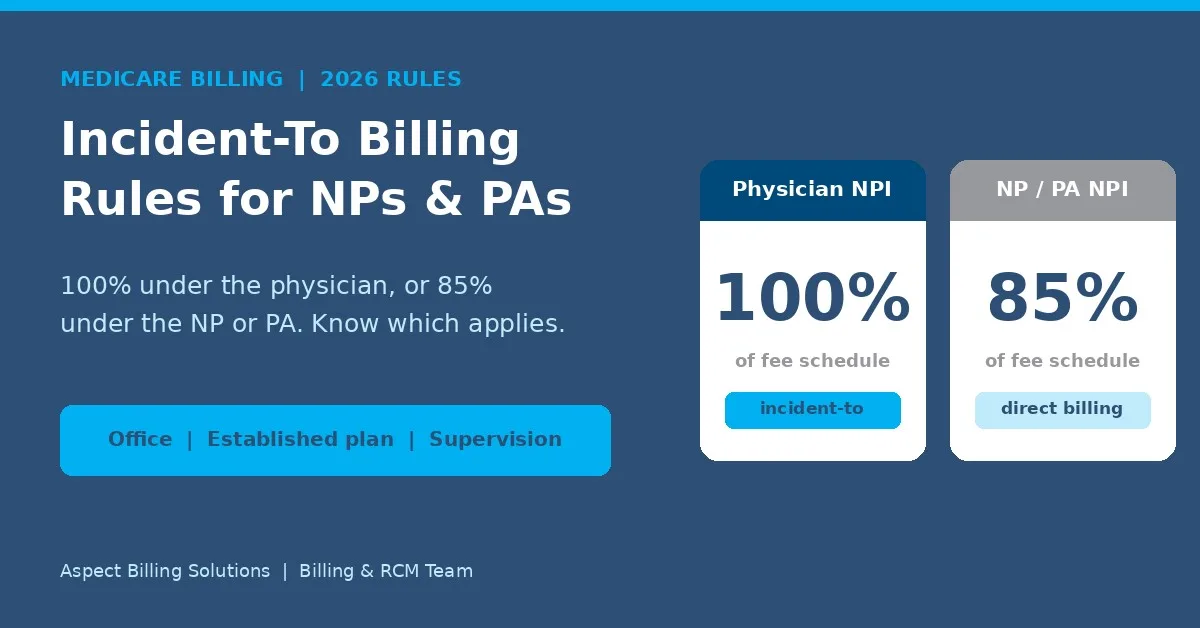
Incident-To Billing Rules for NPs and PAs: 2026 Medicare Guide
Incident-to billing rules for NPs and PAs are Medicare conditions that let a nurse practitioner’s or physician assistant’s office service be billed under a supervising physician’s NPI at 100% of the fee schedule. The service must follow a physician-initiated plan of care, occur in a non-institutional setting, and be performed under direct supervision. When any […]
Read more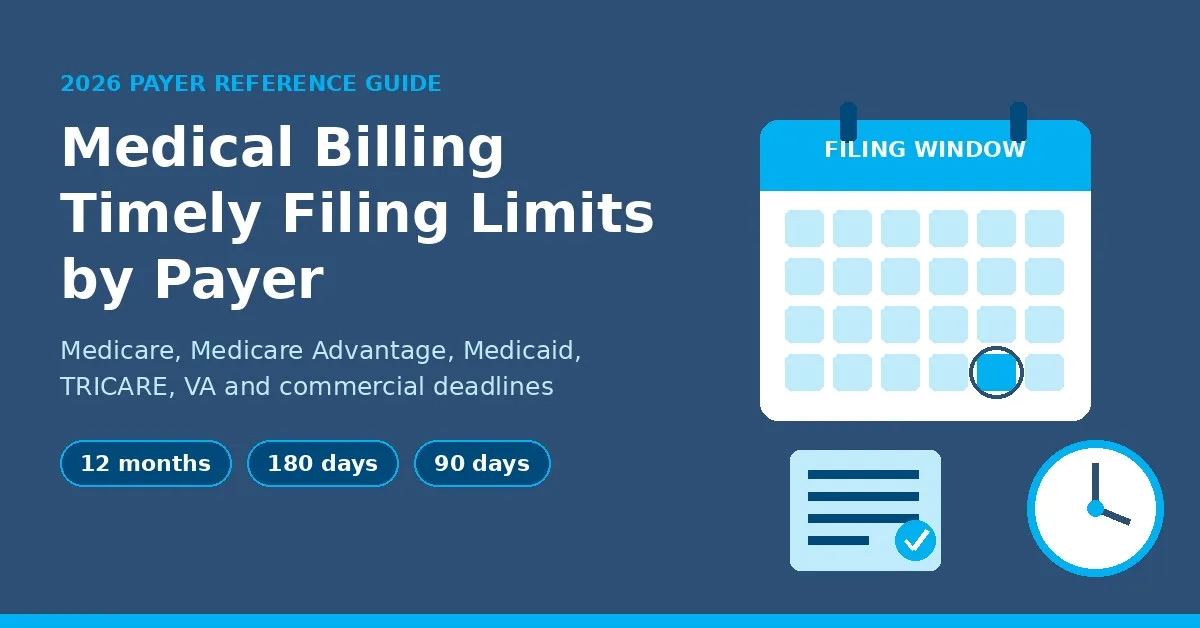
Medical Billing Timely Filing Limits by Payer: 2026 Reference Guide
Medical billing timely filing limits by payer are claim-submission deadlines that each insurer or government program sets, counted from the date of service. Original Medicare allows 12 months, Medicaid programs allow no more than 12 months, TRICARE allows one year, VA Community Care allows 180 days, and commercial contracts commonly allow 90 to 180 days. […]
Read more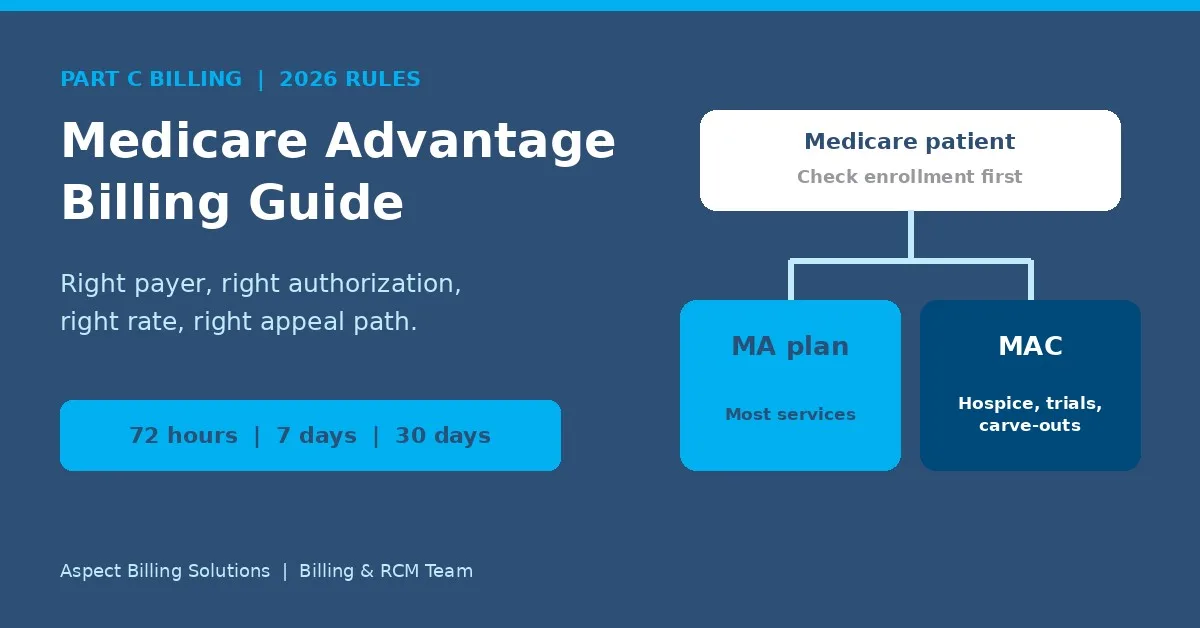
Medicare Advantage Billing Guide: 2026 Rules for Claims, Prior Auth and Appeals
A Medicare Advantage billing guide explains how to bill Part C plans, which are private plans that pay most Medicare-covered services instead of Original Medicare. Claims go to the MA plan, not the MAC, using the plan’s member ID. Since January 1, 2026, MA plans must decide expedited prior authorizations within 72 hours and standard […]
Read more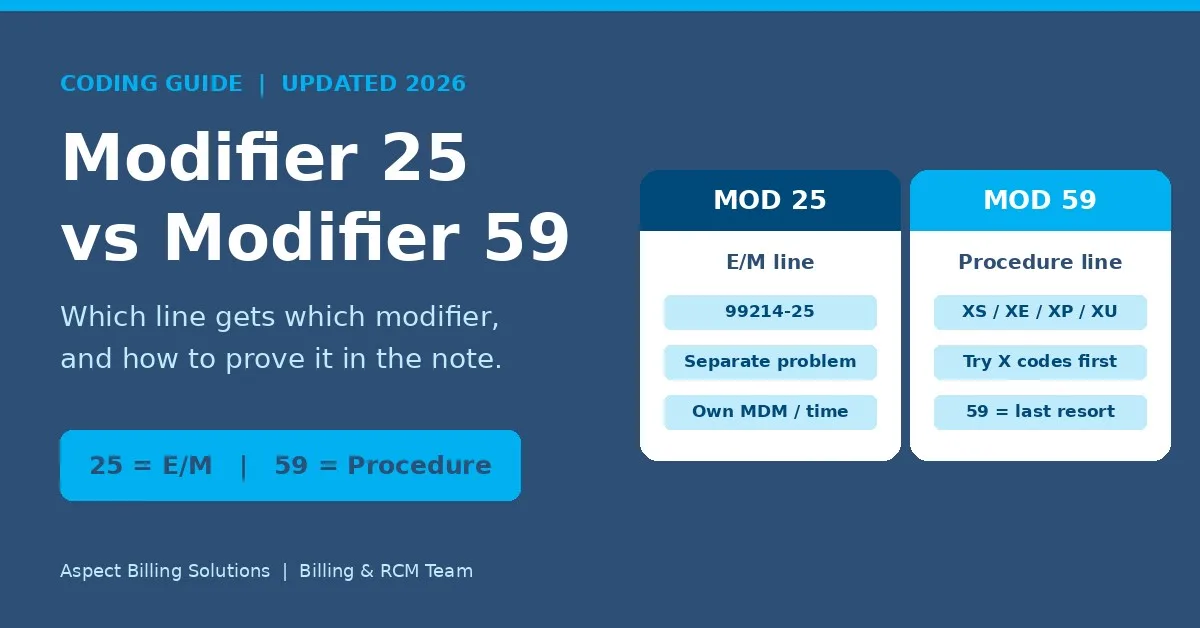
Modifier 25 vs Modifier 59: Which Line Gets Which Modifier (2026 Guide)
Modifier 25 vs modifier 59 comes down to code type. Modifier 25 is a CPT modifier that marks a significant, separately identifiable evaluation and management (E/M) service on the same day as a procedure. Modifier 59 is a CPT modifier that marks a non-E/M procedure as distinct from another same-day procedure that edits would otherwise […]
Read more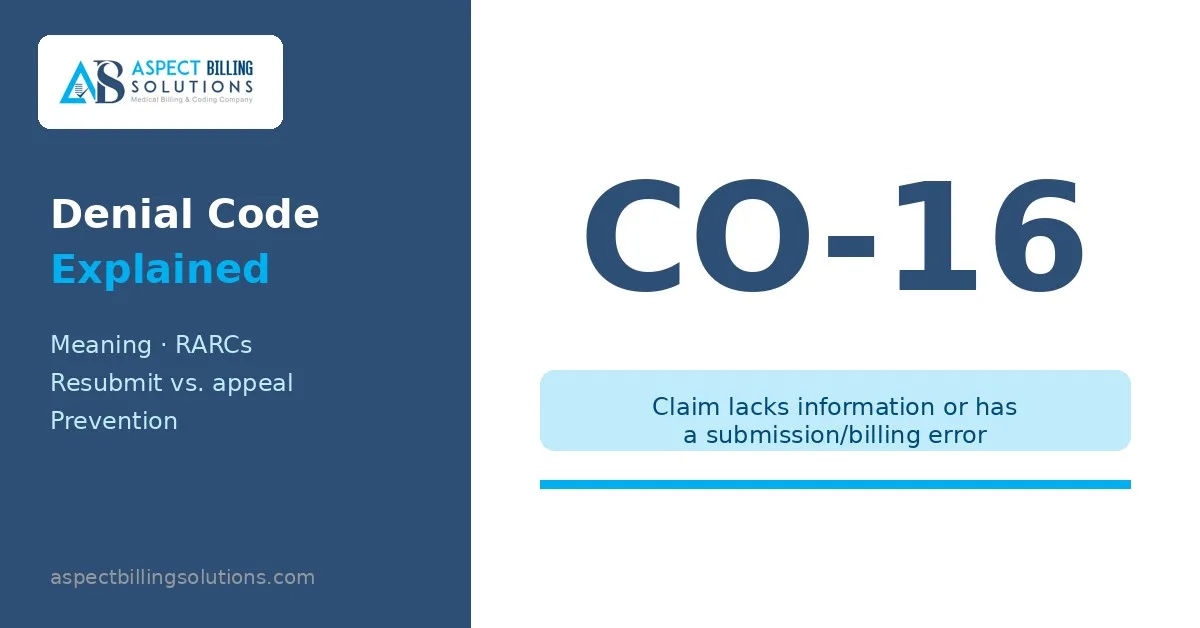
CO-16 Denial Code Explained: Causes, RARCs and Fixes
CO-16 means the claim lacks information or has a submission or billing error needed for adjudication. The “CO” group code makes the provider responsible, so the patient is not billed. A remark code identifies the exact problem. Keeping CO-16 under 10% of all denials is an illustrative practical target, not a mandate. CO-16 is one […]
Read more
CO-50 Denial Code (Medical Necessity): Causes & Fixes
CO-50 means the payer considers a service non-covered because it was not deemed medically necessary. The CO group code makes the provider liable unless a valid ABN shifts liability to the patient. Keeping CO-50 under 10% of all denials is an illustrative practical target, not a mandate. Medical necessity denials rank among the most expensive […]
Read more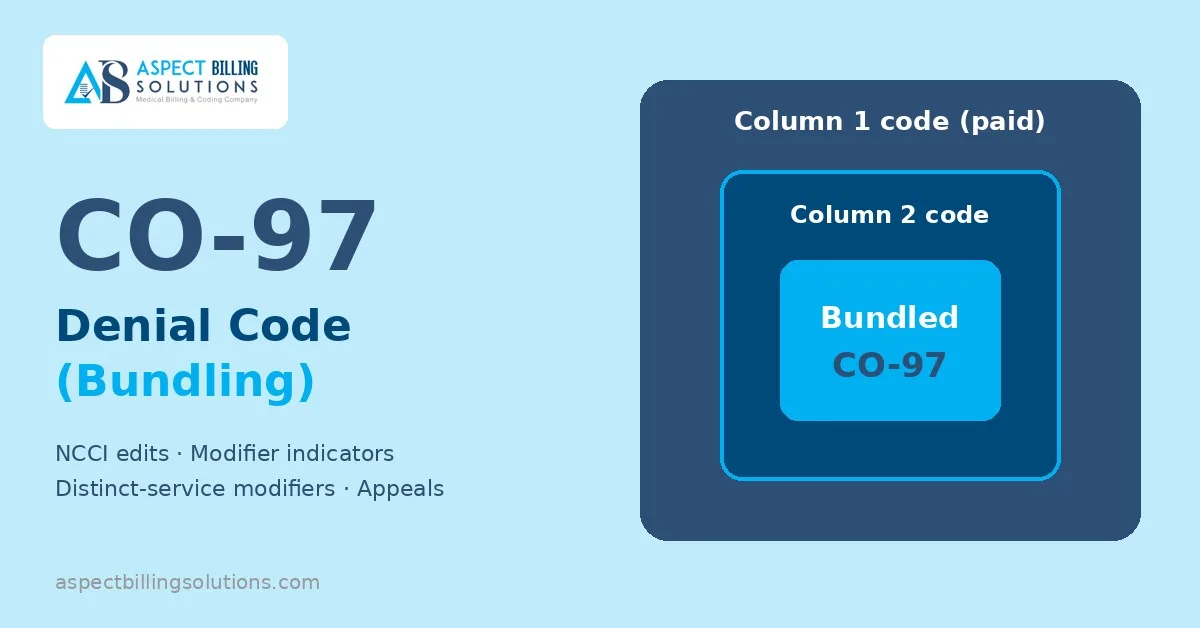
CO-97 Denial Code (Bundling): NCCI Edits and Fixes
CO-97 means the payer considers a service included in the payment for another service already adjudicated. It usually comes from NCCI bundling edits or the global surgical package. The provider cannot bill the patient, and keeping CO-97 under 10% of denials is an illustrative practical target, not a mandate. Bundling denials frustrate billing teams because […]
Read more
Intraoperative Neuromonitoring Billing CPT 95940 95941
CPT 95940 reports in-room, one-on-one intraoperative monitoring per 15 minutes. CPT 95941 reports remote or multi-case monitoring per hour, but Medicare does not accept it and requires HCPCS G0453 instead. Both are add-on codes billed with baseline study codes. A 95% clean claim rate is a commonly cited practical target, not a mandate. Intraoperative neuromonitoring […]
Read more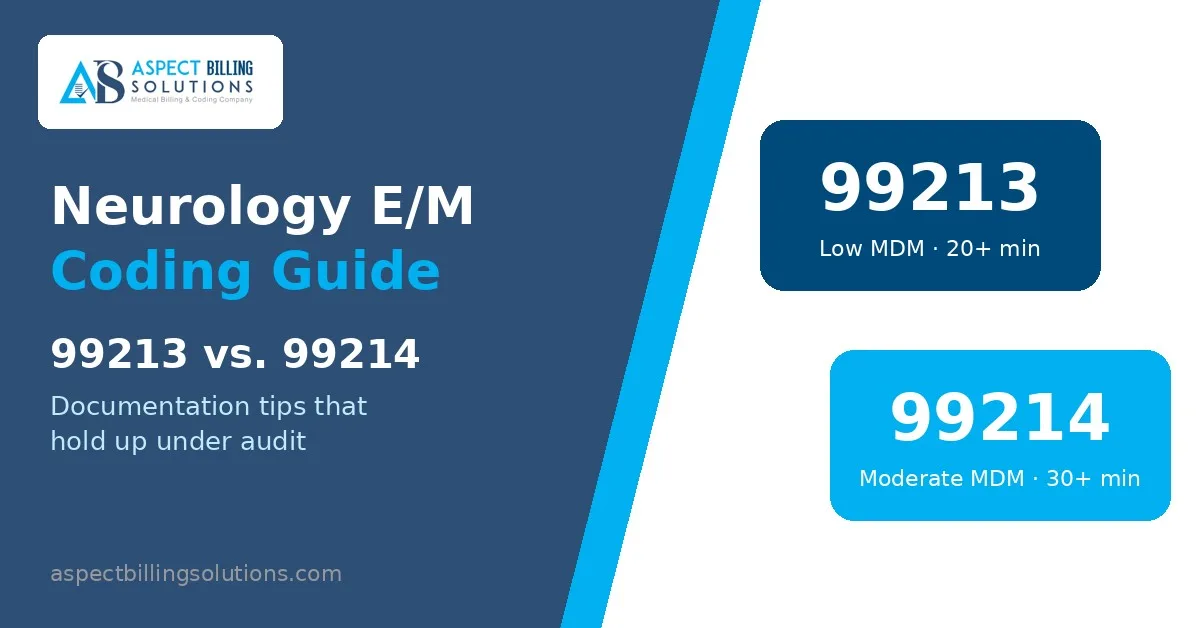
Neurology E/M Coding 99213 99214 Documentation Tips
For an established neurology patient, 99213 requires low medical decision making or at least 20 minutes of total time. 99214 requires moderate decision making or at least 30 minutes. Decision making is met when two of three elements reach the level billed: problems, data, and risk. Many practices aim for 95% or higher accuracy on […]
Read more
Neurosurgery and Spine Surgery Billing Services Guide
Quick answer: Neurosurgery and spine surgery billing services manage prior authorization, operative note coding, and surgical modifiers for brain and spine procedures. They also track global periods, submit claims, and follow up on denials. Medicare rules shape payment, such as 62.5% of the fee to each co-surgeon. A clean claim rate of 95% or higher […]
Read more