
LMFT Credentialing for Medicare, Medicaid and Commercial Plans
LMFT credentialing is the process of getting a licensed marriage and family therapist approved by Medicare, Medicaid and commercial health plans so claims pay at in-network rates. Since January 1, 2024, marriage and family therapists (MFTs) can enroll in Medicare and bill it directly, which added a new track to every LMFT’s file. This guide covers the Medicare rules, a step-by-step workflow, payer panels, the enroll-or-opt-out choice and the mistakes that stall approvals.
If your practice would rather hand off the applications and follow-ups, a dedicated provider credentialing service can track every payer for you. Either way, the steps below show what has to happen and in what order.
| Key takeaways Medicare has covered MFT services since January 1, 2024, at 75% of the clinical psychologist rate.Medicare requires a qualifying degree, 2 years or 3,000 hours of supervised post-master’s experience and a state license.Use taxonomy code 106H00000X on your NPI and file a separate Medicare enrollment for each state of practice.Commercial and Medicaid panels set their own rules, so build CAQH early and confirm every effective date. |
What LMFT credentialing includes
Credentialing for a marriage and family therapist runs on three tracks. Each payer group checks your file in its own way and gives its own start date for billing.
| Track | What it covers | What you get at the end |
| Medicare Part B | Enrollment through PECOS (Medicare’s online enrollment system) or a paper CMS-855I, reviewed by your Medicare Administrative Contractor (MAC) | Approval with an effective date and a Medicare billing number |
| Medicaid | The state program and, in many states, its managed care plans; rules differ by state | State enrollment approval and plan contracts |
| Commercial plans | A credentialing review of your license and history, then a signed participation agreement | A contract with a fee schedule and an effective date |
The two government programs differ in forms, timing and who reviews the file, as our comparison of Medicare and Medicaid credentialing differences explains.
Medicare requirements for marriage and family therapists
Medicare Part B now pays MFTs directly for services that diagnose and treat mental illness, at 75% of the amount a clinical psychologist receives, according to the CMS page on marriage and family therapists and mental health counselors. Services to hospital inpatients fall outside this benefit, and claims with dates of service before January 1, 2024, are not payable.
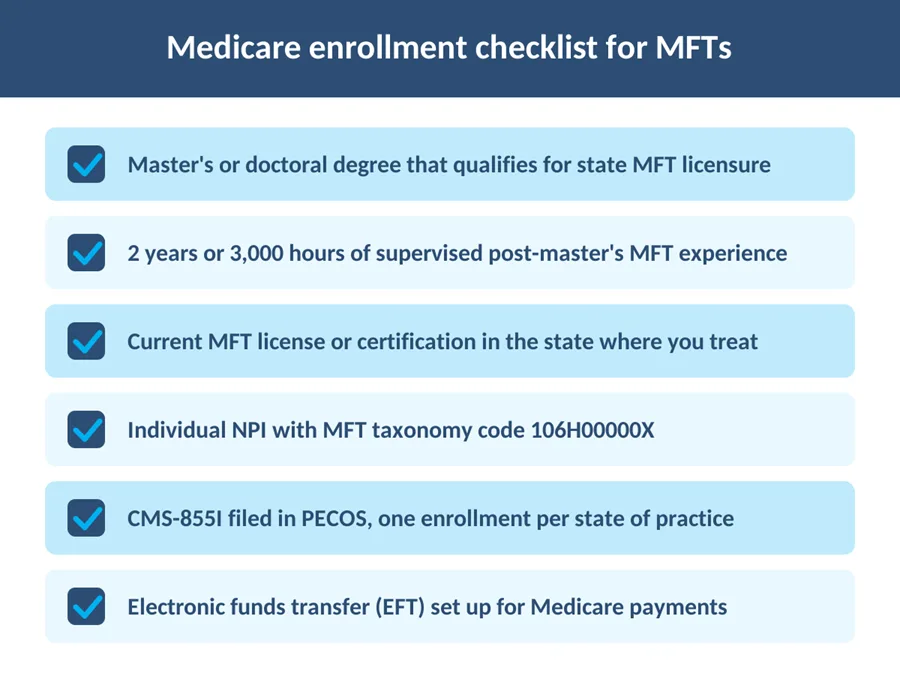
| Requirement | What Medicare expects |
| Degree | A master’s or doctoral degree that qualifies for MFT licensure in your state |
| Supervised experience | At least 2 years or 3,000 hours of post-master’s clinical supervised MFT experience in a setting such as a hospital, skilled nursing facility (SNF), private practice or clinic |
| License | A current MFT license or certification in the state where you treat patients; compact licenses count |
| NPI | An individual National Provider Identifier (NPI) with MFT taxonomy code 106H00000X |
| Enrollment | PECOS or a paper CMS-855I, one per state of practice, with no application fee |
| Payment | Electronic funds transfer (EFT) set up to receive Medicare payments |
Proving your supervised experience
When your state’s licensing rules did not require the 2 years or 3,000 hours, Medicare expects proof with the application. The CMS MFT and MHC provider enrollment FAQ describes two pieces: a signed letter on the supervising setting’s letterhead and confirmation from a licensing or credentialing body. Request both early, because former employers can take weeks to respond.
Where Medicare covers LMFT services
- Offices and clinics: private practice and group settings billed under Part B.
- Rural health clinics and FQHCs: MFT services are covered in these settings.
- Hospice: the interdisciplinary team may include an MFT.
- Skilled nursing facilities: MFT services are excluded from SNF consolidated billing, so the therapist bills Part B and lists the SNF’s Medicare number on the claim.
LMFT credentialing steps, from NPI to first claim
The diagram shows the full sequence. In short, collect documents, fix your NPI, build CAQH, enroll in Medicare, apply to other panels, track each file and load approvals into billing.
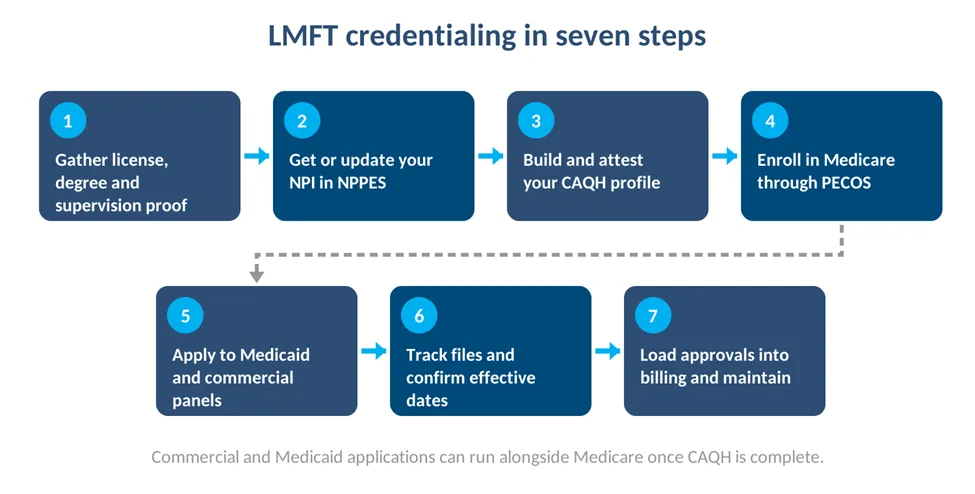
- Gather your file. Collect your license, degree, supervision proof, malpractice certificate, W-9, résumé with work history and every practice address.
- Fix your NPI. In NPPES, the national NPI registry, confirm taxonomy 106H00000X. If you already bill Medicaid, keep your existing NPI rather than applying for a new one.
- Build your CAQH profile. Most commercial plans pull your data from CAQH ProView, and our guide to how CAQH supports credentialing covers the profile in detail. Complete it, upload documents and attest before you apply.
- Enroll in Medicare. File through PECOS, or on paper choose the undefined non-physician practitioner specialty in section 2H of the CMS-855I and write in MFT. The First Coast MFT enrollment page lists the signature rules and the EFT form.
- Apply to Medicaid and commercial panels. Submit each payer’s application or interest form and keep a copy of everything you send.
- Track and confirm. Log every reference number, follow up on a schedule and get the effective date in writing before you bill.
- Load and maintain. Add each approval to your billing system and calendar renewal dates. Medicare generally asks for revalidation every five years.
Sample (fictional data): Maya Ortiz, LMFT, joins a three-therapist group in Cincinnati, Ohio, and also sees patients at the group’s office across the river in Kentucky. She needs a Kentucky license, a separate CMS-855I for each state with the right license listed, and reassignment of benefits to the group in both enrollments. Change the names, states and group details to match your own situation. For practices growing across state lines, our guide to managing multi-state credentialing covers the tracking side.
Commercial and Medicaid panels for LMFTs
Commercial plans set their own LMFT requirements in their credentialing policies, and many route behavioral health applications through a separate behavioral health network. Some panels close to new therapists in areas they consider full, so ask about panel status before you invest time in an application.
Medicaid enrollment is run by each state. Some state Medicaid programs and Medicare Advantage plans require Medicare enrollment first, so a therapist who skips Medicare can end up blocked elsewhere. Pre-licensed or associate MFTs cannot enroll in Medicare, and many commercial plans credential only fully licensed clinicians, so check each plan’s policy before an associate sees its members.
Should an LMFT enroll, reassign or opt out of Medicare?
You have three choices with Medicare. The table and graphic compare them.
| Option | Best fit | Forms |
| Enroll and bill yourself | Solo LMFTs who bill under their own NPI | CMS-855I (or PECOS) and the EFT form |
| Enroll and reassign | LMFTs in a group that bills for their services | CMS-855I with reassignment in section 4F; the group enrolls on the CMS-855B |
| Opt out | Therapists who see Medicare patients only under private contracts | An opt-out affidavit sent to your MAC |
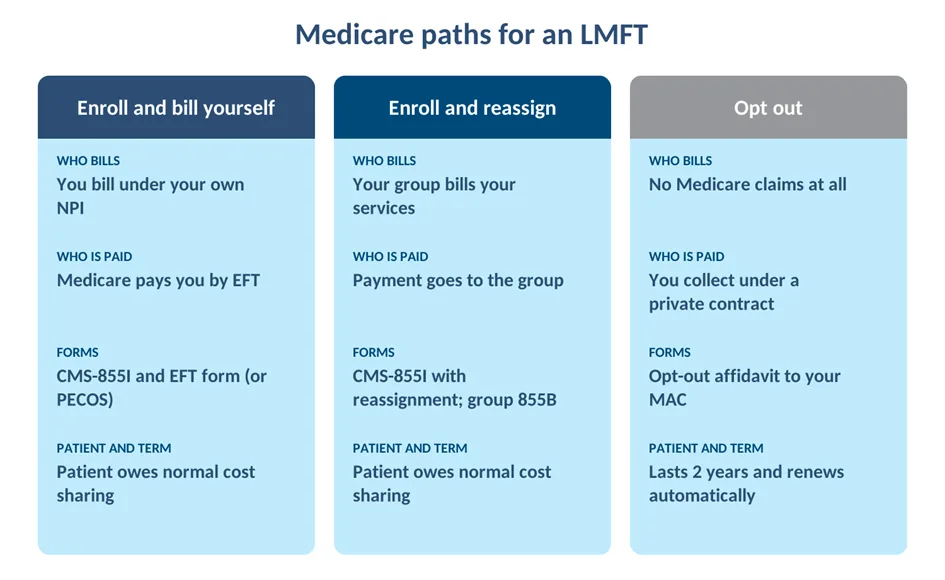
Opting out lasts two years and renews automatically unless you send written notice at least 30 days before the period ends. During that time the patient pays your full fee under a private contract, and Medicare pays nothing.
Common LMFT credentialing mistakes and how to prevent them
Most delays trace back to a short list of errors. Many overlap with the credentialing errors that slow payments seen across specialties.
| Mistake | How to prevent it |
| Wrong or missing taxonomy on the NPI | Check that NPPES shows 106H00000X before any application goes out |
| Billing before the effective date | Hold claims until the approval letter or contract confirms the start date |
| Missing supervision proof | Request the letterhead letter and licensing confirmation at the start |
| One Medicare enrollment for several states | File a separate CMS-855I for each state where you treat patients |
| Letting CAQH go stale | Re-attest on CAQH’s schedule and update documents as they renew |
| Missing a renewal notice | Calendar Medicare revalidation and each payer’s recredentialing cycle |
Renewals are a separate workflow from your first approval, which our article on recredentialing versus initial enrollment walks through.
Frequently asked questions
Can LMFTs bill Medicare?
Yes. Since January 1, 2024, Medicare Part B pays marriage and family therapists directly for services that diagnose and treat mental illness. Payment is 75% of the clinical psychologist amount. You must be enrolled and approved first, and claims for dates of service before January 1, 2024, are not payable.
What taxonomy code does an LMFT use?
Marriage and family therapists use taxonomy code 106H00000X, selected in NPPES when you apply for or update your NPI. Payers match this code against your license during credentialing. A wrong or missing taxonomy is a common reason for returned applications and claim edits, so check it before applying anywhere.
How long does LMFT credentialing take?
There is no single timeline. Medicare processing depends on your MAC’s workload and how complete the file is, and commercial plans set their own review times. Plan for a process that can take several months across all payers, and avoid seeing a plan’s members as in-network until you have a confirmed effective date.
Can a pre-licensed MFT associate be credentialed?
Not with Medicare, which requires a current state MFT license or certification. Commercial plans and Medicaid programs set their own rules, and many credential only fully licensed clinicians. Check each plan’s written policy before an associate treats its members, and do not bill associate services under another clinician’s NPI unless the plan allows it.
Do I need a separate Medicare enrollment for each state?
Yes. Medicare asks for a separate CMS-855I for each state where you render services, with the applicable license listed. A compact license counts as a full license for this purpose. Reassignment to a group must also be set up in each enrollment where the group bills for you.
Does credentialing change how LMFT sessions are coded?
No. Credentialing makes you eligible to bill, while coding rules decide what each session is worth. Psychotherapy and family therapy codes, time rules and documentation are covered in our complete mental health billing guide.
Final Considerations
LMFT credentialing works best as one tracked project: a clean NPI, a complete CAQH profile, a Medicare decision made on purpose and written effective dates for every panel. Get those right and the claims that follow are far easier to collect.
If you want a dedicated agent to manage your LMFT applications and follow-ups, reach our team through the contact page and tell us which payers you need.
Sources: CMS, Marriage and Family Therapists and Mental Health Counselors; CMS, MFT and MHC Provider Enrollment FAQ; First Coast Service Options, Marriage and Family Therapist enrollment. This article is general information, not legal advice. Payer rules change, so confirm requirements with each payer.