
How Psychiatrist Credentialing With Insurance Works
Psychiatrist credentialing is the process insurers use to confirm a psychiatrist’s license, training and DEA registration before adding them to a network. Plan for several months, and plan to bill only after you hold a written effective date. This guide covers the documents you need, the CAQH profile, Medicare enrollment and the tracking habits that keep claims from denying later.
If you would rather hand the paperwork to a dedicated team, Aspect Billing Solutions offers credentialing services for practices that want applications filed and followed up for them.
| Key takeaways Credentialing, contracting and the billing effective date are three separate events. Track each one.Prescribers need DEA and state controlled substance records on file, and expired documents slow applications.Medicare uses its own enrollment path, and the effective date rules differ from commercial plans.Do not schedule a full insured caseload until each plan confirms your start date in writing. |
What Psychiatrist Credentialing Covers
Credentialing is the payer’s review of your qualifications. Contracting is the agreement on rates and terms. Enrollment, or roster setup, is when the plan loads you into its system with a start date. Payers sometimes use different labels, so ask each plan which of these steps it is describing when it sends a status update.
Health plans that follow NCQA standards check credentials through a primary source, a recognized source or a contracted agent, then keep monitoring sanctions and license expirations between recredentialing cycles. For a psychiatrist, that review usually looks like this:
| Item checked | What the payer looks for | Psychiatrist note |
| State license | Active, unrestricted license | Needed in every state where patients are seen, including telehealth |
| DEA and state controlled substance records | Current registration for prescribing | Upload the current certificate and keep renewals on a calendar |
| Education and training | Medical school and residency | Have completion records ready as PDFs |
| Board certification | Current status, if held | If not certified, state your pathway plainly |
| Work history | Continuous history | Add a short written note for any gap |
| Malpractice | Active policy and claims history | Policy must be current when the application is reviewed |
| Sanctions | State board, Medicare and Medicaid checks | Answer every disclosure question completely |
Credentialing review items, based on the credential types NCQA lists in its credentialing guide.
Documents Psychiatrists and Psychiatric NPs Need
Most delays start with an incomplete packet. Collect everything before you open a single application, and save each file as a clear PDF with the current date range visible. Psychiatric nurse practitioners follow the same pattern with a few role-specific records, shown below.
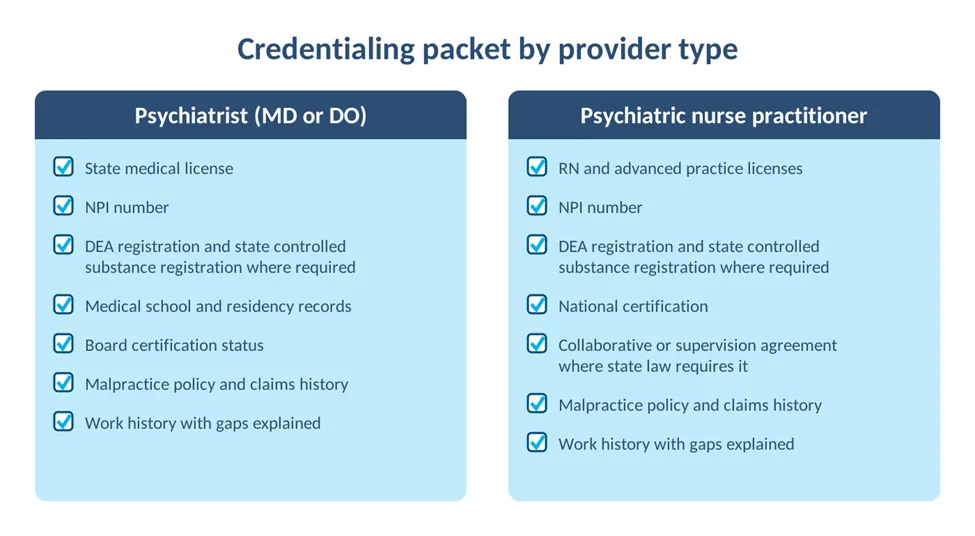
Check your state’s rules for controlled substance registration and for any collaborative or supervision agreement, because requirements vary by state. The role of CAQH in credentialing is to hold these records in one shared profile that many commercial payers can read, so keep that profile complete and attested.
Step-by-Step: From Application to First Claim
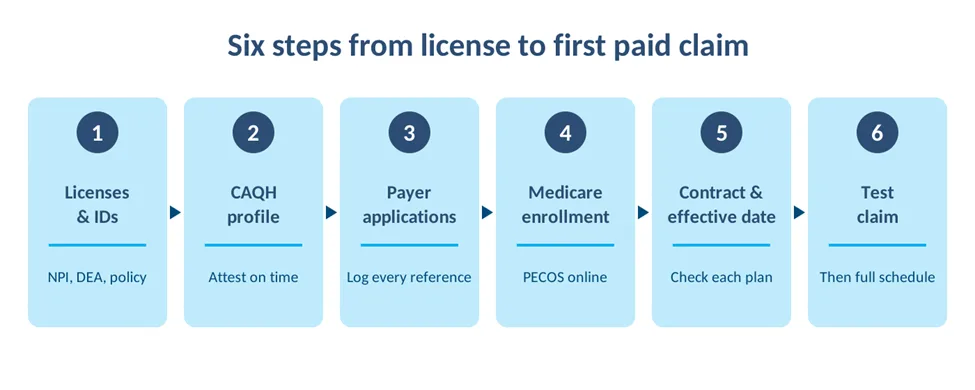
The graphic summarizes six stages: licenses and IDs, CAQH profile, payer applications, Medicare enrollment, contract and effective date, then a test claim.
- Confirm licenses and IDs. Check that your NPI, state license, DEA registration, any state controlled substance registration and malpractice policy are current.
- Complete and attest your CAQH profile. Authorize each payer to view it, and re-attest whenever CAQH requires.
- Apply to each payer. Submit the application, then record the date, the reference number and the contact name.
- Enroll in Medicare separately. Use the Medicare path described in the next section.
- Review the contract and confirm the effective date. Check fee schedules, covered locations and the exact start date for each plan product.
- Send a test claim. Confirm the directory listing and run one clean claim before filling your schedule.
Medicare Enrollment and Opt-Out Rules for Psychiatrists
Most physicians and nonphysician practitioners start Medicare enrollment with the CMS-855I, and CMS has merged the reassignment form into it for practitioners who bill through a group. Groups use the CMS-855B. Physicians do not pay a Medicare enrollment application fee, according to the CMS provider enrollment resource.
Three rules matter most for cash flow. First, billing privileges generally begin on the later of the date a later-approved application was filed or the date you first see patients at a new location, under 42 CFR 424.520, so filing late can cost you billable days. Second, practitioners revalidate every five years or when Medicare asks. Third, ownership changes, practice location changes and final adverse legal actions must be reported within 30 days, and other changes within 90 days.
Some psychiatrists choose to opt out of Medicare instead. The affidavit must be signed, filed with the Medicare Administrative Contractor and renews automatically every two years. A practitioner cannot be enrolled and opted out at the same time. CMS explains the opt-out process and lists eligible practitioner types, including physicians, nurse practitioners, clinical psychologists, clinical social workers and mental health counselors. For how Medicare and Medicaid enrollment differ, see this comparison of Medicare vs. Medicaid credentialing.
Telepsychiatry and Multi-State Credentialing
Telepsychiatry adds a layer. Most states expect a license where the patient is located, and each payer may credential you separately for each state network. Keep a simple matrix of state, license number, DEA and controlled substance records and payer status. This guide to managing multi-state credentialing shows how to keep that matrix current as you add states.
How Long Does Psychiatrist Credentialing Take?
There is no fixed timeline. Each payer sets its own review pace, and a complete application moves faster than one that needs corrections. Plan in months, not weeks, set a separate target date for each plan, and follow up on a schedule instead of waiting for a letter. Do not count on a start date until the plan states it in writing.
Documents can also age out while an application waits. NCQA’s credentialing guide lists time limits of 120 to 180 days for several accreditation items, including board certification, malpractice history, license and work history, so a stalled file may need fresh verification.
Sample tracker (fictional data)
Use a tracker like this one and change the payer names, dates and notes to match your own applications. All details below are fictional.
| Payer | Applied | Reference | Status | Effective date | Notes |
| Northwind Health PPO | Mar 3 | NW-1042 | Approved | Jun 1 | Main office only |
| Harbor Mutual HMO | Mar 3 | HM-7781 | Pending | Not issued | Call again in 2 weeks |
| Medicare | Mar 10 | PECOS online | Approved | Mar 10 | Filing date applies |
| Summit State Medicaid | Mar 17 | SS-3390 | More information requested | Not issued | Send residency letter |
Sample (fictional data): one row per payer keeps dates and next steps visible.
Common Psychiatrist Credentialing Mistakes
Small errors repeat across practices. The graphic below shows the five problems we see most with psychiatric providers and how to prevent each.
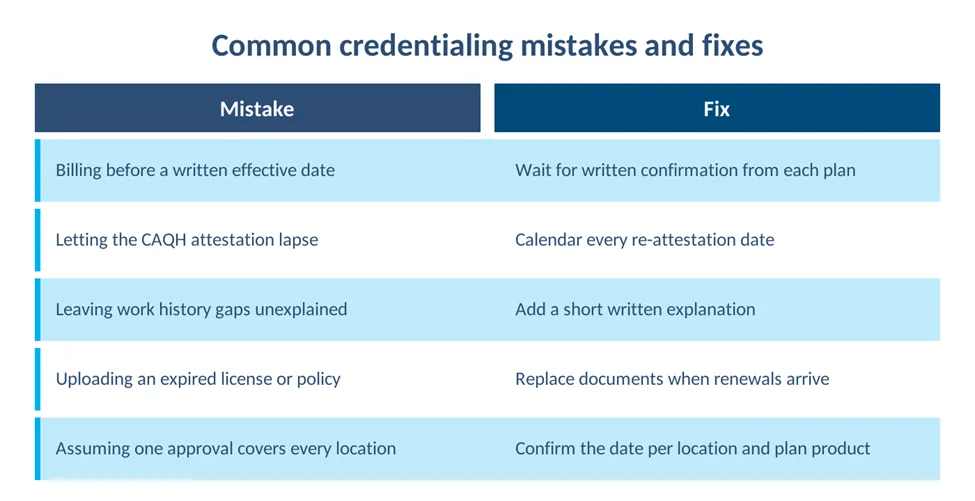
- Billing before a written effective date: wait for confirmation from each plan.
- Letting the CAQH attestation lapse: calendar every re-attestation date.
- Leaving work history gaps unexplained: add a short written note.
- Uploading an expired license or policy: replace documents when renewals arrive.
- Assuming one approval covers every location: confirm the date per location and plan product.
Frequently Asked Questions
How long does it take to get credentialed as a psychiatrist?
It depends on the payer, the completeness of your application and how quickly you answer requests. Expect months rather than weeks. Track each plan separately, follow up on a regular schedule and wait for a written effective date before you schedule insured patients.
Can I see patients while my credentialing is pending?
You can see patients, but you should not assume the plan will pay in network rates. Many plans pay only from the confirmed effective date. Ask each payer in writing about retroactive dates, and tell patients about possible out-of-network costs before the visit.
Do psychiatric nurse practitioners follow the same process?
The steps are the same, but the packet differs. Nurse practitioners add RN and advanced practice licenses, national certification and any collaborative or supervision agreement their state requires. Some payers handle these providers on separate rosters, so ask each plan how it classifies them.
Is my CAQH profile enough to be in network?
No. An attested CAQH profile gives payers the information they need, but each plan still makes its own credentialing decision and issues its own effective date. Keep the profile current, then confirm network status directly with every payer.
Do I need separate credentialing for telepsychiatry in another state?
Usually yes. You generally need a license in the state where the patient is located, and payers may require network participation for that state. Confirm both the license and the payer’s telehealth policy before you see patients across state lines.
Final Considerations
Psychiatrist credentialing rewards preparation: a complete packet, an attested CAQH profile, one log for every application and no billing until a start date is confirmed in writing. Once you are in network, clean claims depend on correct coding and documentation, which our mental health billing guide explains for behavioral health practices.
Aspect Billing Solutions is a HIPAA-compliant medical billing and coding company that assigns a dedicated agent to each provider. If you want help with applications or follow-up, contact our team to discuss your practice.
Sources: NCQA credentialing guide, CMS provider enrollment resources and 42 CFR 424.520. Payer rules vary, so follow each payer’s provider manual and contract. This article is general information, not legal advice.