
Medicare Opt-Out for Mental Health Providers Explained
Medicare opt-out lets an eligible mental health provider stop billing Medicare and see Medicare patients only under private contracts, in two-year periods that renew automatically. It is an all-or-nothing choice, so it deserves a careful look before you sign. This guide covers who can opt out, how the affidavit and private contracts work, what happens with Medicare Advantage and how to decide between opting out and enrolling.
Many practices weigh this choice while planning which networks to join. If you want help with Medicare enrollment or any payer application, Aspect Billing Solutions offers credentialing services for behavioral health providers.
| Key takeaways: Opting out covers all Medicare services you furnish, not only some patients or services. You file an affidavit with your Medicare contractors and sign a private contract with each Medicare patient. The opt-out lasts two years and renews automatically unless you cancel in writing in time. Medicare Advantage plans generally may not pay opted-out providers for basic services. |
What Medicare Opt-Out Means for Mental Health Providers
Under opt-out, the provider and each Medicare patient sign a private contract. The patient agrees to give up Medicare payment for the provider’s services, pays out of pocket, and the usual limits on what the provider may charge do not apply, according to First Coast Service Options. Neither the provider nor the patient can bill Medicare for those services.
Opting out is different from staying out of a commercial network. If your goal is to leave a commercial payer, see our guide to out-of-network claim billing instead.
Who Can and Cannot Opt Out
CMS lists the practitioner types that may opt out. Several mental health provider types are on the list.
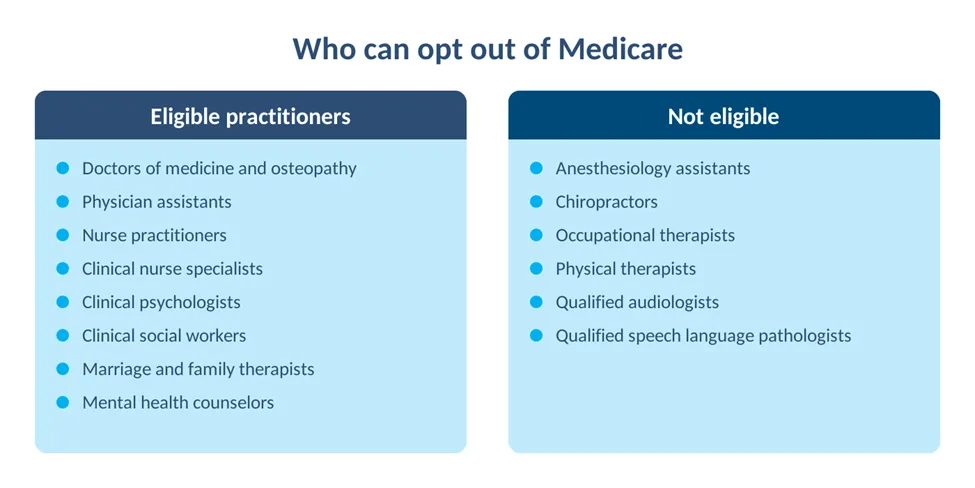
The graphic summarizes the CMS opt-out rules. Psychiatrists qualify as doctors of medicine or osteopathy, and psychiatric nurse practitioners, clinical psychologists, clinical social workers, marriage and family therapists and mental health counselors are also eligible.
How to Opt Out of Medicare
- Confirm you are eligible. Check your practitioner type against the list above.
- Choose your start. If you never enrolled or were a non-participating provider, the period starts the date you sign the affidavit. If you were a participating provider, it starts on the first day of the next calendar quarter, provided the affidavit is submitted at least 30 days before that quarter begins.
- File the affidavit. It must be signed and filed with every Medicare contractor that handles your claims. Some contractors accept it only by mail or fax, so check each one.
- Sign a private contract with each Medicare patient. Do not sign one with a patient who needs emergency or urgent care.
- Stop billing Medicare for covered services. Patients pay you directly under the contract.
- Check the opt-out listing. CMS updates its listing quarterly, so confirm your name appears.
Timing, Renewal and Cancellation
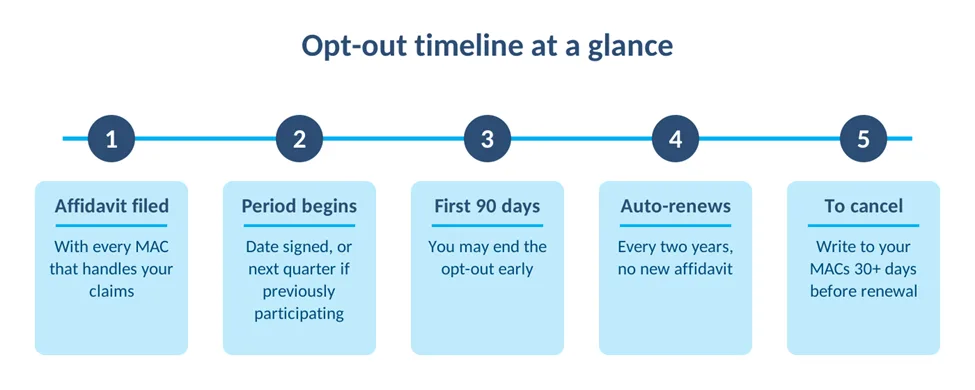
You can end an opt-out within the first 90 days of an initial affidavit. After that, the status renews automatically every two years without a new affidavit. To stop it, send written notice to your contractors at least 30 days before the next period starts. Miss that window and you are locked in for another two years.
Opt-Out and Medicare Advantage
Opting out also affects Medicare Advantage. CMS says plans may not pay, directly or indirectly, for basic services given to an enrollee by an opted-out provider, though they must pay for urgent and emergency services and may pay for supplemental benefits. Read our Medicare Advantage billing guide before you decide, especially if many of your patients use these plans.
Opting Out vs. Staying Enrolled
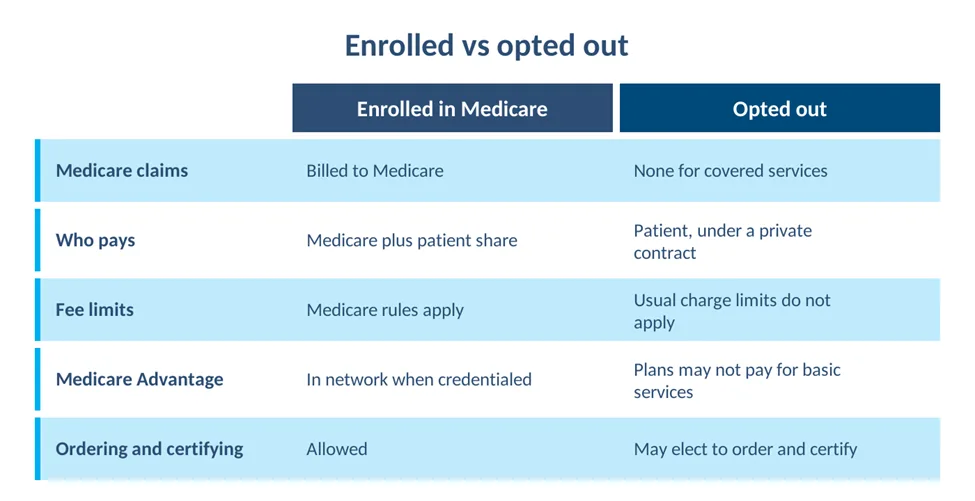
Ask four questions before choosing: how much of your caseload is Medicare, whether your patients will accept paying privately, how many are in Medicare Advantage, and whether you want your name in Medicare networks. A provider who stays enrolled keeps Medicare billing open. Once you choose, make sure your claims workflow matches, and our mental health billing guide covers the day-to-day details.
- Do not opt out for only some patients or services, because the rule covers everything you furnish.
- Do not enroll and opt out at the same time, except to be paid for emergency or urgent care.
- Do not let the automatic renewal date pass without a decision.
Frequently Asked Questions
Can I opt out for only some Medicare patients?
No. CMS says you cannot opt out for some patients or services and not others. The opt-out applies to every Medicare patient and every covered service you furnish for the whole period.
How long does a Medicare opt-out last?
Each period lasts two years and renews automatically. You do not file a new affidavit, but you must send written notice to your contractors at least 30 days before the next period starts if you want to stop.
Can I be enrolled in Medicare and opted out at the same time?
No, except to be paid for emergency or urgent care. CMS says you cannot enroll and opt out at once, so decide which path fits before you file the affidavit or the enrollment form.
Can an opted-out provider still order or certify for Medicare patients?
Yes. CMS says opted-out providers can elect to order and certify Medicare items and services for their Medicare patients. Check the current enrollment steps with your contractor before you rely on this.
Do I need to opt out if I do not see Medicare patients?
Opting out is for providers who want to treat Medicare patients under private contracts. If you do not plan to see Medicare patients, no affidavit is needed. Our comparison of Medicare vs. Medicaid credentialing can help you plan your enrollment choices.
Final Considerations
Medicare opt-out for mental health providers is a business decision as much as a billing one. Confirm eligibility, understand the two-year commitment, plan for Medicare Advantage and keep the cancellation date on your calendar.
Aspect Billing Solutions is a HIPAA-compliant medical billing and coding company that assigns a dedicated agent to each provider. If you would like help with enrollment decisions or applications, contact our team to discuss your practice.
Sources: CMS Manage Your Enrollment page and First Coast Service Options opt-out guidance. Rules can change, so confirm details with your Medicare contractor. This article is general information, not legal advice.