
TMS Billing: CPT 90867, 90868 and 90869 Explained
TMS billing uses three CPT codes: 90867 for the initial treatment with planning and motor threshold determination, 90868 for each subsequent session, and 90869 for a motor threshold re-determination. Each code has its own limits, and Medicare contractors tie coverage to specific diagnoses. This guide covers what each code means, which diagnoses support coverage, what to document and the mistakes that cause denials.
Transcranial magnetic stimulation is a psychiatric service, so it follows the same discipline as the rest of behavioral health billing. For the full revenue cycle picture, start with our mental health billing guide, then return here for the TMS rules.
| Key takeaways: Report 90867 once per episode, and never report 90869 with 90867 or 90868. Medicare coverage rules come from the local contractor, so the covered diagnoses can differ by state. The ordering provider’s name and NPI belong on the claim.Commercial payers usually have their own criteria and authorization rules. |
TMS Billing Codes and What Each One Covers
| CPT code | Service | Key limit |
| 90867 | Initial TMS treatment, including cortical mapping, motor threshold determination, delivery and management | Once per episode, not with 90868 or 90869 |
| 90868 | Subsequent TMS delivery and management, per session | Reported for each later session |
| 90869 | Subsequent motor threshold re-determination with delivery and management | Not with 90867 or 90868 |
TMS treatment codes and the limits that Medicare contractor articles describe.
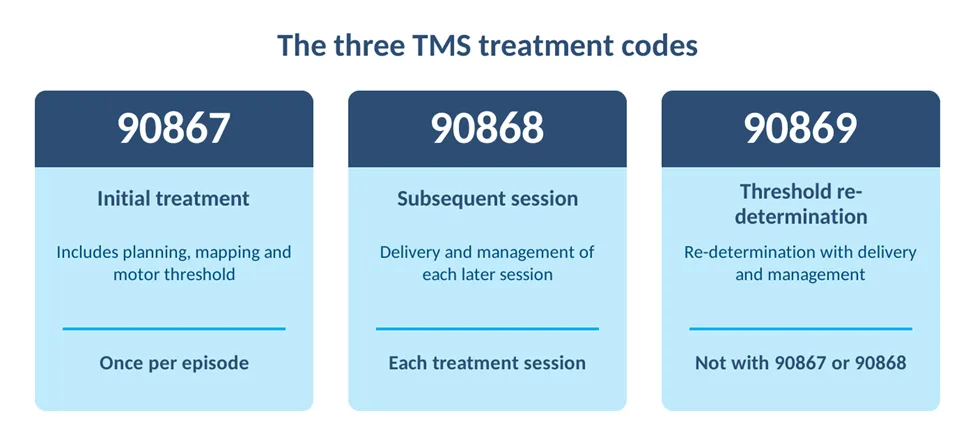
The graphic repeats the three codes. Novitas also says 90867 should not be reported more than once within a six-week period, so a second initial code shortly after the first is a common reason for a denial.
Which Diagnoses Support TMS Coverage
Medicare coverage is set by each Medicare Administrative Contractor (MAC), not nationally. The Novitas billing article lists major depressive disorder codes F32.2 and F33.2 as supporting coverage for 90867, 90868 and 90869 in its jurisdictions. The Palmetto billing article lists the same two codes and also includes F42.2 and F42.8, two obsessive-compulsive disorder codes.
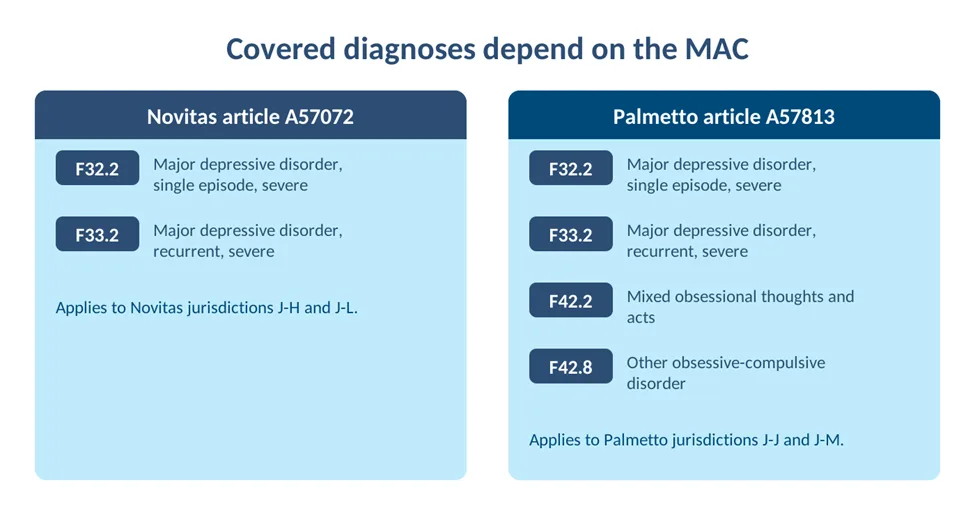
Find your own MAC and read its current article before you bill, because lists change over time. Commercial plans often add their own criteria, so confirm the payer’s medical policy and authorization rules first. Our prior authorization service supports that step for behavioral health practices.
What the Claim and the Record Must Show
Novitas instructs providers to place the ordering provider’s name and NPI on the claim. Both contractors expect a legible, signed record that supports the diagnosis and describes the service performed. Novitas also expects the attending physician to meet the patient face to face for the initial assessment and again when mental or clinical status changes, and to document the evaluation of contraindications. A strong TMS record includes:
- The diagnosis that matches the covered list.
- The physician’s face-to-face assessment and clinical judgment.
- The treatment details for each session, including the motor threshold work when 90867 or 90869 is billed.
- Any status change and the decision that followed.
Same-day E/M services
If a physician performs a separate evaluation and management service on a TMS day, the E/M needs its own note that stands apart from the treatment record, and the claim may need modifier 25. Payers apply their own edits, so confirm the policy first. This comparison of modifier 25 and modifier 59 explains how the two differ.
Common TMS Billing Mistakes
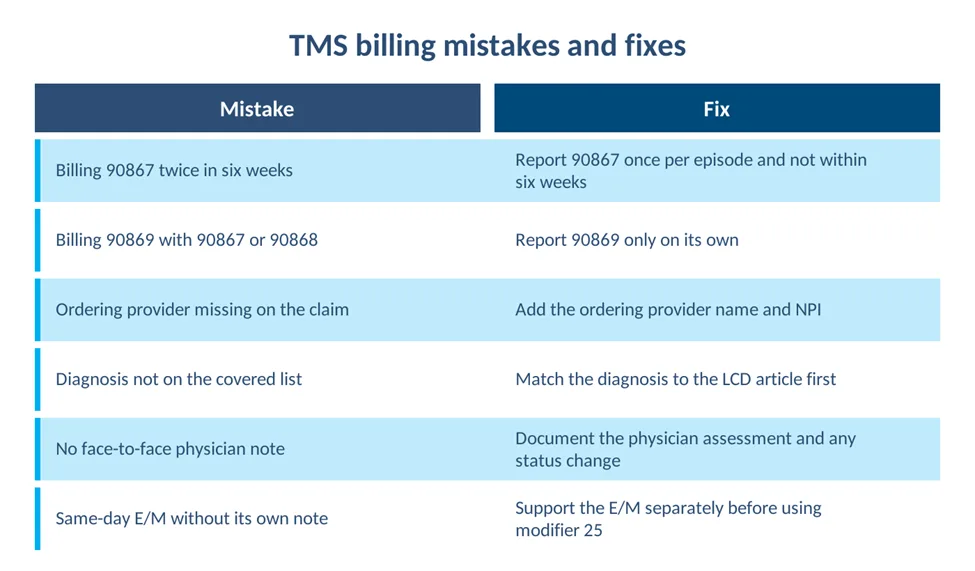
- Billing 90867 twice in six weeks: report it once per episode.
- Billing 90869 with 90867 or 90868: report it on its own.
- Missing the ordering provider: add the name and NPI.
- Using a diagnosis outside the covered list: check the contractor article first.
- No face-to-face physician note: document the assessment and any change.
- Same-day E/M without its own note: support it separately.
If a claim is denied as not medically necessary, this guide to the CO-50 denial code shows how to respond.
Frequently Asked Questions
What are the CPT codes for TMS?
TMS treatment uses 90867 for the initial treatment, 90868 for each subsequent session and 90869 for a motor threshold re-determination. Each code has its own reporting limits, and 90869 is not reported with the other two.
How often can I bill 90867?
Novitas says to report 90867 once per patient per episode and not more than once in a six-week period. Other payers may set different limits, so check the medical policy before you schedule and bill the first session.
Which diagnoses does Medicare cover for TMS?
It depends on the contractor. Novitas lists F32.2 and F33.2, and Palmetto lists those plus F42.2 and F42.8. Read your own MAC’s current article, since the coverage list can change.
Can I bill an E/M visit on the same day as TMS?
Sometimes. The E/M must be a separate, significant service with its own documentation, and the claim may need modifier 25. Payers apply their own edits, so confirm the rule before you bill both on one day.
Do commercial payers follow the Medicare rules?
Not always. Commercial plans publish their own medical policies, authorization requirements and frequency limits. Use the Medicare articles as a starting point, then check each payer’s manual and contract.
Final Considerations
Accurate TMS billing comes down to four habits: know each code’s limit, match the diagnosis to the right contractor article, put the ordering provider on the claim and keep a complete physician record. That protects revenue and lowers audit risk.
Aspect Billing Solutions is a HIPAA-compliant medical billing and coding company that assigns a dedicated agent to each provider. Learn how our medical billing and coding service supports behavioral health practices, or contact our team to discuss yours.
Sources: Novitas Solutions billing and coding article A57072 and Palmetto GBA billing and coding article A57813 from the CMS Medicare Coverage Database, and the AMA CPT code set. Commercial payers set their own rules, so follow each payer’s manual and contract. This article is general information, not legal advice.