
Modifier 25 vs Modifier 59: Which Line Gets Which Modifier (2026 Guide)
Modifier 25 vs modifier 59 comes down to code type. Modifier 25 is a CPT modifier that marks a significant, separately identifiable evaluation and management (E/M) service on the same day as a procedure. Modifier 59 is a CPT modifier that marks a non-E/M procedure as distinct from another same-day procedure that edits would otherwise bundle.
Same-day visits with procedures are where practices most often lose money twice: once when a payer bundles a service that deserved payment, and again when an audit recoups a modifier the note never supported. This guide shows which modifier belongs on which claim line, how edits decide whether a modifier is allowed at all, what changed for 2025 through 2027, and how to measure your own modifier risk with four formulas. A ten-question self-assessment checklist near the end lets you score your practice in about five minutes.
Key Numbers Cheat Sheet
Modifier 25 and 59 metrics at a glance
| Metric | Practical target/range | Review frequency | Source type |
| Modifier 25 rate, per provider | Close to specialty peers; review any provider above 50% of E/M lines | Quarterly | [O] OIG 2005 stratum; [I] peer comparison |
| X modifier share of distinct-service lines (Medicare) | Rising toward most lines where an X modifier fits | Quarterly | [P] CMS MLN1783722 expects X “whenever possible”; [I] target |
| Denial rate on lines carrying 25, 59 or X modifiers | At or below your overall denial rate; under 5% is a common target | Monthly | [I] commonly reported across industry sources |
| Internal audit pass rate for modifier lines | 95% or higher | Quarterly sample | [I] common compliance audit threshold |
| Medicare exposure under the CY 2027 proposal | Calculate now; act once the final rule is published | Once, then annually | [P] CMS-1848-P proposed rule; [I] illustrative math |
[P] = published standard or definition from CMS or the AMA CPT code set. [O] = Office of Inspector General (OIG) study data. [I] = practical or industry-convention target, not a CMS, AMA, AAPC, MGMA or HFMA mandate. Targets vary by specialty, payer mix and place of service.
Modifier 25 vs modifier 59: what is the core difference?
The core difference is the code each modifier attaches to: modifier 25 goes only on an E/M code, and modifier 59 goes only on a non-E/M procedure or service code. Both tell a payer that a service normally treated as included was separate, but they solve different bundling problems and carry different documentation proof.
Under the global surgical period rules, a procedure’s payment already includes routine pre- and post-procedure work. Under NCCI edits (the National Correct Coding Initiative), specific code pairs are flagged as not normally billed together. Modifier 25 answers the first problem for an office visit. Modifier 59 answers the second problem for a second procedure, which is why the two modifiers are not interchangeable.
Modifier 25 vs modifier 59 side by side
| Dimension | Modifier 25 | Modifier 59 |
| Attaches to | E/M codes only (for example 99202-99215) | Non-E/M procedure or service codes only |
| CPT descriptor | Significant, separately identifiable E/M service, same physician or QHP, same day | Distinct procedural service |
| What it tells the payer | The visit went beyond the procedure’s usual pre- and post-service work | Two services that edits pair together were distinct here |
| More specific alternatives | 57 (decision for major surgery), 24 (unrelated post-op visit) | XE, XP, XS, XU, and anatomic modifiers such as RT/LT, F1-F9, T1-T9 |
| Different diagnosis required? | No | No, and a different diagnosis alone is not enough |
| Audit history | OIG 2005: 35% of allowed 2002 claims did not meet requirements | OIG 2005: 40% of FY 2003 code pairs did not meet requirements |
Modifier 25 in plain terms
Modifier 25 signals a significant, separately identifiable E/M service: the provider evaluated a problem, or a separate part of a problem, that needed work beyond the procedure itself. The 2026 NCCI Policy Manual states that the E/M and the minor procedure do not need different diagnoses. The test is the work documented, not the diagnosis code.
Modifier 59 in plain terms
Modifier 59 identifies a distinct procedural service. It applies when a procedure-to-procedure edit bundles two non-E/M codes, yet the services were performed at a different session, anatomic site, organ system, lesion or non-overlapping time. The CPT code set treats modifier 59 as the modifier of last resort, used only when no more specific modifier describes the situation.
In billing audits, a common pattern is an EHR template that adds modifier 25 to every visit on a procedure day. The modifier then appears on claims where the note shows only the decision to do the procedure, which is exactly the work the procedure payment already covers.
When should you use modifier 25 on an E/M code?
Use modifier 25 when the same provider performs an E/M on the same day as a minor procedure, an XXX procedure or another separately paid service, and the note shows evaluation work beyond that service’s routine pre- and post-service work. If the visit only confirms the procedure is needed, do not bill a separate E/M.
The minor-procedure rule
The Medicare NCCI Policy Manual for 2026 defines a procedure with a 0- or 10-day global as a minor procedure. The decision to perform it is included in its payment. A significant, separately identifiable E/M unrelated to that decision is reportable with modifier 25, and a patient being new to the provider does not justify the E/M on its own.
Modifier 25 vs modifier 57
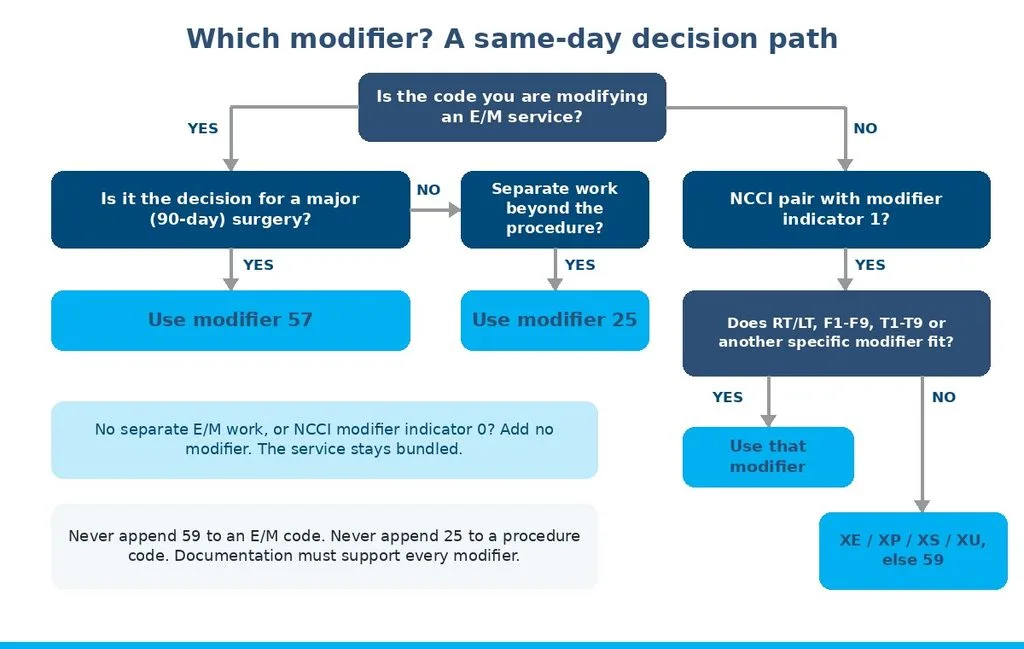
Use modifier 57 instead of 25 when the E/M results in the initial decision to perform a major surgery with a 90-day global, on the day of or the day before surgery. Use modifier 25 for minor and XXX procedures. Swapping the two is a frequent edit failure, especially in orthopedics and general surgery.
Preventive visits and the G2211 change
Modifier 25 also applies when a problem-oriented E/M is billed with a preventive visit. Since January 1, 2025, Medicare pays add-on code G2211 with a modifier 25 E/M only when the other same-day service is an annual wellness visit, vaccine administration or another Part B preventive service, per CMS MLN Matters MM13473. From January 1, 2026, G2211 also applies to home or residence E/M visits.
A practical documentation test
Ask one question before releasing the claim: if the procedure line were deleted, would the note still support the E/M level on its own? When the answer is yes, the E/M section should show its own history or exam as needed, its own medical decision making (MDM) or time, and a plan that is not just “proceed with procedure.”
When should you use modifier 59, and when is an X modifier better?
Use modifier 59 only on a non-E/M code that an NCCI procedure-to-procedure (PTP) edit bundles with another same-day code, when the services were truly distinct and no more specific modifier fits. For Medicare, check XE, XP, XS and XU first, along with anatomic modifiers such as RT/LT or toe and finger modifiers.
CMS’s Proper Use of Modifiers 59, XE, XP, XS & XU booklet (MLN1783722, April 2026) says to use the X{EPSU} modifiers instead of 59 whenever possible. It also states that different diagnoses alone are not adequate criteria, and that different code descriptors alone do not justify the modifier.
The four X{EPSU} modifiers (effective since January 1, 2015)
| Modifier | Meaning | Use when |
| XE | Separate encounter | The service happened at a separate encounter on the same date of service |
| XP | Separate practitioner | A different practitioner performed the service |
| XS | Separate structure | The service was on a separate organ or structure |
| XU | Unusual non-overlapping service | The service does not overlap the usual components of the main service |
Check the modifier indicator before choosing anything
Every PTP pair in the NCCI tables carries a modifier indicator. Indicator 0 means no modifier can bypass the edit. Indicator 1 means an NCCI-associated modifier is allowed when the clinical facts support it. Indicator 9 means the edit no longer applies. A claim scrubber should read this indicator; when it does not, the team is guessing.
When modifier 59 does not belong?
Skip modifier 59 when both procedures were on the same site in the same session, when the only difference is the diagnosis, or when RT/LT or a digit modifier already explains the separation. The CMS booklet uses a shoulder example: different shoulders call for RT and LT, not 59. A practical caution: some commercial payers still accept only 59, so build that into your payer rules.
A pattern that shows up repeatedly in denial reviews is modifier 59 placed on the wrong line. Medicare allows NCCI modifiers on column one or column two codes, but many commercial edits still expect the modifier on the column two code. A correct modifier on the wrong line can deny just like a missing one.
Can modifier 25 and modifier 59 appear on the same claim?
Yes, modifier 25 and modifier 59 can appear on the same claim, but never on the same line. Modifier 25 sits on the E/M line, while modifier 59, or the X modifier that replaces it, sits on the procedure code the edit would otherwise deny.
Illustrative scenario (not an actual client record): an established Medicare patient is seen for knee osteoarthritis and receives a right knee injection (CPT 20610, 0-day global). During the visit, the physician also evaluates newly elevated blood pressure readings, adjusts medication and orders labs. A left wrist injection (CPT 20605) is also performed.
Illustrative claim lines and what each modifier protects (dollar amounts are illustrative)
| Line | Code and modifier | Why | Illustrative allowed amount at risk |
| 1 | 99214-25 | Hypertension work is separate from the injection decision | $130 |
| 2 | 20610-RT | Primary procedure, right knee | $70 |
| 3 | 20605-LT, plus XS only if the current PTP table pairs 20605 with 20610 at indicator 1 | Different joint, different site | $60 |
Dollar amounts are illustrative only. Actual rates depend on your Medicare locality and the multiple procedure payment rules; the CMS Physician Fee Schedule Look-Up Tool shows your exact figures.
Without modifier 25, line 1 is likely to deny as included in the injection, so about $130 of the illustrative $260 is lost. Without the right site modifier on line 3, a further $60 can deny. Correct modifiers protect all three lines, provided the note documents the blood pressure evaluation and each injection site separately.
What changed for modifier 25 and modifier 59 in 2025, 2026 and 2027?
The biggest recent change is a proposal, not a final rule: the CY 2027 Medicare Physician Fee Schedule proposed rule would pay the lower-priced service at 50% when an office or outpatient E/M with modifier 25 is billed with a same-day 0-, 10- or 90-day global procedure. The other changes are already in effect.
The CY 2027 proposed rule (CMS-1848-P) in the Federal Register names otolaryngology, dermatology and podiatry as the most affected specialties. It also proposes replacing G2211 with a modifier. As of this update, CMS has not finalized either policy; Physician Fee Schedule final rules typically publish in early November.
Other updates are live. CMS reissued MLN1783722 in April 2026. The 2026 NCCI manuals restate the minor-procedure rule for both Medicare and Medicaid. Blue Cross Blue Shield of Michigan announced a 50% reduction for E/M lines with modifier 25 billed with a same-day minor procedure, reported with a May 1, 2026 effective date after revisions earlier in the year. Check its current provider manual before you model the impact.
How do Medicare, Medicare Advantage, Medicaid and commercial payers differ?
Medicare and Medicaid both apply NCCI edits and the published modifier rules, while Medicare Advantage and commercial plans layer their own policies on top. The modifier choice rarely changes by payer, but acceptance of X modifiers, line placement, payment reductions and attachment rules often do.
Illustrative payer comparison for modifier 25 and 59 claims
| Payer type | NCCI edits | X modifiers | Modifier 25 watch-outs |
| Medicare (fee-for-service) | Yes, quarterly PTP tables | Accepted and preferred | MAC audits of 25 with minor procedures; CY 2027 cut proposed |
| Medicare Advantage | Usually NCCI-based plus plan edits | Usually accepted; confirm per plan | Plan-specific payment and documentation policies |
| Medicaid | Medicaid NCCI edits apply | Varies by state | Check your state Medicaid manual and fee schedule |
| Commercial | Proprietary edits, often NCCI-based | Some accept only 59 | Reductions (for example BCBSM 2026) or record requests |
Illustrative summary built from CMS, MAC and payer policy documents; actual rules vary by plan, state and contract year.
Noridian’s guidance on NCCI edits for Medicare Part B adds two points billing teams often miss. Exceptions to bundling must be documented in the record and submitted with the right modifier. Its reason-code guidance also states that patients may not be billed for NCCI edit denials, and an Advance Beneficiary Notice (ABN) cannot shift that liability.
How do you measure modifier 25 and 59 risk with real numbers?
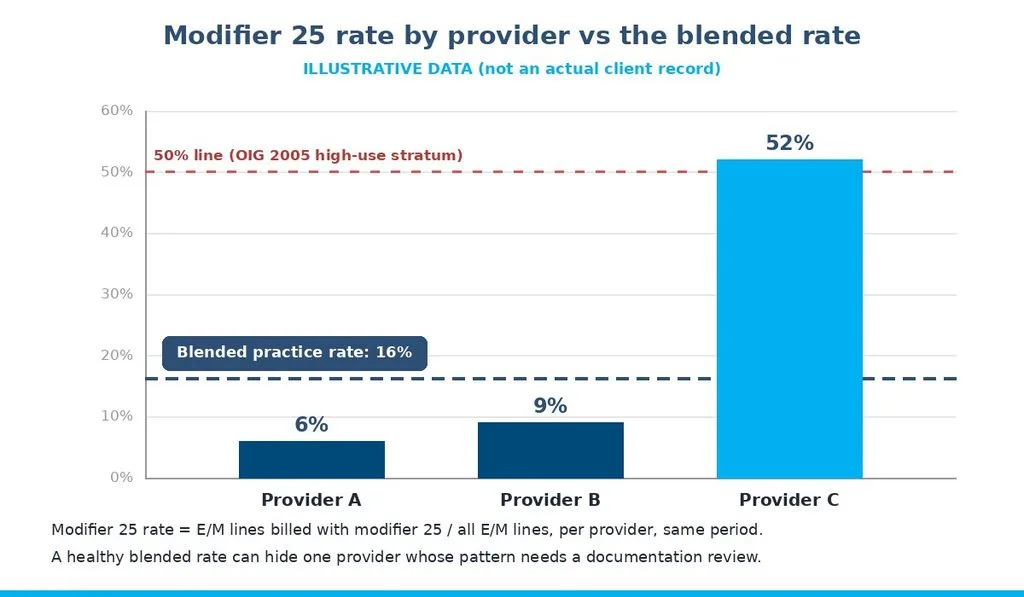
Measure modifier risk with four ratios: modifier 25 rate per provider, X modifier share, modifier-line denial rate and proposed-rule exposure. Calculate each by provider and payer, not just practice-wide, because a blended average can hide the one segment an auditor or payer will find first.
Worked example 1: modifier 25 rate per provider
Formula: E/M lines billed with modifier 25 ÷ all E/M lines, for the same provider and period. Illustrative scenario (not an actual client record): Provider A bills 108 of 1,800 E/M lines with 25 (6%), Provider B 126 of 1,400 (9%), and Provider C 416 of 800 (52%). The blended rate is 650 ÷ 4,000, or about 16%, which looks unremarkable.
Provider C is the finding. OIG’s 2005 modifier 25 review treated providers who used the modifier on more than half their claims as a separate high-use group. A 52% rate is not proof of error, since a dermatologist or podiatrist may legitimately run high, but it should trigger a focused documentation review against peers in the same specialty.
Worked example 2: X modifier share
Formula: lines billed with XE, XP, XS or XU ÷ all lines billed with 59 or an X modifier. Illustrative scenario: 90 X-modifier lines and 210 modifier 59 lines give 90 ÷ 300, or 30%. For Medicare lines, a low share suggests coders default to 59 even where XS or XE fits, which is exactly what CMS guidance asks practices to avoid.
Worked example 3: denial rate on modifier lines, by payer
Formula: denied lines carrying 25, 59 or X ÷ submitted lines carrying those modifiers. Illustrative scenario: 76 of 950 lines deny, a blended 8%. By payer, Medicare is 10 of 500 (2%), Medicare Advantage 12 of 200 (6%), Medicaid 9 of 100 (9%), and one commercial plan 45 of 150 (30%). The blended rate hides a single-payer problem, usually an X-modifier acceptance or line-placement rule.
Worked example 4: exposure under the CY 2027 proposal
Formula: annual Medicare encounters with a 25-modified office E/M plus a same-day global procedure × average allowed amount of the lower-paid service × 50%. Illustrative scenario: 300 encounters × $95 × 0.5 = $14,250 a year. Recalculate with real claims data once the final rule is published, because the policy could change or be withdrawn.
How should you interpret these benchmarks?
Compare like with like: the same specialty, payer, place of service and time period. A modifier 25 rate that is normal for dermatology can be an outlier in internal medicine, so peer comparison matters more than any single number. Treat one missed benchmark as a signal to pull charts, not a verdict.
Look for patterns across metrics. A high modifier 25 rate with a low denial rate may simply mean payers have not reviewed those claims yet. A high denial rate on 59 lines with a low X share usually points to payer rules, not provider documentation. Run an internal medical billing compliance audit on a sample of 10 to 20 charts per flagged provider before changing any coding habit.
What is the right step-by-step process before a claim goes out?
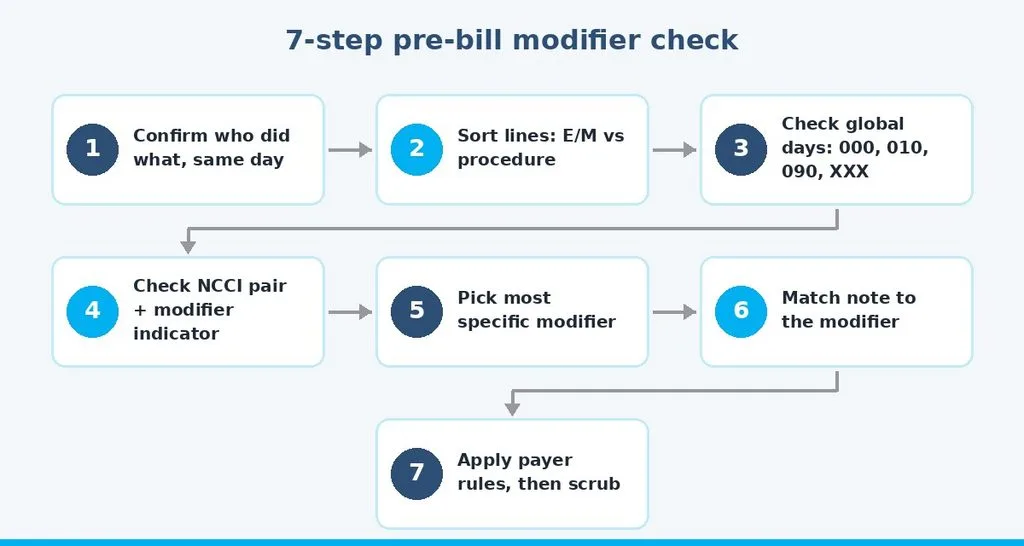
Run every same-day encounter with more than one billed service through the same seven checks before release. The order matters because each step narrows the options for the next one.
- Confirm what was performed, by whom and on what date, including whether a second practitioner in the same group was involved.
- Sort each line into E/M or non-E/M; this alone rules out half the wrong modifier choices.
- Look up each procedure’s global period in the Medicare Physician Fee Schedule: 000, 010, 090 or XXX.
- Check the current quarter’s NCCI PTP table for each procedure pair and read the modifier indicator.
- Choose the most specific modifier: 57, 24 or 25 for the E/M; then anatomic modifiers; then XE, XP, XS or XU; then 59.
- Confirm the note supports the modifier, with a distinct E/M section, separate sites, sessions or times as applicable.
- Apply payer-specific rules for X acceptance, line placement and attachments, then run the claim through your clearinghouse claim scrubbing edits.
When an NCCI denial arrives with claim adjustment reason code (CARC) 236 or 97, verify the code pair first. If a supported modifier was missing, Noridian’s guidance is to request an appeal to add it; follow your own MAC’s reopening and appeal guidance and keep Medicare’s 12-month timely filing limit in mind for corrected claims. Our guide on how to write a claims appeal letter covers the structure.
How long does it take to fix modifier problems?
Most practices can fix modifier rules within weeks, but documentation habits and denial trends usually take several months to settle. Treat the ranges below as general planning ranges, not guarantees, because volume, specialty and payer mix change the pace.
Scrubber rules, a payer modifier matrix and EHR template fixes are often in place within 2 to 6 weeks. Provider documentation changes, such as a clearly separated E/M section, typically take 1 to 3 months of feedback. Denial rates on modifier lines tend to show partial improvement within 60 to 90 days of claims, with fuller results across 3 to 6 months as older claims age out.
What are the most common modifier 25 and 59 mistakes?
The most common mistakes are using a modifier to force payment rather than to describe what happened, and choosing the modifier before checking the edit. Each mistake below has a simple control.
Auto-appending modifier 25
Templates that add 25 to every procedure-day visit create unbundling risk on every claim. Remove the default and let coders add 25 only after the documentation test is met.
Billing the decision to do a minor procedure
An E/M that only confirms a 0- or 10-day procedure is included in the procedure payment. Bill the procedure alone unless a separate problem was evaluated.
Putting 59 on an E/M code, or 25 on a procedure
The CPT code set restricts each modifier to its code type. A scrubber rule can block both errors at entry.
Defaulting to 59 when a better modifier exists
Use RT/LT, digit modifiers or XS for separate sites, and XE for separate encounters, before 59. For recurring errors like these, the guide to fixing recurring medical coding errors explains how to turn one-off corrections into rules.
Assuming commercial payers follow Medicare
Commercial plans can reduce, deny or request records for modifier lines under their own policies. Keep a payer matrix and review it at least each quarter, and more often when a payer bulletin announces a change. The broader list of common reasons for claim denials shows how modifier denials fit into the bigger picture.
From internal reviews, injection-heavy specialties tend to show the most modifier friction, because drug, administration and visit codes all land on one claim. The CPT injection administration guide covers that code family, and specialty modifier patterns appear in the family practice CPT modifiers guide.
Quick Summary
- Modifier 25 goes on the E/M line; modifier 59 goes on a non-E/M procedure line.
- Both modifier requires a different diagnosis, and a different diagnosis alone never justifies 59.
- For Medicare, try anatomic modifiers and XE, XP, XS or XU before 59; check the NCCI modifier indicator first.
- Review any provider whose modifier 25 rate exceeds 50% of E/M lines or sits far above specialty peers.
- Keep modifier-line denials at or below your overall denial rate; under 5% is a common practical target.
- Model the CY 2027 proposed 50% reduction now, then recalculate once CMS publishes the final rule.
Self-Assessment Checklist
Answer yes or no for your practice:
- Does your EHR leave modifier 25 off by default on procedure-day visits?
- Do you calculate the modifier 25 rate for each provider at least quarterly?
- Is every provider’s modifier 25 rate below 50% of E/M lines, or explained by specialty peers?
- Does your scrubber read the NCCI modifier indicator for each code pair?
- Do coders try anatomic and X modifiers before modifier 59 on Medicare claims?
- Is your denial rate on modifier lines at or below your overall denial rate?
- Do you track modifier denials by payer, not just practice-wide?
- Does your internal audit sample pass at 95% or higher for modifier lines?
- Do you keep a payer matrix covering X acceptance, line placement and modifier 25 reductions?
- Have you estimated your exposure under the CY 2027 proposed modifier 25 reduction?
Scoring: 9 to 10 yes answers means modifier controls are strong; keep quarterly reviews. 6 to 8 yes answers means targeted gaps exist; fix the “no” items within one quarter. 5 or fewer means high exposure to denials and recoupment; prioritize a documentation and claims audit.
When should a practice consider professional support?
Consider outside support when modifier problems keep returning after you have tried internal fixes. These signals usually mean the in-house approach has reached its limits:
- One provider’s modifier 25 rate stays far above peers after education.
- Denials on 59 or X lines remain above your overall denial rate for two or more quarters.
- A payer has requested records, applied a reduction or opened a review on modifier claims.
- Nobody owns quarterly NCCI updates and payer bulletins.
- Corrected claims and appeals for bundling denials are piling up past 60 days.
When evaluating outside help, look for certified coders who audit against the NCCI manual and MLN guidance, payer-specific edit management, reporting broken out by provider and payer, and a clear process for documentation feedback. An independent medical billing audit service is a sensible first step when you need a baseline.
Aspect Billing Solutions is one example of this kind of partner. Its medical billing and coding services cover end-to-end billing and coding, credentialing, eligibility verification and prior authorization, A/R follow-up and compliance support, with a dedicated agent assigned to each provider. Its denial management and appeals service works bundling denials back through review and appeal. Results vary by practice, specialty and payer mix. You can review how the team runs end-to-end revenue cycle management for medical practices.
Final Considerations
The modifier 25 vs modifier 59 decision is simpler than its denial history suggests: identify the code type, check the global period and the NCCI indicator, then choose the most specific modifier the note supports. Most errors come from skipping one of those steps, not from obscure rules.
Some numbers here are firm published standards: the 0- and 10-day minor-procedure definition, the X modifier definitions, the NCCI modifier indicators, and the 2025 and 2026 G2211 rules. The OIG error rates are historical study data. The 50% review threshold, the 5% denial target and the 95% audit pass rate are practical targets, and the worked-example figures are illustrative.
The natural next question is how your own claims compare. Pull one quarter of modifier lines, run the four formulas by provider and payer, and score the checklist. If the gaps are bigger than your team can close, explore revenue cycle management support from Aspect Billing Solutions.
Frequently Asked Questions
Can modifier 59 be used on an E/M code like 99213?
No. Modifier 59 is defined for non-E/M procedures and services only. When an office visit such as 99213 is significant and separately identifiable from a same-day procedure, modifier 25 is the correct modifier on the E/M line. Placing 59 on an E/M code is a recognized coding error and typically fails payer edits or later audit review.
Does modifier 25 require a different diagnosis than the procedure?
No. The CPT code set and the 2026 Medicare NCCI Policy Manual both state that the E/M and the procedure may share a diagnosis. What matters is document work beyond the procedure’s usual pre- and post-service care. For minor procedures, the E/M also cannot be based on the decision to perform that procedure.
What is a good modifier 25 utilization rate?
There is no published national target. A practical approach is to compare each provider with peers in the same specialty and review anyone using modifier 25 on more than half of E/M lines, the high-use group OIG examined in 2005. Procedure-heavy specialties such as dermatology and podiatry legitimately run higher than primary care.
What is a good denial rate for claims with modifier 59 or X modifiers?
A practical target is a modifier-line denial rate at or below the practice’s overall denial rate, with under 5% commonly cited across industry sources. Track it by payer. A low Medicare rate can hide one commercial plan denying 59 or X modifiers because of its own acceptance or line-placement rules.
What is a good way to choose between modifier 59 and XS?
Use XS for Medicare when the distinct service was on a separate organ or structure, because CMS guidance prefers X modifiers whenever they apply. Use modifier 59 only when no X or anatomic modifier fits, or when a payer does not accept X modifiers. Never report 59 and an X modifier on the same line.
Is the 2027 modifier 25 payment cut final?
Not as of October 2, 2026. The 50% reduction for same-day office E/M visits with modifier 25 and a 0-, 10- or 90-day global procedure appears in the CY 2027 proposed rule. CMS typically publishes the final rule in early November, so check the final text before changing budgets or schedules.
Sources and Methodology
(a) Published standards and definitions: AMA CPT code set modifier definitions (Appendix A) as described in AMA’s “Reporting CPT Modifier 25” guidance; CMS Medicare and Medicaid NCCI Policy Manuals, revision date January 1, 2026; CMS MLN1783722, Proper Use of Modifiers 59, XE, XP, XS & XU (April 2026); CMS MLN Matters MM13473 on G2211 and modifier 25 (2025 update); CY 2026 Medicare Physician Fee Schedule final rule (CMS-1832-F); CY 2027 proposed rule (CMS-1848-P, published July 16, 2026); Noridian JE and JF Part B NCCI and CARC 236 guidance.
(b) Named benchmarking data providers: none used. No MGMA, HFMA or vendor benchmark is cite for modifier rates, because no named provider publishes a national modifier 25 or 59 target.
(c) Practical or illustrative targets: the 5% denial target is commonly report across industry sources; the 95% audit pass rate is a common compliance threshold; timeframes to improvement are general planning ranges; all work-example and claim-line figures are illustrative scenarios, not client records. Payer policy summaries draw on Blue Cross Blue Shield of Michigan and Michigan State Medical Society communications from 2026.
(d) Survey or study data: HHS OIG, “Use of Modifier 25” (OEI-07-03-00470, 2005), 35% of 2002 allowed claims not meeting requirements; HHS OIG, “Use of Modifier 59 to Bypass Medicare’s NCCI Edits” (OEI-03-02-00771, 2005), 40% of FY 2003 code pairs not meeting requirements; HHS OIG 2025 report on E/M services with intravitreal injections, where documentation for 22 of 24 sampled services did not support modifier 25.
Results vary by practice, specialty, payer mix and documentation quality. Figures reflect information available at the time of research (October 2026). CPT, HCPCS and ICD-10 codes, NCCI edits, the Medicare Physician Fee Schedule and payer policies change at least annually, and NCCI tables update quarterly.