
Psychotherapy CPT Codes 90832, 90834 and 90837 Explained
Psychotherapy CPT codes 90832, 90834 and 90837 are chosen by the minutes of psychotherapy spent with the patient: 16 to 37, 38 to 52, and 53 or more. Record the real time, report only what the note supports, and add the right add-on code when an E/M visit happens the same day. This guide covers the time ranges, add-on rules, documentation and common mistakes.
These codes sit at the center of any behavioral health practice, so they also drive denials and audits. For the full revenue cycle picture, start with our mental health billing guide, then return here for the code rules.
| Key takeaways Pick the code from actual psychotherapy minutes, not the scheduled appointment length.Sessions under 16 minutes do not qualify for a psychotherapy code.With an E/M visit, use the add-on codes and time each service separately.Missing time in the note is a leading reason psychotherapy claims fail review. |
Psychotherapy CPT Codes and Their Time Ranges
Three codes cover individual psychotherapy with the patient. The code depends on face-to-face psychotherapy time, and Medicare contractor guidance says to select the code that most closely matches the time actually spent.
| CPT code | Descriptor | Time with patient |
| 90832 | Psychotherapy, 30 minutes | 16 to 37 minutes |
| 90834 | Psychotherapy, 45 minutes | 38 to 52 minutes |
| 90837 | Psychotherapy, 60 minutes | 53 minutes or longer |
Individual psychotherapy codes and time ranges, as listed in Medicare contractor guidance.
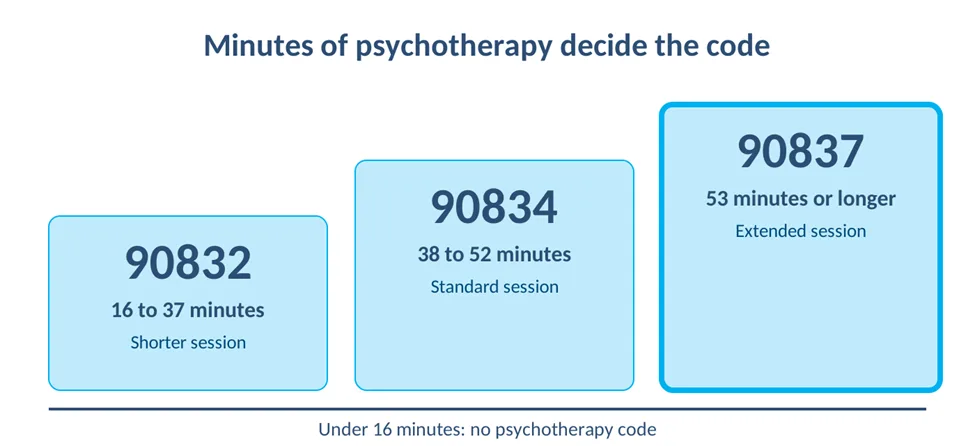
The graphic repeats the three ranges and notes that sessions under 16 minutes do not qualify for a psychotherapy code.
How to Choose Between 90832, 90834 and 90837
- Start with the clock. Count only the minutes of psychotherapy with the patient, not check-in, scheduling or paperwork.
- Match the range. Find the range that contains the total, then report that code.
- Report one unit. Most psychotherapy codes are reported with one unit per session, with a limited exception for Medicare partial hospitalization.
- Handle family time correctly. Family members who join as informants are included in the same psychotherapy code. Family psychotherapy with its own focus is separate only when it is a distinct service in a separate time interval.
Worked example (fictional data)
| Session | Psychotherapy minutes | Code to report |
| Brief check-in | 14 | No psychotherapy code |
| Follow-up visit | 35 | 90832 |
| Standard session | 50 | 90834 |
| Extended session | 55 | 90837 |
Sample (fictional data): the code follows documented minutes, not the booked slot.
Psychotherapy Add-On Codes With E/M
When a psychiatrist or other prescriber provides an E/M visit and psychotherapy on the same day, the add-on codes 90833, 90836 and 90838 replace the standalone codes. They use the same three time ranges. Both services must be significant and separately identifiable, and the note should show minutes for each one.
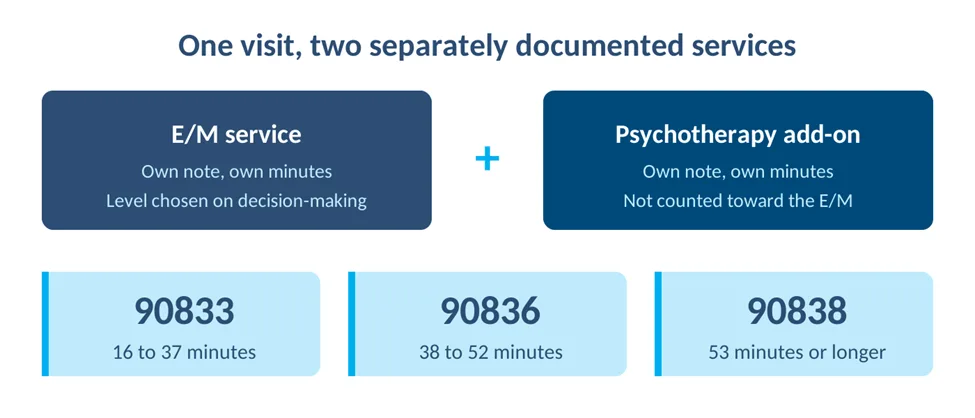
Time spent on the E/M cannot count toward the psychotherapy code, and Medicare contractor guidance says the E/M level should be based on medical decision-making instead. Prolonged service codes should not be added in this situation either. Our guide to E/M coding with MDM versus time explains how to choose the E/M level correctly. The Noridian add-on billing tips describe these rules in detail.
Documentation That Supports the Code
Reviewers look for time first. The First Coast psychotherapy guidance says the medical record must show the length of the psychotherapy encounter, and it flags missing face-to-face time as a common error finding. A strong note includes:
- Total psychotherapy minutes, or start and stop times.
- Who attended, including any family members and why.
- The diagnosis, treatment goals and the intervention used.
- A separate time entry for the E/M when an add-on code is billed.
Telehealth sessions follow the same time rules, but modifier and place-of-service requirements differ by payer. See modifier 95 versus GT for telehealth before you submit virtual visits. If a claim comes back as not medically necessary, this guide to the CO-50 denial code shows how to respond.
Common Psychotherapy Billing Mistakes
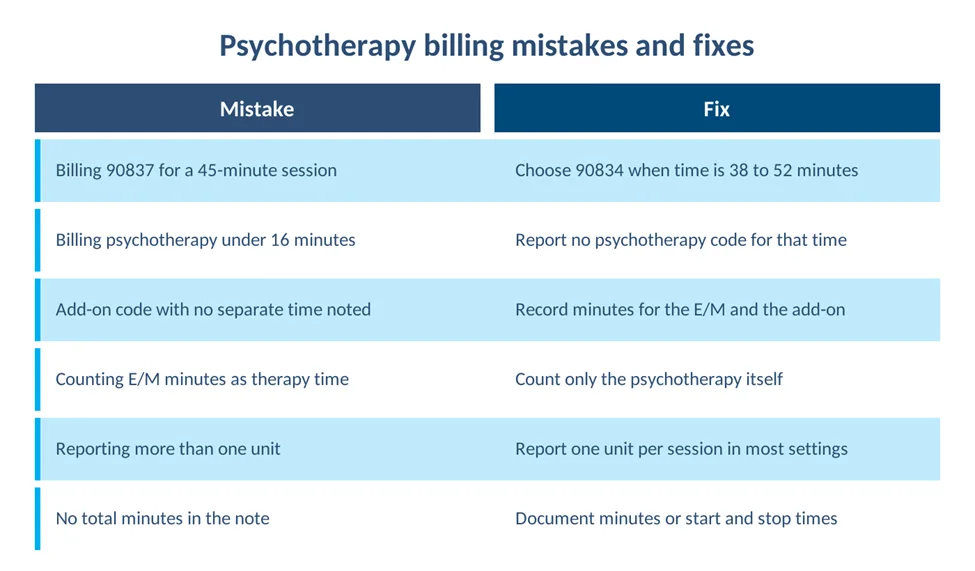
- Billing 90837 for a 45-minute session: choose 90834 for 38 to 52 minutes.
- Billing under 16 minutes: report no psychotherapy code.
- Add-on with no separate time: record minutes for both services.
- Counting E/M minutes as therapy time: count psychotherapy only.
- Multiple units: report one unit per session in most settings.
- No minutes in the note: document total time every visit.
Frequently Asked Questions
What is the difference between 90834 and 90837?
The difference is time. Code 90834 covers 38 to 52 minutes of psychotherapy with the patient, and 90837 covers 53 minutes or longer. Report 90837 only when the note supports at least 53 minutes of psychotherapy, regardless of the length of the appointment slot.
Can I bill 90837 for a 50-minute session?
No. Fifty minutes falls in the 38 to 52 minute range, so 90834 is the matching code. Payers may also review how often 90837 is billed, so keep the time documented in every note and follow each payer’s policy.
Can I bill psychotherapy and an E/M on the same day?
Yes, when both services are significant and separately identifiable. Report the E/M with the add-on code 90833, 90836 or 90838, and document the minutes for each service separately. The E/M level should not rely on the psychotherapy minutes.
What if the session is under 16 minutes?
Do not report a psychotherapy code. Medicare contractor guidance says sessions under 16 minutes do not meet the lowest time range. Depending on what happened, another service may apply, so review the note and the payer’s policy before choosing a code.
Do all payers follow the same time ranges?
The CPT time ranges are standard, but payers set their own coverage rules, frequency limits and documentation expectations in their provider manuals. Medicare rules are the starting point, so check each commercial payer’s manual and contract before you bill.
Final Considerations
Accurate psychotherapy CPT codes come down to one habit: record the minutes, match the range and keep each service documented on its own. That protects revenue and reduces audit risk.
Aspect Billing Solutions is a HIPAA-compliant medical billing and coding company that assigns a dedicated agent to each provider. Learn how our medical billing and coding service supports behavioral health practices, or contact our team to discuss yours.
Sources: Medicare contractor guidance from First Coast Service Options and Noridian, and the AMA CPT code set. Commercial payers set their own limits, so follow each payer’s manual and contract. This article is general information, not legal advice.