
Modifier 95 vs GT Telehealth: Which One to Bill, and When Medicare Wants Neither
Modifier 95 vs GT telehealth: modifier 95 is the CPT modifier for a synchronous audio-video telehealth service, commonly required by commercial payers, while GT is an older HCPCS modifier that Medicare now requires only on critical access hospital Method II institutional claims. Medicare professional claims use place of service 02 or 10 instead.
Modifier 95 did not replace GT, and most Medicare telehealth claims need neither. Many practices append 95 to every telehealth claim, then see denials from payers that wanted a different rule. This guide separates the two modifiers, shows what Medicare, Medicare Advantage, Medicaid and commercial plans expect in 2026, and gives a four-question method for choosing. A self-assessment checklist near the end scores your own claim process.
The Dates and Rules Behind Telehealth Modifiers
Seven items explain most telehealth modifier errors: five published rules or dates and two practical review targets. Table 1 gives each with its review frequency and source type, so you can tell a CMS instruction from a billing convention before you build a process around it.
Key facts for telehealth modifiers and place of service
| Item | Practical target / range | Review frequency | Source type |
| Medicare modifier 95 on professional claims in 2023 | Normal in-person POS plus modifier 95, through December 31, 2023 | Historical | Published standard (a): Noridian Medicare (MAC) |
| Medicare place of service since January 1, 2024 | POS 02 (patient not at home) or POS 10 (patient at home) | Yearly | Published standard (a): CMS MLN901705 |
| Modifier GT for Medicare | Institutional claims from critical access hospitals billing Method II | Yearly | Published standard (a): CMS MLN901705, Noridian |
| Medicare telehealth flexibilities | Temporary changes run through December 31, 2027 | At each legislative deadline | Published standard (a): Consolidated Appropriations Act, 2026, as reported by Noridian and KFF |
| RHC and FQHC telehealth payment | CMS continues payment through December 31, 2026 | Before year end | Published standard (a): CMS MLN901705 |
| Telehealth modifier accuracy | Audit a sample of claims each month by payer and compare each payer with its own baseline | Monthly | Practical target (c) |
| Telehealth denial rate by payer | Track modifier and place-of-service denials separately from clinical denials | Monthly | Practical target (c) |
Source labels: (a) federal rule, CMS instruction or MAC publication; (b) named benchmarking data provider; (c) practical target commonly used across industry sources, not a mandated standard; (d) named survey or study. This guide uses no (b) or (d) sources. Telehealth dates change by legislation; confirm before you bill.
Modifier 95 vs GT Telehealth: What Does Each One Mean?
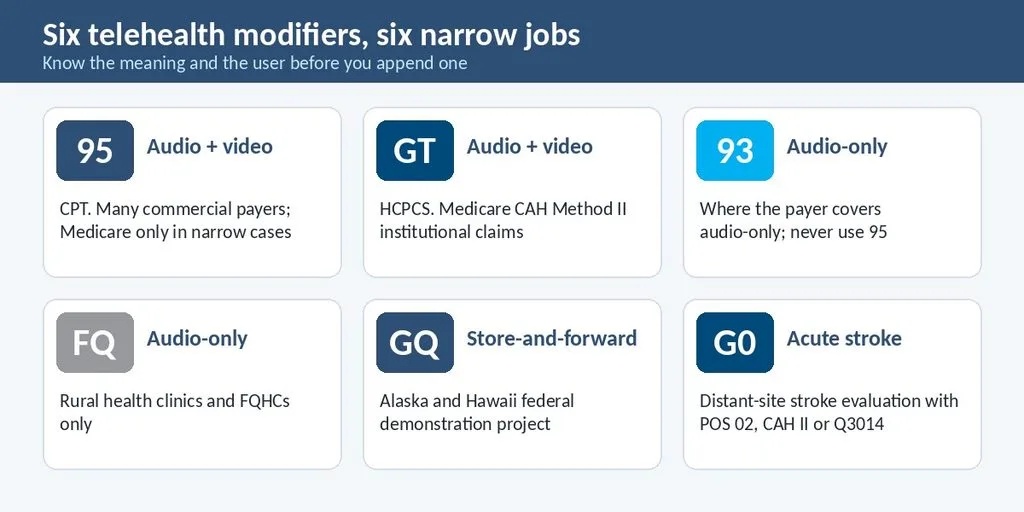
Modifier 95 and GT both describe real-time audio-video telehealth, but they come from different code sets. Modifier-95 is a CPT modifier defined as a synchronous telemedicine service rendered via a real-time interactive audio and video telecommunications system. GT is a HCPCS Level II modifier for interactive audio and video telecommunications.
Because the wording overlaps, many people assume 95 replaced GT. It did not. Industry sources commonly report that Medicare stopped requiring GT on professional claims around 2018, and that many commercial payers moved to 95. In both cases the payer’s own policy decides, not the modifier’s definition. See our telehealth billing guide for 2025 for the earlier background and our overview of telehealth codes and billing challenges for common code pairings.
Telehealth modifiers compared
| Modifier | Meaning | Who uses it | Watch-out |
| 95 | Synchronous audio and video telemedicine (CPT) | Many commercial payers; Medicare only in narrow cases such as outpatient therapy by qualified therapists | Not for audio-only visits |
| GT | Interactive audio and video (HCPCS) | Medicare critical access hospitals billing Method II on institutional claims; some legacy payers | Not needed on most Medicare professional claims |
| 93 | Synchronous audio-only | Audio-only visits where the payer covers them | Many payers do not recognize it |
| FQ | Audio-only | Rural health clinics and federally qualified health centers only | RHCs and FQHCs may report 93 or FQ |
| GQ | Asynchronous store-and-forward | Alaska and Hawaii federal demonstration project | Rare outside that program |
| G0 | Telehealth for acute stroke evaluation | Distant-site stroke services with POS 02, CAH Method II or Q3014 | Narrow clinical use |
Meanings follow the CPT definition as quoted in the CCHP billing guide and the FCSO Medicare modifier page; confirm payer-specific rules in each payer’s policy.
In billing audits, a common pattern is that 95 gets added by default in the EHR template, so every telehealth visit carries it whether or not the payer wants it. A default is convenient, but it hides which payers truly require the modifier. Check each payer’s policy before keeping it on every claim.
Does Medicare Still Want Modifier 95 or GT on Telehealth Claims?
Medicare generally does not want 95 or GT on professional telehealth claims. Since January 1, 2024, professional claims use place of service 02 or 10, and modifier 95 applies only in specific situations. GT remains required on critical access hospital Method II institutional claims, per CMS’s MLN telehealth booklet.
Noridian, a Medicare Administrative Contractor, states that modifier 95 is not required on other telehealth visits, and it describes the narrow uses: outpatient therapy by physical, occupational and speech therapists, and a visit where the clinician is in the hospital and the patient is at home. It also says 2023 telehealth claims used the normal in-person place of service with 95, through December 31, 2023. The FCSO modifier page lists 93 for audio-only and ties GT to critical access hospital Method II institutional claims.
The Noridian telehealth page also lists the temporary changes running through December 31, 2027. Those flexibilities lapsed on September 30, 2025 and were restored retroactively in November, then lapsed again at the end of January 2026 before the February 2026 extension. KFF’s telehealth explainer notes that most pandemic-era flexibilities remain temporary, so reconfirm the dates when the deadline nears.
For detail on wider Medicare billing rules, see our Medicare billing guide. For how telehealth rules have kept shifting since the public health emergency ended, see how telehealth billing continues to evolve, and apply the dates in this guide to your own payer mix.
How Do POS 02 and POS 10 Fit With Telehealth Modifiers?
Place of service tells the payer where the patient was, and the modifier tells how the service was delivered. For Medicare, POS 02 means telehealth provided other than in the patient’s home, and POS 10 means telehealth provided in the patient’s home. Using the wrong one can change payment or trigger an edit.
Reported guidance indicates Medicare pays POS 10 at the non-facility rate, which is usually higher than the facility rate used with POS 02. Your exact rate depends on your Medicare locality, and the CMS Physician Fee Schedule Look-Up Tool shows it for each code. Never choose a place of service for the rate; choose it from where the patient actually was.
Commercial plans may use their own place-of-service rules, so a combination that Medicare accepts may fail elsewhere. Where a plan’s policy is unclear, ask the payer representative for a claim example in writing and file it with the policy, noting the date and the representative’s name.
Which Payers Want Which Rule?
Each payer type uses a different rule set, so a single default will fail somewhere. Table 3 summarizes the common pattern for Medicare, Medicare Advantage, Medicaid and commercial plans. These are starting points, since each plan’s policy and each state’s Medicaid manual can differ, and a rule sheet per payer is the dependable fix.
Telehealth modifier and POS expectations by payer type
| Payer type | Typical expectation | Watch-outs | Where to check |
| Original Medicare | POS 02 or 10; no 95 or GT on most professional claims | 95 for outpatient therapy and narrow hospital cases; GT for CAH Method II institutional claims | CMS MLN901705; your MAC |
| Medicare Advantage | Often follows Medicare, but plan policy governs | Some plans add their own modifier or POS rules | Plan provider manual |
| Medicaid and CHIP | State-defined; some states use 95, GQ or their own codes | California, for example, uses its own telehealth rules and requires GQ for some store-and-forward services | State Medicaid manual |
| Commercial | Frequently 95 for audio-video; 93 for audio-only where covered | Some Blue plans use GT with other modifiers; many do not recognize 93 | Payer telehealth policy |
Illustrative summary; policies vary by payer, plan and state and change often. The California GQ example follows the CCHP billing guide (September 2024).
Which Modifier Should You Use? Four Questions in Order
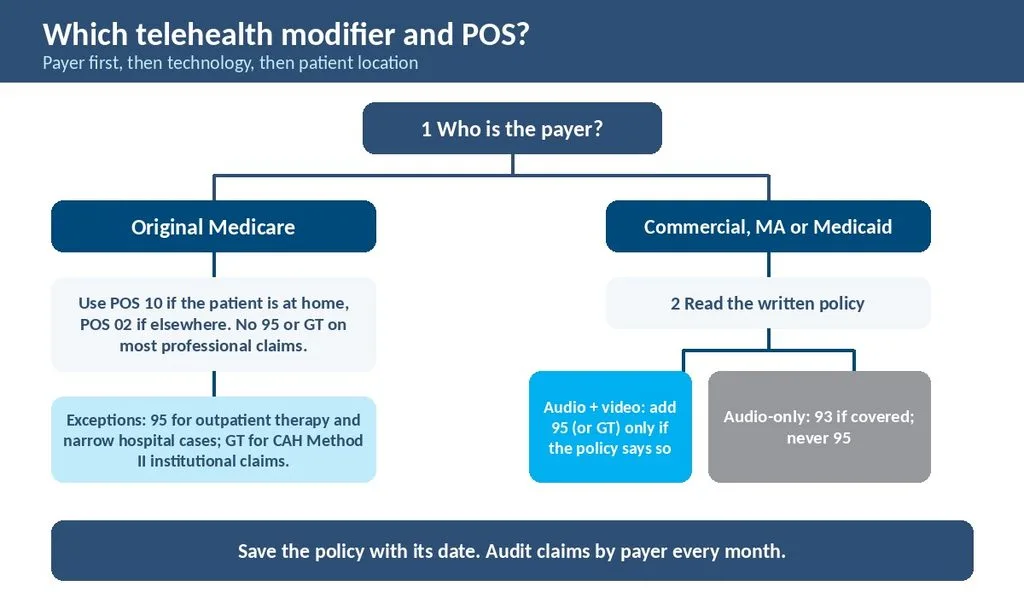
Choose the modifier by answering four questions in order: who is the payer, what technology was used, where was the patient, and what does the written policy say. Each question has a condition, so staff do not default to 95 or GT.
- Who is the payer? When it is Original Medicare, use POS 02 or 10 and skip 95 unless a narrow exception applies. When it is a commercial or Medicaid plan, go to the policy.
- What technology was used? When the visit used real-time audio and video, 95 is the usual choice where required. When it was audio-only, use 93 where the payer covers it, and never 95.
- Where was the patient? When the patient was at home, use POS 10 for Medicare. When elsewhere, use POS 02.
- What does the payer’s written policy say? When it requires 95, GT or a state code, follow it. Save the policy with its date to your payer file.
Practices that bill therapy by telehealth should read the therapist rules in our physical therapy billing guide, and behavioral health teams can see the audio-only and in-person requirements in our mental health billing guide. Rules differ by specialty, so confirm them before applying a general default.
Can You Measure Modifier Accuracy? Worked Examples
Yes, with three simple measures: accuracy by payer, telehealth denial rate against in-person, and the dollar effect of the wrong place of service. Each example gives the formula first, then one numeric walkthrough that your team can repeat on its own claims. All figures are illustrative.
Example 1: accuracy by payer
Formula: accuracy = claims with the correct modifier and place-of-service combination ÷ claims audited × 100. Illustrative scenario (not an actual client record): a practice audits 200 telehealth claims. Medicare has 59 correct of 60 (98.3%), Commercial A has 85 of 90 (94.4%) and Commercial B has 40 of 50 (80.0%). The blend is 184 of 200, or 92.0%.
A 92.0% blended rate looks acceptable. Commercial B is not. Comparing like with like means judging each payer against its own history, because the blend lets one payer’s problem hide behind two healthy ones. A single low audit is a signal to investigate, not a verdict.
Example 2: telehealth denial rate versus in-person
Formula: denial rate = denied claims ÷ claims submitted × 100. Illustrative scenario (not an actual client record): telehealth shows 45 denials on 500 claims, or 9.0%, while in-person shows 80 on 2,000 claims, or 4.0%. Of the 45 telehealth denials, 18 carry CARC 4, which the X12 list describes as a modifier inconsistent with the procedure code or missing. That is 40.0% of telehealth denials.
Pulling the CARC 4 lines shows which payer and which modifier repeat. A fix at the template or payer rule level is cheaper than reworking claims one by one, and the comparison with in-person claims shows how much of the gap is telehealth specific.
Example 3: the dollar effect of the wrong place of service
Formula: monthly impact = (rate with correct POS − rate with wrong POS) × visits. Illustrative scenario (not an actual client record): suppose the allowed amount is $110 with POS 10 and $92 with POS 02 for one code, using illustrative rates, not actual fee schedule values. With 120 home-based visits a month filed as POS 02, the difference is $18 × 120 = $2,160 a month.
Your real figure depends on code, locality and payer, and the CMS Physician Fee Schedule Look-Up Tool shows the exact rates. The point is to size the issue, then correct the rule that sets the place of service so it follows the patient’s location.
What Happens When the Modifier or POS Is Wrong?
A wrong modifier or place of service usually produces a rejection, a denial or a lower payment, depending on the payer. Denials often cite CARC 4 for a missing or inconsistent modifier and CARC 5 for a procedure that does not match the place of service. Read the remark code on the remittance for the next step.
- Missing or inconsistent modifier (CARC 4): correct the claim and resubmit if the payer allows it.
- Procedure and place of service mismatch (CARC 5): confirm where the patient was, fix the POS and resubmit.
- Underpayment from the wrong POS: compare the allowed amount with the fee schedule, then ask for a reprocess.
Denial reasons for telehealth often overlap with the usual causes in our guide to common claim denial reasons, and Medicare denials follow a defined path in our Medicare appeal guide. Check timely filing windows before you rework an old claim.
How Should You Use These Numbers Correctly?
Use the numbers to find the next question, not to grade a person. Compare each payer with its own history, and compare telehealth with telehealth rather than with in-person visits, because modifiers and place of service apply only to telehealth.
- Compare Medicare with Medicare, and commercial plans with commercial plans.
- When accuracy dips, check whether a payer changed its policy before blaming staff.
- Review again at each legislative deadline, since temporary flexibilities can change the rules.
A recurring pattern in claim reviews is a policy update that lands in a payer bulletin but never reaches the biller, so the old rule stays in force for months. Assign someone to scan payer bulletins monthly and record the date reviewed.
How Fast Can You Fix Telehealth Modifier Errors?
Most practices can fix template defaults and write a payer rule sheet within a few weeks, while denial trends take a couple of billing cycles to show improvement. These are general planning ranges, not guarantees, and results vary by payer mix.
- 1 to 2 weeks: audit a sample of telehealth claims by payer and remove any blanket default from the EHR template.
- 30 to 60 days: modifier-related denials decline as payer rules are applied by payer.
- 3 to 6 months: monthly audits show whether accuracy holds when payer policies change.
Where Do Practices Go Wrong With Modifier 95 and GT?
Practices go wrong when they apply one rule to every payer and never check whether the rule still holds. Six mistakes recur in claim reviews, and each has a short correction you can add to your claim rules.
- Defaulting to 95 on every claim. Apply it by payer policy.
- Using GT on Medicare professional claims. Reserve it for CAH Method II institutional claims.
- Using 95 for audio-only visits. Use 93 where the payer covers audio-only.
- Choosing POS by rate. Choose POS 02 or 10 by where the patient was.
- Assuming flexibilities are permanent. Confirm dates, since the current extension ends December 31, 2027.
- Not saving payer policies. Keep the policy and its date with the payer file.
Modifier 95 vs GT Quick Summary
- Modifier 95 is a CPT modifier for synchronous audio-video telehealth; GT is a HCPCS modifier for interactive audio and video.
- Medicare professional claims use POS 02 or 10 and generally need neither modifier.
- GT remains required on critical access hospital Method II institutional claims.
- Use 93 for audio-only visits where covered, never 95.
- Medicare’s temporary telehealth flexibilities run through December 31, 2027.
- Practical targets in this guide are working conventions, not mandates from CMS or the AMA.
Self-Assessment: Is Your Telehealth Modifier Process Sound?
Answer yes or no for your practice.
- Do you keep a written modifier and POS rule for each major payer?
- Is 95 added by payer policy rather than by an EHR default?
- Does staff use POS 10 or 02 for Medicare based on the patient’s location?
- Is GT reserved for CAH Method II institutional claims?
- Do audio-only visits use 93 where covered?
- Do you audit telehealth claims by payer every month?
- Do you track CARC 4 and CARC 5 denials separately?
- Does someone watch payer bulletins and CMS updates for changes?
- Do you know your telehealth flexibility end dates?
Scoring guide: 8 to 9 yes answers suggest a mature process; keep reviewing quarterly. 5 to 7 yes answers suggest gaps worth closing in the next 60 days. 4 or fewer suggest telehealth claims are likely losing revenue and deserve priority attention.
When Is It Time to Get Outside Billing Help for Telehealth?
Outside help makes sense when payer rules change faster than the team can track them, or when telehealth volume has outgrown a manual review. Watch for these signals:
- Telehealth denials cite CARC 4 or CARC 5 month after month.
- Nobody can state each payer’s current modifier and POS rule.
- EHR templates apply one modifier to every payer.
- Rework of old telehealth claims keeps running past timely filing windows.
- Telehealth volume is growing across several states with different Medicaid rules.
Look for support that maintains a payer rule sheet, audits claims by payer, reads the remittance codes and reports monthly. Ask how the vendor tracks policy changes, who reviews payer bulletins, and whether you receive audit results, not only collections totals.
Aspect Billing Solutions is one example. The team provides end-to-end billing and coding, credentialing, eligibility verification and prior authorization, denial management, A/R follow-up and compliance support, with a dedicated agent assigned to each provider. Its virtual care billing support covers telehealth claims, and the range appears on its services page. Results vary by practice. A self-check can start with our internal billing compliance audit guide. Explore the revenue cycle management service.
Final Thoughts: Check the Payer First, Then the Modifier
Modifier 95 vs GT telehealth comes down to one habit: read the payer’s rule before choosing a modifier. The POS 02 and 10 definitions, the narrow GT use on CAH Method II claims and the December 31, 2027 extension are published rules. The accuracy audits and denial tracking are practical conventions.
The worked examples are illustrative. They show a real pattern: a blended accuracy rate can look fine while one payer, one template default or one wrong place of service quietly costs money each month. Auditing by payer keeps the problem visible.
Your natural next question is which payers on your telehealth claims are failing and why. A monthly audit by payer answers it. If you want a team to build the rule sheet and keep it current, see the revenue cycle management service from Aspect Billing Solutions.
Modifier 95 and GT FAQs
Did modifier 95 replace GT?
No. Modifier 95 is a CPT modifier and GT is a HCPCS modifier, so neither replaced the other. Medicare stopped requiring GT on most professional claims, and many commercial payers prefer 95, yet each payer’s policy decides. GT still applies to critical access hospital Method II institutional claims.
Does Medicare require modifier 95 for telehealth?
Generally no. Medicare professional claims use place of service 02 or 10, and Noridian says 95 is not required on other telehealth visits. It applies to outpatient therapy by qualified therapists and a few hospital cases, so check your MAC’s page for your service.
When is modifier GT still used?
Medicare requires GT on institutional claims from critical access hospitals billing under Method II. Some legacy commercial or Medicaid plans may still ask for it, and some Blue plans pair it with other modifiers. Confirm the requirement in each payer’s written telehealth policy before using it.
Which place of service goes with telehealth?
For Medicare, use POS 10 when the patient is at home and POS 02 when the patient is elsewhere, such as a clinic. Choose by the patient’s actual location, not by the rate. Commercial plans may use different place-of-service rules, so read each policy.
What is a good telehealth modifier accuracy rate?
No national body sets a target. A practical approach is to audit a sample of telehealth claims each month, calculate accuracy by payer, and compare each payer with its own history. A high blended rate can hide one payer with a recurring modifier problem.
What is a good telehealth denial rate?
No published standard sets one. A practical approach is to track telehealth denials by payer and reason, separate modifier and place-of-service denials from clinical ones, and compare against your own in-person baseline. Review monthly and investigate any payer that moves well above its norm.
Sources and Methodology
(a) Published standards and definitions: CMS MLN901705, Telehealth & Remote Monitoring (December 2025), covering POS 02 and 10, modifier 95 for outpatient therapy, GT on CAH Method II institutional claims, GQ and the RHC and FQHC payment period; Noridian Medicare JE Part B telehealth page (updated April 6, 2026); First Coast Service Options (FCSO) telehealth modifier page (October 7, 2026); Consolidated Appropriations Act, 2026 (signed February 3, 2026), as reported by the Center for Medicare Advocacy and KFF (March 19, 2026); CPT definition of modifier 95 as quoted in the CCHP Medicare Billing for Telehealth Encounters guide (September 2024); ASC X12 CARC list for CARCs 4 and 5.
(b) Named benchmarking data providers: none cited in this guide.
(c) Practical or illustrative targets: the audit routines, accuracy and denial tracking, planning ranges and all worked examples are working conventions or illustrations commonly used across industry sources. CMS, AMA, AAPC, MGMA, HFMA and X12 do not mandate them. Statements that Medicare stopped requiring GT on professional claims around 2018 and that many commercial payers prefer 95 are commonly reported across industry sources; payer policies vary.
(d) Survey and study data: none cited in this guide.
Results vary by practice, specialty, payer mix and state. Figures and rules reflect information available at the time of research in October 2026; telehealth flexibilities, CMS instructions and payer policies change frequently, so confirm current terms before you bill.