
CO-97 Denial Code (Bundling): NCCI Edits and Fixes
CO-97 means the payer considers a service included in the payment for another service already adjudicated. It usually comes from NCCI bundling edits or the global surgical package. The provider cannot bill the patient, and keeping CO-97 under 10% of denials is an illustrative practical target, not a mandate.
Bundling denials frustrate billing teams because some are correct and some are not. The CO-97 denial code (bundling) appears either way. This guide explains how to tell the difference using NCCI procedure-to-procedure edits, the modifier indicator, and your documentation. It covers when a distinct procedural service modifier is justified and when to write off. Worked examples and a self-assessment checklist near the end help you check your own process.
Bundling Figures to Keep Handy
| Metric | Practical Target/Range | Review Frequency | Primary Source |
| NCCI edit updates | At least quarterly | Quarterly | CMS published policy |
| Modifier indicator values | 0, 1, or 9 per code pair | Per claim | CMS NCCI Policy Manual |
| Clean claim rate | 95% or higher | Monthly | Commonly reported range |
| Overall denial rate | 5% or lower | Monthly | Commonly reported range |
| CO-97 share of all denials | Under 10% | Monthly | Illustrative target |
| Modifier 59/X claims fully supported | 100% on audit | Quarterly | Practical target |
| CO-97 review turnaround | Within 10 business days | Weekly | Practical target |
Table 1. “CMS” sources are official Medicare policy; commercial payers may use their own edits. “Commonly reported range” is widely cited, not mandated. “Practical” and “Illustrative” targets are working goals to verify locally.
Why Payers Bundle Services?
CARC 97 states that the benefit for a service is included in another service already adjudicated. The CO group code makes the provider responsible, so the patient is not billed. Most Medicare CO-97 denials come from NCCI edits, which list code pairs that should not be reported together. Others come from the global surgical package, where routine post-op visits are included in the surgery. CO-97 differs from CO-45 contractual adjustments, which reduce payment to the allowed amount.
How NCCI Code Pairs Work?
Each NCCI edit pairs a column 1 code with a column 2 code. When both are billed for the same patient, date, and provider, the column 2 code denies unless a valid modifier applies. The CMS NCCI FAQ library notes that these edits may update at least quarterly. Checking the current file matters, because an old edit table can explain a denial that no longer applies.
The Three Modifier Indicators
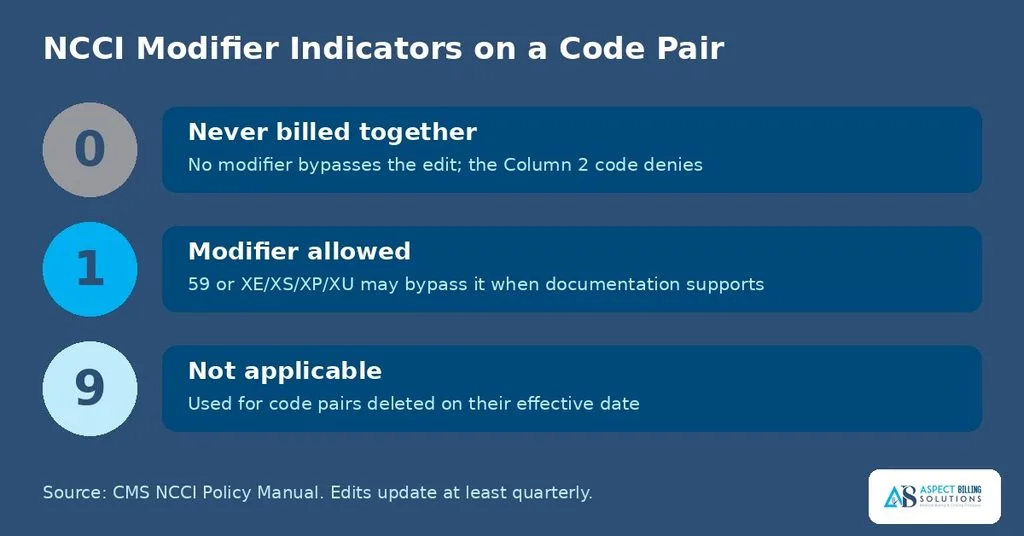
Each code pair carries a modifier indicator. A “0” means the codes are never billed together, and no modifier helps. A “1” means an NCCI-associated modifier may bypass the edit when documentation supports separate services. A “9” means the indicator does not apply, used for pairs deleted on their effective date.
Using Distinct-Service Modifiers Correctly
The CMS modifier 59 booklet (MLN1783722) says modifier 59 mainly shows procedures at different anatomic sites or encounters. It should be used only when no more specific modifier fits. The X-modifiers give that specificity. XE marks a separate encounter and XS a separate structure. XP marks a separate practitioner, and XU an unusual non-overlapping service. Modifier 59 never goes on an E/M; modifier 25 does that job. See our modifier guide for specialty examples.
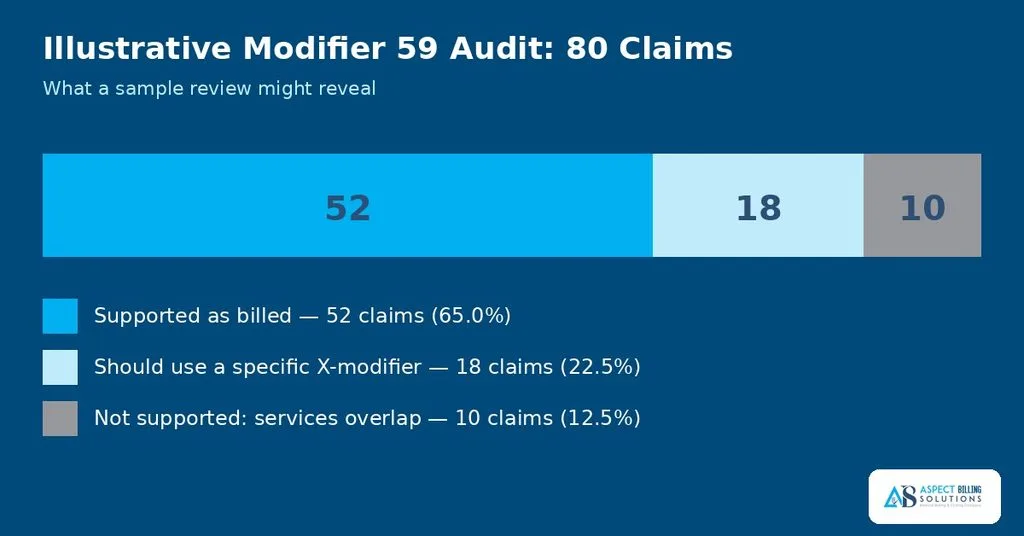
Worked example — modifier audit accuracy. Formula: fully supported modifier claims ÷ claims audited × 100. Illustrative scenario (not an actual client record): 52 of 80 sampled modifier 59 claims are fully supported, or 65%. Another 18 should have used a specific X-modifier, and 10 billed overlapping services. Against a practical 100% target, that calls for coder education, not just claim fixes.
When CO-97 Is Correct
Many CO-97 denials are right. A service that is part of a larger procedure, like the approach to a surgical site, is not separately payable. Adding a modifier there is unbundling, a compliance risk. If the indicator is 0, or the note shows no distinct service, accept the denial and write it off. Our list of common coding mistakes covers related errors.
Resolving a CO-97 Step by Step
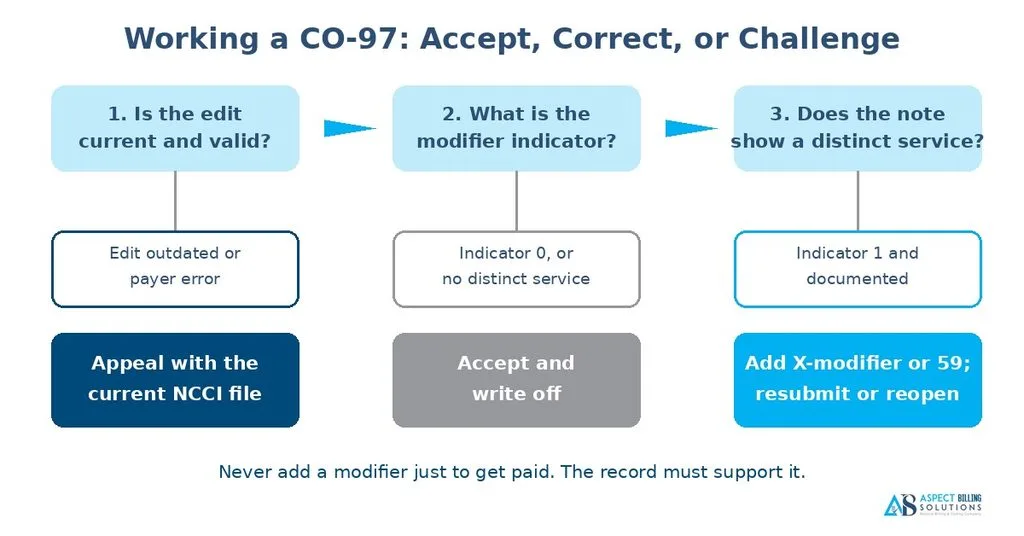
First, confirm the edit was active on the date of service. Next, check the modifier indicator. Then read the note to see whether the services were truly distinct. If they were and the indicator is 1, add the correct modifier and resubmit or request a reopening. Depending on the Medicare contractor, adding a modifier may need a reopening or a redetermination with records. If the payer misapplied an edit, appeal with the current NCCI file. For appeal backlogs, our denial management and appeals service can help.
Worked example — revenue at stake. Formula: CO-97 lines × average allowed amount. Illustrative figures: 140 CO-97 lines at $85 each total $11,900 in a quarter. If a review finds 40% were distinct services missing a modifier, about $4,760 is recoverable. The rest is correct bundling and should stay written off.
Measuring CO-97 Across the Practice
CO-97 share of denials equals CO-97 denials ÷ all denials × 100. Appeal overturn rate equals overturned CO-97 appeals ÷ CO-97 appeals filed × 100; 21 of 35 overturned is 60%. A low overturn rate often means appeals are filed on correct bundling.
| Provider | All denials | CO-97 denials | CO-97 share |
| Provider A | 140 | 6 | 4.3% |
| Provider B | 150 | 8 | 5.3% |
| Provider C | 120 | 48 | 40.0% |
| Blended | 410 | 62 | 15.1% |
Table 2. Illustrative figures, not from a named source. Actual rates vary by specialty; verify against your own data.
The blended 15.1% suggests a moderate problem. In fact, two providers sit well under an illustrative 10% target, while Provider C drives more than three-quarters of CO-97 denials. That usually points to one procedure mix or template habit. Review a sample of that provider’s claims first. If charting is the root cause, coding support services can review notes before claims go out.
Comparing CO-97 Numbers Sensibly
Compare CO-97 rates only against practices with similar specialties and procedure mix. A procedure-heavy surgical group will naturally see more bundling edits than a primary care office. Use the same reporting period and edit version. One high month is a signal to investigate, not a verdict.
How Long Bundling Fixes Take?
| Fix | Early signs | Fuller results |
| Quarterly NCCI file update in scrubber | Next billing cycle | 60 days |
| X-modifier coder education | 30 days | 60–90 days |
| Pre-bill review of indicator-1 pairs | 30 days | 60–90 days |
| Appeal triage (valid vs. correct bundling) | 30 days | 90–120 days |
Table 3. General planning ranges only, not a guarantee for any specific practice.
CO-97 Denial Code (Bundling): Recap
- CO-97 means a service is included in another service already paid.
- NCCI edits and the global surgical package drive most CO-97 denials.
- Indicator 0 pairs never unbundle; indicator 1 pairs need documented distinct services.
- Prefer XE, XS, XP, or XU over modifier 59 when one fits.
- 95% clean claims and 5% denials are commonly reported targets, not mandates.
Test Your Bundling Workflow
Answer yes or no, then count your yes answers.
- Does your scrubber load each quarterly NCCI update?
- Do coders check the modifier indicator before adding a modifier?
- Are X-modifiers used instead of 59 when one fits?
- Does documentation support every distinct-service modifier?
- Is modifier 59 kept off E/M services?
- Are correct bundling denials written off instead of appealed?
- Is CO-97 under 10% of all denials?
- Is your clean claim rate 95% or higher?
- Do you track CO-97 by provider and procedure?
Scoring: 8–9 yes = strong workflow. 5–7 = targeted fixes needed. 0–4 = a coding and modifier audit is overdue; our internal audit guide explains how to start.
When Outside Coding Help Pays Off?
Some signs show your in-house handling of the CO-97 denial code (bundling) has hit its limits. Modifier 59 is add by habit. Appeals are file on every CO-97, and most fail. Nobody updates edit files each quarter. One provider or procedure keeps driving denials. Good outside support offers certified coders, current NCCI edit checks, documentation review, and appeal triage. Aspect Billing Solutions follows that structure. Each provider gets a dedicated agent across end-to-end revenue cycle management: coding, billing, credentialing, denial management, and HIPAA compliance. Results vary by practice.
Final Considerations
The CO-97 denial code (bundling) is not always a mistake to fix. Sometimes it is correct coding at work. Check the edit, the indicator, and the note before acting, and track denials by provider.
NCCI edits, modifier indicators, and modifier 59 and X-modifier rules are publish CMS standards. The 95% clean claim and 5% denial figures are commonly report ranges. The CO-97 share, audit, and turnaround targets are practical or illustrative goals.
Frequently Asked Questions
What does CO-97 mean?
It means the service is include in the payment for another service already process. The provider, not the patient, absorbs the amount.
Can I bill the patient for a CO-97 denial?
No. The CO group code makes it a contractual obligation, so the patient is not responsible.
Will modifier 59 fix a CO-97?
Only when the indicator is 1 and documentation shows a distinct service. For indicator 0 pairs, no modifier helps.
What is the difference between CO-97 and CO-45?
CO-97 denies a service as bundled into another. CO-45 reduces payment to the contracted allowed amount.
Can I appeal a CO-97 denial?
Yes, when the edit was misapply or the service was truly distinct. Appealing correct bundling usually wastes time.
What is a good CO-97 rate?
No official figure exists. Keeping CO-97 under 10% of denials is an illustrative target; compare against similar specialties.
What is a good clean claim rate?
Many practices aim for 95% or higher, a commonly reported range. It is not a regulatory standard.
What is a good appeal overturn rate for CO-97?
No official benchmark exists. A low rate often means appeals are being file on correct bundling.
Sources and Methodology
(a) Published standards: CMS NCCI Policy Manual and FAQ library; CMS MLN1783722 on modifiers 59, XE, XP, XS, and XU; X12 CARC 97 definition.
(c) Practical and illustrative targets: clean claim and denial figures are commonly report ranges. CO-97 share, audit, and turnaround targets are practical or illustrative, and worked examples use invented numbers.
(b, d) Named benchmarking providers and survey data: none used. Actual results vary by practice; figures reflect information available in September 2026.