
Intraoperative Neuromonitoring Billing CPT 95940 95941
CPT 95940 reports in-room, one-on-one intraoperative monitoring per 15 minutes. CPT 95941 reports remote or multi-case monitoring per hour, but Medicare does not accept it and requires HCPCS G0453 instead. Both are add-on codes billed with baseline study codes. A 95% clean claim rate is a commonly cited practical target, not a mandate.
Intraoperative neuromonitoring claims fail for predictable reasons: the wrong time code, miscounted units, or missing baseline studies. This guide to intraoperative neuromonitoring billing CPT 95940 95941 explains which code fits each setting and how to convert minutes into units. It covers IONM time codes, baseline study codes, and payer medical necessity policies, with worked examples. A self-assessment checklist near the end helps you score your current process.
IONM Billing Numbers at a Glance
| Metric | Practical Target/Range | Review Frequency | Primary Source |
| 95940 unit | 15 min; first unit at 8 min | Per case | CPT (AMA); CMS Article A56722 |
| G0453 unit | 15 min; at least 8 min; max 4 per hour | Per case | CMS published FAQ |
| 95941 unit | Per hour; not valid for Medicare | Per case | CPT (AMA); CMS rule |
| Baseline study per session | Once per operative session | Per case | Commonly applied payer policy |
| Start/stop times documented | 100% of cases | Weekly | Practical target |
| Clean claim rate | 95% or higher | Monthly | Commonly reported range |
| Denial rate | 5% or lower | Monthly | Commonly reported range |
| Days in A/R | Under 45 days | Monthly | Commonly reported range |
Table 1. “CPT (AMA)”, “CMS” sources are official definitions or Medicare policy. “Commonly applied payer policy” appears in several payer policies but is not universal. “Commonly reported range” is widely cited, not mandated. “Practical target” is a working goal.
Choosing Between 95940, 95941, and G0453
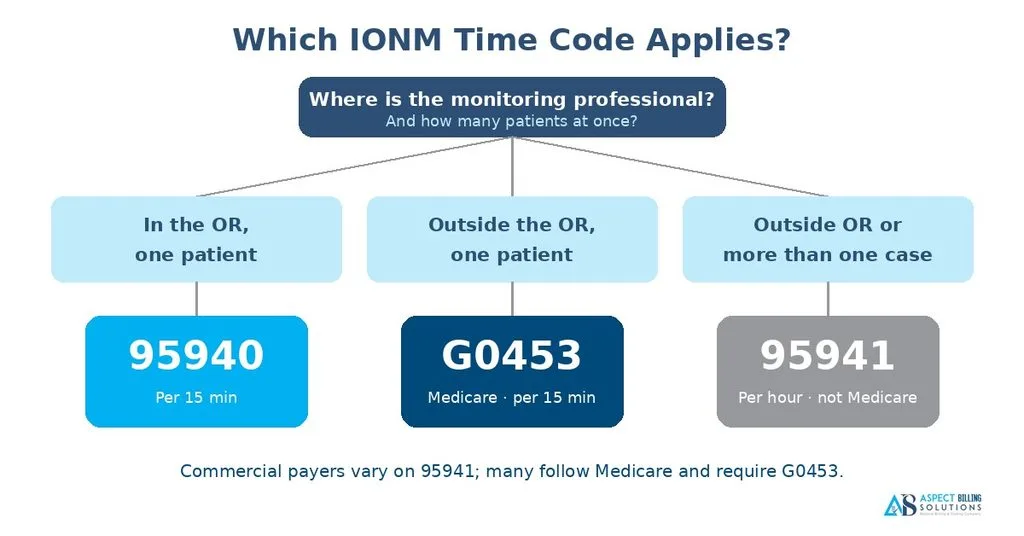
The right time code depends on where the monitoring professional is and how many patients they watch. CPT 95940 covers one-on-one monitoring with the professional physically in the operating room. CPT 95941 covers monitoring from outside the room, or more than one case at once, billed per hour. Medicare does not accept 95941. It created HCPCS G0453 for remote monitoring with attention directed to one patient only.
Commercial payers split on this. Some accept 95941, while others follow Medicare and require G0453. Check each payer’s policy before the first claim, not after the first denial.
Who Can Bill IONM Time?
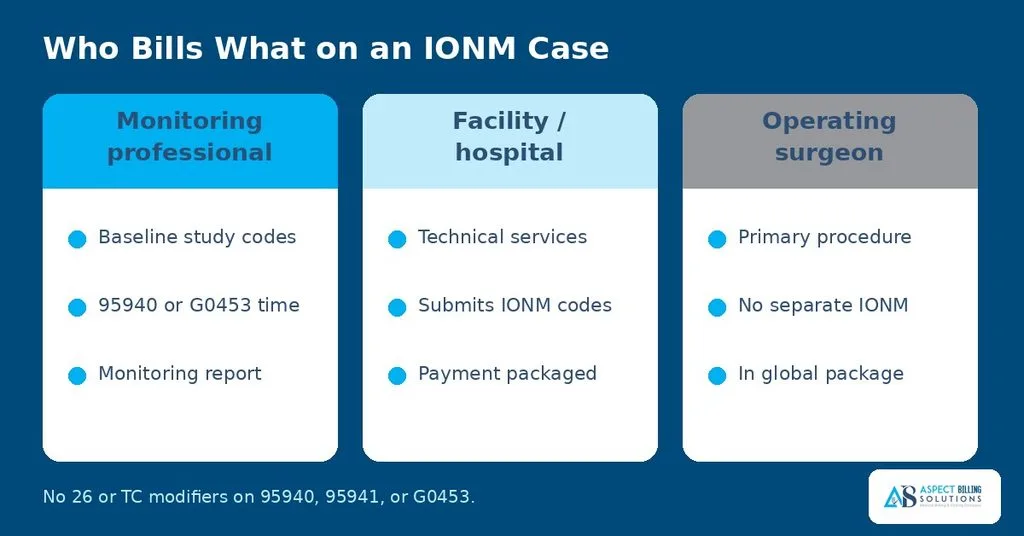
The surgeon and the anesthesiologist cannot bill IONM, because monitoring is included in their services. None of the three time codes accept modifiers 26 or TC. Several payers, including a Washington plan effective October 2025, no longer pay “incident to” claims for technician monitoring. Payment goes only to the monitoring physician.
Facility Billing Is Different
Hospitals and ASCs should still report IONM codes. Under Medicare’s outpatient and ASC systems, however, payment for that time is packaged into the surgery. Separate facility payment generally does not follow.
Turning Monitoring Minutes into Units
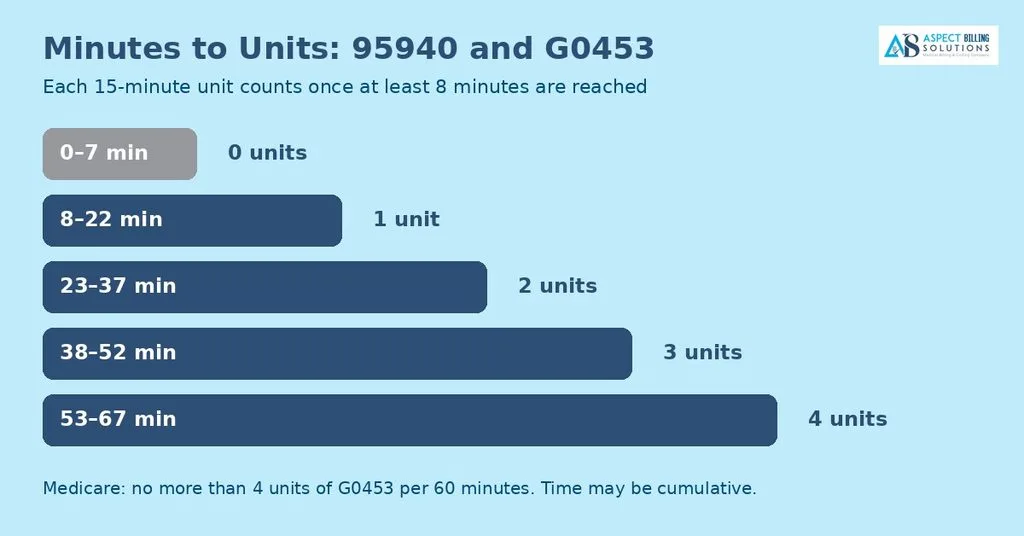
CMS Article A56722 states that 95940 counts only time the professional spent in the operating room, one-on-one. Time is cumulative and may begin before incision when positioning creates risk. For G0453, the CMS remote IONM FAQ lets non-continuous time on one patient be added together. It allows no more than four units per hour.
Worked example — 95940 units. Formula: total one-on-one minutes ÷ 15; a remainder of 8 minutes or more adds one unit. A spine case logs 97 minutes in the room. That is six full units (90 minutes) with 7 minutes left over, so bill six units. At 98 minutes, bill seven.
Worked example — G0453 non-continuous time. A remote physician spends 20 minutes, steps away, then returns for 18 minutes on the same patient. Total time is 38 minutes: two full units plus 8 minutes. Bill three units of G0453.
Worked example — 95941 hours. A commercial payer accepting 95941 follows hourly units, and some policies bar billing 30 minutes or less. Remote multi-case monitoring of 130 minutes supports two units; the last 10 minutes do not count. Confirm the rounding rule in each contract.
Baseline Study Codes Come First
Time codes are add-ons and never stand alone. They accompany the study codes performed, such as 95938 for sensory or 95939 for motor evoked potentials. Several payer policies allow each baseline study once per operative session. Our guide to EEG and EMG coding tips covers the study codes in more detail.
Payer Rules and Medical Necessity
Coverage depends on the surgery and diagnosis. Some commercial policies treat IONM as not medically necessary for lumbar surgery below L1–L2, and others require prior authorization by diagnosis. Build a payer grid of accepted codes and authorization rules. If authorization is slowing cases, prior authorization services can manage that step. The neurology modifiers guide explains related modifier rules.
Illustrative scenario (not an actual client record): a monitoring group bills 95941 to every commercial payer. Two plans that require G0453 deny every remote claim for months. Mapping each payer to its accepted code stops new denials, and denied claims within filing limits are corrected and resubmitted.
Tracking IONM Claim Performance
Three measures show whether IONM billing is healthy. Clean claim rate equals claims paid first pass ÷ claims submitted × 100. Denial rate equals denied claims ÷ claims submitted × 100. Days in A/R equals A/R balance ÷ average daily charges.
Worked example — clean claim rate. 268 of 290 claims paid first pass gives 268 ÷ 290 × 100 = 92.4%. That falls below a commonly reported 95% target.
| Payer group | Claims | Denials | Denial rate |
| Medicare (G0453/95940) | 150 | 3 | 2.0% |
| Commercial accepting 95941 | 90 | 4 | 4.4% |
| Commercial requiring G0453 | 50 | 8 | 16.0% |
| Blended | 290 | 15 | 5.2% |
Table 2. Illustrative figures, not from a named source. Actual rates vary; verify against your own payer data.
The blended 5.2% sits near a commonly reported 5% target. Yet one payer group denies 16% of claims, a code-selection problem the average hides. Split denials by payer every month. For stubborn denial patterns, our denial management and appeals service can take on the rework.
Comparing IONM Results Like-for-Like
Compare groups with a similar mix of in-room and remote monitoring, similar payers, and the same reporting period. One missed number is a signal to investigate, not a verdict.
When IONM Billing Fixes Show Results?
| Fix | Early signs | Fuller results |
| Payer-by-payer time code mapping | Next billing cycle | 60–90 days |
| Start/stop time documentation template | 30 days | 60–90 days |
| Baseline study pairing check | 30 days | 60 days |
| Denial backlog rework | 30 days | 90–120 days |
Table 3. General planning ranges only, not a guarantee for any specific practice.
Intraoperative Neuromonitoring Billing CPT 95940 95941: Recap
- 95940 is in-room, one-on-one, per 15 minutes.
- 95941 is remote or multi-case, per hour, and not valid for Medicare.
- G0453 is Medicare’s remote code: one patient, 15-minute units, max four per hour.
- Time codes always accompany baseline study codes; no 26 or TC modifiers.
- 95% clean claims and 5% denials are commonly reported targets, not mandates.
Audit Your IONM Billing
Answer yes or no, then count your yes answers.
- Does every note record monitoring start and stop times?
- Is 95940 used only for in-room, one-on-one time?
- Is G0453 used instead of 95941 for Medicare?
- Does each payer have a mapped, accepted remote code?
- Are time codes always paired with baseline study codes?
- Are units calculated with the 8-minute rule?
- Are modifiers 26 and TC left off IONM time codes?
- Is the clean claim rate 95% or higher?
- Is the denial rate 5% or lower for every payer group?
Scoring: 8–9 yes = strong process. 5–7 = targeted fixes needed. 0–4 = a full IONM billing review is overdue.
When Specialist IONM Billing Help Pays Off?
Certain signs show your in-house approach to intraoperative neuromonitoring billing CPT 95940 95941 has reached its limits. Remote claims deny for code choice. Units are rounded by habit rather than rule. Nobody tracks which payers accept 95941. Baseline studies are billed twice or not at all. Good outside support offers neurophysiology-trained coders, a payer policy grid, pre-bill time audits, and payer-level reporting. Aspect Billing Solutions follows that structure. Each provider gets a dedicated agent across end-to-end revenue cycle management: coding, billing, credentialing, denial management, and HIPAA compliance. Results vary by practice.
Final Considerations
Intraoperative neuromonitoring billing CPT 95940 95941 comes down to three habits. Choose the right time code, calculate units correctly, and pair every claim with its baseline studies. A payer grid keeps remote monitoring from turning into a denial pattern.
The 95940, 95941, and G0453 definitions and unit rules are publish AMA and CMS standards. The once-per-session baseline rule is a commonly apply payer policy. The 95% clean claim, 5% denial, and 45-day A/R figures are commonly report ranges.
Frequently Asked Questions
What is the difference between CPT 95940 and 95941?
95940 is one-on-one monitoring inside the operating room, billed per 15 minutes. 95941 is remote or multi-case monitoring, billed per hour.
Can I bill 95941 to Medicare?
No. Medicare requires G0453 for remote monitoring of one patient at a time.
How many units of G0453 can I bill per hour?
No more than four. Each unit needs at least 8 minutes of monitoring.
Can the surgeon bill 95940?
No. Monitoring by the operating surgeon or anesthesiologist is include in their own services.
Do IONM codes take modifier 26 or TC?
No. 95940, 95941, and G0453 are global services without separate components.
What is a good denial rate for IONM claims?
Five percent or lower is a commonly report target, not a mandate. Check it by payer, since code-choice problems often hide in one plan.
What is a good clean claim rate for neuromonitoring?
Many practices aim for 95% or higher, a commonly reported range. Remote-monitoring claims may run lower until payer mapping is complete.
What is a good days in A/R figure for IONM groups?
Under 45 days is a commonly report range. Compare against groups with a similar payer mix and your own trend.
Sources and Methodology
(a) Published standards: AMA CPT descriptors for 95940 and 95941; CMS Article A56722; CMS remote IONM FAQ for G0453.
(c) Practical and illustrative targets: the baseline rule reflects common payer policy. Clean claim, denial, and A/R figures commonly report ranges, and worked examples are illustrative.
(b, d) Named benchmarking providers and survey data: none used. Actual results vary by practice; figures reflect information available in September 2026.