
Neurosurgery and Spine Surgery Billing Services Guide
Quick answer: Neurosurgery and spine surgery billing services manage prior authorization, operative note coding, and surgical modifiers for brain and spine procedures. They also track global periods, submit claims, and follow up on denials. Medicare rules shape payment, such as 62.5% of the fee to each co-surgeon. A clean claim rate of 95% or higher is a commonly cited practical target, not a regulatory requirement.
One spine case can carry several procedure codes, add-on codes, an assistant surgeon, and a prior authorization. Each piece can reduce payment or deny the claim. This guide explains what neurosurgery and spine surgery billing services should handle, from the global surgical package to surgical modifiers and prior authorization. It includes worked payment calculations and the metrics worth tracking. A self-assessment checklist near the end helps you score your current process.
Surgical Billing Numbers in One Place
| Metric | Practical Target/Range | Review Frequency | Primary Source |
| Major surgery global period | Day before + day of + 90 days | Per case | CMS published rule |
| Multiple procedures (51) | 100% primary; 50% each additional | Per case | CMS payment policy |
| Co-surgeon payment (62) | 62.5% of fee to each surgeon | Per case | CMS payment policy |
| Assistant at surgery | 16% (80/82); 13.6% for NPP (AS) | Per case | CMS payment policy |
| Elective cases authorized pre-surgery | 100% | Weekly | Practical target |
| Clean claim rate | 95% or higher | Monthly | Commonly reported range |
| Denial rate | 5% or lower | Monthly | Commonly reported range |
| Days in A/R | Under 45 days | Monthly | Commonly reported range |
| Op note to charge entry | 3 days or fewer | Weekly | Practical target |
Table 1. “CMS published rule” and “CMS payment policy” are Medicare policy; commercial payers may differ. “Commonly reported range” is widely cited, not mandated. “Practical target” is a working goal to verify locally.
The Surgical Package and Its Modifiers
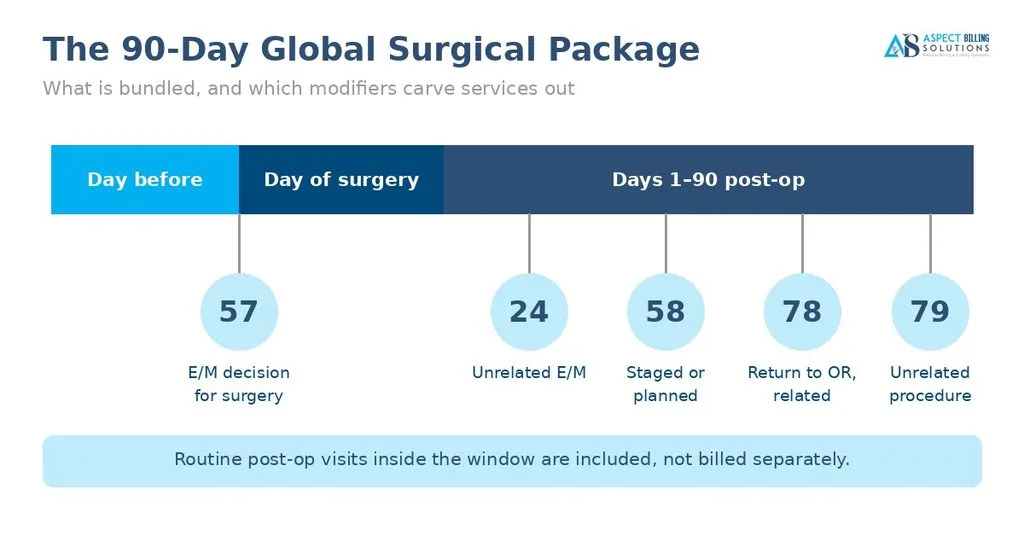
Major spine and cranial procedures carry a 90-day global period. Payment covers the day before surgery, the surgery itself, and routine post-op care for 90 days. Services inside that window are bundled unless a modifier shows otherwise. The FCSO Medicare global surgery guidance lists the modifiers that apply. Modifier 57 marks the visit where surgery was decided. Modifiers 24, 58, 78, and 79 separate unrelated visits, staged procedures, returns to the OR, and unrelated procedures.
Worked example — global period dates. Formula: surgery date + 90 days = last global day. A lumbar fusion on March 3 opens the window on March 2. Adding 90 days ends it on June 1. A June 2 visit for the same condition is billable as a normal E/M.
Co-Surgeons and Assistants
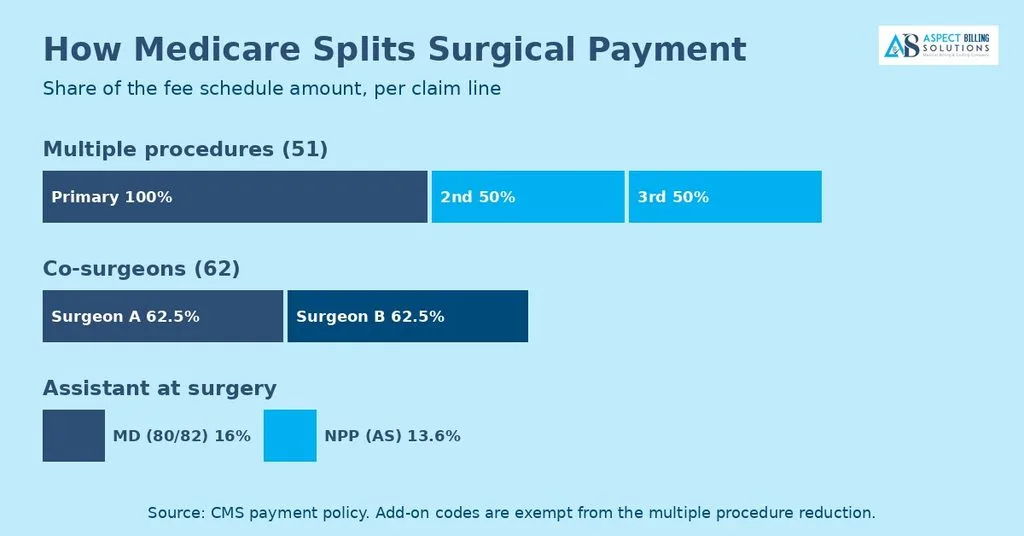
Complex spine cases often pair a neurosurgeon with an access surgeon. When two surgeons of different specialties each perform part of one procedure, both bill it with modifier 62. CMS co-surgery guidance pays each the lesser of the charge or 62.5% of the fee schedule amount. If only one surgeon appends 62, claims can pay incorrectly or deny.
Worked example — co-surgery and assistant pay. Formula: fee × payment percentage. Using an illustrative $3,000 fee, each co-surgeon receives $1,875, a combined 125%. An assisting physician billing modifier 80 receives 16%, or $480. A physician assistant billing with AS receives 85% of that, or $408.
Before any of that math applies, check the code itself. The Medicare Physician Fee Schedule gives every procedure a co-surgeon indicator and an assistant-at-surgery indicator. For co-surgery, 2 means allowed, 1 means allowed only with supporting documentation, and 0 means not permitted. For assistants, 2 means payable, 0 means payable only with documentation of medical necessity, and 1 means Medicare will not pay at all. Checking these indicators at scheduling prevents a denial that no appeal can fix.
Multiple Procedures in One Session
Decompression plus fusion in one session triggers the multiple procedure reduction. Medicare pays the highest-valued procedure at 100% and each additional one at 50%. Add-on codes are exempt, and spine cases carry many of them: additional fusion levels, instrumentation codes such as 22840–22848, and bone graft codes such as 20930, 20931, and 20936–20938. Never append modifier 51 to an add-on code. Rank procedures correctly on the claim, or the reduction hits the wrong line.
Worked example — multiple procedure payment. Illustrative fees: primary $2,400, second $1,200, add-on $800. Payment is $2,400 + ($1,200 × 50%) + $800 = $3,800. Mis-sequencing the codes could cut the higher-value line instead. See our modifier guide for related rules.
Authorization Rules That Hit Spine Practices Hardest
Elective spine surgery is among the most authorization-heavy work in medicine. Commercial and Medicare Advantage plans commonly require approval for fusions, stimulators, and injections. Traditional Medicare now adds its own layer through the WISeR model, which runs from January 2026 through December 2031. It applies in six states: Arizona, New Jersey, Ohio, Oklahoma, Texas, and Washington. The CMS WISeR model fact sheet lists the covered services. Those that matter most to spine and neurosurgery practices include cervical fusion, epidural steroid injections, spinal cord and other nerve stimulators, and vertebral augmentation.
Two details catch practices off guard. First, WISeR targets office, home, ambulatory surgery center, and hospital outpatient settings, so inpatient fusions fall outside it. Second, CMS delayed deep brain stimulation and percutaneous lumbar decompression to a future year and can add services quarterly. Providers can request prior authorization or accept pre-payment medical review of the claim. Our article on pre-authorization for high-value procedures covers the process in more detail.
Illustrative scenario (not an actual client record): a practice schedules a two-level fusion after approval for one level. The second level denies after surgery, and appeals take months. Matching the authorized codes to the final op note before billing prevents this. If authorization backlogs delay scheduling, prior authorization services can take that work on.
Measuring Your Surgical Revenue Cycle
Three calculations show whether billing keeps pace with surgery. Clean claim rate equals claims paid on first pass ÷ claims submitted × 100. Days in A/R equals A/R balance ÷ average daily charges. Denial rate equals denied claims ÷ submitted × 100, and it hides problems when blended.
Worked example — days in A/R. $540,000 in A/R ÷ ($1,080,000 billed over 90 days ÷ 90) = 45 days, right at a widely used ceiling for surgical practices.
| Payer group | Claims | Denials | Denial rate |
| Traditional Medicare | 180 | 5 | 2.8% |
| Commercial | 140 | 6 | 4.3% |
| Medicare Advantage | 80 | 9 | 11.3% |
| Blended | 400 | 20 | 5.0% |
Table 2. Illustrative figures, not from a named source. Actual rates vary; verify against your own payer data.
The blended 5.0% looks healthy. Yet Medicare Advantage denials run four times higher than traditional Medicare. That pattern often points to authorization mismatches. Review denials by payer monthly. For persistent patterns, our denial management and appeals service can help recover revenue.
Benchmarking Surgical Practices Fairly
Compare your numbers only with practices of similar case mix, payer mix, and size. A cranial trauma program and an elective spine ASC will never match. Compare the same reporting periods, since authorization delays shift revenue between months. One missed benchmark is a signal to investigate, not a verdict.
What to Expect After Process Changes?
| Fix | Early signs | Fuller results |
| Authorization-to-op-note match check | Next billing cycle | 60–90 days |
| Modifier and sequencing review | 30 days | 60–90 days |
| Underpayment tracking by contract | 30–60 days | 3–6 months |
| Denial backlog rework | 30 days | 90–120 days |
Table 3. General planning ranges only, not a guarantee for any specific practice.
Neurosurgery and Spine Surgery Billing Services: Key Points
- Major procedures carry a 90-day global period plus the day before.
- Medicare pays co-surgeons 62.5% each and assistants 16%, or 13.6% for NPPs.
- Additional procedures pay at 50%; add-on codes are exempt.
- Match authorized codes to the final op note before billing.
- WISeR adds Medicare prior authorization for services such as cervical fusion in six states, outside inpatient settings.
- 95% clean claims, 5% denials, and under 45 A/R days are widely cited goals, not mandates.
Rate Your Surgical Billing Process
Answer yes or no, then count your yes answers.
- Is every elective case authorized before surgery?
- Are authorized codes checked against the final op note?
- Do both co-surgeons append modifier 62?
- Are multiple procedures sequenced by value?
- Are global period end dates tracked for each case?
- Is the clean claim rate 95% or higher?
- Is the denial rate 5% or lower for every payer group?
- Are days in A/R under 45?
- Are payments checked against contracted rates?
- Are co-surgeon and assistant-at-surgery indicators checked at scheduling?
Scoring: 9–10 yes = strong process. 6–8 = targeted fixes needed. 0–5 = a full revenue cycle review is overdue.
Choosing Outside Surgical Billing Support
Several signs suggest in-house billing has hit its limits. Authorization denials arrive after surgery. Co-surgeon claims deny or underpay. Nobody checks payments against contracts. A/R climbs as case volume grows. If that sounds familiar, look for a team whose coders read operative notes every day. Each authorization should be tied to the final codes, and reporting should be split by payer. Aspect Billing Solutions builds its revenue cycle management around one dedicated agent per surgeon, so authorization gaps and underpayments surface before they age. Outcomes depend on each practice’s payer mix and volume. Groups with orthopedic partners may also find our orthopedic surgeon RCM guide useful.
Final Considerations
Surgical revenue depends on authorization, sequencing, and modifiers working together. Tracking denials by payer and checking payments against contracts catches what averages hide.
The global period, multiple procedure, co-surgeon, and assistant percentages are published CMS policies, and the WISeR states and services come from CMS model documents. The 95% clean claim, 5% denial, and 45-day A/R figures are commonly reported ranges. Authorization and charge-lag targets are practical goals.
Frequently Asked Questions
Neurosurgery and spine surgery billing services
What do neurosurgery and spine surgery billing services include?
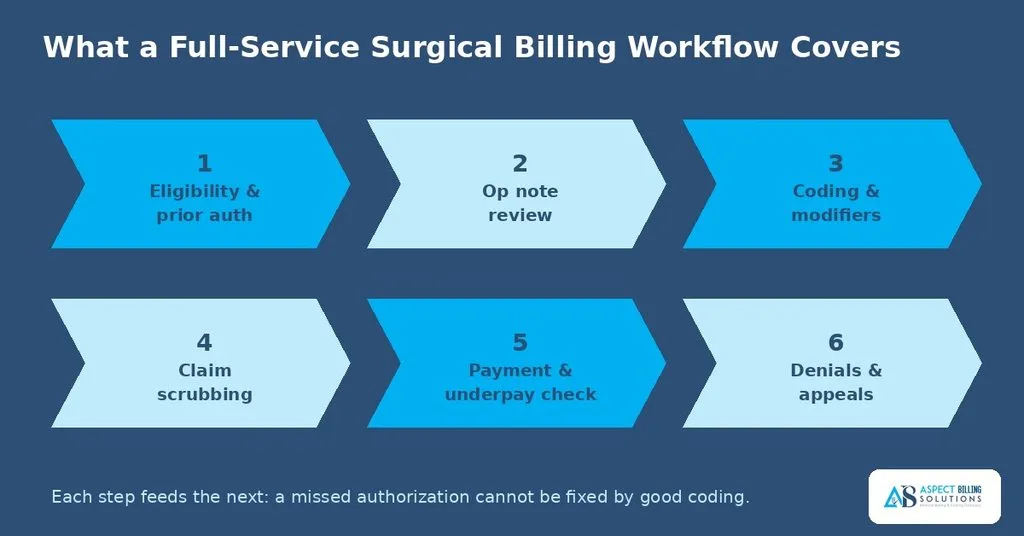
They cover eligibility, prior authorization, operative note coding, modifiers, claim submission, payment review, and appeals. Some also handle credentialing.
How long is the global period for spinal fusion?
Most spinal fusions carry a 90-day global period. It also includes the day before surgery.
How does Medicare pay co-surgeons?
Each co-surgeon receives 62.5% of the fee schedule amount. Both must append modifier 62.
Are add-on codes reduced as multiple procedures?
No. Add-on codes, such as additional spinal levels, are exempt from the 50% reduction.
Does WISeR apply to Medicare Advantage?
No. WISeR applies to traditional Medicare in the six model states, while Medicare Advantage plans use their own authorization rules.
Which states use the WISeR prior authorization model?
Arizona, New Jersey, Ohio, Oklahoma, Texas, and Washington, from January 2026 through December 2031. It applies to traditional Medicare in outpatient, office, home, and ASC settings.
What is a good denial rate for a spine practice?
Five percent or lower is a widely used industry target, not a mandate. Check it by payer, since one plan can hide behind a healthy average.
What is a good clean claim rate for neurosurgery?
Many practices aim for 95% or higher, a common industry benchmark. Complex multi-surgeon cases may run lower at first.
What is a good days in A/R figure for surgical practices?
Under 45 days is a figure widely cited for surgical specialties. Compare against similar practices and your own trend.
Sources and Methodology
(a) Published standards: CMS global surgery, multiple procedure, co-surgery, and assistant-at-surgery payment policies; CMS WISeR model provider fact sheet and Provider and Supplier Operational Guide; Medicare Physician Fee Schedule co-surgeon and assistant-at-surgery indicators; CPT add-on code designations (AMA); FCSO Medicare global surgery guidance.
(c) Practical and illustrative targets: clean claim, denial, and A/R figures are commonly reported ranges; authorization and charge-lag targets are practical; all fees and worked examples are illustrative.
(b, d) Named benchmarking providers and survey data: none used. Actual results vary by practice; figures reflect information available in September 2026.