
2027 CPT Code Changes for Internal Medicine Practices
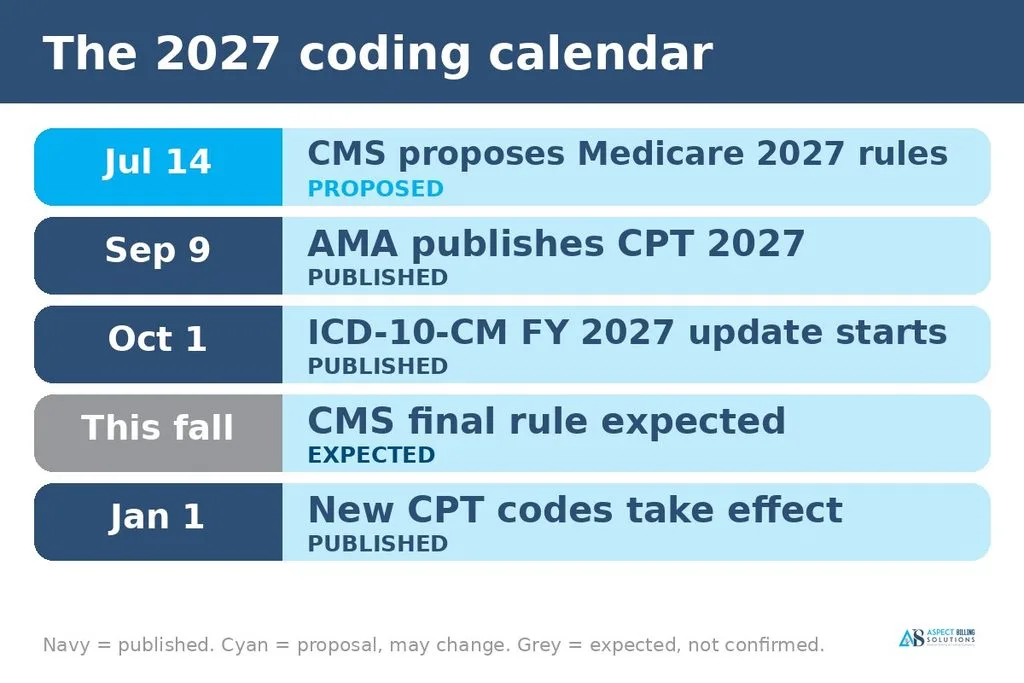
The 2027 CPT code changes for internal medicine practices take effect January 1, 2027. The AMA reports 453 editorial changes [A], but few reach a general office directly: new sleep study codes, AI-related codes, and proposed Medicare payment shifts. Only the AMA figures are final; the CMS items are proposals.
2027 CPT Code Changes for Internal Medicine Practices-A new CPT code set meets real claims every January, and some of those claims bounce. This guide covers what changes for internal medicine and what to fix before go-live. It separates AMA-published changes from CMS proposals still open to revision. Worked examples, a payer-lag plan, and a grouped self-check follow. Read the examples first: they show how each change could reach your monthly cash flow.
Key Numbers at a Glance
Numbers to know for the 2027 code changes
| Metric | Practical Target/Range | Review Frequency | Primary Source |
| CPT 2027 editorial changes | 453: 299 new, 74 revised, 80 deleted | Once, at codebook release | [A] AMA announcement |
| FY 2027 ICD-10-CM update | 190 new, 30 deleted, 4 revised (counts vary by source); starts Oct 1, 2026 | Every October | [G] Trade summaries of CMS files |
| Non-QP conversion factor | $32.84, down 1.68% from $33.40 | Until final rule | [P] CMS proposed rule |
| G2211 replacement | +16% modifier; 32% for eligible ACO clinicians | Until final rule | [P] CMS proposed rule |
| Same-day visit plus global procedure | Lower-paid service at 50% | Until final rule | [P] CMS proposed rule |
| Unattended sleep tiers | 3-4, 5-10, and 11+ channels | At codebook release | [G] AASM summary |
| Test claims before go-live | About 20-30 per major payer | November to December | [D] Illustrative target |
Source labels: [A] = official AMA text; [P] = CMS proposal that may change; [G] = society or trade summary; [D] = illustrative planning target, not a mandate.
What Changes in the CPT Code Set?
The AMA’s headline numbers
The AMA released the CPT 2027 code set on September 9, 2026, and its announcement confirms 453 editorial changes [A]. Most headline updates target other fields, such as maternity care and hernia repair. The key-update list does not name the office visit family, 99202–99215, which is reassuring for evaluation and management billing. Confirm details in the codebook. The changes that reach a general office are narrower, and easy to miss.
Unattended sleep studies: three codes retire, six arrive
Many internists order home sleep apnea testing, and some bill for the device or the interpretation. The AMA lists six new unattended sleep study codes [A]. Per the American Academy of Sleep Medicine, 95800, 95801, and 95806 are deleted [G]. The new codes split technical and professional work and sort studies by channels: three to four is low, five to ten moderate, and eleven or more high. CMS used placeholder numbers, so confirm final codes. Medicare has also used G0398–G0400 for some home tests [G]; ask your MAC how they will map. See our sleep medicine billing guide.
Tiers follow channels and parameter categories, so each report must show both. Record the device, the channels acquired, and who performed setup and interpretation. A note such as “home sleep test done” will not support a tier. Build a short template now and test it on sample studies.
AI-related codes and autonomic testing
AI-related CPT codes describe services where software performs part of the work. Under the AMA’s taxonomy, the software’s role is assistive, augmentative, or autonomous [A]. The announcement adds ten codes but does not list them, so check the codebook before assuming relevance. Earlier AI codes centered on imaging and cardiac analysis [G]. Most internists will not bill one unless they use a specific tool with a matching code; the announcement does not say whether documentation-assist tools qualify. For now, treat AI-related codes as watch-list items, not action items. Separately, CMS’s proposed rule lists six placeholder autonomic testing codes, 95XX4–95XX9, beside 95921–95924 [P]. Practices with tilt tables should confirm the final descriptors.
How ICD-10-CM and CPT changes fit together?
Two code sets change on two dates. The FY 2027 ICD-10-CM update starts October 1, 2026, three months before CPT [G]. Deleted diagnosis codes reject from that date, so refresh your diagnosis pick lists first. CPT tells the payer what you did; ICD-10-CM shows why. We found no source tying the new diagnosis codes to the sleep tiers, which rest on channels, not diagnoses. Keep sleep diagnoses specific, such as G47.33.
To check for deletions, use the 2027 addendum and conversion table on the CMS ICD-10 page. Then run a 12-month diagnosis report and flag every code that is deleted, revised, or now a non-billable header. Counts differ by source: most report 190 new and 30 deleted, while AAPC reports 238 new and 21 removed, likely because some counts include non-billable headers [G]. Trade summaries name the S23.420 sternoclavicular sprain series as a notable deletion, which is unlikely to matter in a general office. We could not confirm other internal medicine deletions, so run the check yourself. Our ICD-10 coding support services can share that work.
Medicare’s 2027 Proposals: Where Payment Could Shift?
CPT tells payers what a service is, while CMS decides what Medicare pays. The CY 2027 Medicare Physician Fee Schedule proposed rule, released July 14, 2026, remains open to change. Comments closed September 14, and final rules typically arrive in the fall. Everything in this section is proposed, not final. Model the impact, but do not rebuild your fee schedule or staffing around it yet.
Conversion factor
CMS proposes a conversion factor of $32.84 for non-qualifying practices, down 1.68% from $33.40 [P]. Qualifying APM participants would see $33.17, down 1.19%. Statutory updates of 0.25% and 0.75% are included, but a one-year 2.5% increase enacted for 2026 expires. That expiry drives the cut.
G2211 becomes a modifier
G2211 is the office visit complexity add-on that CMS finalized in 2021 and implemented for 2025. It recognizes the inherent complexity of ongoing care, which is common in internal medicine. CMS now proposes replacing it with a modifier that raises the E/M payment by 16%, or 32% for eligible ACO clinicians [P]. The uplift would scale with visit level, so accurate E/M leveling matters even more.
Modifier 25 and same-day procedures
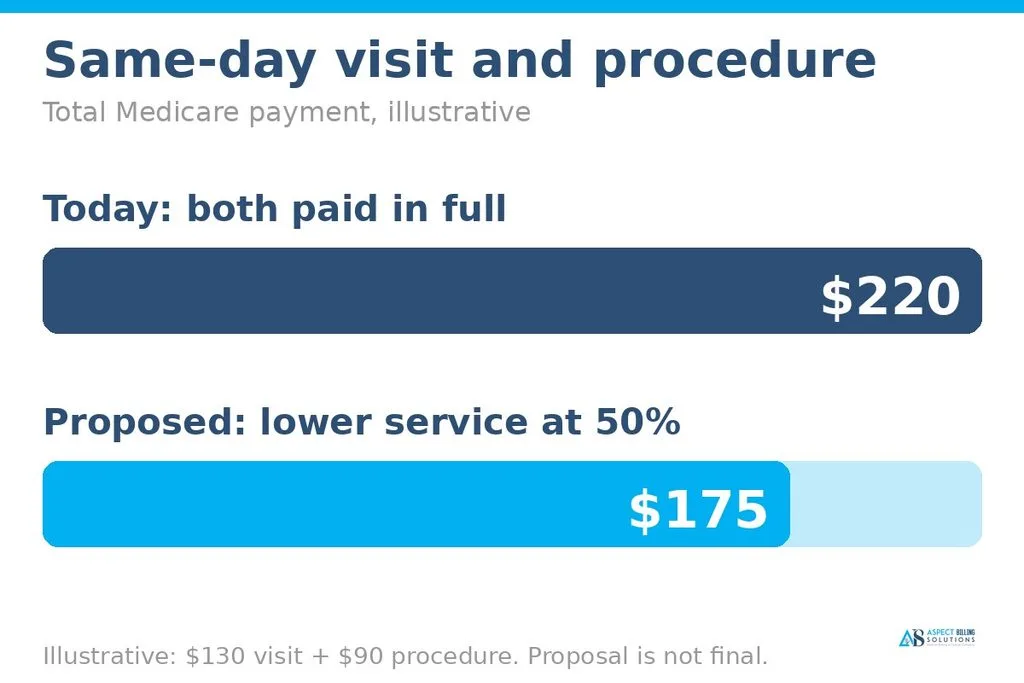
CMS proposes paying a separately identifiable office visit at 50% when the same physician, or a colleague in the practice, bills it with a procedure carrying a zero-, 10-, or 90-day global period [P]. The higher-paid service keeps 100%. Skin biopsies and joint injections are common examples. Why does Holland & Knight expect the heaviest impact elsewhere? CMS’s own impact analysis names otolaryngology, dermatology, and podiatry as hit hardest, because they often pair modifier 25 visits with global procedures. Most other specialties would see a small gain from redistribution. Internists are not exempt, so model your exposure. Our internal medicine modifiers guide covers current use.
Remote monitoring and advance care planning
CMS proposes several remote patient monitoring changes. The table shows what exists today against what would change [P]. The practical impact is largest for practices that rely on an outside monitoring vendor.
Remote monitoring: today versus the CMS proposal
| Element | Today [G] | Proposed [P] |
| Patient status | Generally an established patient, with consent | Established patient required for therapy monitoring |
| Starting the service | No separate visit required | Separately reportable initiating visit |
| Who furnishes it | Contracted staff can be used | Only clinical staff employed by the practice |
| Device supply | 16+ days of data, or 2–15 days (added 2026) | Revalued; devices assumed cheaper |
| Code structure | 19 CPT codes across monitoring families | CMS asks about four HCPCS G-codes |
If you use an outside vendor, the employed-staff rule could end payment for that arrangement. A move to four G-codes would mean rebuilding charge masters and payer contracts. For advance care planning, CMS proposes two staff-time HCPCS codes, leaving 99497 and 99498 for practitioner time. See our remote monitoring guide.
Running the Numbers: Four Worked Examples
All dollar amounts and RVU values are illustrative [D], not fee-schedule rates. Substitute your own remittance data where precision matters.
Example 1: Conversion factor cut
Formula: payment ≈ total RVUs × conversion factor. A 2.00-RVU service pays $66.80 at $33.4009 and $65.68 at the proposed $32.8409, which is $1.12 less. On $400,000 of yearly Medicare revenue, 1.68% is about $6,720.
Example 2: G2211 as a modifier
Formula: uplift = visit amount × 16% (32% for eligible ACOs). A $130 visit earns $20.80 and pays $150.80. A $190 visit earns $30.40. The 32% version adds $41.60 to the $130 visit.
Example 3: Modifier 25 proposal
Formula: total = higher-paid service + 50% × lower-paid service. A $130 visit plus a $90 procedure pays $220 today. Under the proposal it pays $130 + $45 = $175, a $45 gap of about 20%.
Example 4: Sleep study tier
Formula: technical payment ≈ technical RVUs × conversion factor. AASM lists proposed values of 1.71, 1.88, and 4.47 for the low, moderate, and high tiers. At $32.84, that is about $56.16, $61.74, and $146.80. CMS practice-expense changes may shift them.
How a healthy-looking average hides a failing service line?
Illustrative scenario (not an actual client record): a practice sends 1,000 claims in January. Nine hundred are office visits with a 97% clean claim rate, giving 873 clean claims. One hundred are sleep studies billed with retired codes at a 70% clean rate, giving 70. The blended rate is 94.3%, which looks acceptable, yet three in ten sleep claims fail. Split your clean claim rate by service line and payer. Our denial management workflow guide helps trace root causes.
How to Model Your Own Exposure?
- Pull the data. Export 12 months of Medicare remittances by CPT code, units, allowed amount, and date of service.
- Conversion factor. Multiply Medicare fee-schedule revenue by 0.0168, or 0.0119 for qualifying APM clinicians. This ignores RVU shifts.
- Modifier 25. List dates where a modifier 25 visit shares a day with a 0-, 10-, or 90-day global procedure. Exposure = lower-paid allowed amount × 50%, summed. Sixty encounters with a $90 lower-paid service equals $2,700 a year [D].
- No RVU data? Use allowed amounts from your own remittances as the base. The CMS fee schedule files can refine it later.
- Sleep studies. Count 2026 home tests by device and channels to estimate your tier mix.
Run three scenarios: proposal finalized, partly finalized, and dropped. Keep a one-page summary, and refresh it when the final rule appears.
When Payers Lag: Denial Patterns and What to Do?
Federal law requires CPT for electronic transactions, yet payer edits and pricing often lag January 1. Check payer bulletins and fee schedule files, get a written answer from your provider representative, and send a small batch of test claims. If a payer has not loaded a code, ask in writing how to bill until it does. Never bill a deleted code for a 2027 service date. Log every answer, and watch timely filing limits.
Common post-update denial patterns (triggers are commonly reported [G])
| Reason (CARC) | Typical Trigger | Practical Fix |
| CO-181: invalid on date of service | Deleted code left in favorites | Remove retired codes early |
| CO-4: modifier problem | New modifier missing or invalid | Update scrubber rules |
| CO-16: information missing | Report lacks tier details | Update templates |
| CO-197: authorization absent | Approval issued under an old code | Re-verify with the payer |
| CO-50: not medically necessary | Documentation does not support the code | Tighten notes and diagnosis pointers |
Reading the Figures Fairly: Compare Like With Like
A benchmark helps only when the comparison is fair. Compare a payer with itself, and compare the same service line, month, and visit mix. A Medicare proposal says nothing about a commercial contract. One missed target is a signal to investigate, not a verdict. Check coding first, then payer edits, then documentation. Our internal medicine CPT codes guide can anchor that review.
How Long Until Things Settle: A Planning Timeline?
Table 4. General planning ranges [D], not guarantees; your EHR vendor, payer mix, and staffing will change them
| Action | Partial Results | Fuller Results |
| Update code library and charge master | 2–4 weeks | Complete before January 1 |
| Train coders and clinicians on new codes | 2–3 weeks | 4–6 weeks, with feedback |
| Clean claim rate stabilizes after go-live | 30–45 days | 60–90 days |
| Denials on changed codes normalize | About 60 days | 90–120 days |
Quick Recap
- The AMA’s set has 299 new, 74 revised, and 80 deleted codes, effective January 1, 2027 [A].
- ICD-10-CM changes start October 1, 2026, so update diagnosis lists first.
- Conversion factor, G2211, modifier 25, and remote monitoring items are proposals [P].
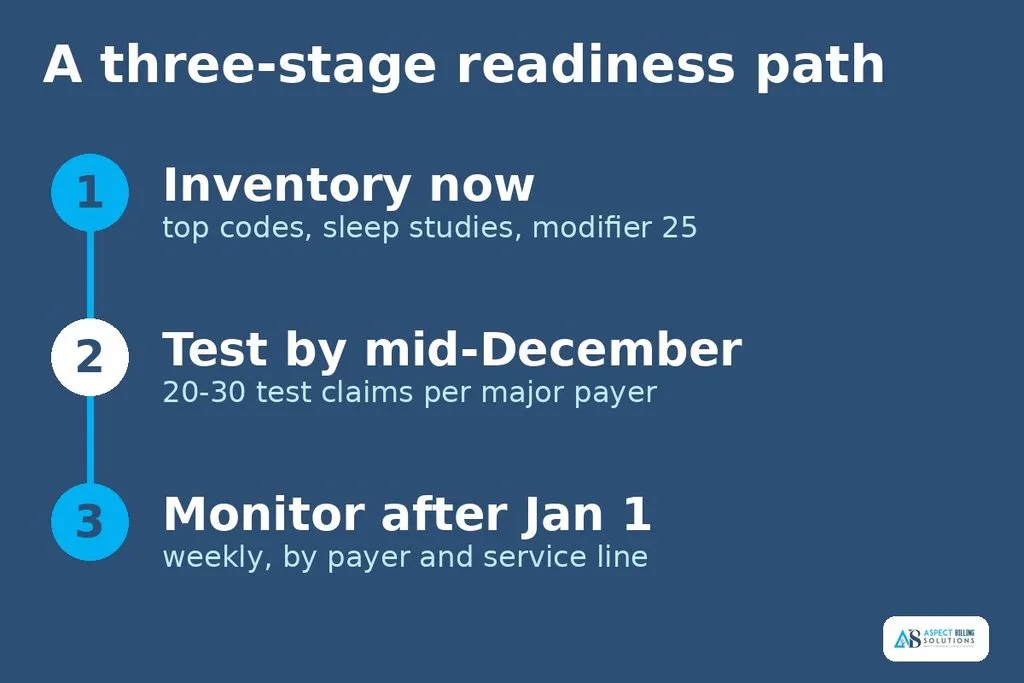
- Model your own exposure, and test 20–30 claims per major payer before go-live [D].
Ready for January 1? A Nine-Question Self-Check
| # | Question (Yes / No) | If you answered No |
| 1 | Have you ordered the 2027 codebook or code data file? | Order it now; final sleep codes appear there. |
| 2 | Has your EHR vendor confirmed 2027 code load dates? | Ask for written dates and a test environment. |
| 3 | Do you know whether you bill 95800, 95801, or 95806? | Run a 12-month report by code. |
| 4 | Do sleep reports document channels and who performed each component? | Draft a template and test five sample studies. |
| 5 | If you bill remote monitoring, do employed staff furnish it after an initiating visit? | Map staffing and visits against the proposal. |
| 6 | Have you modeled modifier 25 exposure at 50%? | Use the steps in the modeling section. |
| 7 | Have you estimated the 1.68% conversion factor change? | Multiply Medicare revenue by 0.0168. |
| 8 | Do you track clean claim rate by service line and payer? | Add both filters to your report. |
| 9 | Have you scheduled test claims with major payers? | Book them for November and December. |
Scoring guide
| Yes answers | What it suggests |
| 8–9 | On track. Keep monitoring the final rule. |
| 5–7 | Gaps exist. Tackle the No items first. |
| 0–4 | Higher risk. Start this week and consider an outside review. |
Final Considerations
Only a few items here are firm published standards: the AMA’s counts, the January 1 effective date, and the ten new AI-related codes [A]. The sleep code numbers, the $32.84 conversion factor, the 16% G2211 modifier, and the 50% same-day rule come from CMS proposals or secondary summaries [P][G]. They may change in the final rule, so treat them as working assumptions.
The dollar examples, the 20–30 test-claim target, and the timeline ranges are illustrative planning aids [D]. Use them to size your effort, then check them against your own data. Start with an inventory of the codes you bill, test claims early, and revisit this guide when CMS publishes its final rule.
Frequently Asked Questions
2027 CPT Code Changes for Internal Medicine Practices
When do the 2027 CPT code changes take effect?
The 2027 CPT code set takes effect on January 1, 2027. Services on or after that date should use the new codes.
Are office visit codes 99202–99215 changing in 2027?
The AMA’s key-update list does not name them. Confirm in the codebook and with payers. CMS proposals affect payment, not descriptors.
What replaces CPT 95800, 95801, and 95806?
Six complexity-tiered unattended sleep study codes, split into technical and professional components. Confirm final numbers in the codebook.
Is the CMS G2211 modifier change final?
No. CMS proposed a 16% modifier in July 2026. For 2026 dates of service, keep billing G2211 as usual.
What if a payer has not loaded the new codes?
Ask in writing how to bill, and never use a deleted code for a 2027 service date. Log the answer and watch filing limits.
What is a good clean claim rate for internal medicine?
Many sources cite 95% or higher as a practical target, though no standards body mandates it. Track it by payer and service line.
What is a good denial rate after a code update?
Industry sources commonly report 5–10% as a typical range, not a mandate. Compare against your own pre-January baseline first.
What is a good lead time for testing new codes?
An illustrative target is loading codes in November and sending 20–30 test claims per major payer by mid-December.
Who is affected by the modifier 25 proposal?
Practices billing an office visit with a 0-, 10-, or 90-day global procedure on the same day. It is proposed, not final.
When Outside Billing Help Starts to Make Sense?
Annual code changes strain small teams. These signals suggest your in-house approach has reached its limit:
- Clean claims dip after each January update, and no one can name the cause.
- Denials on changed codes sit unworked while filing windows tick down.
- You cannot tell whether a payment drop reflects rates, coding, or payer policy.
Look for credentialed coders, a written process for annual code updates, denial tracking by code, and one accountable contact. Ask how the team tests claims before code changes go live, and be cautious of promised collection percentages. Aspect Billing Solutions is one example of this structure. It provides HIPAA-compliant US medical billing and coding (ICD-10, CPT, HCPCS). Services include claim and denial management, eligibility verification, prior authorization, accounts receivable, and credentialing. Each provider works with a dedicated agent, so one person can track how your payers handle each January update. Results vary by practice. Explore its revenue cycle management services.
Where These Figures Come From?
- (a) Published standards [A]: the AMA’s CPT 2027 announcement of September 9, 2026. Confirm final codes in the official codebook.
- Proposed material [P]: the CMS CY 2027 proposed rule and fact sheet (CMS-1848-P, 91 FR 43842, published July 16, 2026).
- Society and trade summaries [G]: the AASM summary; Holland & Knight’s July 2026 analysis; trade reports on the ICD-10-CM files; secondary remote-monitoring guides.
- (b) Named benchmarking data providers: none used.
- (c) Illustrative targets [D]: test-claim sample, timeline ranges, clean claim and denial ranges, and every dollar example.
- (d) Survey data: none used.
Research flags: final sleep code numbers and every CMS figure were unconfirmed as of September 20, 2026. Results vary by practice and situation.