
2027 CPT Code Changes Neurology Billing Guide
2027 CPT code changes neurology billing teams face begin January 1, 2027. Three areas touch neurology most: six new unattended sleep study codes, autonomic testing codes that CMS lists as new, and Medicare proposals that include a review of vagus nerve stimulator programming values. Only the AMA’s counts and effective date are final; the payment items are proposals.
Neurology practices rarely get a quiet January. 2027 CPT code changes neurology billing-This year, new codes and a proposed Medicare pay cut arrive together. This guide starts with a neurology watch list, then covers sleep codes, the same-day visit proposal, payment changes, and payer lag. It separates published facts from proposals. Near the end you will find four worked examples and a grouped self-assessment. Keep your top twenty billed codes open as you read, because small mismatches with the new code set are where January denials begin.
The Numbers at a Glance
2027 CPT code changes neurology billing
2027 CPT code changes neurology billing–Key numbers for neurology practices
| Metric | Practical Target/Range | Review Frequency | Primary Source |
| CPT 2027 code set | 299 new, 74 revised, 80 deleted; effective Jan 1, 2027 | Before go-live | [A] AMA |
| Unattended sleep codes | 3 legacy codes become 6 (3 technical, 3 professional) | At codebook release | [A] AMA; [G] AASM |
| Autonomic testing | 6 placeholder codes (95XX4–95XX9) listed | At final rule | [P] CMS proposed rule |
| VNS programming (95970, 95976, 95977) | Valuation review requested | At final rule | [P] CMS; [G] AASM |
| Medicare conversion factor | $32.84 standard; $33.17 qualifying APM | At final rule | [P] CMS proposed rule |
| Same-day E/M with global procedure | Higher-paid 100%, other 50% (0-, 10-, 90-day globals) | At final rule | [P] CMS proposed rule |
| FY 2027 ICD-10-CM | 190 new, 30 deleted, 4 revised; starts Oct 1, 2026 | Every October | [G] Trade summaries of CMS files |
| New-code first-pass acceptance | At or above your own baseline; weekly for 60 days | Weekly | [D] Illustrative target |
Source labels: [A] = official AMA text; [P] = CMS proposal that may change; [G] = society or trade summary; [D] = illustrative planning target, not a mandate.
The Neurology Watch List
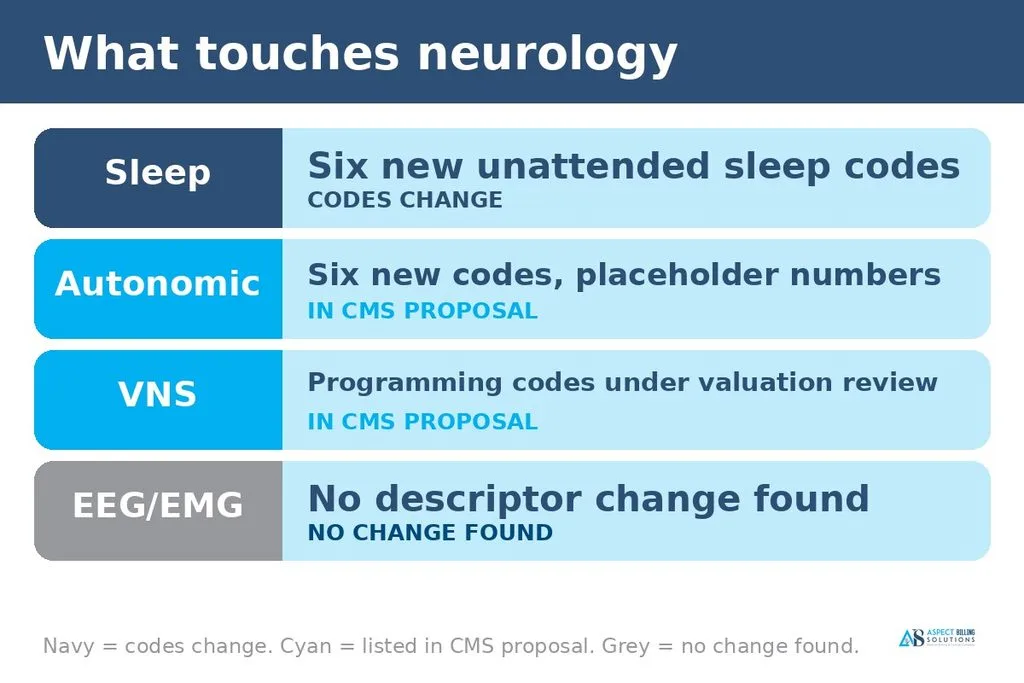
The AMA released the CPT 2027 set on September 9, 2026, with 453 editorial changes [A]. Most headline areas sit outside neurology, but its announcement names sleep medicine, radiology, and biofeedback. Because 80 codes are deleted, an old code left in an EHR favorites list can trigger a rejection. The table sorts what we found by status.
Neurology-relevant items and their status
| Area | What Is Changing | Status |
| Unattended sleep studies | 95800, 95801, 95806 deleted; six tiered codes | Published [A]; descriptors via [G] |
| Autonomic function testing | Existing 95921–95924 plus six placeholder codes in the CMS list | Proposal [P]; confirm in codebook |
| Cranial nerve neurostimulator analysis | 95970, 95976, 95977 nominated as potentially misvalued | Proposal [P] |
| Nerve blocks 64400, 64405 | Valuation review; CMS proposes work RVUs of 0.73 and 0.84 | Proposal [P] |
| Head and neck MRA | New table, plus new and revised codes | Published [A] |
| Biofeedback | New time-based code structure | Published [A] |
| EEG, EMG, nerve conduction | No descriptor change found | Not in AMA key list or CMS code list |
What we did not find matters as much. Neither the AMA’s key-update list nor the proposed rule’s code list names EEG, EMG, or nerve conduction descriptor changes. Their payment would still move with the conversion factor and practice expense changes below. Our guide to EEG and EMG coding covers today’s workflow.
Sleep Codes for Neurologists: Tiers, Documentation, and a Crosswalk
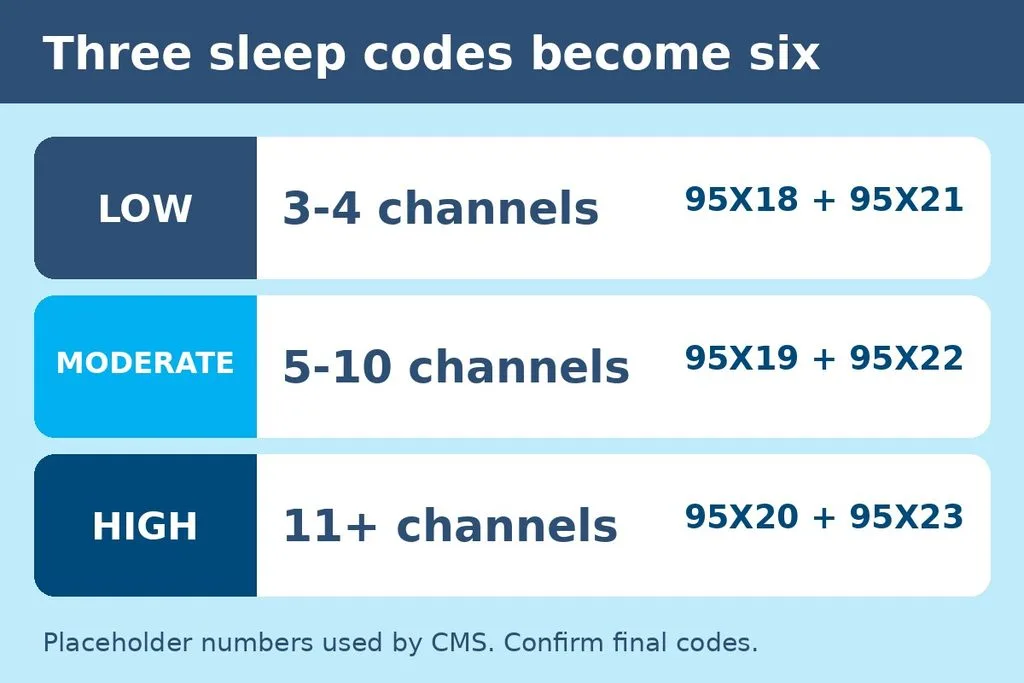
Sleep testing is the clearest neurology-facing change. The American Academy of Sleep Medicine reports that six new codes replace 95800, 95801, and 95806 [G]. Proposed descriptors sort each study into low, moderate, or high complexity by channels and parameter categories. For practices running home sleep apnea testing, this changes how a study is billed and what the report must show. CMS proposes committee-recommended values for five codes and a lower value for the sixth [P]. None is final. See our sleep medicine billing guide.
Proposed sleep study tiers (placeholder numbers; values as listed by AASM, RUC / CMS)
| Tier | Channels; Parameter Categories | Technical | Professional |
| Low | 3–4; at least 3–5 | 95X18: 1.71 / 1.71 | 95X21: 0.81 / 0.81 |
| Moderate | 5–10; at least 6–8 | 95X19: 1.88 / 1.88 | 95X22: 1.05 / 1.05 |
| High | 11 or more; at least 9 | 95X20: 4.47 / 4.47 | 95X23: 1.60 / 1.42 |
Source: AASM summary of the CMS proposed rule [G]. The summary does not say whether values are work or total RVUs, and CMS practice-expense changes may shift them. Confirm final codes in the CPT 2027 codebook.
Documentation now decides the tier. Reports should state the channels recorded and the parameter categories reported. Update templates now, and train physicians and technologists together. Medicare has also used G0398–G0400 for some home tests [G], so ask your MAC how the new codes will map.
Worked Example 1: A sleep crosswalk
Formula: claim lines = studies × components billed. Illustrative scenario (not an actual client record): a practice bills 40 home tests a month globally today, so 40 lines. Under the six-code structure, owning both components means 80 lines: 40 technical and 40 professional. Suppose the mix is 25 low, 10 moderate, and 5 high. Using the listed values at $32.84 [D], the studies total about $3,998 a month.
| OPERATIONAL CHANGE: CLAIM LINES DOUBLE If your practice owns both components, each study becomes two claim lines. Your charge master, scrubber, and payer edits must accept a technical line and a professional line for every study, or half of each claim may reject. |
Same-Day Visits and Procedures: Which Neurology Codes Carry a Global Period?
CMS proposes cutting payment when the same physician, or a colleague in the practice, bills a separately identifiable office visit on the same day as a procedure with a 0-, 10-, or 90-day global period [P]. The higher-paid service gets 100%; the other gets 50%. Scope matters. Trigger point injections 20552 and 20553 carry a zero-day global [G], so a visit billed with modifier 25 on those days would be in scope. Diagnostic tests such as EEG, EMG, and nerve conduction typically carry an XXX indicator, meaning no global period applies [G]. Check each code, including chemodenervation and nerve blocks, in the Medicare fee schedule file. Our neurology modifier guide explains current use.
CMS’s impact analysis expects the largest hit on otolaryngology, dermatology, and podiatry [P]. The AAN reports that CMS projects no change in total payments to neurology overall, before the expiring 2026 increase [G]. That is a specialty average, not your practice.
Worked Example 2: Same-day visit and procedure
Formula: total payment = higher-paid service × 100% + other service × 50%. Illustrative scenario (not an actual client record): a visit allowed at $130 and a zero-day-global injection allowed at $80 [D]. Today: $130 + $80 = $210. Proposed: $130 + ($80 × 50%) = $170. The encounter loses $40, about 19%, and only if CMS finalizes the policy.
Global indicators to check before you model the same-day proposal
| Code Family | Global Indicator | What We Could Confirm |
| Trigger point injections 20552, 20553 | 000 (zero-day) | Confirmed [G]; in scope if billed with a visit |
| EEG, EMG, nerve conduction, evoked potentials | Typically XXX (no global) | General rule for diagnostic tests [G]; verify each code |
| New sleep study codes | Not yet posted | Look up once CMS publishes values |
| Chemodenervation 64612, 64615 | Not confirmed in our sources | Look up in the fee schedule file |
| Nerve blocks 64400, 64405 | Not confirmed in our sources | Look up in the fee schedule file |
| VNS analysis and programming 95970, 95976, 95977 | Not confirmed in our sources | Look up in the fee schedule file |
Only 0-, 10-, and 90-day indicators fall under the proposal; XXX means the global concept does not apply. Definitions: CMS status indicators.
Medicare’s 2027 Payment Proposals for Neurology
Conversion factor and practice expense
In its CY 2027 proposed rule, CMS proposes a conversion factor of $32.84 for most clinicians, down 1.68% from $33.40 [P]. Qualifying APM participants would see $33.17, down 1.19%. The main driver is the expiry of a one-year 2.5% increase from 2026. CMS also proposes removing a 2007-era practice expense step and capping yearly PE RVU changes at 5% [P]. It says the current method inadvertently favors services with technical and professional components, typically diagnostics, and proposes one method for most services [P]. Effects on your EEG, EMG, and nerve conduction lines are not quantified in what we reviewed. The rule also discusses the 2.5% efficiency adjustment for non-time-based services [G].
Worked Example 3: Conversion factor impact
Formula: Medicare payment = total RVUs × conversion factor (geographic adjustment ignored). Illustrative scenario (not an actual client record): a service carries 3.00 total RVUs. At $33.40, payment is $100.20. At $32.84, it is $98.52. The gap is $1.68, or 1.68%. Over 2,000 Medicare services a year, that is $3,360 [D].
G2211, VNS programming, and telehealth
G2211 is the office visit complexity add-on implemented in 2025 for ongoing care. CMS proposes replacing it with a modifier that raises the E/M payment by 16%, or 32% for eligible ACO clinicians [P]. On telehealth, the proposal implements a 2026 law that keeps the in-person requirement for Medicare behavioral health telehealth suspended through December 31, 2027 [P]. We found no neurology-specific telehealth code change.
VNS programming codes under review
An outside party nominated 95970, 95976, and 95977, the cranial nerve neurostimulator analysis and programming codes, as potentially misvalued [G]. That flag means a code may be paid too high or too low compared with similar services. It is not a finding. The nominator compared them with three phrenic nerve stimulator codes and raised equipment differences, so we cannot tell whether values would rise or fall. CMS only asks for comment on the valuation, and comments closed September 14. Epilepsy practices should not change coding now. Simple programming (1–3 parameters) is 95976 and complex programming (more than 3) is 95977 [G]. Pull 2026 volume and payment for all three codes, so you can measure any change after the final rule.
ICD-10-CM and CPT: Two Code Sets, Two Start Dates
The FY 2027 ICD-10-CM update, with 190 new, 30 deleted, and 4 revised codes, starts October 1, 2026, three months before CPT [G]. Deleted diagnosis codes reject from that date, so refresh your pick lists first. We found no source linking the new diagnosis codes to the sleep tiers, which rest on channels, not diagnoses. Keep diagnoses as specific as documentation allows, and review your top 25 diagnoses beside your top 20 procedures. Our ICD-10 coding support can share that work.
AI-Related Codes: Do They Reach Neurology?
The AMA added ten AI-related codes, bringing the total to 43 [A]. They describe services where software does part of the work, classed as assistive, augmentative, or autonomous. The announcement does not list them. Earlier AI codes centered on imaging and cardiac analysis [G], so imaging or signal-analysis tools are plausible candidates. We could not confirm that any of the ten applies to EEG or neuroimaging. Check the codebook before billing one. For now, treat AI-related codes as watch-list items, not action items.
If a Payer Has Not Loaded the New Codes
Federal rules require CPT for electronic transactions, yet payer edits and pricing often lag January 1. Check payer bulletins and fee schedule files, get a written answer from your provider representative, and send a small batch of test claims. If a payer has not loaded a code, ask in writing how to bill until it does. Never bill a deleted code for a 2027 service date. Log every answer, and watch timely filing limits.
Common post-update denial patterns (triggers are commonly reported [G])
| Reason (CARC) | Typical Trigger | Practical Fix |
| CO-181: invalid on date of service | Deleted code left in favorites | Remove retired codes early |
| CO-4: modifier problem | New modifier missing or invalid | Update scrubber rules |
| CO-16: information missing | Sleep report lacks channel details | Update templates |
| CO-197: authorization absent | Approval issued under an old code | Re-verify with the payer |
| CO-50: not medically necessary | Notes or diagnosis do not support the study | Tighten documentation |
Modeling Your Own Financial Impact
- Pull the data. Export 12 months of Medicare remittances by CPT code, units, allowed amount, and date of service.
- Conversion factor. Multiply Medicare fee-schedule revenue by 0.0168, or 0.0119 for qualifying APM clinicians.
- Same-day visits. List dates where a modifier 25 visit shares a day with a 0-, 10-, or 90-day global code. Exposure = lower-paid allowed amount × 50%, summed.
- No RVU data? Use allowed amounts from your own remittances as the base, and refine with the CMS fee schedule files later.
- Sleep and diagnostics. Count home tests by device and channels for tier mix, and flag EEG, EMG, and nerve conduction volume for practice expense changes.
Run three scenarios: proposal finalized, partly finalized, and dropped. Refresh the summary when the final rule appears.
Building Your January Readiness Plan
Step 1: Crosswalk every active code
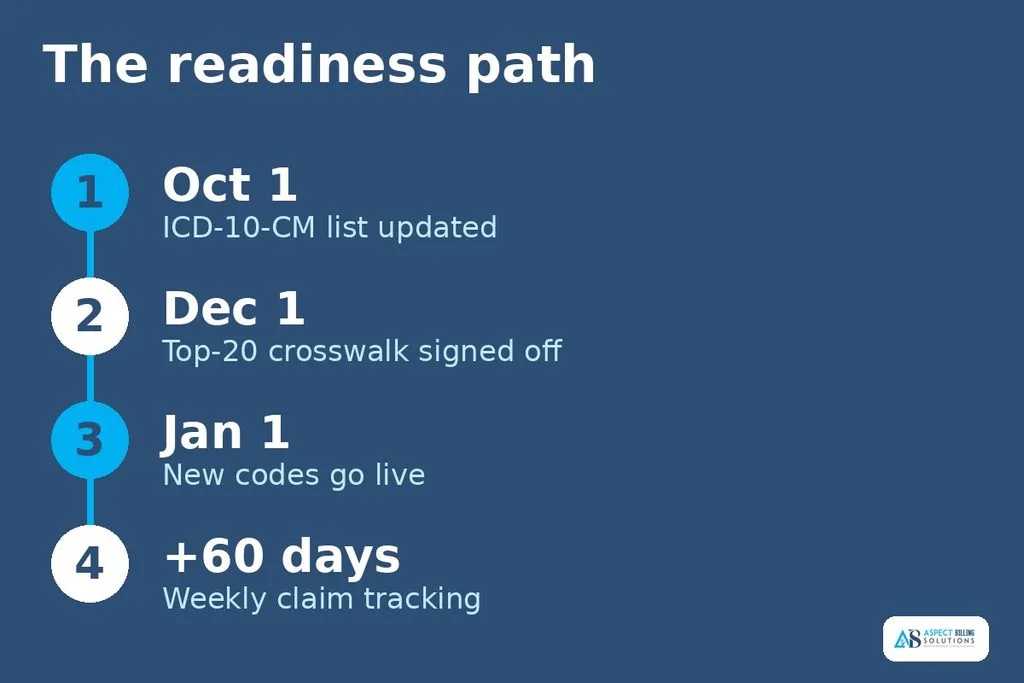
Start with your top twenty CPT codes by volume and revenue. Match each against the new code set, then check your charge master, EHR favorites, and superbills for retired codes. Give special attention to sleep testing, autonomic testing, imaging orders, and biofeedback. Assign one named person to sign off on each line, and aim to finish by December 1 [D].
Step 2: Fix documentation before claims
Confirm that prior authorization requests and eligibility notes list the correct code once payers publish crosswalks. Our prior authorization and eligibility work shows how a dedicated team can own that step.
Step 3: Watch the first 60 days
Track first-pass acceptance weekly, and separate new-code claims from everything else. Rejection reasons by payer often reveal a pattern within two weeks. Common culprits are stale code tables, missing modifiers, and mismatched diagnosis pointers. Our denial management and appeals service can absorb overflow.
Worked Example 4: How a blended average hides a problem
Formula: first-pass acceptance = claims accepted on first submission ÷ total submitted × 100. Illustrative scenario (not an actual client record): 1,000 claims in one month. 900 non-sleep claims at 96% gives 864 accepted. 100 new-code sleep claims at 70% gives 70. Blended: 934 ÷ 1,000 = 93.4%, which looks close to healthy, yet 30 sleep claims failed [D].
Reading Benchmarks Like for Like
Every figure here is useful only when compared fairly. A multi-specialty group’s first-pass rate means little for a small neurology practice. Compare the same payer mix, volume, services, and period. Your own pre-2027 baseline is usually the most honest benchmark. One missed target is a signal to investigate, not a verdict.
How Long Readiness Typically Takes?
General planning ranges [D], not a guarantee for any practice
| Action | Partial Results | Fuller Results |
| Code crosswalk and EHR table updates | 2 to 4 weeks | 6 to 8 weeks |
| Documentation templates and training | 4 to 6 weeks | 8 to 12 weeks |
| Stable first-pass acceptance on new codes | About 30 days after go-live | 90 to 120 days |
Quick Summary
- Six unattended sleep codes replace three, effective January 1, 2027 [A].
- CMS lists new autonomic codes and a VNS programming review; EEG, EMG, and nerve conduction descriptors show no change [P].
- The $32.84 conversion factor and 50% same-day rule are proposals, not final [P].
- Review your top twenty codes by December 1, and track new-code claims for 60 days [D].
Self-Assessment: Ten Questions in Four Groups
| Group | Question (Yes / No) | If you answered No |
| Code inventory | 1. Have you listed your top twenty CPT codes? | Run the 12-month report. |
| Code inventory | 2. Have you compared each with the CPT 2027 set? | Assign an owner per line. |
| Code inventory | 3. Are deleted codes removed from your charge master and EHR favorites? | Search for 95800, 95801, 95806. |
| Documentation | 4. Do you know each sleep device’s likely complexity tier? | List devices by channel count. |
| Documentation | 5. Have physicians reviewed updated report templates? | Schedule a joint review. |
| Money | 6. Have you modeled Medicare revenue at $32.84 versus $33.40? | Multiply revenue by 0.0168. |
| Money | 7. Do you know how often visits and global procedures share a day? | Pull the same-day report. |
| Monitoring | 8. Do you track first-pass acceptance by payer and code group? | Add both filters. |
| Monitoring | 9. Does a named person own the final rule and payer updates? | Name an owner this week. |
| Monitoring | 10. Do you have an appeals plan for new-code rejections? | Draft one before January. |
Scoring guide
| Yes answers | What it suggests |
| 8 to 10 | On track. Keep monitoring the final rule. |
| 5 to 7 | Some gaps. Prioritize crosswalk and documentation. |
| 0 to 4 | Start now. Consider a structured plan or outside support. |
Final Considerations
The changes neurology must handle are real, but most are narrow. Six sleep codes, autonomic and imaging updates, and 80 deletions call for review, not panic. The firm numbers are the AMA’s counts and the January 1 date [A]. The sleep descriptors, conversion factors, same-day rule, and VNS review are proposals or society summaries [P][G].
The dollar examples, top-twenty review, 60-day window, and timeline ranges are illustrative planning tools [D]. Replace them with your own data. The goal is simple: enter January knowing what changed, who owns it, and how you will spot trouble.
Frequently Asked Questions
2027 CPT code changes neurology billing
When do the 2027 CPT code changes take effect?
The AMA says the CPT 2027 code set takes effect January 1, 2027. Medicare payment values await the CMS final rule.
Which neurology codes are being replaced?
The AASM reports that 95800, 95801, and 95806 are replaced by six sleep study codes. Check the codebook for others.
Do EEG, EMG, or nerve conduction codes change?
We found no descriptor changes in the AMA’s key-update list or the proposed rule’s code list. Confirm in the codebook.
Will Medicare pay 50% for visits on procedure days in 2027?
Only if CMS finalizes its proposal, and only for 0-, 10-, or 90-day global procedures. Many diagnostic tests carry no global period.
What if a payer has not loaded the new codes?
Ask in writing how to bill, never use a deleted code for a 2027 service date, and log the answer.
What is a good first-pass acceptance rate for neurology claims?
No standards body mandates one number. Compare against your own baseline and payer mix.
What is a good denial rate for a neurology practice?
Sources commonly cite under roughly ten percent as a practical ceiling, but no body mandates it. Track by payer and code group.
What is a good timeline to update my charge master before January?
An illustrative target is finishing the crosswalk by early December, leaving time to test claims.
When to Consider Professional Support?
- Your team learned about a deleted or revised code from a rejection, not from a plan.
- Denials tied to changed codes sit unworked for several weeks.
- Nobody owns payer updates, fee schedule changes, and charge master upkeep.
For neurology, look for coders who understand sleep, EEG, and EMG workflows, a named contact, and reporting by code and payer. Ask how a vendor tracks payer changes and handles appeals, and be cautious of promised outcomes. Aspect Billing Solutions is one example of this structure. It provides HIPAA-compliant US medical billing and coding (ICD-10, CPT, HCPCS). Services include claim and denial management, eligibility verification, prior authorization, accounts receivable, and credentialing. Each provider is assigned a dedicated agent, so one person can follow how your payers load each update. Results vary by practice and situation. Its revenue cycle management services connect billing, coding, and compliance end to end. See also our neurology CPT code guide.
Sources and Methodology
- Published standards [A]: the AMA’s CPT 2027 announcement of September 9, 2026.
- Proposed material [P]: the CMS CY 2027 Physician Fee Schedule proposed rule and fact sheet (CMS-1848-P, 91 FR 43842, published July 16, 2026).
- Society and trade summaries [G]: the AASM summary; AAN commentary; trade reports on the ICD-10-CM files; coding references for global period indicators.
- Illustrative targets [D]: all dollar examples, timelines, and review dates.
- Named benchmarking data providers and survey data: none used.
Research flags: final sleep and autonomic code numbers and all CMS figures were unconfirmed as of September 20, 2026. Results vary by practice and situation.