
Stroke Care Billing and Coding for Neurologists (2026)
Quick answer: Stroke care billing and coding for neurologists means matching each stroke encounter to the correct ICD-10-CM cerebrovascular code, the right E/M, critical care, or telehealth CPT code, and any required modifier. Accuracy depends on documenting stroke type, vessel, laterality, NIHSS score, and total time. A 95% clean claim rate is a commonly cited practical target, not a regulatory requirement.
Stroke encounters are urgent and heavily documented, so they are easy to mis-code. One vague diagnosis or miscounted minute can trigger a denial. This guide to stroke care billing and coding for neurologists shows which ICD-10-CM cerebrovascular codes fit each phase of care, how Medicare counts critical care time, and how telestroke billing works. It also covers key revenue cycle metrics, with worked examples, and ends with a self-assessment checklist.
Stroke Billing Benchmarks at a Glance
Every key number in this guide, with its source type:
| Metric | Practical Target/Range | Review Frequency | Primary Source |
| 99291 critical care time | 30–74 minutes per date | Per claim | CPT (AMA) descriptor |
| First Medicare 99292 unit | 104 total minutes | Per claim | CMS published rule |
| NIHSS score codes | R29.700–R29.742 (score 0–42) | Per acute encounter | ICD-10-CM code set |
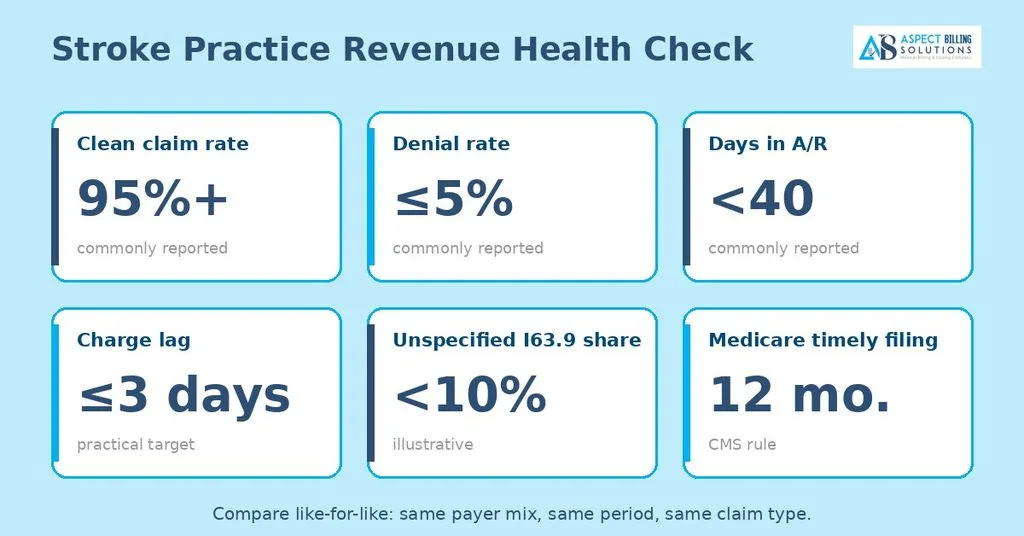
| Medicare timely filing | 12 months from service date | Monthly | CMS published rule |
| Clean claim rate | 95% or higher | Monthly | Commonly reported range |
| Denial rate | 5% or lower | Monthly | Commonly reported range |
| Days in A/R | Under 40 days | Monthly | Commonly reported range |
| Charge lag | 3 days or fewer | Weekly | Practical target |
| Unspecified I63.9 share | Under 10% | Quarterly | Illustrative target |
Table 1. “CPT (AMA)” and “CMS published rule” are official. “Commonly reported range” is widely cited, not mandated. “Practical” and “Illustrative” targets are working goals to verify locally.
Choosing the Right Cerebrovascular Diagnosis Code
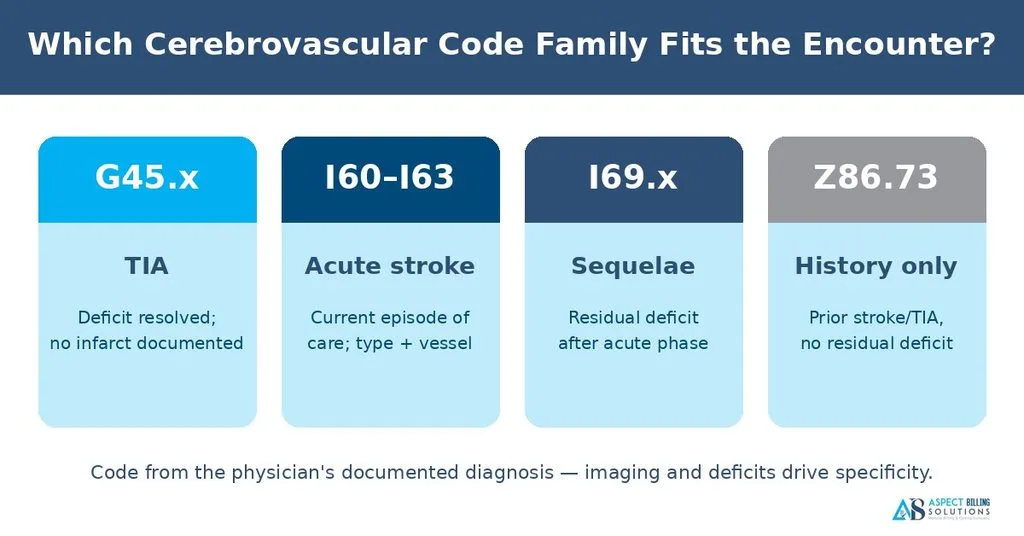
Stroke diagnosis coding follows the phase of care. During the acute episode, I60–I62 describe hemorrhagic stroke and I63 describes cerebral infarction. After the acute phase, residual deficits move to stroke sequelae codes in category I69, while Z86.73 covers history without deficits. TIA uses G45.9 when no infarction is documented. The most frequent error is carrying I63 into office follow-ups, where I69 usually belongs. Our guide to common ICD-10 coding errors covers related pitfalls.
Reporting the NIHSS Score
The NIHSS score has its own range, R29.700 through R29.742, one code per point. It is always secondary, never principal. Other clinicians may document the score, but the stroke diagnosis must come from the provider. Report at least the initial score, sequenced after the stroke code, to support medical necessity for higher-level care.
Documentation Details That Unlock Specificity
A specific I63 code needs the mechanism, such as thrombosis or embolism, plus the vessel and side affected. Notes that only say “CVA” push coders toward I63.9, which invites payer scrutiny. Strong clinical documentation names the artery, laterality, and known cause, such as atrial fibrillation. For I69, record the exact deficit and side.
Worked example — unspecified code rate. Formula: I63.9 claims ÷ total I63 claims × 100. Illustrative scenario (not an actual client record): 18 of 120 quarterly claims carry I63.9, so the rate is 15%. Against an illustrative target under 10%, that signals a documentation education need.
Coding Hospital, Critical Care, and Telestroke Encounters
Inpatient and Observation Visits
Since 2023, hospital inpatient and observation visits share one family of inpatient E/M codes: 99221–99223 initial and 99231–99233 subsequent, leveled by decision making or time. The American Academy of Neurology’s documentation guide notes that Medicare, many Medicaid programs, and most commercial payers do not pay consultation codes. Medicare stroke consults are billed as initial hospital visits. Office-side codes appear in our neurology CPT codes guide.
Critical Care and the 104-Minute Medicare Rule
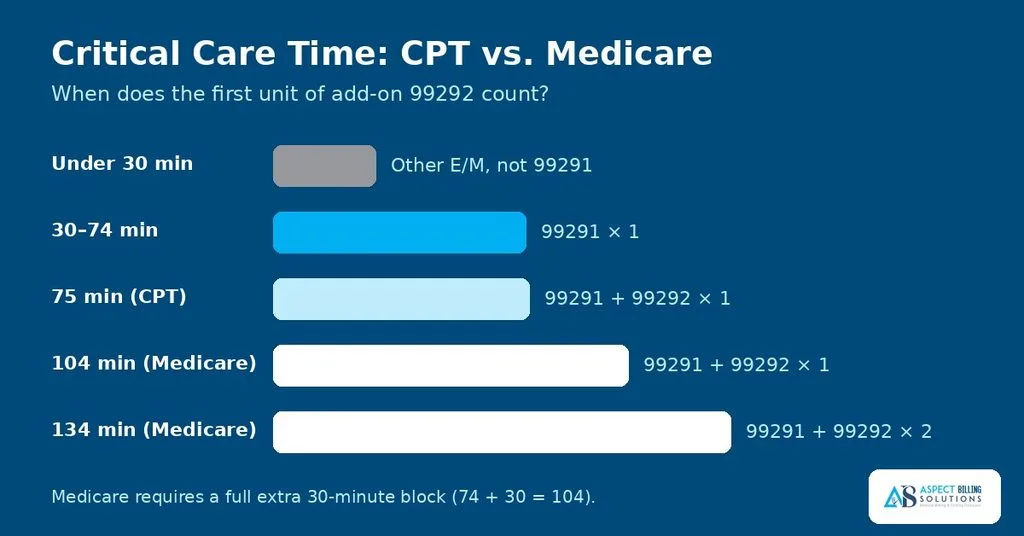
Acute stroke patients often meet the critical care definition: high-complexity decisions to prevent life-threatening deterioration. CPT 99291 covers the first 30–74 minutes on a date of service, and add-on 99292 each further 30 minutes. CPT allows the first 99292 unit at 75 minutes, but CMS requires 104 total minutes for Medicare. Exclude time on separately billable procedures, and document why the care was critical.
Worked example — Medicare critical care units. Formula: 99292 units = full 30-minute blocks after minute 74. At 110 minutes, 110 − 74 = 36, one full block, so bill 99291 × 1 plus 99292 × 1. At 95 minutes, Medicare allows 99291 only, though a CPT-timing payer may accept one 99292 unit.
Telestroke and Modifier G0
The Bipartisan Budget Act of 2018 removed Medicare’s geographic and site-type limits for acute stroke telehealth. CMS guidance (MLN MM11043) directs billers to append modifier G0 to distant site codes with POS 02 and to originating site fee Q3014. G0 is informational and does not raise payment, but without it a claim may be processed under standard telehealth rules and deny. See our telehealth billing guide for other modifiers.
Illustrative scenario (not an actual client record): a telestroke group finds modifier G0 dropped from a charge template after an EHR update, and urban Medicare claims deny. Restoring it fixes new claims; recent denials are resubmitted. If stroke denials outpace your team, our denial management and appeals service can work that backlog.
Tracking the Revenue Numbers Behind Stroke Claims
Coding accuracy shows up in a few key performance indicators. Definitions follow common revenue cycle usage, and targets are commonly reported ranges, not standards-body mandates. Our revenue cycle dashboard guide covers the wider set.
- Denial rate: denied claims ÷ claims submitted × 100. With 33 denials on 620 claims, the rate is 5.3%.
- Clean claim rate: claims paid on first submission ÷ claims submitted × 100. With 571 of 620 paid first pass, the rate is 92.1%.
- Days in accounts receivable: A/R balance ÷ average daily charges. $186,000 ÷ ($486,000 ÷ 90 days) = 34.4 days.
| Payer group | Claims | Denials | Denial rate |
| Traditional Medicare | 400 | 12 | 3.0% |
| Commercial | 160 | 8 | 5.0% |
| Medicare Advantage | 60 | 13 | 21.7% |
| Blended | 620 | 33 | 5.3% |
Table 2. Illustrative payer split, not from a named source. Actual figures vary; verify against your own payer data.
The blended 5.3% looks close to the commonly reported 5% target. Yet more than one in five Medicare Advantage claims is denied, often from prior authorization or plan edits. Always split denial rate by payer. If documentation is the root cause, ICD-10 coding support can review charts before submission.
Reading Stroke Benchmarks the Right Way
A benchmark helps only when the comparison is fair. Compare against practices of similar size, payer mix, and reporting period. Compare critical care, telestroke, and office claims separately. One missed benchmark is a signal to investigate, not a verdict. Watch the trend over three or more months before changing staff or vendors.
Realistic Timelines for Seeing Results
| Fix | Early signs | Fuller results |
| Restore G0 on telestroke templates | Next billing cycle | 60–90 days |
| Critical care time template | 30–60 days | 90–120 days |
| I63 vs. I69 documentation education | 30–60 days | 3–6 months |
| Denial backlog rework | About 30 days | 90–120 days |
Table 3. General planning ranges only, not a guarantee for any specific practice.
Stroke Care Billing and Coding for Neurologists: Recap
- I60–I63 for the acute episode, I69 for residual deficits, Z86.73 for history only.
- NIHSS goes on R29.700–R29.742 as a secondary code.
- Medicare pays the first 99292 unit at 104 minutes, a published CMS rule.
- Medicare acute stroke telehealth claims need modifier G0.
- 95% clean claims, 5% denials, and under 40 A/R days are commonly reported targets, not mandates.
Score Your Stroke Billing Process
Answer yes or no, then count your yes answers.
- Do post-discharge visits use I69 or Z86.73 instead of I63?
- Is the initial NIHSS score coded on acute encounters?
- Is your I63.9 share under 10%?
- Do Medicare claims add 99292 only at 104 minutes or more?
- Does every critical care note record total time and the critical condition?
- Do Medicare telestroke claims carry modifier G0?
- Is your clean claim rate 95% or higher?
- Is your denial rate 5% or lower for every payer group?
- Are days in A/R under 40 and charge lag three days or fewer?
Scoring: 8–9 yes = strong process. 5–7 = specific gaps to fix this quarter. 0–4 = a structured workflow review is overdue.
Signs It Is Time for Outside Billing Help
Watch for these signs. Denials return for the same reason after retraining. Critical care time is missing from notes, or 99292 units are guessed. Telestroke claims deny and nobody can explain why. A/R keeps climbing while staff work overtime. Good outside support for stroke care billing and coding for neurologists offers certified neurology coders, pre-submission chart review, payer-level reporting, and clear ownership of denials. Aspect Billing Solutions follows that structure, assigning a dedicated agent to each provider across end-to-end revenue cycle management, covering coding, billing, credentialing, denial management, and HIPAA compliance. Results vary by practice and situation.
Final Considerations
Stroke care billing and coding for neurologists rewards precision. The right code family, a documented NIHSS score, accurate critical care time, and modifier G0 prevent most avoidable stroke denials. Tracking denials by payer catches what averages hide.
Keep source types straight. ICD-10-CM ranges, the CPT 30–74 minute descriptor, Medicare’s 104-minute rule, modifier G0, and 12-month timely filing are published standards. The clean claim, denial, and A/R figures are commonly reported ranges; charge lag and I63.9 targets are practical or illustrative.
Frequently Asked Questions
What is the first step in stroke care billing and coding for neurologists?
Confirm the phase of care from the documentation. That choice decides whether I63, I69, G45, or Z86.73 applies.
What ICD-10 code is used for acute ischemic stroke?
Acute ischemic stroke falls in category I63, cerebral infarction. Specific codes name the mechanism, vessel, and side.
When should I use I69 instead of I63?
Use I63 during the acute episode of care. Afterward, code residual deficits with I69, or Z86.73 if no deficit remains.
Can neurologists bill consultation codes for stroke consults?
Medicare does not pay consultation codes, so bill initial hospital or office visits instead. Verify each commercial payer’s current policy.
Is the NIHSS score billable on its own?
No. R29.7xx codes are secondary and add severity detail alongside the acute stroke code.
Does modifier G0 increase telestroke payment?
No, G0 is informational. It identifies acute stroke services exempt from the usual site limits, so omitting it can cause denials.
What is a good denial rate for a neurology practice?
Five percent or lower is a commonly reported target, not a mandated standard. Check it by payer, because a healthy blended rate can hide one problem plan.
What is a good clean claim rate for stroke claims?
Many practices aim for 95% or higher, a commonly reported range. Track time-based and telehealth stroke claims separately.
What is a good days in A/R figure for neurologists?
Under 40 days is a commonly reported range. Compare against similar practices and your own trend.
Sources and Methodology
(a) Published standards: ICD-10-CM code set and Official Guidelines; AMA CPT descriptors; CMS rules on critical care time, modifier G0, and timely filing; AAN hospital E/M guidance.
(c) Practical and illustrative targets: clean claim, denial, and A/R figures are commonly reported ranges; charge lag and I63.9 targets are practical or illustrative; worked examples use invented numbers.
(b, d) Named benchmarking providers and survey data: none used. Actual results vary by practice and situation; figures reflect information available in September 2026.