
How Telehealth Psychotherapy Billing Works for Therapists
Telehealth psychotherapy billing uses the same CPT codes as an office session, and the claim shows telehealth through the place of service and, when needed, a modifier. For Medicare, that means POS 10 or POS 02 based on where the patient was, plus modifier 93 for audio-only visits. This guide covers those rules, how commercial and Medicaid plans differ, Medicare’s 2027 and 2028 changes, what the note must show and the mistakes that cause denials.
| Key takeaways Psychotherapy codes and time rules do not change for telehealth.Place of service reflects the patient’s location: POS 10 at home, POS 02 elsewhere.Medicare uses modifier 93 for audio-only sessions; many other payers still ask for modifier 95 on video visits.Medicare’s current behavioral health telehealth flexibilities run through December 31, 2027.From 2028, Medicare in-person visit rules apply to new mental health telehealth patients. |
What Changes on a Telehealth Therapy Claim?
Very little changes in the code itself. A 53-minute video session is still 90837, and an intake by video is still 90791. What changes is how the claim tells the payer the visit was remote. For the wider set of psychotherapy codes, see our complete practice guide to mental health billing.
| Claim field | Office visit | Telehealth visit (Medicare) |
| CPT code | 90832, 90834, 90837 and others | Same codes, same time rules |
| Place of service | 11 (office) | 10 if the patient is at home, 02 if elsewhere |
| Modifier | None for location | 93 for audio-only; 95 only in limited cases |
| Rendering provider | Treating clinician | Same, licensed where the patient is located |
| Note | Standard elements | Standard elements plus modality, patient location and consent where required |
Place of Service: POS 10 or POS 02
The place of service describes where the patient was during the session, not where the therapist sat. Use POS 10 when the patient joined from home and POS 02 when the patient was somewhere else, such as a clinic or workplace. Medicare has paid POS 10 telehealth claims at the non-facility rate since January 1, 2024, while POS 02 is generally paid at the lower facility rate.
Getting this wrong can underpay a clean claim or trigger a rejection. If the patient’s location changes during treatment, check it at every visit rather than copying the last claim.
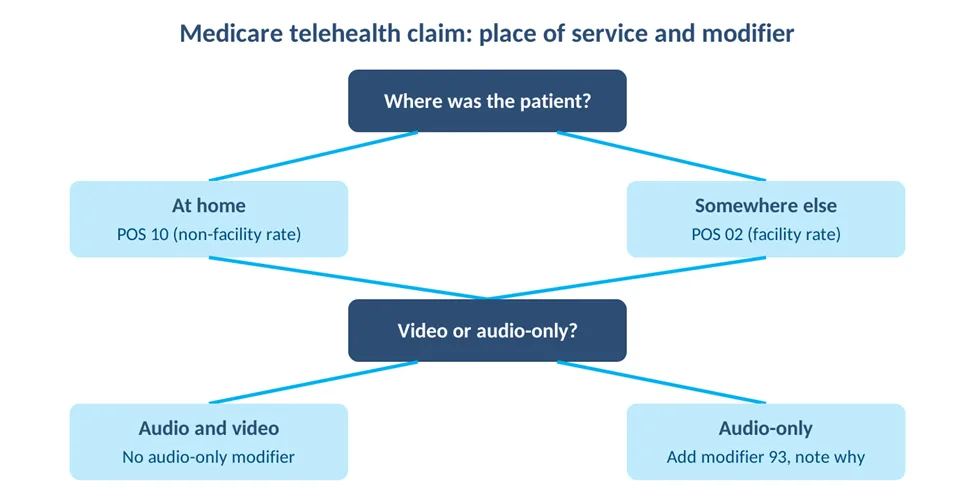
In short, the flowchart asks two questions: where the patient was, which sets the POS, and whether video was used, which decides modifier 93.
Telehealth Modifiers: 93, 95 and GT
Medicare contractor First Coast’s list of Medicare telehealth service modifiers defines modifier 93 as a real-time audio-only service and allows it for patients at home who cannot use video or do not consent to it. The same page limits modifier 95 to specific Medicare cases, such as Acute Hospital Care at Home, and limits GT to critical access hospital method II claims.
Commercial plans and Medicaid programs often follow different rules. Many still require modifier 95 on video sessions, and a few still accept GT. Our comparison of modifier 95 and GT for telehealth claims explains the difference, and our guide to telehealth billing practices across the US covers broader payer trends.
Billing audio-only therapy sessions
Under current law, Medicare covers audio-only behavioral health telehealth for patients at home through December 31, 2027. Add modifier 93 and document why video was not used. Some commercial plans limit which codes they pay by phone, so confirm coverage before booking phone sessions.
Medicare Changes in 2027 and 2028
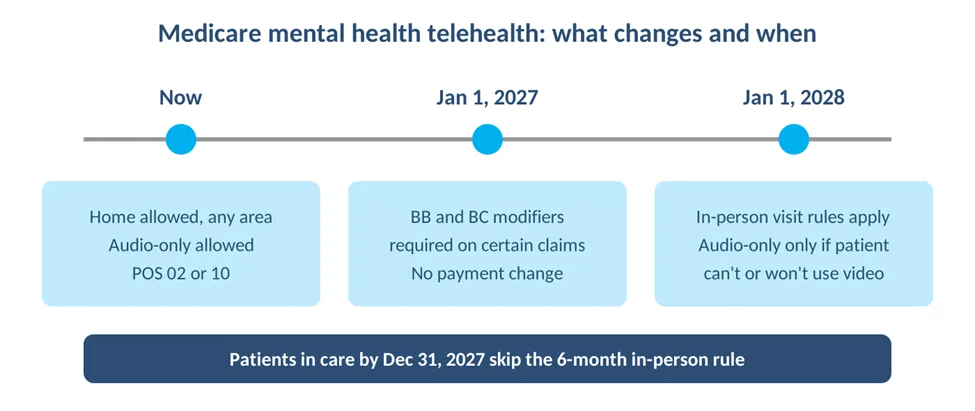
The CMS Medicare telehealth FAQ updated in October 2026 confirms that behavioral health telehealth can be received in the patient’s home in rural or urban areas, and that the current flexibilities run through December 31, 2027. Two later changes affect therapy practices.
- January 1, 2027: Medicare requires two new informational modifiers. BC marks telehealth services furnished incident to a practitioner’s service, and BB applies to certain services delivered through a telehealth virtual platform. CMS says neither changes payment.
- January 1, 2028: a new mental health telehealth patient needs an in-person visit within 6 months before the first home telehealth service, then an in-person service within 12 months of each telehealth service. Patients already in care by December 31, 2027 skip the 6-month rule. A clinician of the same specialty in the same group can provide the in-person visit.
- From 2028, audio-only: allowed for home behavioral health when the clinician can use video but the patient cannot or does not consent to it.
Practice Setup Rules That Affect Claims
Two setup issues cause many telehealth denials. First, the clinician generally needs a license valid in the state where the patient is located, so a client who travels or moves can make a claim unbillable. Practices that see clients in several states should read our guide to managing multi-state credentialing.
Second, Medicare enrollment must list a valid practice location. CMS says therapists who work from home but have a physical office do not need to report their home address, while virtual-only clinicians must enroll the home address as a practice location, which CMS can hide from public listings.
What a Telehealth Therapy Note Must Show
Telehealth notes need everything an office note needs, plus details that prove the visit met telehealth rules.
| Element | What to record |
| Modality | Audio and video, or audio-only, and the reason video was not used |
| Patient location | Address or at least city and state at the time of the session |
| Clinician location | Where the clinician was, for your own records and licensure checks |
| Consent | Telehealth consent where your state or payer requires it |
| Time | Start and stop times for time-based psychotherapy codes |
| Clinical content | Diagnosis, interventions, response and plan, as for any session |
Common Telehealth Therapy Billing Mistakes
These errors appear again and again on telehealth therapy claims.
| Mistake | What happens | Prevention |
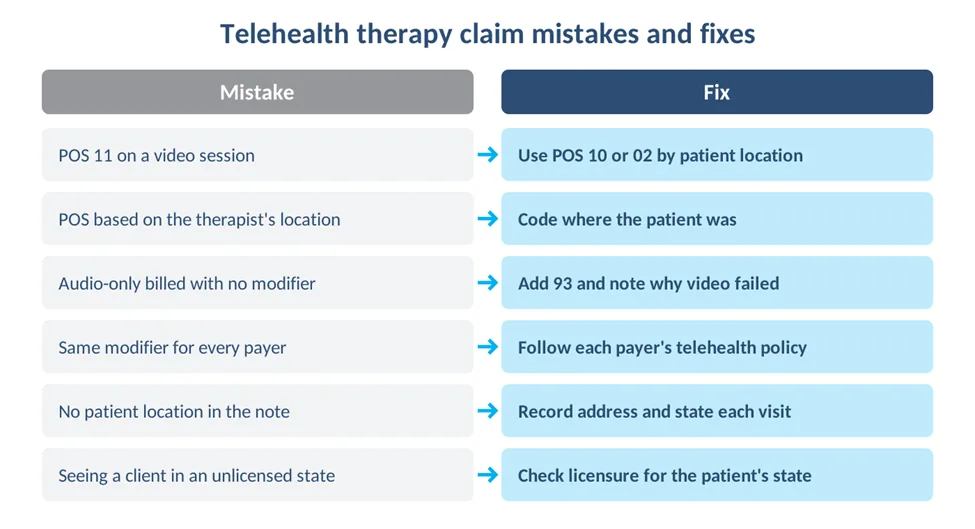
| POS 11 on a video session | Claim pays as in-person or is flagged in review | Use POS 10 or 02 by patient location |
| Audio-only with no modifier | Claim looks like a video visit the note does not support | Add 93 and note why |
| One modifier rule for all payers | Rejections from payers with different rules | Keep a payer-by-payer telehealth grid |
| Missing patient location | Licensure and POS cannot be confirmed | Record location at every visit |
If a payer rejects a claim for missing or invalid information, our explainer on the CO-16 denial code shows how to correct and resubmit it.
Frequently Asked Questions
Is telehealth psychotherapy paid the same as in-person therapy?
For Medicare, telehealth with the patient at home (POS 10) is paid at the non-facility rate, the same rate as an office visit. Telehealth with the patient somewhere else (POS 02) is generally paid at the lower facility rate. Commercial and Medicaid plans set their own telehealth rates in contracts, so check your fee schedule.
Do I still need modifier 95 for Medicare therapy sessions?
Generally no. Medicare uses POS 02 or 10 to identify telehealth, and its contractor guidance limits modifier 95 to specific cases such as Acute Hospital Care at Home. Many commercial plans and Medicaid programs still require 95 on video sessions, so follow each payer’s telehealth policy.
Can I bill 90837 for an audio-only session?
Medicare covers audio-only behavioral health telehealth for patients at home through December 31, 2027, using modifier 93 with the normal time-based code. Some commercial plans exclude certain codes from audio-only coverage or pay them differently, so check the plan’s audio-only policy before billing a phone session as 90837.
Does the in-person visit requirement apply to my current patients?
Not the 6-month rule. Under the CMS telehealth FAQ, patients who began receiving mental health telehealth on or before December 31, 2027 do not need the in-person visit before their first telehealth service. From 2028, an in-person service within 12 months of each telehealth service still applies.
What place of service do I use if the patient is at work?
Use POS 02, because the patient was not at home. POS 10 applies only when the patient is in their home, meaning a private residence rather than a facility or workplace. Record the patient’s location in the note so the place of service can be supported in review, and check each commercial plan’s own definition.
Final Considerations
Telehealth psychotherapy billing is mostly about three fields: the right code, the right place of service and the right modifier for each payer. Keep a payer telehealth grid, record patient location every visit and plan now for Medicare’s 2027 and 2028 changes. For how recent CMS rules affect therapists more broadly, read our guide to billing under CMS’s latest behavioral health directives.
Aspect Billing Solutions is a HIPAA-compliant billing and coding company that assigns a dedicated agent to each provider. If you would like help with telehealth therapy claims, see our medical billing and coding service or send us a message through our contact page.
Sources: CMS Medicare Telehealth FAQ (updated October 2026); First Coast Service Options, Telehealth Service Modifiers (October 2026). This article is general billing information, not legal advice. Payer telehealth policies change often, so confirm current rules with each payer.