
TRICARE Credentialing: A Step-by-Step Guide for Therapists
TRICARE credentialing lets a therapist or behavioral health group treat military families and get paid by the military health program. You first become a TRICARE-authorized provider through the regional contractor for your state, then choose whether to join that contractor’s network. This guide explains which behavioral health providers TRICARE pays, the counselor rules that trip people up, network versus non-network status and the steps in order.
| Key takeaways Humana Military runs the East Region and TriWest Healthcare Alliance runs the West Region.Every provider must be TRICARE-authorized; joining the network is a separate, optional contract.Counselors billing independently must meet TRICARE certified mental health counselor rules, not just hold a state license.Non-network providers can participate case by case; non-participating providers may bill up to 115 percent of the allowable.Some provider types, such as marriage and family therapists, also sign a TRICARE participation agreement. |
How TRICARE Credentialing Works
TRICARE is the health program for service members, retirees and their families, and civilian care is run by regional contractors. The official TRICARE FAQ on becoming a TRICARE provider tells providers to contact the contractor for their state: Humana Military in the East Region or TriWest Healthcare Alliance in the West Region. If you want a team to handle the applications, our insurance credentialing service covers TRICARE alongside commercial plans.
Credentialing has two layers. TRICARE certification confirms you are an authorized provider type with the right license, degree and experience. Network contracting is optional and adds a rate agreement and directory listing. Since January 1, 2025, TriWest has administered the West Region, which includes several states that moved from the East, so check your region before you apply.
Which Behavioral Health Providers Can TRICARE Pay?
TRICARE recognizes a wider set of mental health professionals than many plans, but each type has its own rules.
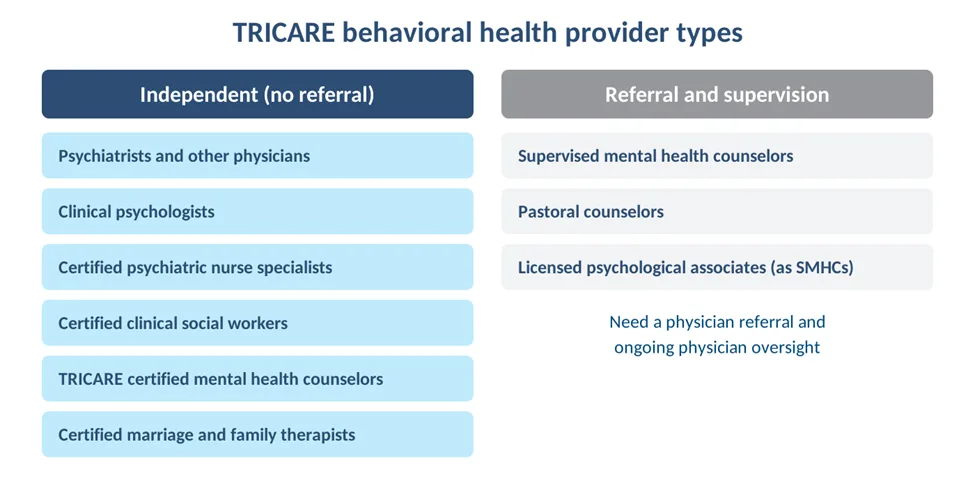
| Provider type | Key TRICARE requirements | Referral needed? |
| Clinical psychologist | Doctoral-level, licensed for independent practice | No |
| Certified clinical social worker | MSW from a CSWE-accredited program, state license, 2 years or 3,000 hours supervised practice | No |
| TRICARE certified mental health counselor | CACREP-accredited master’s, NCMHCE passed, highest-level license, supervised experience | No |
| Certified marriage and family therapist | Master’s degree, state MFT license, supervised experience, participation agreement | No |
| Certified psychiatric nurse specialist | Advanced psychiatric nursing certification and license | No |
| Supervised mental health counselor | Master’s, state license, supervised experience | Yes, physician referral and oversight |
The counselor rules that cause most rejections
A state LPC or LMHC license alone does not make a counselor an independent TRICARE provider. The TRICARE Policy Manual section on mental health counselors requires a TRICARE certified mental health counselor to hold a master’s from a CACREP-accredited mental health or clinical mental health counseling program, pass the NCMHCE, hold an independent-practice license and complete two years of post-master’s supervised practice, including 3,000 clinical hours and 100 hours of face-to-face supervision.
Counselors who do not meet those standards can still treat TRICARE patients as supervised mental health counselors, but only with a physician referral and ongoing physician oversight, and each claim certifies that written results go to the referring physician. Check your degree’s accreditation before you apply.
Network, Participating or Non-Participating?
Once certified, you choose how to work with TRICARE patients. Network providers sign a contract with the regional contractor and accept its rates. Non-network providers do not, and the TRICARE page on non-network providers explains the difference: participating providers accept the TRICARE allowable charge as payment in full and may participate case by case, while non-participating providers may charge up to 15 percent more than the allowable.
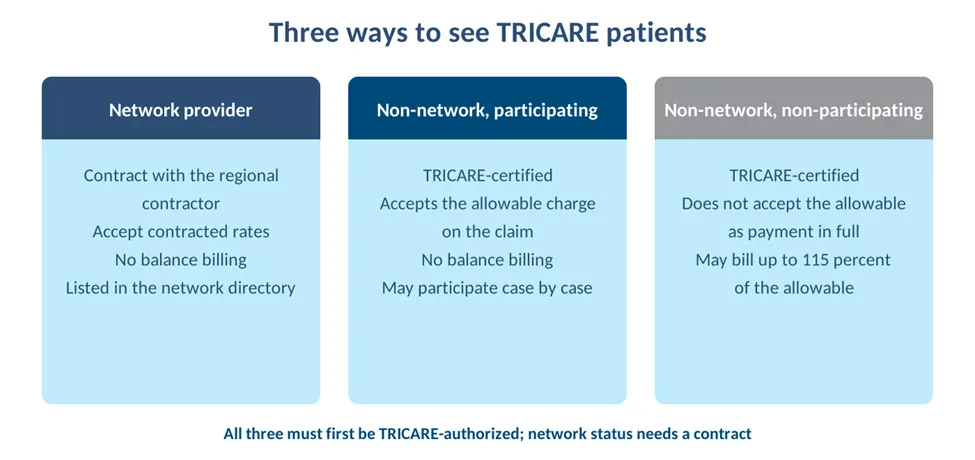
In short, the comparison shows that network status brings referrals and directory listing, while non-network status keeps more flexibility but less visibility to beneficiaries.
Practices near bases often weigh this choice against their payer mix; our article on billing services for practices near military bases covers the claims side of serving military families.
How to Get TRICARE Credentialed, Step by Step
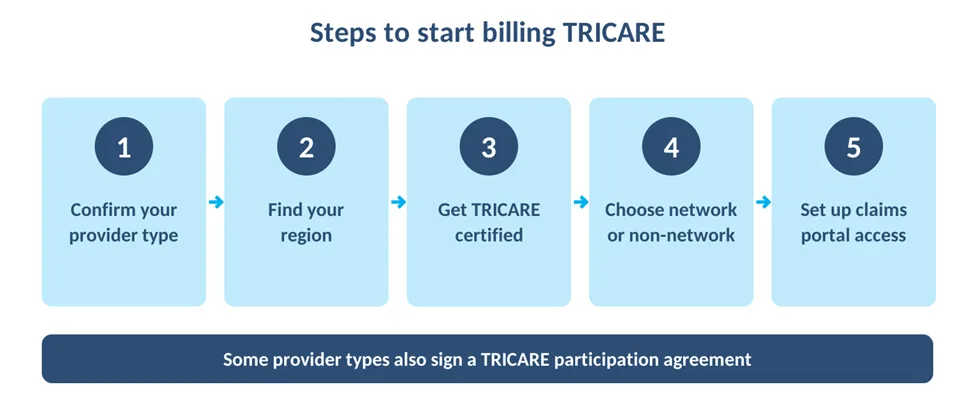
- Confirm your TRICARE provider type and that your degree, license and supervised hours meet its standard.
- Find your region by the state where you practice, and open the provider section of that contractor’s website.
- Submit the TRICARE certification application for your provider type, plus a participation agreement if your type requires one.
- Decide on network status; to join, submit the contractor’s network request with your tax ID and follow its credentialing review.
- Register for the contractor’s claims and authorization portal once you are approved.
- Keep your license, malpractice coverage and practice details current with the contractor.
Many networks also pull data from your CAQH ProView profile, so keep it current and re-attested. For ways to shorten approval times, see our guide on getting credentialed with insurance panels faster.
Common TRICARE Credentialing Mistakes
| Mistake | What happens | Prevention |
| Applying as an independent counselor without CACREP or NCMHCE | Application denied or limited to supervised status | Check counselor requirements first |
| Applying to the wrong region | Delays while the file is redirected | Confirm the region for your practice state |
| Treating patients before certification | Claims deny | Wait for written confirmation |
| Missing participation agreement | Certification stalls | Submit it with the application if your type needs one |
| Outdated license or malpractice records | Payments held | Update the contractor whenever records change |
Our list of credentialing mistakes that delay payments covers problems that apply to every payer, and our explainer on re-credentialing versus initial enrollment covers what happens after approval.
Frequently Asked Questions
Can LPCs get credentialed with TRICARE?
Yes, in one of two ways. Counselors who meet the TRICARE certified mental health counselor standard, including a CACREP-accredited degree and a passing NCMHCE score, practice independently. Counselors who do not can work as supervised mental health counselors, which requires a physician referral and ongoing physician oversight.
Do I have to join the TRICARE network to see TRICARE patients?
No. You must be TRICARE-authorized, but network membership is optional. Non-network providers can still treat beneficiaries, either as participating providers who accept the allowable charge case by case, or as non-participating providers who may charge up to 15 percent above it. Network status adds a contract and directory listing.
Which TRICARE region am I in?
It depends on the state where you practice. Humana Military administers the East Region and TriWest Healthcare Alliance administers the West Region. Several states moved from East to West on January 1, 2025, including Texas and Illinois, so confirm your state on the contractor’s website before applying.
Can LCSWs bill TRICARE without a physician referral?
Yes. Under the TRICARE Policy Manual, certified clinical social workers can provide covered services within their license without a physician referral or supervision. They need a master’s in social work from a CSWE-accredited program, a state license and at least two years or 3,000 hours of supervised clinical practice.
Can marriage and family therapists bill TRICARE?
Yes. Certified marriage and family therapists are TRICARE-authorized when they hold a state MFT license, a qualifying master’s degree and the required supervised experience. They also sign a TRICARE participation agreement as part of certification, so include it with the application to avoid delays.
Final Considerations
TRICARE credentialing rewards preparation: confirm your provider type, check counselor requirements early, apply in the right region and decide on network status with your payer mix in mind. Once approved, accurate claims keep payments flowing; our mental health billing guide covers coding and documentation.
Aspect Billing Solutions is a HIPAA-compliant billing and credentialing company that assigns a dedicated agent to each provider. If you would like help with TRICARE or other payer applications, send us a message through our contact page.
Sources: TRICARE FAQ on becoming a provider; TRICARE non-network providers page; TRICARE Policy Manual, Chapter 11, Sections 3.6 (clinical social worker) and 3.11 (mental health counselor); TriWest provider resources. This article is general information, not legal advice. Requirements change, so confirm them with your regional contractor.