
Health Behavior Assessment and Intervention Billing: 96156-96171
Health behavior assessment and intervention billing uses CPT 96156 through 96171 for behavioral care that helps a patient manage a physical illness, such as diabetes, chronic pain or heart disease. The main diagnosis on the claim must be the physical condition, not a mental health diagnosis. This guide covers each code, who can bill Medicare, how to count units, how HBAI differs from psychotherapy and the denials to avoid.
| Key takeaways 96156 is the untimed assessment; intervention codes use a 30-minute base and 15-minute add-ons.The primary diagnosis must be a physical health condition.Medicare lets clinical psychologists, clinical social workers, MFTs and mental health counselors bill HBAI.Do not report HBAI and psychotherapy codes on the same date; bill the predominant service.All of the codes are on Medicare’s telehealth list. |
What Are Health Behavior Assessment and Intervention Codes?
HBAI services address the psychological, behavioral, emotional, cognitive and social factors that affect a physical health problem or its treatment. A psychologist helping a patient with heart failure stick to a fluid restriction, or a social worker helping a patient with chronic pain build coping routines, is doing HBAI work. For the codes used when mental health is the main problem, see our complete practice guide to mental health billing.
HBAI is not preventive counseling for a healthy patient, and it is not psychotherapy for depression or anxiety. It sits between the two, focused on behavior that changes how a medical condition progresses.
The HBAI Codes at a Glance
The family has one assessment code and four intervention settings, each with a base code and an add-on.
| Code | Description | Time |
| 96156 | Health behavior assessment or reassessment | Untimed |
| 96158 / +96159 | Health behavior intervention, individual | First 30 minutes / each additional 15 |
| 96164 / +96165 | Health behavior intervention, group (two or more patients) | First 30 minutes / each additional 15 |
| 96167 / +96168 | Health behavior intervention, family with patient present | First 30 minutes / each additional 15 |
| 96170 / +96171 | Health behavior intervention, family without patient present | First 30 minutes / each additional 15 |
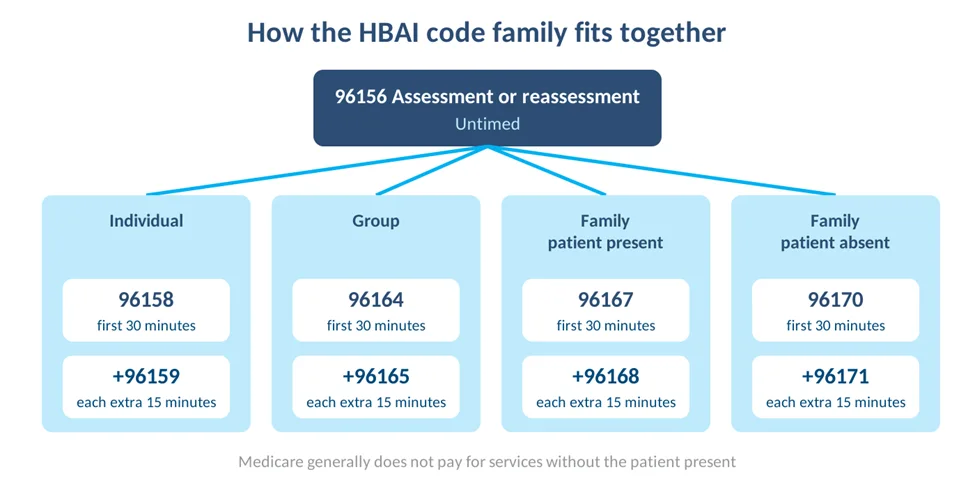
In short, the diagram shows one assessment code leading to four intervention settings, each billed as a base code plus add-on units.
Who Can Bill HBAI Services?
The CMS Medicare Mental Health booklet (MLN1986542, March 2026) states that clinical psychologists, clinical social workers, marriage and family therapists and mental health counselors can bill HBAI services to Medicare. Before 2024, Medicare limited these codes to clinical psychologists among non-physician mental health professionals; the CY 2024 Physician Fee Schedule final rule opened them to the other three groups. Physicians and other qualified practitioners can also report them within their scope.
Medicaid programs and commercial plans keep their own provider lists. Montana Medicaid’s HBAI billing code notice, for example, lists social workers, marriage and family therapists, professional counselors, psychologists and physicians, and requires a primary diagnosis that is physical in nature. Our guide to billing under CMS’s latest behavioral health directives covers the wider 2024 changes for therapists.
Diagnosis Rules for HBAI Claims
The first-listed diagnosis must be the physical condition being managed, using an ICD-10-CM code such as type 2 diabetes, chronic pain or congestive heart failure. A mental health diagnosis can appear as a secondary code if it affects care, but it cannot drive the claim. Medicare also requires the specific sign, symptom or complaint for every service billed.
Document the link in plain terms: which behavior is affecting which condition, and how the intervention targets it. Without that link, payers often deny the claim for medical necessity; our explainer on the CO-50 medical necessity denial shows how to respond.
How to Count Time and Units
Intervention codes are timed, and only face-to-face time counts. The base code requires at least 16 minutes, and each add-on unit follows the same midpoint approach for its 15-minute block. Record start and stop times in the note.
| Face-to-face time | Codes to report (individual) |
| Under 16 minutes | Not reportable as 96158 |
| 16 to 37 minutes | 96158 x 1 |
| 38 to 52 minutes | 96158 x 1 and 96159 x 1 |
| 53 to 67 minutes | 96158 x 1 and 96159 x 2 |
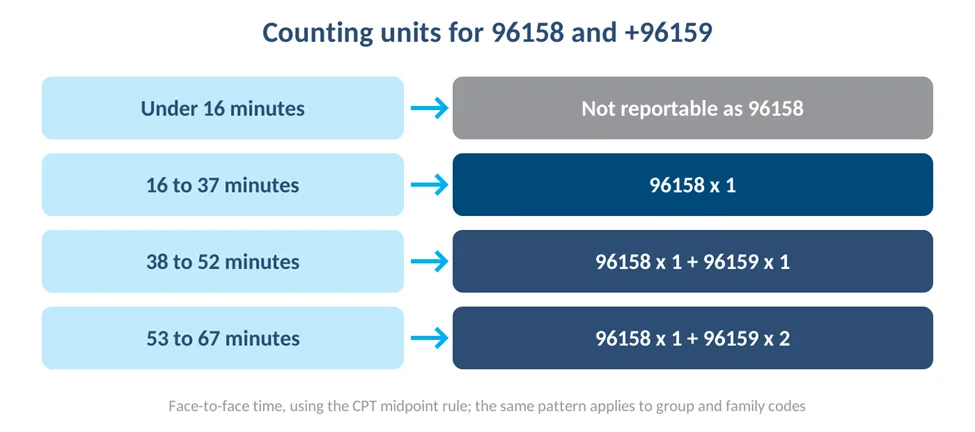
The same pattern applies to group, family and family-without-patient codes. Commercial plans may apply their own unit limits or authorization rules, so check the policy before scheduling long sessions.
HBAI or Psychotherapy: Choosing the Right Code
The deciding factor is the main diagnosis and the goal of the session. If the patient’s primary problem is a medical condition and the work targets behavior affecting it, use HBAI. If the primary problem is a mental health disorder, use psychotherapy codes. Testing services follow separate rules; see our neuropsychological testing billing guide.
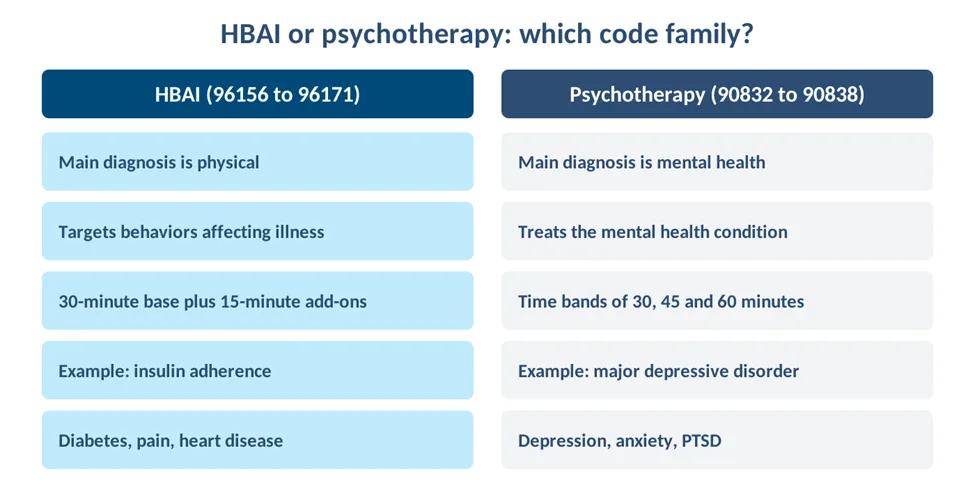
Same-day restrictions
CPT guidance says not to report HBAI codes with psychiatric service codes 90785 to 90899 on the same date; when a patient receives both kinds of care in one day, report the predominant service. The same-provider limits also apply with certain counseling E/M codes. If a payer bundles the services, our breakdown of CO-97 bundling denials explains the fix.
HBAI in integrated primary care
Many practices deliver HBAI inside primary care, alongside care management programs. Our behavioral health integration billing guide explains how those monthly care management codes work and where HBAI visits fit next to them.
Common HBAI Billing Mistakes
| Mistake | Result | Prevention |
| Mental health diagnosis listed first | Denial or recoding request | List the physical condition first |
| HBAI and psychotherapy on the same date | One line denied as bundled | Bill the predominant service only |
| Add-on billed without the base code | Add-on line rejected | Always pair 96159 with 96158, and so on |
| No start and stop times | Units cannot be supported | Record face-to-face time each session |
| Family without patient billed to Medicare | Likely denial | Check coverage for 96170 and 96171 first |
HBAI codes are on Medicare’s telehealth list, so remote sessions follow the usual place-of-service rules; our comparison of modifier 95 and GT for telehealth claims helps with other payers’ modifier rules.
Frequently Asked Questions
Can LCSWs bill 96158 to Medicare?
Yes. Since January 1, 2024, Medicare allows clinical social workers, marriage and family therapists and mental health counselors, along with clinical psychologists, to bill health behavior assessment and intervention codes. The patient’s primary diagnosis must be a physical condition, and the clinician must be enrolled with Medicare.
Can I use a depression diagnosis with 96158?
Not as the primary diagnosis. HBAI codes require a physical health condition as the first-listed diagnosis, such as diabetes or chronic pain. A depression code can be listed as a secondary diagnosis when it affects the medical condition, but when depression itself is the focus of treatment, psychotherapy codes are the correct choice.
What is the minimum time for 96158?
At least 16 minutes of face-to-face time. Under 16 minutes, the intervention cannot be reported as 96158. The add-on 96159 is reported for each additional 15 minutes beyond the first 30, using the same midpoint approach, so a 38-minute session generally supports one unit of each. Always record start and stop times.
Can HBAI services be billed by telehealth?
Yes for Medicare, which lists the HBAI codes as telehealth services. Use POS 10 when the patient is at home and POS 02 when the patient is elsewhere. Commercial and Medicaid plans set their own telehealth rules and modifiers, so check each payer’s policy before billing remote sessions.
Is 96156 billed more than once?
96156 covers an assessment or reassessment and is untimed, so it is reported once per assessment. Reassessment is appropriate when the patient’s condition, treatment or progress changes enough to need a new plan. Payers may limit how often they pay for reassessment, so check the policy before repeating it.
Final Considerations
Health behavior assessment and intervention billing works when three things line up: a physical primary diagnosis, documented face-to-face time and a clear link between behavior and illness. With those in place, HBAI lets therapists and psychologists be paid for medical-adjacent work they often already do.
Aspect Billing Solutions is a HIPAA-compliant billing and coding company that assigns a dedicated agent to each provider. If you would like help coding HBAI and other behavioral health services, see our medical billing and coding service or send us a message through our contact page.
Sources: CMS MLN1986542, Medicare Mental Health (March 2026); CY 2024 Medicare Physician Fee Schedule final rule; Montana Medicaid HBAI billing code notice (2025); AMA CPT guidelines for HBAI codes. This article is general billing information, not legal advice. Confirm current rules with each payer.