
Do You Need to Credential Your CoCM Care Team?
CoCM credentialing requirements confuse most practices launching the Collaborative Care Model, mostly because the team has three roles but only one of them actually enrolls with Medicare. The billing practitioner needs full credentialing; the psychiatric consultant and behavioral health care manager (BHCM) generally do not. This guide breaks down exactly what each role needs, what documentation an auditor will ask for, and where commercial payers sometimes ask for more than Medicare does.
This sits inside the broader credentialing process covered in Aspect Billing Solutions’ mental health credentialing guide, which walks through payer enrollment for behavioral health providers generally. CoCM adds one wrinkle most providers do not expect: two of the three care-team roles never touch a payer credentialing application at all.
| Key Takeaways Only the billing practitioner, the physician or nonphysician practitioner who reports the CoCM code, needs to be separately enrolled with Medicare. The psychiatric consultant does not need a Medicare enrollment of their own; they work under the billing practitioner’s enrollment, typically remotely, with no direct patient contact required. CMS sets no specific license for the behavioral health care manager role; the person’s own state scope of practice governs what they can actually do. A written employment or contractor agreement, not a payer credentialing file, is what establishes the consultant’s and BHCM’s relationship to the billing practitioner. Some commercial payers set stricter rules than Medicare and may ask for the psychiatric consultant to be listed on file; check each payer’s provider manual before assuming Medicare’s rules apply everywhere. |
Who on the CoCM Team Actually Needs What
A Collaborative Care Model (CoCM) team has three defined roles: the billing practitioner, the psychiatric consultant, and the behavioral health care manager. Practices new to CoCM often assume all three need to go through payer credentialing the way a new provider joining the practice would. That assumption is wrong for two of the three roles, and it is the single biggest source of wasted credentialing effort when a practice stands up a CoCM program.
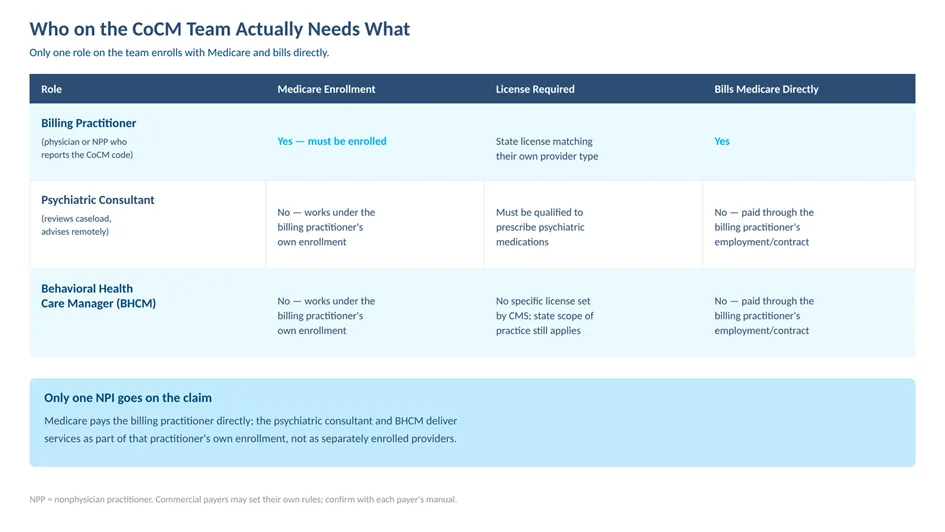
Medicare pays the billing practitioner directly for CoCM services; the psychiatric consultant and BHCM deliver their part of the service under that practitioner’s own enrollment, not as separately billing providers. The table below lines up what each role actually needs.
The Billing Practitioner
The billing practitioner is the physician or nonphysician practitioner (NPP) who reports the CoCM code and receives payment. This is the one CoCM role with a conventional credentialing requirement: an active Medicare enrollment, state license matching their own provider type, and standard payer credentialing with any commercial plan they bill.
The Psychiatric Consultant
The psychiatric consultant has to be qualified to prescribe the full range of psychiatric medications, but does not need a Medicare enrollment of their own for this role. They are typically remotely located and are not generally expected to have direct patient contact; their caseload review happens on a set schedule, not in person. Aspect Billing Solutions’ psychiatrist credentialing guide covers full payer enrollment for a psychiatrist who also sees patients directly and bills separately from CoCM.
The Behavioral Health Care Manager (BHCM)
CMS describes the BHCM as a designated provider with formal education or specialized training in behavioral health, working under the billing practitioner’s oversight. It sets no single required license for this role; social work, nursing, and psychology backgrounds all qualify. That does not mean licensure is irrelevant: whoever holds the BHCM role still practices under their own state’s scope-of-practice rules. Aspect Billing Solutions’ LCSW credentialing guide covers one common path into this role for a clinical social worker who also bills general BHI codes directly.
Why Only One NPI Goes on the Claim
CoCM services are delivered incident to the billing practitioner’s own professional services. Medicare makes separate payments each month to that one practitioner; the psychiatric consultant and BHCM deliver their part of the service as employees or contracted staff, not as providers with their own billing relationship to Medicare. A general supervision relationship, without an actual psychiatric consultant and BHCM doing the work described in the code, does not satisfy this requirement on its own.
CMS’s own guidance confirms this structure directly: care team members are CMS’s Behavioral Health Integration Services booklet‘s description of “employees or working under contract with the billing practitioner,” and CMS’s Incident To Services and Supplies guidance sets general, rather than direct, supervision as the applicable standard for behavioral health services billed this way.
Setting Up a Credentialing-Compliant CoCM Team
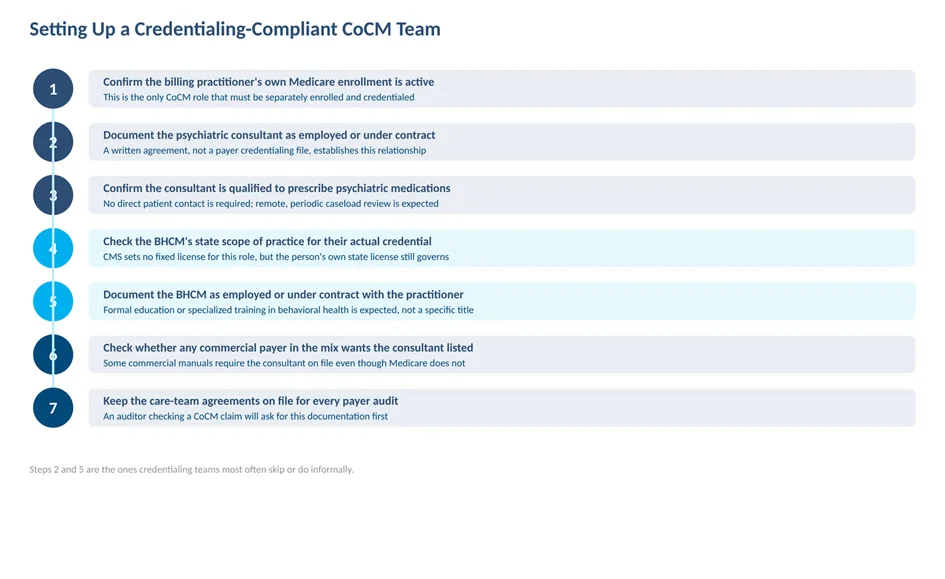
The steps below follow the order a credentialing team should actually work through before a practice bills its first CoCM claim.
- Confirm the billing practitioner’s own Medicare enrollment is active.
- Document the psychiatric consultant as employed or under contract.
- Confirm the consultant is qualified to prescribe psychiatric medications.
- Check the BHCM’s state scope of practice for their actual credential.
- Document the BHCM as employed or under contract with the practitioner.
- Check whether any commercial payer in the mix wants the consultant listed.
- Keep the care-team agreements on file for every payer audit.
Medicare Sets the Floor; Commercial Payers Can Ask for More
Everything above describes Medicare’s CoCM credentialing rules. A commercial payer or Medicare Advantage plan is not required to follow the same structure, and some provider manuals do ask for the psychiatric consultant to be listed on file even though Medicare does not require it. State Medicaid programs can set their own rules too, and they do not always mirror Medicare’s. Aspect Billing Solutions’ guide to Medicare vs. Medicaid credentialing differences covers how enrollment requirements diverge between the two programs more broadly. Before billing a commercial CoCM claim, confirm the payer’s own manual against what this guide describes for Medicare.
Common Mistakes and How to Prevent Them
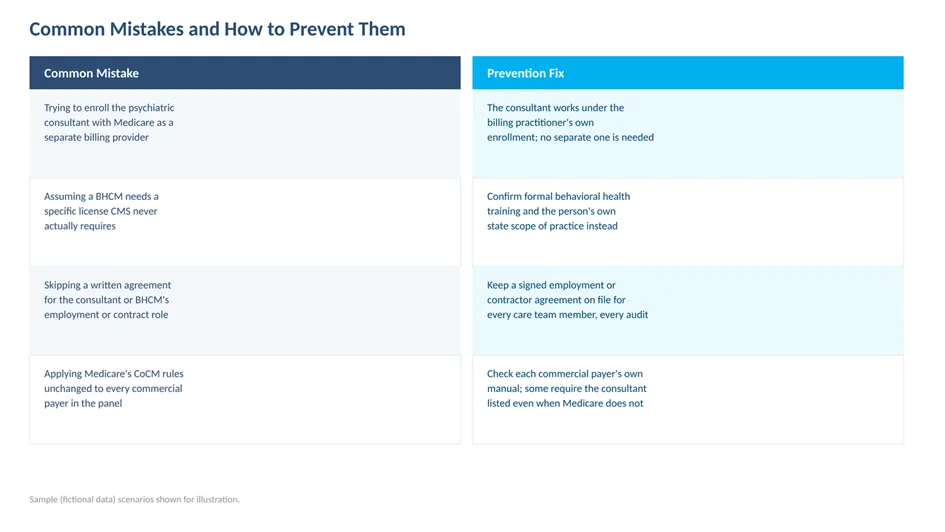
The same few mistakes account for most of the wasted credentialing effort and audit exposure on CoCM care teams.
- Trying to enroll the psychiatric consultant with Medicare as a separate billing provider. The consultant works under the billing practitioner’s own enrollment; no separate one is needed.
- Assuming a BHCM needs a specific license CMS never actually requires. Confirm formal behavioral health training and the person’s own state scope of practice instead.
- Skipping a written agreement for the consultant or BHCM’s employment or contract role. Keep a signed employment or contractor agreement on file for every care team member, every audit.
- Applying Medicare’s CoCM rules unchanged to every commercial payer in the panel. Check each commercial payer’s own manual; some require the consultant listed even when Medicare does not.
None of this replaces the billing practitioner’s own standard credentialing. Aspect Billing Solutions’ guide to the role of CAQH in credentialing covers how most commercial payers pull that practitioner’s own credentials, which still has to happen on its usual timeline regardless of how the CoCM team itself is structured.
Frequently Asked Questions
Does the psychiatric consultant need to be credentialed with every payer the practice bills?
Not under Medicare’s rules, where the consultant works under the billing practitioner’s own enrollment. Some commercial payers set stricter requirements and may ask for the consultant to be listed on file, so check each payer’s provider manual rather than assuming Medicare’s rule applies everywhere.
What license does a behavioral health care manager need?
CMS does not set one specific license for this role; it describes the BHCM as having formal education or specialized training in behavioral health, with social work, nursing, and psychology backgrounds all qualifying. The person’s own state scope-of-practice rules still govern what they can actually do in that role.
Can the psychiatric consultant and the billing practitioner be the same person?
No. The roles are define separately because the billing practitioner reports the code and receives payment, while the psychiatric consultant provides specialty input into the case. A solo practitioner running a CoCM program still needs a separate, qualified psychiatric consultant on the care team.
What documentation should be on file if a payer audits a CoCM claim?
A signed employment or contractor agreement for both the psychiatric consultant and the BHCM, proof of the consultant’s qualification to prescribe psychiatric medications, and the billing practitioner’s own active enrollment. These establish the care-team relationship the audit will check first.
Getting CoCM Credentialing Right the First Time
CoCM’s credentialing requirements are lighter than most practices expect, but the documentation behind that lighter structure, the employment agreements, the qualification records, the payer-by-payer check, still has to be in place before the first claim goes out. Aspect Billing Solutions’ medical billing and credentialing team sets up and documents CoCM care teams correctly from the first enrollment, so a claim never rests on an assumption an auditor would reject.
Sources: CMS’s Behavioral Health Integration Services booklet (MLN909432) and CMS’s Incident To Services and Supplies guidance. Commercial payer and state Medicaid rules vary; confirm current requirements with each payer’s manual before relying on them. This article is general information, not legal or billing advice for any specific claim.