
How Mental Health Credentialing Works for Therapists and Groups
Mental health credentialing is how insurance payers confirm a clinician’s license, training, and professional history before adding that clinician to their network. Most practices should plan for several months between the first application and the first payable claim, so the work starts well before the first insured session. This guide covers who needs credentialing, the steps in order, how Medicare, Medicaid, and commercial plans differ, and the mistakes that stall approvals.
| Key takeaways Credentialing verifies qualifications. The contract and the effective date decide when claims become payable.A complete CAQH ProView profile, re-attested every 120 days, is the base of most commercial applications.Medicare uses PECOS and the CMS-855I, and marriage and family therapists and mental health counselors have been able to enroll since January 1, 2024.Some plans send behavioral health applications to a separate organization, so ask each payer where to apply.Commercial plans commonly quote 60 to 120 days, so start four or more months before a clinician’s first insured visit. |
What does mental health credentialing involve?
Mental health credentialing is a payer’s verification of a clinician’s license, education, work history, malpractice history, and sanctions before the clinician joins the payer’s network. Four terms often get blurred together in daily practice. Each has a different owner, and only the last two decide when a claim gets paid.
| Term | What it means | Who controls it |
| Licensing | State permission to practice a profession | State licensing board |
| Credentialing | Payer review and verification of qualifications | Payer or its credentialing vendor |
| Enrollment | Registering the clinician and NPI so claims can be processed | Payer or Medicare Administrative Contractor (MAC) |
| Contracting | Agreeing to the fee schedule, terms, and effective date | Payer |
Approval by a credentialing committee does not make claims payable on its own. Ask for the signed contract and the effective date in writing. Practices adding several clinicians can also read our credentialing and enrollment guide for physician groups, which covers group-level setup.
Which mental health providers need to be credentialed?
Any clinician who wants a payer to reimburse at in-network rates needs credentialing with that payer, whatever the license type. The path differs by profession, as the table shows.
| Provider type | Typical payer path | What to watch |
| Psychiatrist (MD or DO) | Enrolls as a physician with Medicare; commercial plans credential individually | Board certification, controlled-substance registrations, and hospital affiliations |
| Psychiatric-mental health nurse practitioner (PMHNP) | Enrolls as a nurse practitioner | State practice authority and any collaborative agreement the payer asks about |
| Clinical psychologist | Credentialed individually with each plan | License verification with the state board |
| Licensed clinical social worker or licensed professional counselor | Credentialed individually; license titles differ by state | Payers list accepted license titles, so confirm yours is on the list |
| Marriage and family therapist (MFT) | Medicare enrollment open since January 1, 2024; commercial rules vary | Supervised-experience requirement for Medicare |
| Pre-licensed associate or intern | Payer-specific | Some payers credential only fully licensed clinicians, so ask before booking insured visits |
Medicare adds a specific rule for therapists. Medicare Part B began paying for MFT and mental health counselor (MHC) services on January 1, 2024, and the CMS frequently asked questions for MFTs and MHCs state that applicants need at least two years or 3,000 hours of post-master’s supervised clinical experience. Clinicians still in supervision typically do not meet that requirement yet.
How do you get credentialed with insurance, step by step?
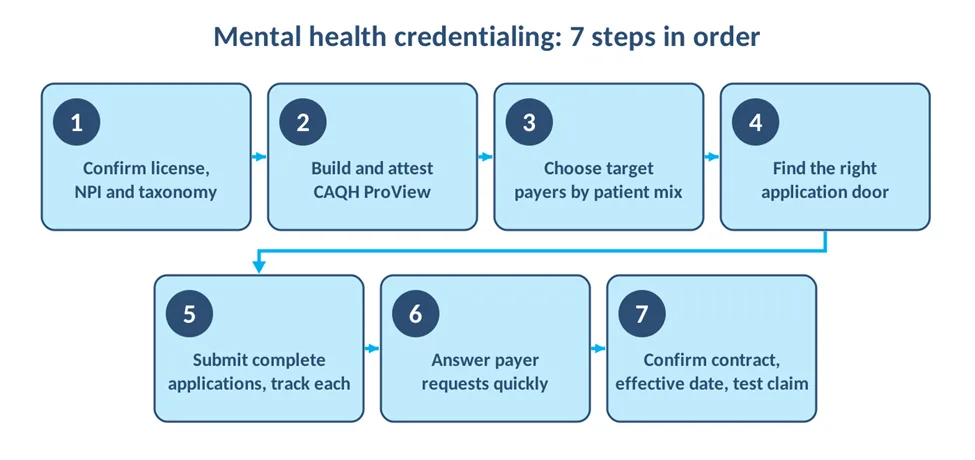
Most payers follow the same sequence, and completing the steps in order prevents the rework behind most delays. Use this list when a clinician has a confirmed start date or the practice decides to begin accepting insurance.
- Confirm the basics. Check that the license is active and unrestricted in every state where patients will be seen. Confirm the individual National Provider Identifier (NPI) in NPPES and choose a taxonomy code that matches the license. CMS lists taxonomy code 106H00000X for MFTs and 101YM0800X for MHCs.
- Build the CAQH ProView profile. CAQH ProView is the shared database many commercial payers use to collect provider data. It is free for providers, and the CAQH provider guide says to re-attest every 120 days. Upload the license, malpractice certificate, and a current CV, then authorize each payer to view the profile.
- Choose target payers by patient mix. List the plans your referrals and waitlist use most. Start with those, then add others in batches so follow-up stays manageable.
- Find the right application door. Ask each payer which team credentials behavioral health clinicians. The next sections explain why this step matters.
- Submit complete applications and track them. Fill in every field, match names and addresses across documents, and log each submission date in one tracker.
- Answer payer requests quickly. Processing stalls while a payer waits for missing information. Reply within days and check status on a regular schedule.
- Confirm the contract, effective date, and a test claim. Get the effective date in writing. Then load the clinician’s NPI and payer IDs into the billing system and submit one clean claim to test the setup. Our mental health billing guide explains how to keep those claims paid.
How long does mental health credentialing take?
Plan for several months, because each payer sets its own timing. Commercial plans commonly quote about 60 to 120 days across industry sources, and some behavioral health panels run longer.
Medicare publishes processing standards for its contractors. For CMS-855I initial applications, First Coast Service Options lists processing goals of 95 percent of internet-based applications within 15 days when no site visit, development request, or fingerprinting is needed. When those steps apply, the goal for 95 percent is 50 days. Paper applications carry longer goals.
Illustrative scenario (not an actual client record): A group practice hires a licensed clinical social worker who will start on June 1. Counting back 120 days puts the application deadline in early February. The practice submits the CAQH profile and the first three payer applications by February 1 and logs each one in a tracker. If approvals arrive early, the clinician starts seeing insured patients sooner. If they run late, the practice has time to follow up before the start date.
Complete files shorten the timeline more than rush requests do. A missing signature or mismatched address can restart a review, so check every document before submitting.
How do Medicare, Medicaid, and commercial credentialing differ?
Medicare enrolls clinicians through one federal process, Medicaid enrolls them through each state, and commercial plans each run their own credentialing. Plan the work separately for each payer type.
| Payer type | Where you apply | Renewal | Notes |
| Medicare | PECOS online, which CMS prefers, or the paper CMS-855I; your MAC processes it | Revalidation generally every five years | MFTs and MHCs file a separate CMS-855I for each state; reassigning benefits to a group needs both parties enrolled |
| Medicaid | State Medicaid agency, then each managed care plan | Set by the state | Forms, rules, and timelines vary, so check your state Medicaid agency |
| Commercial | Payer portal or CAQH-based application | Plans following NCQA standards recredential about every three years | Each plan sets its own contract, fee schedule, and effective-date rules |
Original Medicare enrollment does not put a clinician in Medicare Advantage networks, because those private plans credential on their own. Our comparison of Medicare versus Medicaid credentialing walks through the government programs in more detail. Check each payer’s provider manual for its own limits.
Why do behavioral health networks add extra steps?
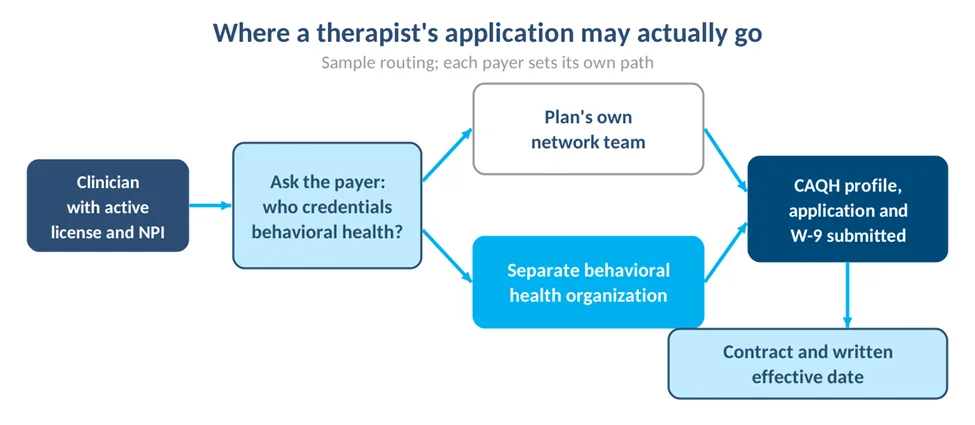
Some health plans delegate behavioral health to a separate behavioral health organization, so a therapist may need a different application than the plan’s medical network uses. Applying to the wrong team is a common cause of lost months.
For example, an Indiana Medicaid presentation on UnitedHealthcare says the process to join the network for behavioral health practitioners begins with Optum Behavioral Health. It also tells clinicians to keep CAQH current and attested.
Carelon Behavioral Health takes applications through the Availity portal and pulls profile data from CAQH. Its join-our-network guide says a completed W-9 is required, and a missing W-9 can delay or deny the application.
A payer can also stop accepting new clinicians of a given license type in a given area. Ask in writing whether the panel is open and whether a waitlist exists, so you do not wait on an application that cannot move.
Telehealth does not remove state-by-state requirements. Licensing rules usually follow the patient’s location, and enrollments are tied to the states where you treat. After credentialing is done, review telehealth coding in our guide to modifier 95 versus GT so virtual visits are billed correctly.
How does a group practice add a new clinician?
A group adds a clinician by credentialing the individual first, then linking that clinician to the group’s contract and billing NPI, which the payer must confirm before claims are paid under the group. Use this checklist for each new hire.
- Collect the license, malpractice certificate, CV, and work-history explanations before the start date.
- Update the clinician’s CAQH profile and authorize each payer the group uses.
- Submit the payer’s add-clinician or roster request, using the group’s tax ID and billing NPI.
- For Medicare, confirm that both the clinician and the group are enrolled, and complete reassignment of benefits on Form CMS-855R.
- Record each payer’s written effective date, and load the clinician’s rendering NPI in the billing system only after it is confirmed.
When a clinician works in a private practice and for a group at the same time, Medicare expects both arrangements to be reported. Keep the records for each setting separate.
How often do you renew or re-credential?
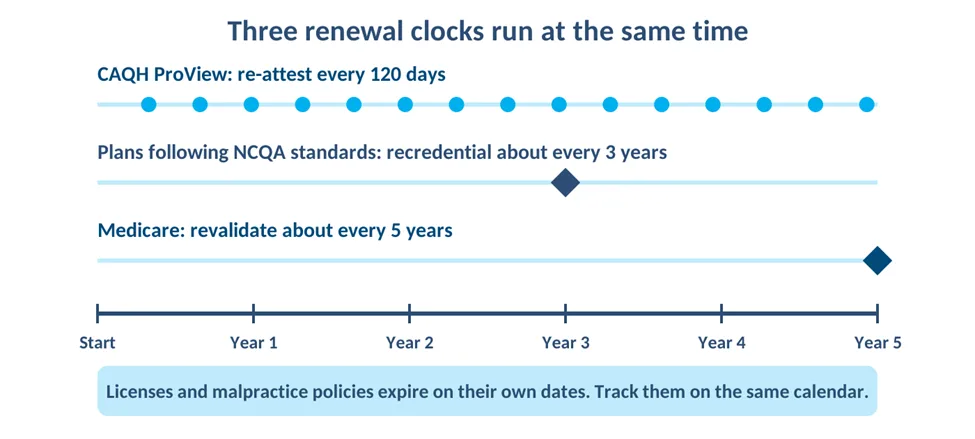
Three renewal clocks run at once: CAQH asks for re-attestation every 120 days, plans following NCQA standards recredential about every three years, and Medicare generally revalidates every five years. Missing any one of them can interrupt payment.
Keep the CAQH profile current between payer requests, as explained in our overview of the role of CAQH in credentialing. NCQA states that it requires recredentialing every three years for the plans it accredits, and each payer sets its own cycle in its contract.
The CMS FAQ warns that late Medicare revalidation can place a hold on reimbursement, and deactivated billing privileges require a new complete application with no payment during the gap. The difference between a renewal and a fresh application is covered in re-credentialing versus initial enrollment. Set reminders well ahead of every license and malpractice expiration date too.
What mistakes delay mental health credentialing?
Most delays trace back to incomplete or inconsistent files rather than slow reviewers. In billing audits, a common pattern is a clinician whose name or address differs across the license, NPPES, CAQH, and W-9.
| Mistake | Why it hurts | How to prevent it |
| Lapsed CAQH attestation | The payer cannot access the profile, so the review pauses | Set a reminder before each 120-day deadline |
| Name or address mismatch across records | Verification fails and the file goes back for correction | Match the license, NPPES, CAQH, and W-9 exactly |
| Missing W-9 or signature | Some payers delay or deny incomplete packets | Use a pre-submission checklist for every payer |
| Unexplained gaps in work history | Reviewers request a written explanation | Add a short explanation to the CAQH profile at the start |
| Applying to the wrong team | The application sits in a queue that cannot approve it | Ask which team credentials behavioral health first |
| No status follow-up | Requests for information go unanswered | Check each application on a regular schedule and log it |
Our article on credentialing mistakes that delay payments adds more examples from general medical credentialing. Fix the items in this table before each submission, not after a denial letter arrives.
What does a working credentialing tracker look like?
A tracker turns scattered emails into a single view of what is pending and who owns the next step. Sample (fictional data): copy this layout and replace every row with your own clinicians and payers.
| Clinician | Payer | Submitted | Last follow-up | Status | Next action |
| Clinician 1 (LCSW) | Commercial Plan A | Feb 1 | Feb 20 | Additional document requested | Send updated malpractice certificate by Feb 24 |
| Clinician 1 (LCSW) | Behavioral organization B | Feb 3 | Feb 20 | In review | Call for status on Mar 6 |
| Clinician 2 (PMHNP) | Medicare | Feb 5 | Feb 19 | Submitted through PECOS | Check status on Mar 5 |
| Clinician 2 (PMHNP) | Commercial Plan A | Feb 5 | Feb 20 | Approved, contract pending | Request effective date in writing |
Update the tracker the same day anything changes. When a status stays unchanged past the payer’s quoted timeframe, escalate it with a call and note the reference number.
When should a practice get outside credentialing help?
Outside help makes sense when credentialing work starts costing more in delays than it would cost to hand off. Common signals include:
- Applications sit pending with no one tracking next steps.
- New clinicians start work before any payer has confirmed an effective date.
- The practice credentials in several states or with several behavioral health organizations at once.
- CAQH attestations or Medicare revalidations lapse because no one owns the calendar.
Look for a partner that explains its process, shows how it tracks each application, and works with your billing team. Aspect Billing Solutions is one example. Its medical billing and credentialing services cover credentialing and enrollment alongside billing and coding, with a dedicated agent assigned to each provider. Results vary by practice, so ask any partner how it reports status.
Frequently asked questions
Can I see patients while my credentialing is pending?
You can see patients as self-pay or out-of-network clients, and many practices provide superbills for that. Billing a payer as in-network before the effective date usually leads to denials. Confirm the date in writing before scheduling insured visits. Policies differ by payer and contract, so check yours before you book.
How long does credentialing take for a therapist?
Commercial plans commonly quote about 60 to 120 days, and some behavioral panels take longer. Medicare publishes processing standards for contractors, with online applications often processed faster than paper ones. Each payer sets its own timing, so start at least four months before the first insured appointment and track every application.
Is CAQH ProView required for mental health credentialing?
Many commercial payers and behavioral health organizations pull application data from CAQH ProView, so a complete profile is usually required. Medicare does not use CAQH. It uses PECOS. ProView is free for providers, and profiles need re-attestation every 120 days. Ask each payer whether it requires CAQH.
Do pre-licensed therapists need to be credentialed?
Rules depend on the payer and state. Medicare requires post-master’s supervised experience before an MFT or MHC can enroll, so clinicians still in supervision typically cannot. Some commercial payers credential only fully licensed clinicians. Ask each payer in writing whether supervised associates can be credentialed or billed under a supervisor.
How often does a mental health provider need to re-credential?
CAQH asks for re-attestation every 120 days, plans following NCQA standards recredential about every three years, and Medicare generally revalidates every five years. Licenses and malpractice policies expire on their own schedules, so a shared calendar with reminders ahead of each date prevents lapses.
Where to start with mental health credentialing
Mental health credentialing goes faster when the license, NPI, CAQH profile, and payer routing are settled before the first application goes out. Start with your highest-volume payers, track every submission, and get each effective date in writing.
Your next question is probably which payers to approach first and who should own the follow-up. If you want help with that, contact the Aspect Billing Solutions team to talk through your practice’s setup.
Sources: CMS (MFT and MHC enrollment FAQ), CAQH ProView provider guide, NCQA, First Coast Service Options (Medicare Administrative Contractor), Carelon Behavioral Health, and the Indiana Medicaid (IHCP) UnitedHealthcare behavioral health presentation. Payer rules vary, so check each payer’s provider manual. This article is general information, not legal advice.