
Getting In Network: Medicaid Managed Care Credentialing Guide
Medicaid managed care credentialing is the process that lets a therapist or behavioral health group see a Medicaid plan’s members in network and get paid by that plan. It usually takes three things: enrollment with the state Medicaid program, credentialing with each managed care organization (MCO), and a signed contract with an effective date. This guide explains each step, the federal rules behind them, how renewals work and the mistakes that delay approval.
| Key takeaways Federal rules require states to screen and enroll every Medicaid managed care network provider.Each MCO credentials you separately, using a uniform policy your state sets for all its plans.A plan may contract with you while state screening is pending, but only for up to 120 days.Behavioral health is often handled by a separate plan or vendor, so ask where to apply.CAQH re-attestation, plan recredentialing and state revalidation each run on their own clock. |
What Is Medicaid Managed Care Credentialing?
In most states, private health plans run Medicaid benefits under contract with the state. Joining one of those networks is different from joining fee-for-service Medicaid, because the state and the plan each check you. If you want the work handled end to end, our insurance credentialing service covers state and plan applications.
Think of it as three gates, each run by a different party.
| Gate | Who runs it | What it checks | What you get |
| State Medicaid enrollment | State Medicaid agency | Identity, license, ownership disclosures, federal exclusions | A Medicaid provider ID |
| MCO credentialing | Each Medicaid health plan or its behavioral health vendor | License, NPI, education, malpractice coverage, work history | Approval by the plan’s credentialing committee |
| Contract and loading | Each health plan | Signed agreement and rates | An effective date and a claims-ready record |
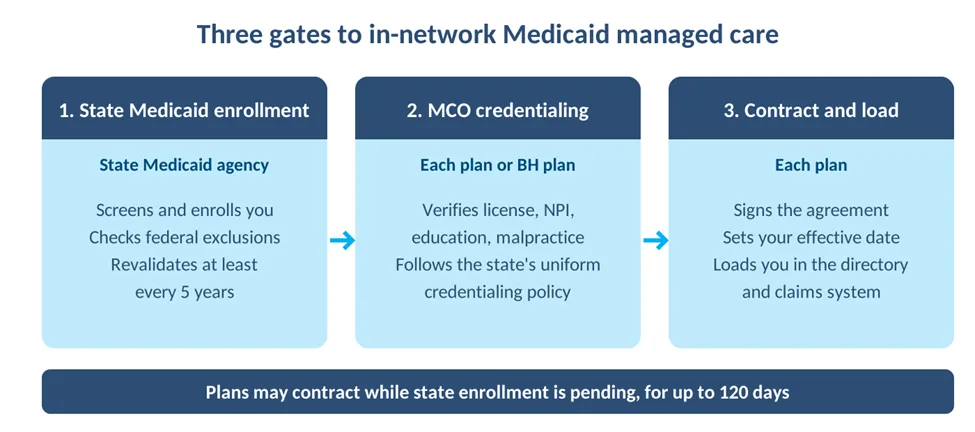
In short, state enrollment proves you can take part in Medicaid at all, and each plan then decides whether to add you to its own network.
Why Behavioral Health Adds Extra Steps
Under 42 CFR 438.214, each state must set one uniform credentialing and recredentialing policy that covers mental health and substance use disorder providers, and every Medicaid plan must follow it. Plans cannot discriminate against providers who serve high-risk populations or costly conditions, and they cannot contract with providers excluded from federal health care programs. States can add their own requirements on top.
The bigger practical difference is routing. Many states carve behavioral health out to a separate prepaid plan or regional entity, and many medical MCOs subcontract it to a behavioral health vendor. Sending your application to the medical plan’s general team can stall it for weeks. Our comparison of Medicare and Medicaid credentialing differences covers how the two programs diverge in general.
How to Get Credentialed With Medicaid Managed Care Plans
The order below keeps the state and plan applications moving together without rework.
- Confirm your license type is one your state Medicaid program enrolls, and note any supervision rules for associate-level clinicians.
- Make sure your name, address and taxonomy match across your license, the NPI registry (NPPES) and your W-9.
- Apply for state Medicaid enrollment through the state portal, as an individual and, for a group, as the group too.
- Complete or update your CAQH ProView profile and its role in credentialing, since most plans pull data from it.
- List the Medicaid plans in your area and ask each one which team or vendor handles behavioral health applications.
- Submit each plan’s application and track every request for missing documents.
- Review and sign each contract, then get the effective date in writing.
- Confirm you appear in the plan’s provider system before scheduling members, and test with one claim.
Provisional agreements and the 120-day limit
Under 42 CFR 438.602(b), the state must screen and enroll all managed care network providers, but a plan may sign a provisional agreement while that screening is pending for up to 120 days. If the state denies enrollment, or 120 days pass without it, the plan must end your participation. Starting the state application first protects you from that cut-off. State Medicaid sites explain their own process; for example, New York’s Medicaid managed care network enrollment page says unenrolled providers must enroll or leave the network.
Documents to Gather Before You Apply
Most applications ask for the same core items. Collect them once and store current copies in one place.
| Document | Why plans ask for it |
| State license and any supervision agreement | Confirms you may practice and bill at your level |
| Individual NPI, and group NPI if applicable | Identifies you and your practice on claims |
| W-9 and tax ID details | Links payment to the correct entity |
| Malpractice insurance certificate | Shows active coverage at the required limits |
| Degree and training records | Supports primary source verification |
| Work history and explanation of any gaps | Required by most credentialing policies |
| Practice location and hours, including telehealth | Needed for the provider directory |
| State Medicaid provider ID, once issued | Ties the plan record to your state enrollment |
How Long It Takes and What to Do Meanwhile
Timelines vary widely by state, plan and how complete your file is, so plan for several months from first application to first payable claim. Do not see a plan’s members as an in-network provider before your effective date, and check your state’s rules before treating a Medicaid member you cannot yet bill.
While you wait, set up front-desk checks so you know which plan each client has. Our guide to checking patient insurance eligibility step by step shows how to confirm the plan before the first visit.
Keeping Your Medicaid Network Status Active
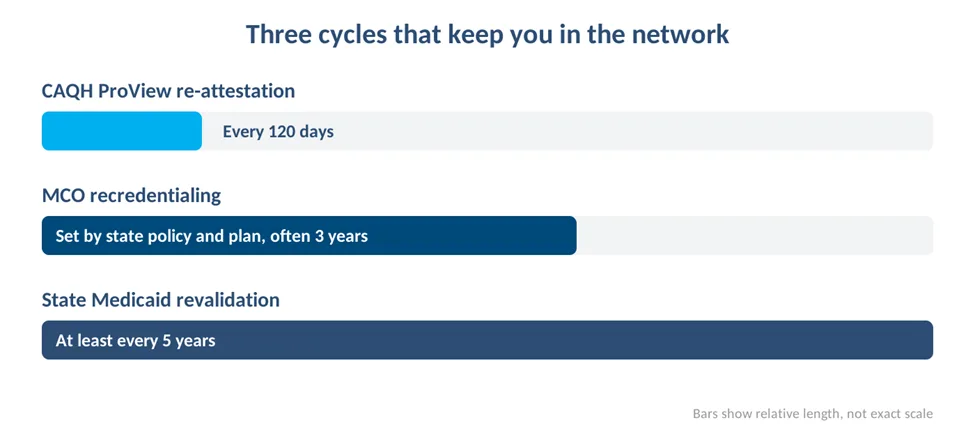
Getting in is only half the job. Three cycles run at once, and missing any of them can stop payments.
- CAQH ProView: re-attest every 120 days so plans see current data.
- Plan recredentialing: each MCO rechecks you on the schedule in the state policy, often every three years.
- State revalidation: CMS guidance tells states to revalidate every provider at least every five years, as stated in the Medicaid.gov revalidation guidance for state agencies.
Our explainer on re-credentialing versus initial enrollment covers what each renewal asks for.
Common Medicaid Credentialing Mistakes
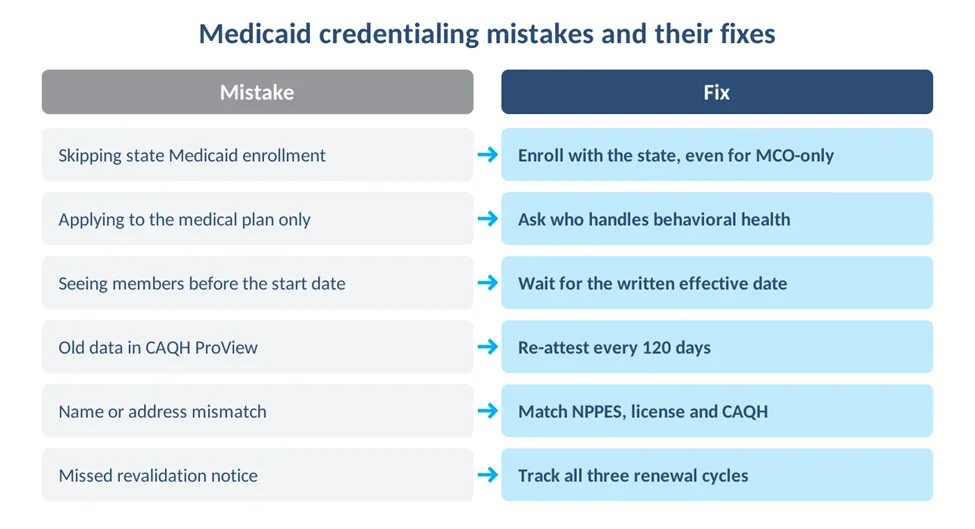
Most delays come from avoidable gaps rather than denials.
| Mistake | What happens | Prevention |
| Applying only to the MCO | Plan ends participation if state enrollment never completes | File the state application first |
| Wrong application door | Behavioral health file sits with the medical team | Ask each plan where behavioral health goes |
| Data mismatches | Plan returns the file for correction | Match NPPES, license, CAQH and W-9 |
| Seeing members early | Claims deny before the effective date | Wait for written confirmation |
| Missed renewals | Termination and payment holds | Track all three cycles on one calendar |
Our list of credentialing mistakes that delay payments covers more of these, and groups that work across state lines should read our guide to managing multi-state credentialing.
Frequently Asked Questions
Do I need state Medicaid enrollment to join a Medicaid MCO?
Yes. Federal rules require states to screen and enroll every provider in a Medicaid managed care network. You do not have to accept fee-for-service Medicaid patients, but you must be enrolled. A plan can contract with you while the state screens you, for up to 120 days, then must end participation if enrollment is not complete.
Is MCO credentialing the same for every plan in my state?
The rules are, but the applications are not. Each state sets one credentialing and recredentialing policy that all its Medicaid plans must follow, so the standards match. Each plan still runs its own application, committee and contract, so you apply separately to every plan you want to join.
Can associate-level or pre-licensed therapists join Medicaid plans?
It depends on the state. Some state Medicaid programs enroll certain associate-level clinicians under supervision, while others require full independent licensure. Check your state Medicaid provider manual and each plan’s behavioral health requirements before promising clients in-network coverage.
How often do I renew Medicaid managed care credentialing?
There are three cycles. CAQH ProView needs re-attestation every 120 days. Each plan recredentials you on the schedule in your state’s policy, commonly every three years. The state Medicaid program revalidates your enrollment at least every five years. Missing any one of them can interrupt payment.
Who handles behavioral health applications for Medicaid plans?
It varies. Some states carve behavioral health out to a separate plan or regional entity, and some medical plans subcontract it to a behavioral health vendor. Before applying, call each plan’s provider services line and ask which team or organization credentials therapists and behavioral health groups.
Final Considerations
Medicaid managed care credentialing goes smoothly when state enrollment, plan applications and renewals are run as one project rather than separate tasks. Once you are in network, our mental health billing guide covers coding and claims.
Aspect Billing Solutions is a HIPAA-compliant billing and credentialing company that assigns a dedicated agent to each provider. If you would like help with Medicaid plan applications, send us a message through our contact page.
Sources: 42 CFR 438.214 and 438.602 (Medicaid managed care); Medicaid.gov Sub-Regulatory Guidance 2016-001 on revalidation; New York Medicaid (eMedNY) managed care network enrollment page; CAQH ProView attestation rules. This article is general information, not legal advice. Rules vary by state, so confirm requirements with your state Medicaid agency and each plan.