
CPT Code 90853 Explained: How to Bill Group Therapy Right
CPT code 90853 reports group psychotherapy for unrelated patients, and you bill it once for each eligible patient who took part, under that patient’s own diagnosis and note.
Because the code descriptor does not specify a time requirement, payers determine claim reimbursement based on their rules for group size, billing units, and supporting documentation. This guide covers what 90853 includes, who can lead the group, how to build each claim, telehealth rules, the notes reviewers expect and the denials that hit group therapy most.
| Key takeaways 90853 is billed per patient, per session, usually as one unit, with each patient’s own diagnosis.The leader must be licensed to provide psychotherapy under state law and enrolled with the payer.Every member needs an individual note; one shared group summary does not support the claims.Medicare allows behavioral health telehealth in the patient’s home, using POS 02 or 10 as appropriate.Family sessions and multiple-family groups use different codes, not 90853. |
What Does CPT Code 90853 Cover?
CPT 90853 describes group psychotherapy other than a multiple-family group. It fits a planned session where a licensed leader uses the interaction between members as part of treatment for several unrelated patients at once. It is one code inside the wider psychotherapy family explained in our complete practice guide to mental health billing.
Unlike individual psychotherapy codes, the descriptor sets no time. Use this table to distinguish 90853 from the codes with which providers most commonly confuse it.
| Code | What it reports | Who takes part |
| 90853 | Group psychotherapy (other than of a multiple-family group) | Several unrelated patients and one leader |
| 90849 | Multiple-family group psychotherapy | Family members of several patients |
| 90847 | Family psychotherapy with the patient present | One patient and that patient’s family |
| 90846 | Family psychotherapy without the patient present | The family only |
| +90785 | Interactive complexity add-on | Reported with a primary psychotherapy code when a qualifying factor is documented |
What 90853 does not cover
A group is not billable as psychotherapy just because several patients meet together. Education classes, peer support meetings, socialization, recreation, music or art activities and outings do not count as group psychotherapy under Medicare coverage policy. The patient also needs enough cognitive capacity to communicate and take part; severe dementia or delirium that blocks effective communication makes the service not medically necessary.
Who Can Lead and Bill a 90853 Group?
State law must authorize the leader to provide psychotherapy, and the payer must enroll the leader as the rendering provider. The First Coast Medicare LCD L33252 on psychiatric evaluation and psychotherapy also caps a group at 12 people and expects the group to be sized so it can work therapeutically. Other Medicare contractors and commercial plans may set different limits, so check the policy that applies to your region and contract.
Medicare allows physicians, clinical psychologists, clinical social workers, nurse practitioners, clinical nurse specialists, and physician assistants to bill for psychotherapy services. Since January 1, 2024, marriage and family therapists and mental health counselors can enroll and bill as well. Our guide to billing under CMS’s latest behavioral health directives explains how those changes affect therapists. Medicaid programs and commercial plans keep their own provider lists, and some state Medicaid programs pay group counseling under HCPCS H-codes instead of 90853.
How to Bill CPT Code 90853, Step by Step
Treat one group session as several separate services, each built from that patient’s own record.
- Confirm group therapy is written into each patient’s treatment plan, and check each patient’s insurance eligibility and any visit limits before the first session.
- Record attendance, the start and stop time and the leader’s name for every session.
- Write an individual note for each patient who attended (see the checklist below).
- Create one claim line per patient: 90853, usually one unit, the patient’s own ICD-10-CM diagnosis and the leader as rendering provider.
- Add +90785 only for the patients whose notes describe a qualifying interactive complexity factor.
- Set the place of service: 11 for an office group, or 02 or 10 for telehealth based on where the patient is located.
- Run the claims through your scrubber to catch same-day code conflicts before submission.
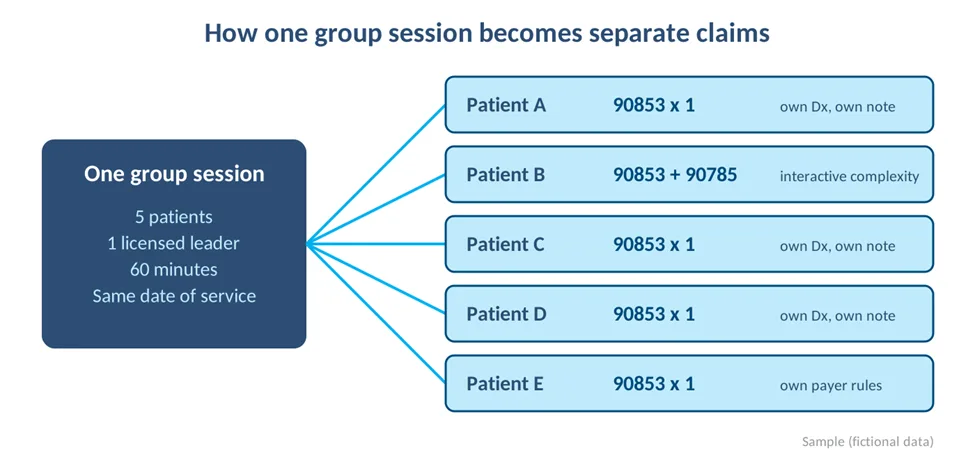
In short, the diagram illustrates how one group session involving five patients generates five separate claims, with the add-on code applied only when the requirements are met.
Sample claim lines for one group session
Sample (fictional data). Replace the patients, diagnoses and place of service with your own session details.
| Patient | Diagnosis (ICD-10-CM) | CPT codes | Units | POS |
| Patient A | F33.1 | 90853 | 1 | 11 |
| Patient B | F41.1 | 90853, +90785 | 1 each | 11 |
| Patient C | F43.10 | 90853 | 1 | 11 |
| Patient D | F32.1 | 90853 | 1 | 11 |
Group size, time and units
Since CPT 90853 has no time requirement in its descriptor, providers generally bill 60-minute and 90-minute group sessions the same way. Most payers expect one unit per patient per session, so read the contract before reporting more. Record start and stop times anyway; reviewers use them to confirm the service.
Adding interactive complexity (90785)
First Coast’s billing article A57520 lists group psychotherapy among the services that 90785 can accompany. Report it only for a patient whose note shows a factor such as a need to manage disruptive communication or a third party interfering with care. Do not report it for a patient who cannot communicate by any means.
Billing Group Therapy Through Telehealth
Medicare covers group psychotherapy as a telehealth service, and for 2026 CMS also added multiple-family group psychotherapy to its telehealth list. The CMS Medicare telehealth FAQ updated in October 2026 confirms that behavioral health telehealth can be received in the patient’s home, in rural or urban areas, and that audio-only behavioral health visits continue under current law through December 31, 2027.
Use POS 10 when the patient joins from home and POS 02 when the patient is somewhere else, such as a clinic. Commercial plans set their own telehealth modifiers and place-of-service rules, so our comparison of modifier 95 and GT for telehealth claims is a useful check before you bill a virtual group.
Group Therapy Inside IOP and PHP Programs
Programs often include groups delivered in intensive outpatient or partial hospitalization settings as part of the overall program rather than billing them as stand-alone 90853 claims, depending on the setting and payer. Our guides to substance abuse IOP billing and partial hospitalization program billing cover those methods.
Documentation Each Group Note Needs
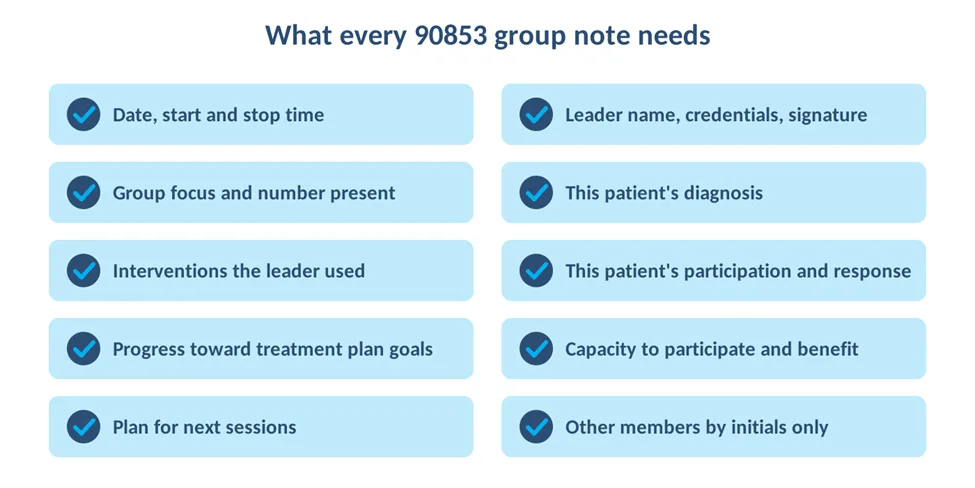
LCD L33252 requires providers to document the patient’s ability to participate in and benefit from group and family psychotherapy, while following and monitoring the treatment plan. In practice, each note needs the elements below.
| Element | What to write |
| Session facts | Date, start and stop time, number of members present and the group’s focus |
| Patient diagnosis | The diagnosis this patient is being treated for in the group |
| Interventions | What the leader did, such as cognitive restructuring or role play |
| Participation | How this patient took part and responded during the session |
| Progress | Movement toward the goals in this patient’s treatment plan |
| Capacity | Whether the patient can take part in and benefit from the group, reviewed periodically |
| Plan | Next steps, frequency and any change to the plan |
| Privacy and signature | Other members not named in this patient’s record; leader name, credentials and signature |
Common 90853 Denials and How to Prevent Them
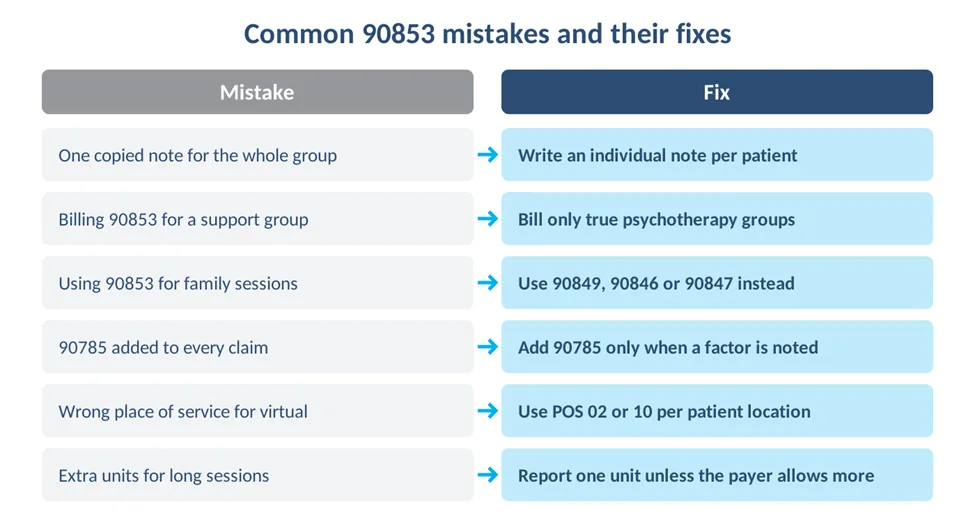
Check the claim adjustment reason code (CARC) and remittance advice remark code (RARC) on the explanation of benefits (EOB) or electronic remittance advice (ERA) to see which problem you face.
| Problem | Likely cause | Prevention |
| Denied as not medically necessary | Note does not tie the group to the patient’s plan or diagnosis | Link each note to treatment plan goals |
| Bundled with individual therapy | Same-day individual and group psychotherapy for one patient | Check payer policy and edits; document separate times and need |
| Wrong code for the session | Family or multiple-family session billed as 90853 | Match the code to who was in the room |
| Provider not eligible | Leader not licensed or not enrolled with the plan | Confirm enrollment before the group starts |
| Telehealth rejection | Wrong POS or missing payer-required modifier | Follow each payer’s telehealth billing rules |
If a payer bundles a same-day individual session into the group claim, our breakdown of CO-97 bundling denials and NCCI edits explains when a modifier is appropriate and when it is not.
Frequently Asked Questions
Can you bill 90853 and 90834 on the same day?
Sometimes. Some payers deny individual and group psychotherapy for the same patient on the same date, while others pay both when each is medically necessary and clearly documented. Record separate start and stop times, explain why both were needed and check the payer’s policy and edit rules before submitting. Use a modifier only when the payer allows it.
Is there a minimum time for 90853?
No. The CPT descriptor for 90853 has no time requirement, so a group is billed the same way whatever its length. Payers can still set expectations in their contracts or policies, and reviewers look at start and stop times, so always record them in each patient’s note. Check your payer manual for any session-length rule.
How many patients can be in a 90853 group?
There is no national CPT limit. Medicare contractor First Coast caps groups at 12 people in LCD L33252 and expects a size that can work therapeutically. Other Medicare contractors, Medicaid programs and commercial plans may set their own limits in policy or contract terms, so confirm the number that applies before building a group.
Can 90853 be billed through telehealth?
Yes for Medicare, which lists group psychotherapy as a telehealth service and allows behavioral health telehealth in the patient’s home. Use POS 10 for patients at home and POS 02 for other locations. Commercial plans and Medicaid set their own rules on platforms, modifiers and audio-only groups, so read each payer’s telehealth policy first.
Can LMFTs and LPCs bill 90853 to Medicare?
Yes, if they qualify. Since January 1, 2024, Medicare enrolls marriage and family therapists and mental health counselors, who can then bill psychotherapy codes, including 90853, within their state scope of practice. They must be enrolled before billing, and claims for services before their enrollment effective date will not be paid.
Final Considerations
CPT code 90853 claims get paid when each one stands on its own: the right code, that patient’s diagnosis, an individual note and a leader the payer recognizes. Build those habits into your note templates to prevent most group therapy denials.
Aspect Billing Solutions is a HIPAA-compliant billing and coding company that assigns a dedicated agent to each provider. If you would like help coding and submitting group therapy claims, see our medical billing and coding service or send us a message through our contact page.