
Medical Claim Scrubbing and Clean Claim Rate: How They Work Together in 2026
Medical claim scrubbing is the automated review of a claim against coding, payer and format rules before submission, and clean claim rate is the percentage of submitted claims that pass without rejection, denial or a request for more information. Scrubbing is the process; clean claim rate is the scorecard that shows whether the process works.
Two practices can both report a 95% clean claim rate and still collect at very different speeds, because the term has no single definition. Some count claims a clearinghouse accepts, others count claims a payer pays. This guide explains medical claim scrubbing and clean claim rate in plain terms, shows what a scrubber checks, gives four worked calculations and ends with a ten-question self-assessment checklist.
Claim scrubbing and clean claim rate: key numbers at a glance
Seven numbers anchor most scrubbing decisions, and three of them are published timing and update standards rather than targets. Table 1 sets them beside practical benchmarks and a review rhythm, so a billing lead can see which figures are fixed and which are goals.
Key numbers cheat sheet
| Metric | Practical target/range | Review frequency | Source type |
| Medicare payment floor | Earliest release is 14 days after submission, counting the submission day | Per claim batch | Published standard |
| Medicare clean-claim processing window | Up to 30 days to process clean claims without interest | Weekly A/R review | Published standard |
| NCCI edit file updates | Quarterly; Q4 2026 files took effect October 1, 2026 | Each quarter | Published standard |
| Clean claim rate | Commonly cited target of about 95%; below about 90% usually warrants root-cause review | Weekly, split by payer | Practical target |
| Initial denial rate | Many practices aim for under about 5% | Monthly | Practical target |
| Clearinghouse rejection rate | Many practices aim for under about 3% | Weekly | Practical target |
| Scrubber rule review | Monthly, plus after every quarterly edit update and payer bulletin | Monthly | Practical target |
Source type: Published standard = stated by CMS or a Medicare Administrative Contractor (CGS, citing CMS manuals; CMS NCCI page). Practical target = commonly cited across industry sources and Aspect Billing Solutions’ working guidelines; no payer, CMS, HFMA or MGMA mandate sets these numbers.
How are claim scrubbing and clean claim rate related?
Claim scrubbing is the action and clean claim rate is the result. A claim scrubber is software, built into a practice management system or a clearinghouse, that applies rules to each claim and flags errors before the payer sees it. The more errors scrubbing catches, the higher the clean claim rate usually climbs.
The word “clean” has an official meaning for Medicare. CGS Medicare, citing CMS manuals, defines a clean claim as one with no circumstance or defect that would inhibit timely payment. A claim is not clean if the contractor has asked for medical records. Practices often use a looser everyday meaning, which is why Table 2 separates four related measures. For denials, the HFMA Claim Integrity Task Force report gives the standard initial denial rate definition.
Four claim metrics that are often confused
| Metric | Formula | Measured at | What it tells you |
| First-pass acceptance rate | Claims accepted by clearinghouse ÷ claims submitted × 100 | Clearinghouse | Format and front-end rule quality |
| Clean claim rate | (Claims submitted − rejected − denied − held for information) ÷ claims submitted × 100 | Clearinghouse and payer | Overall claim quality at submission |
| First-pass resolution rate | Claims paid on first submission ÷ claims submitted × 100 | Payer remittance | Cash-flow reality |
| Initial denial rate | Claims with an initial denial ÷ claims submitted × 100 | Payer remittance | Payer-side failures |
Sources: formulas are standard industry usage. HFMA’s Claim Integrity Task Force defines initial denial rate (claim-level volume and dollar versions) but does not define clean claim rate or set targets. Practices should write down which version they use.
The choice of definition changes the score. A clearinghouse may accept 98% of claims, yet payers still deny a share on medical necessity or eligibility. AKASA’s head of revenue cycle operations cautioned in a 2021 survey release, reported by TechTarget, that clean claim metrics can make performance look better than it is. Tracking first-pass resolution alongside it closes that gap.
Where do scrubbing checkpoints sit between charge entry and payment?
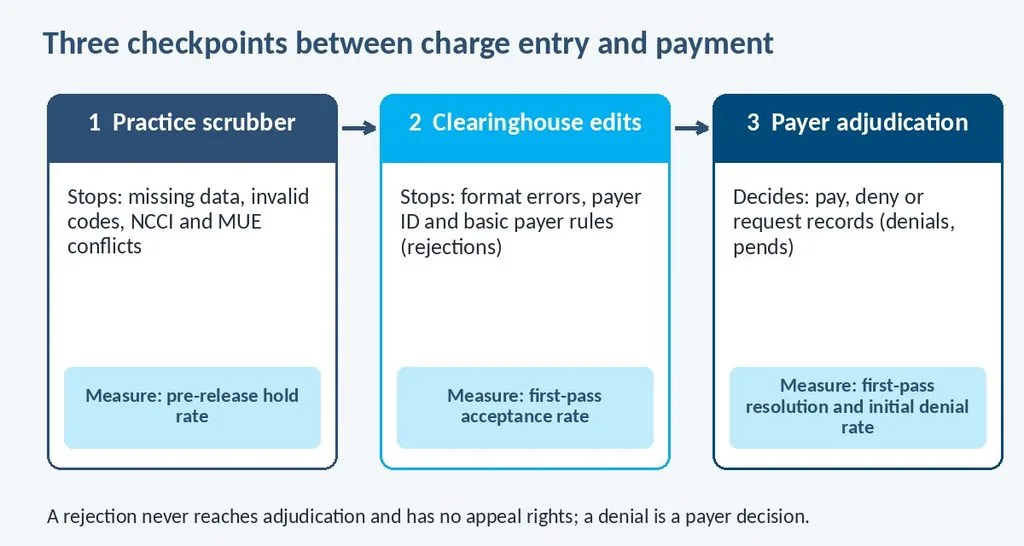
A claim passes up to three checkpoints: the practice’s own scrubber, the clearinghouse edits and the payer’s adjudication system. A clearinghouse is the intermediary that reformats and routes claims. Each checkpoint stops different problems, so a single metric cannot describe all three.
The difference between a rejection and a denial matters here. A claim rejection means the claim failed technical or data checks and never entered adjudication. Noridian Medicare describes these as unprocessable claims, returned with remittance message MA130, which “is not denied” and carries no appeal rights. The practice corrects and resubmits instead. The guide to claim rejections lists the most common causes.
A denial is a payer decision on a claim it did process. Scrubbing prevents rejections directly and prevents some denials indirectly, by catching missing modifiers or coverage mismatches before submission. In billing audits, a common pattern is a practice that celebrates a low rejection rate while denials for eligibility and authorization quietly rise, because those problems sit outside most scrubber rule sets. Pair scrubbing with eligibility verification for that reason.
What does a claim scrubber actually check?
A scrubber checks six families of rules: patient and provider data, code validity, code combinations, units, medical necessity and payer-specific requirements. Table 3 lists examples for each, and the strongest rule sets combine published CMS edits with payer-specific rules built from a practice’s own remittance history.
Common scrubber edit families
| Edit family | Example check | Typical error caught |
| Patient and provider data | Name and date of birth match, member ID present, rendering and billing NPI valid | Rejection for mismatched or missing demographics |
| Code validity | CPT, HCPCS and ICD-10-CM codes are active for the date of service | Retired or truncated diagnosis code |
| Code combinations | NCCI procedure-to-procedure edits: a Column Two code billed with a Column One code needs an allowed modifier | Bundling denial (see CO-97) |
| Units | Medically unlikely edits (MUEs) cap units of service per code per day | Unit count above the published limit |
| Medical necessity | Diagnosis supports the procedure under the payer’s policy | Denial for lack of medical necessity |
| Payer-specific rules | Authorization number present; plan-specific modifier or place-of-service rule | Denial for missing authorization or invalid modifier |
Sources: CMS NCCI page (PTP edits and MUEs); Noridian Medicare terminology. The examples are illustrative of typical rule sets, not a complete list, and individual scrubbers vary.
Medicare’s own edits change often. CMS states that it posts changes to the NCCI PTP files on a quarterly basis, and the CMS NCCI procedure-to-procedure page listed Quarter 4 2026 files effective October 1, 2026. Under a PTP edit, the Column Two code is denied unless a clinically appropriate modifier is also reported. The CO-97 denial code guide explains how those bundling denials appear on remittances.
Rules also need clinical context. A scrubber can confirm that modifier 25 is present but cannot judge whether the visit note supports a separate service. Our team often sees practices treat a passed scrub as a coding sign-off. Use scrubbing to catch rule violations, and keep periodic coding audits for documentation questions.
How do you run claim scrubbing step by step?
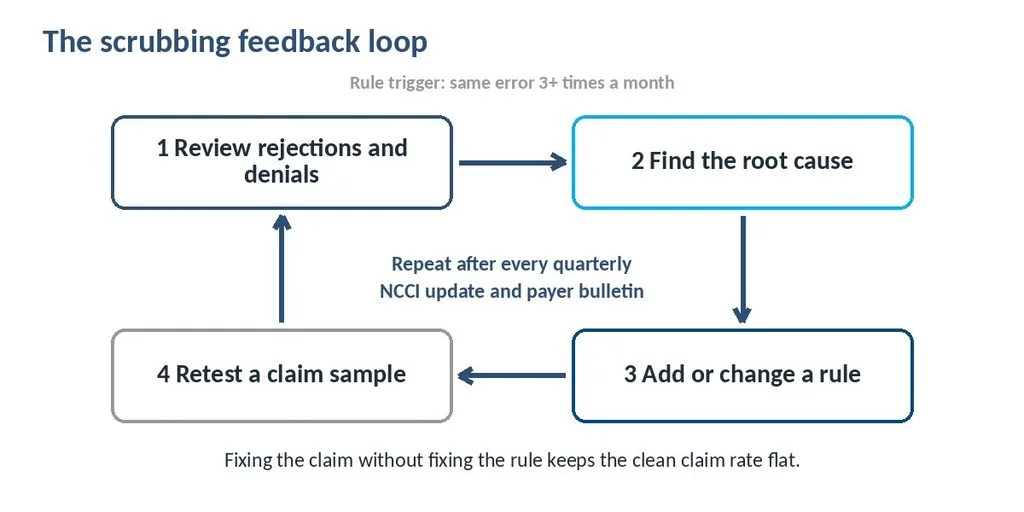
Effective scrubbing is a loop with six steps, and the feedback step is the one most practices skip. Follow the order below when setting up a new scrubber or tightening an old one, and assign an owner to each step so rule changes do not stall.
- Fix the front end first. Verify eligibility and collect complete demographics at check-in, using a routine like the front-end RCM workflow. Scrubbers cannot repair what was never captured.
- Run claims through the practice scrubber before release. Hold flagged claims for review instead of sending them with warnings.
- Review clearinghouse rejection reports daily. Correct and resubmit within the same day when possible, and log the reason code.
- Track payer outcomes weekly. Compare rejection, denial and first-pass resolution rates by payer rather than in one blended number.
- Turn each repeat error into a rule. When the same rejection or denial appears three or more times in a month, add or adjust an edit. This is the feedback step.
- Retest after every update. Re-run a sample of recent claims after each quarterly NCCI release, code-set update and payer bulletin.
A clearinghouse adds a second layer of edits, and automated claim submission speeds release once rules are stable. Do not rely on the clearinghouse alone when the practice scrubber is absent, because clearinghouse edits mainly test format and common payer requirements. The denial prevention checklist can double as a pre-release review list.
Scrubbing and clean claim rules by payer: Medicare, Medicare Advantage, Medicaid and commercial plans
Payer type changes which edits matter and how long a clean claim takes to pay. Table 4 summarizes the main differences, using published CMS and contractor statements for Medicare and flagging the rest as illustrative guidance, since contracts and states differ.
Payer differences (illustrative except where a source is named)
| Payer type | Edits and clean-claim rules | Timing | What to check |
| Medicare (fee-for-service) | NCCI PTP and MUE edits apply; unprocessable claims return with MA130 and no appeal rights; clean claim means no defect inhibiting timely payment | Payment floor 14 days; up to 30 days for clean claims without interest | Quarterly NCCI files; MAC bulletins |
| Medicare Advantage | Plan-specific edits and authorization rules; contracts govern | Set by the provider contract | Plan manuals and portal alerts |
| Medicaid | State-specific edits, billing manuals and fee schedules | State rules apply | State Medicaid agency bulletins |
| Commercial plans | Own edit logic and policies; often stricter on modifiers, authorizations and medical necessity | Contract and state prompt-pay law | Payer provider manual and contract |
Sources: CGS Medicare payment timeframe page; Noridian Medicare terminology; CMS NCCI page. Illustrative where no source is named; actual rules vary by contract and state.
The Medicare timing figures come from the CGS payment timeframe page, which states that a claim can be released for payment no sooner than 14 days after submission and that contractors have up to 30 days to process clean claims without interest. Commercial and Medicaid timelines differ, so check your contract and state prompt-pay rules before setting cash forecasts.
Four calculations that show whether scrubbing is working
Four short calculations show whether scrubbing is lifting the clean claim rate or merely moving problems around. Each example is illustrative, opens with its formula and can be rerun with a practice’s own remittance and clearinghouse data. Replace every sample figure with real counts before drawing any conclusion.
Example 1: clean claim rate
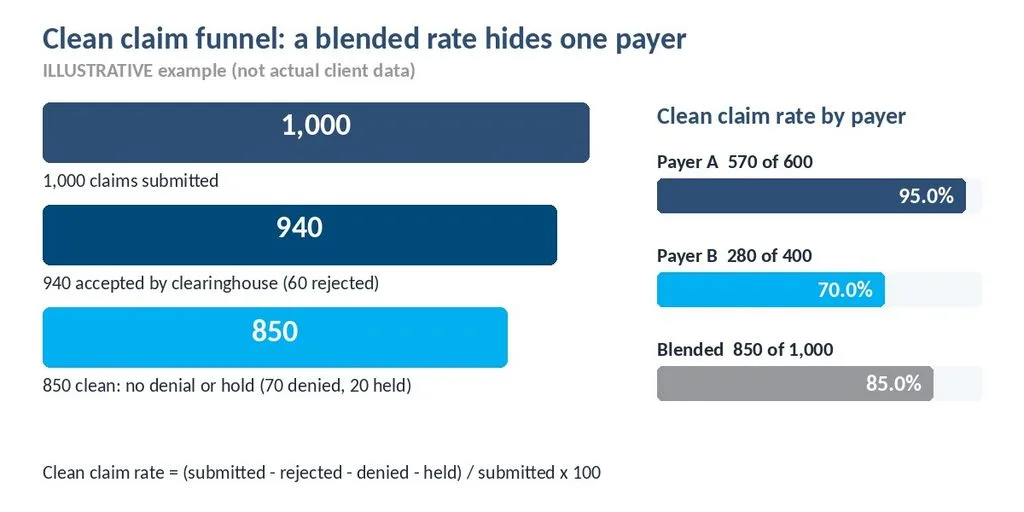
Formula: clean claim rate = (claims submitted − rejected − denied − held for information) ÷ claims submitted × 100. Illustrative scenario (not an actual client record): a practice submits 1,000 claims in a month; 60 are rejected, 70 are denied and 20 are held for records. The clean count is 1,000 − 60 − 70 − 20 = 850, so the clean claim rate is 85.0%.
Example 2: blended rate by payer
Formula: payer clean rate = clean claims for the payer ÷ claims submitted to that payer × 100. Illustrative scenario (not an actual client record): Payer A receives 600 claims and 570 are clean, which is 95.0%. Payer B receives 400 claims and 280 are clean, which is 70.0%. Blended, 850 ÷ 1,000 = 85.0%. The blended figure hides a payer whose rules the scrubber probably lacks.
Example 3: rework cost
Formula: monthly rework cost = non-clean claims × cost per reworked claim. Illustrative scenario (not an actual client record): assume $25 of staff time per reworked claim, a figure each practice should replace with its own. At 85.0%, 150 claims need rework, costing $3,750. At 92.0%, 80 claims need rework, costing $2,000, a difference of $1,750 per 1,000 claims.
Example 4: cash-timing impact of a rejection
Formula: earliest Medicare release = submission date + 13 days, because the 14-day floor counts the submission day. Illustrative scenario (not an actual client record): a clean claim submitted October 1 can be released about October 14. If it is rejected and resubmitted on October 8, the earliest release moves to about October 21, a one-week delay before any payer processing time.
How to use these numbers correctly
Compare like with like: one payer against its own history, and one specialty against similar practices. One missed benchmark is a signal to investigate, not a verdict. When a rate dips, split the month by payer, by rejection reason and by claim age before changing any rule.
How long does it take to raise a clean claim rate?
Partial improvement often appears within 30 to 60 days after rule fixes, and a full cleanup commonly takes 90 to 180 days. These are general planning ranges, not guarantees. Quick wins come from correcting missing data and code-validity edits. Slower gains come from payer-specific rules, staff habits and eligibility problems, and results vary by specialty and payer mix.
Which scrubbing mistakes keep clean claim rates low?
Most low clean claim rates trace to six repeatable mistakes, and each has a concrete fix. Review them quarterly alongside the practice’s denial rate trends, and assign each fix to a named owner so the list does not become a wish list.
- Stale rules. Update edits after each quarterly NCCI release, every October 1 and January 1 code update and each payer bulletin. Do this before the effective date, not after the first denials.
- Fixing claims but not rules. Our team often sees staff correct the same rejection weekly while the rule that would stop it is never written. Convert any error that repeats three times into an edit.
- Overriding warnings. Release held claims only when a reviewer documents the reason. Blanket overrides defeat the purpose.
- Counting the wrong thing. Choose one written definition of clean claim and apply it every month. Mixing clearinghouse acceptance with payer payment inflates the score.
- Reporting only a blended rate. Split by payer and specialty whenever volume allows.
- Skipping upstream checks. Verify eligibility and authorization before service, because a scrubber cannot see a coverage lapse.
Quick summary
- Claim scrubbing is the pre-submission check; clean claim rate is the measure of its results.
- Pick one written definition of “clean” and track first-pass resolution beside it.
- A commonly cited practical target is a clean claim rate near 95%, not a mandate.
- Medicare’s 14-day floor and 30-day clean-claim window are published timing standards.
- Update rules after every quarterly NCCI release and payer bulletin.
- Split every metric by payer; a blended average can hide a failing plan.
Self-assessment: is your scrubbing process working?
Answer yes or no to each question, using last month’s data wherever a question mentions a rate. The scoring guide below the list shows what the total suggests and what to do next. A “no” is a to-do, not a failure.
- Do you have a written definition of “clean claim” and use it every month?
- Do claims pass a practice-level scrubber before release?
- Are flagged claims held and reviewed instead of sent with warnings?
- Is your clean claim rate about 95% or at least above 90%?
- Do you track clean claim rate and first-pass resolution rate by payer?
- Is your clearinghouse rejection rate under about 3%?
- Is your initial denial rate under about 5%?
- Do you review rejection reports daily and log reasons?
- Do you update scrubber rules after each quarterly NCCI release and payer bulletin?
- Do you verify eligibility and authorization before service?
Scoring guide
| Yes answers | What it suggests | Next step |
| 9-10 | Scrubbing process looks mature | Keep monthly rule reviews and quarterly retests |
| 6-8 | Gaps worth closing | Fix the “no” items first and re-measure in 60 days |
| 0-5 | High risk of rework and delayed cash | Define metrics, split by payer and rebuild the rule set |
Scoring is a practical guide, not a published standard.
When does outside billing support make sense?
Outside support makes sense when the in-house scrubbing loop has stalled, and the stall shows up in rework before it shows up in cash. Consider help when several of these five signals are already present, since each one tends to compound the others across billing cycles:
- The clean claim rate has stayed below about 90% for two or more months.
- One payer produces most rejections, and nobody owns its rules.
- Staff fix the same errors weekly without changing the scrubber.
- Quarterly code and edit updates are applied late or inconsistently.
- Denials for eligibility or authorization keep rising even as rejections fall.
When evaluating a partner, look for payer-level reporting, a documented rule-update process, experience with your specialty and signed HIPAA safeguards. Aspect Billing Solutions is one example. It provides HIPAA-compliant, end-to-end medical billing and coding, credentialing, eligibility verification and prior authorization, denial management, A/R follow-up and compliance support, with a dedicated agent assigned to each provider. Results vary by practice. A medical billing audit is a practical starting point, and the revenue cycle management service page describes the full approach.
Practices comparing options can also review how Aspect Billing Solutions’ billing and coding services fit together. The revenue cycle metrics guide explains which numbers belong on a monthly dashboard, and both help frame the first conversation with any partner, including questions about reporting and rule ownership.
Final Considerations
Medical claim scrubbing and clean claim rate belong in the same conversation: one is the control, the other is the proof. Scrubbing earns its value only when rejections feed back into rules, and the clean claim rate earns trust only when its definition is written down and split by payer.
Firm published standards here are Medicare’s 14-day payment floor, the 30-day clean-claim window, the Medicare definition of a clean claim, the MA130 unprocessable-claim treatment and the quarterly NCCI update cycle. The 95% clean claim target, the 3% and 5% rate goals, the timeframe ranges and every worked example are practical or illustrative.
The next question is which of your payers is quietly dragging the average down. To find out, ask Aspect Billing Solutions for a claim scrubbing review and bring last month’s remittance data by payer, so the review can compare each plan with its own history.
Frequently asked questions
What is medical claim scrubbing?
Medical claim scrubbing is the automated review of a claim against coding, payer and format rules before submission. A claim scrubber flags missing data, invalid codes, bundling conflicts and unit errors so staff can correct them first. The goal is fewer rejections, fewer denials and faster payment.
What is a clean claim rate?
Clean claim rate is the percentage of submitted claims that pass without rejection, denial or a request for more information. The common formula is clean claims divided by total claims submitted, multiplied by 100. Practices should document whether clean means clearinghouse-accepted or payer-paid.
What is a good clean claim rate?
Many practices aim for a clean claim rate near 95%, and rates below about 90% usually justify a root-cause review. These figures are commonly cited practical targets, not CMS, HFMA or MGMA mandates. Compare each payer to its own history, because specialty and payer mix change results.
What is a good initial denial rate?
Many practices aim to keep the initial denial rate under about 5%. HFMA’s Claim Integrity Task Force defines the metric at the claim level but sets no target, so this goal is a practical convention. Track it by payer and denial reason, because blended rates can mask one failing plan.
Does a claim scrubber guarantee payment?
No. A scrubber catches rule violations before submission, but it cannot confirm coverage changes, judge whether documentation supports the service or predict every payer decision. Passing a scrub raises the odds of payment, so pair scrubbing with eligibility checks, coding audits and denial analysis.
What is the difference between clean claim rate and first-pass resolution rate?
Clean claim rate measures claims that pass checks without problems, often at the clearinghouse or payer acceptance stage. First-pass resolution rate counts claims actually paid on first submission. The second is stricter and closer to cash flow, so tracking both exposes issues the first can hide.
Sources and methodology
(a) Published standards and definitions from named bodies
- CGS Medicare, Payment Timeframes for Medicare Claims (14-day payment floor; up to 30 days for clean claims; definition of a clean claim, citing CMS Pub. 100-04, Chapter 1).
- CMS, Medicare NCCI Procedure to Procedure (PTP) Edits (quarterly updates; Q4 2026 files effective October 1, 2026; Column Two denial unless an appropriate modifier is reported).
- Noridian Healthcare Solutions, Incomplete or Invalid Claims Processing Terminology (unprocessable claims, MA130, no appeal rights).
- HFMA, Claim Integrity Task Force: Standardizing denial metrics for revenue cycle benchmarking and process improvement (initial denial rate definition; no clean claim rate definition or targets).
(b) Named benchmarking data providers
None. No MGMA or other benchmarking-provider figures are cited in this article.
(c) Practical or illustrative targets from general industry sources
- The 95% clean claim target, the 90% review threshold, the 5% initial denial goal and the 3% clearinghouse rejection goal are commonly cited across industry sources, including vendor guides, and are not mandated by CMS, HFMA or MGMA.
- The 30 to 60 day and 90 to 180 day improvement ranges are general planning ranges, not guarantees.
- All worked examples, including the $25 rework assumption, are labeled illustrative.
(d) Survey or study data
- AKASA survey release (September 2021), as reported by TechTarget: comment from AKASA’s head of revenue cycle operations on clean claim metrics.
Results vary by practice, payer and state. Figures and rules reflect information available in October 2026, and codes, edit files and payer policies change often.