
UB-04 vs CMS-1500: Which Claim Form Fits Your Practice in 2026?
The UB-04, also called the CMS-1450, is the institutional claim form that hospitals, nursing facilities and clinics such as rural health centers use to bill facility charges. The CMS-1500 is the professional claim form that physicians, practitioners and suppliers use to bill clinician services. Electronic claims mirror the split: 837I for institutional, 837P for professional.
Sending a claim on the wrong form is cheap to prevent and slow to fix. A rejected claim restarts the payment clock, and Medicare’s 12-month filing limit leaves little room for repeated corrections. This guide explains UB-04 vs CMS-1500 in practical terms: who files each form, what each captures, why one hospital visit can need both, and how payers differ. It closes with a ten-question self-assessment checklist, so a billing manager can score current claim-form habits in about ten minutes.
Which numbers matter most when picking a claim form?
Seven figures cover most form-selection questions, and five of them come from published rules rather than industry habit. Table 1 lists each with a review rhythm, so the numbers can sit on a billing dashboard instead of in someone’s memory.
Key numbers cheat sheet
| Metric | Practical target/range | Review frequency | Source type |
| Medicare filing limit | 12 months from the date of service; institutional claims use the “through” date | Every claim; audit monthly | Published standard |
| CMS-1500 paper service lines | 6 per form | When billing on paper or splitting claims | Published standard |
| CMS-1500 diagnosis codes | Up to 12 per claim (Item 21, letters A-L) | Every claim | Published standard |
| UB-04 service lines per page | 22 lines plus a totals line (line 23) | Every claim | Published standard |
| ASCA paper-claim exception (Medicare) | Fewer than 10 full-time equivalent employees | Yearly | Published standard |
| First-pass clean claim rate | Commonly targeted at 95% or higher, tracked by claim type | Monthly | Industry convention |
| Claim-type or form rejections | As close to zero as practical; investigate any repeat reason | Weekly | Practical target |
Source type: Published standard = defined by a named body (NUCC, NUBC, CMS or a Medicare Administrative Contractor). Industry convention = a target commonly cited across industry sources, not mandated by CMS or any standards body. Practical target = Aspect Billing Solutions’ working guideline.
How does UB-04 vs CMS-1500 differ on a real claim?
The CMS-1500 reports a clinician’s services line by line with CPT or HCPCS codes, while the UB-04 reports a facility’s charges by revenue code under a type of bill. A professional claim covers the work of a physician or practitioner. An institutional claim covers the facility’s resources: rooms, nursing, supplies and outpatient department services. Older names still circulate. The CMS-1500 was once the HCFA 1500, and the UB-04 is the form behind the CMS-1450 data set.
Electronic claims follow the same line. The 837P transaction carries CMS-1500 data and the 837I carries UB-04 data. A type of bill is a four-character code in form locator (FL) 4 that identifies the facility type, the classification of care and the bill’s sequence within an episode of care. A revenue code is a four-digit NUBC code naming the department or service category being charged. Unfamiliar terms are defined in Aspect Billing Solutions’ medical billing terminology guide.
UB-04 vs CMS-1500 side by side (published form rules; payer rules vary)
| Feature | CMS-1500 | UB-04 (CMS-1450) |
| Bills for | A clinician’s own professional services | A facility’s charges: room and board, nursing, supplies, outpatient department services |
| Typical filers | Physicians, nurse practitioners, therapists, suppliers, Medicare ASCs | Hospitals, critical access hospitals, skilled nursing facilities, home health, hospice, rural health clinics, FQHCs |
| Electronic format | 837P | 837I |
| Service coding | CPT or HCPCS Level II with modifiers; place of service on each line | Revenue codes (FL 42) with HCPCS where required (FL 44); type of bill (FL 4) |
| Diagnoses and procedures | Up to 12 ICD-10-CM diagnoses (Item 21) | Principal diagnosis (FL 67) with present-on-admission indicator; ICD-10-PCS procedures on inpatient claims (FL 74) |
| Capacity | 6 service lines per form | 22 service lines plus a totals line per page |
| Maintained by | NUCC (1500 Claim Form, version 02/12) | NUBC (Official UB-04 Data Specifications Manual) |
| Medicare completion rules | Claims Processing Manual, Chapter 26 | Claims Processing Manual, Chapter 25 |
Sources: CMS Medicare Claims Processing Manual Chapters 25 and 26; NUCC 1500 Claim Form Reference Instruction Manual; NUBC UB-04 manual information.
Two shortcuts cause trouble. “Part B means CMS-1500 and Part A means UB-04” is wrong, because hospital outpatient services are billed on the UB-04 even though Part B pays them. “The UB-04 uses revenue codes instead of CPT” is also wrong: Chapter 25 of the Medicare Claims Processing Manual directs outpatient services to report the HCPCS code in FL 44 beside the revenue code.
Some details change every year. The NUBC manual runs on a July 1 to June 30 subscription cycle, and its current edition is valid through June 30, 2027. The NUCC releases instruction manual updates annually, so confirm the edition on nucc.org. As of October 2026, the NUCC announcements page showed no change to the 02/12 claim form layout.
Where do the same data elements sit on each form?
The same information lives in different places on each form, and Table 3 maps the fields billers look up most often. Matching them before submission prevents many data-entry rejections, because each payer edit reads a specific box on the CMS-1500 or a specific position among the UB-04’s form locators (FL).
Where the same information lives on each form
| Data element | CMS-1500 box | UB-04 form locator |
| ICD version | Item 21 indicator (0 = ICD-10-CM) | FL 66 qualifier (0 = ICD-10) |
| Diagnosis | Item 21, letters A-L | FL 67 principal diagnosis with POA indicator |
| Service or procedure | Item 24D (CPT or HCPCS plus modifier) | FL 44 (HCPCS, outpatient); FL 74 (ICD-10-PCS, inpatient) |
| Charges | Item 24F, per service line | FL 47, per revenue-code line |
| Billing provider NPI | Item 33a | FL 56 |
| Treating clinician | Item 24J rendering NPI | FL 76 attending provider |
| Setting | Item 24B place of service (two-digit code) | FL 4 type of bill |
Sources: CMS Medicare Claims Processing Manual Chapters 25 and 26; NUCC 1500 Claim Form Reference Instruction Manual.
Which providers bill on the UB-04 and which on the CMS-1500?
Facilities that bill for rooms, nursing and outpatient department services use the UB-04, and clinicians billing their own work use the CMS-1500. Medicare’s institutional provider list includes hospitals, skilled nursing facilities, home health agencies, hospice organizations, critical access hospitals, federally qualified health centers and rural health clinics, according to the CMS booklet MLN006926.
Typical claim form by setting (Medicare rules; other payers may differ)
| Setting | Facility or clinic charges | Professional charges |
| Independent physician office | Not applicable | CMS-1500 / 837P |
| Hospital outpatient department | UB-04 / 837I (type of bill 13X) | CMS-1500 / 837P, POS 22 on campus or POS 19 off campus |
| Medicare ambulatory surgical center (freestanding or hospital-operated) | CMS-1500 / 837P | CMS-1500 / 837P |
| Rural health clinic or FQHC | UB-04 / 837I | Included in the clinic’s institutional claim |
| Critical access hospital, Method II clinic | UB-04 / 837I (type of bill 85X) | Included on the UB-04 |
| Skilled nursing facility | UB-04 / 837I | Visiting clinicians: CMS-1500 / 837P |
Sources: CMS MLN006926; Noridian Medicare provider-based facilities guidance; ResDAC (Medicare ASC billing). Commercial and Medicaid plans can differ.
Mixed workflows cause the most errors. A team supporting a rural health clinic, a federally qualified health center or a critical access hospital works mainly on institutional claims, while the employed clinicians around them may still bill professionally. Ambulatory surgery is a special case: Medicare ASCs bill on the CMS-1500 even when a hospital runs them, though commercial payers sometimes ask for a UB-04, so follow each payer’s written rule. The ASC financial metrics guide covers what else to track there.
How do you decide which form a claim needs?
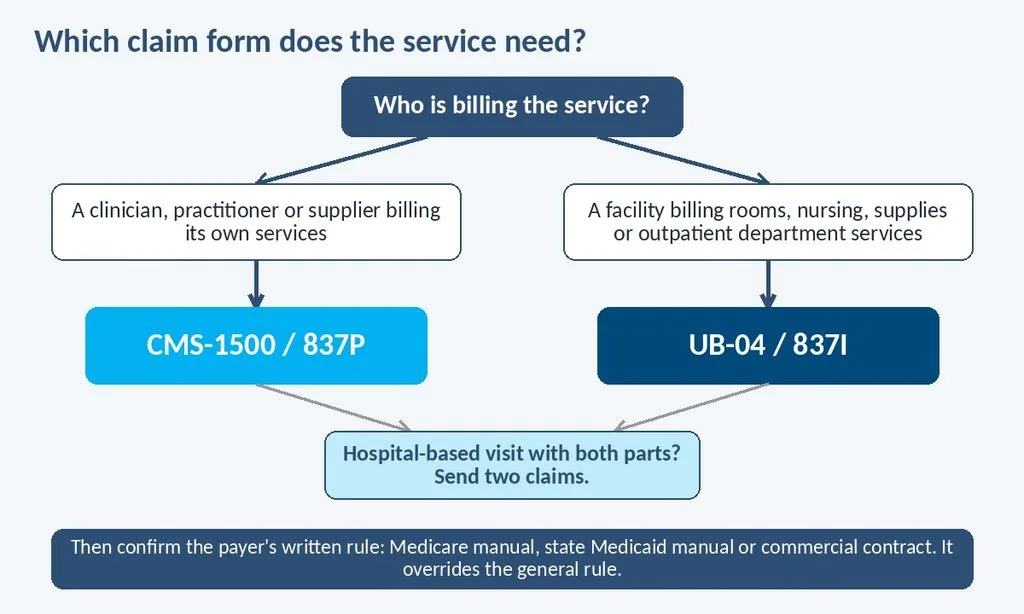
Decide by who is billing and what is being billed, not by where the patient was treated. A hospital hallway and a physician’s office can sit in the same building and still require different forms. The five steps below work for a new payer, a new location or a claim that keeps rejecting.
- Identify the billing entity. Confirm whether the payer enrolled it as a professional or an institutional biller. Do this when adding a payer, a location or a tax ID.
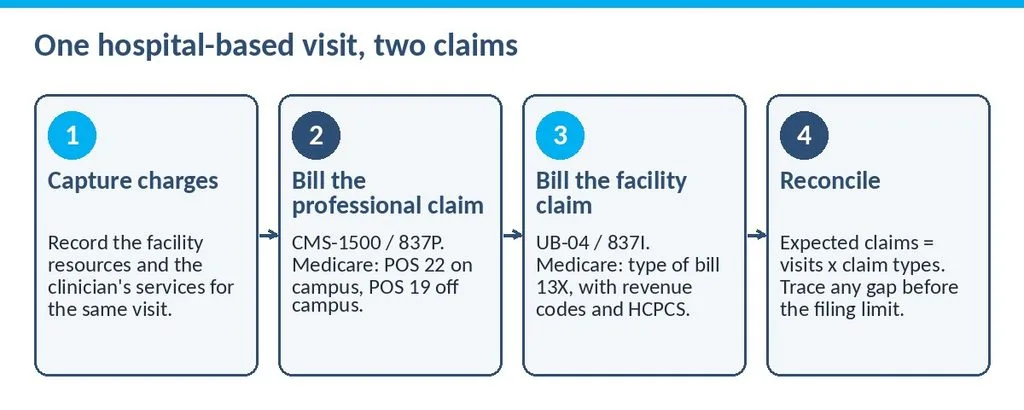
- Match the service type. Clinician work goes on the CMS-1500. Facility charges go on the UB-04. When one visit includes both, plan on two claims.
- Read the payer’s written rule. Check the Medicare manual, the state Medicaid provider manual or the commercial contract for your provider type. When the payer’s rule differs from the general rule, follow the payer and keep a copy.
- Set the claim type at the entity level. Configure 837P or 837I in the billing system and the clearinghouse once per billing entity, not per claim.
- Test before releasing a batch. Send about ten claims per claim type and read the front-end rejection report. Release the full batch only when the test is clean.
Paper is the exception, not the default. Under ASCA, Medicare requires electronic claims unless an exception applies, and Chapter 26 of the Medicare Claims Processing Manual says paper professional claims must use the current 02/12 form, not photocopies. Noridian’s ASCA guidance describes the small-provider exception as fewer than 10 full-time equivalent employees. The NUCC adds that paper forms should print in red ink so scanners can read them.
Why can one hospital visit produce two claims?
A hospital-based visit can produce two claims because the facility bills its charges on a UB-04 while the physician bills professional services on a CMS-1500. This is provider-based billing, and Noridian’s Medicare guidance spells out the split: a UB-04 with type of bill 13X or 85X for the facility, and a CMS-1500 for professional services with POS 22 for on-campus care or POS 19 for off-campus care.
Off-campus departments add modifier rules. Modifier PO applies to excepted services at off-campus provider-based departments, and PN applies to nonexcepted services. Both are reported on the facility’s claim, so confirm with the MAC before adding either to a professional line. In billing audits, a common pattern is a hospital-employed physician’s visit billed on the facility template because the practice management system defaulted to the clinic’s institutional setup.
Commercial payers do not all follow Medicare’s split. One Blue Cross plan’s published provider manual states that it does not recognize provider-based billing, so all clinic services go on one CMS-1500 with POS 11 and no separate UB-04. Treat that as one example, and confirm current wording in each payer’s manual before changing a workflow.
Do Medicare, Medicare Advantage, Medicaid and commercial payers handle the forms differently?
The forms are standardized, but payer rules on which provider type uses which form, how long a claim may wait and which attachments are needed are not. Table 5 summarizes the differences billers meet most often, using Medicare’s published rules as the baseline and showing where other payer types commonly depart from it.
Illustrative payer differences (actual rules vary by plan and state)
| Payer type | Form rule | Filing limit | What to check |
| Medicare fee-for-service | Professional on CMS-1500/837P, institutional on UB-04/837I; paper only under an ASCA exception | 12 months from date of service | MAC guidance; Chapters 25 and 26 |
| Medicare Advantage | Plan contract governs; plans generally keep the professional/institutional split | Set by the provider contract | Contract and plan provider manual |
| Medicaid | State sets the form by provider type | State-specific | State Medicaid provider manual and fee schedule |
| Commercial | Payer manual governs; some do not recognize provider-based split billing | Set by contract | Payer manual and enrollment record |
Illustrative: Medicare fee-for-service rows reflect published CMS and MAC guidance; other rows are general patterns, and actual figures vary.
Medicare filing rules are covered in the Medicare billing guide. When rejection reports show claim-type errors across several payers, the root cause is usually payer setup rather than staff typing. That is where an outside review of enrollment mapping and edits, such as Aspect Billing Solutions’ claim and denial management services, can save weeks of rework.
How can you tell whether claim-type errors are costing you money?
Three simple calculations show whether form problems are hurting cash flow: a rejection rate by claim type, a filing-deadline check and a reconciliation gap. Each example below is illustrative, and each opens with its formula so the same arithmetic can be rerun on a practice’s own monthly numbers.
Example 1: claim-type rejection rate
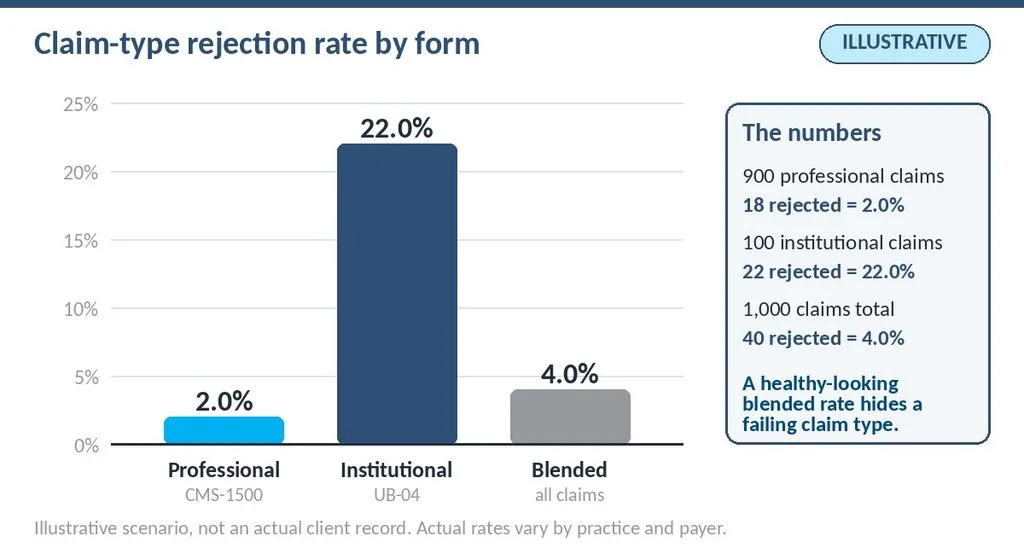
Formula: claim-type rejection rate = claims rejected for form or claim-type reasons ÷ claims submitted of that type × 100. Illustrative scenario (not an actual client record): a group with a provider-based wound-care clinic submits 900 professional and 100 institutional claims in a month. Clearinghouse reports show 18 professional and 22 institutional rejections tied to form-field errors. Professional: 18 ÷ 900 = 2.0%. Institutional: 22 ÷ 100 = 22.0%. Blended: 40 ÷ 1,000 = 4.0%.
A blended 4.0% looks tolerable, yet more than one in five institutional claims is failing. In rejection reviews, one claim type is often buried inside a healthy blended average, so splitting the report by claim type is usually the fastest first diagnostic when a dashboard looks fine but cash is slow.
Example 2: filing deadline and days remaining
Formula: Medicare deadline = date of service + 12 months; days remaining = deadline − today. Illustrative scenario (not an actual client record): a professional claim has a date of service of March 14, 2026, so the claim must reach the MAC by March 14, 2027. On October 16, 2026, 149 days remain. Institutional claims use the “through” date: a stay from October 28 to November 3, 2026 has a facility deadline of November 3, 2027, while a physician claim spanning those dates uses the “from” date. The Noridian timely filing page lists exceptions.
Example 3: claim reconciliation gap
Formula: gap = (expected claims − submitted claims) ÷ expected claims × 100. Illustrative scenario (not an actual client record): a provider-based clinic completes 120 visits that each require a facility and a professional claim, so 240 claims are expected. If 231 go out, the gap is 9 ÷ 240 = 3.75%. Each missing claim is unbilled revenue, so trace the nine by claim type before the filing limit approaches.
How to use these numbers correctly
Compare like with like: professional claims against professional history, institutional against institutional, and each payer against its own past. One missed benchmark is a signal to investigate, not a verdict. When a rate jumps, pull the rejection report by payer first, because a single enrollment change can explain a whole month.
How long does it take to fix claim-form problems?
Rejections from claim-type setup errors often start falling within one to two billing cycles after the setup is corrected, and a full cleanup commonly takes 60 to 120 days. These are general planning ranges, not guarantees. Partial results arrive once rejected claims are corrected and resubmitted. Full results arrive after replacement claims are paid and older receivables normalize. Payers that require enrollment re-validation sit at the slow end of the range.
Which mistakes cause the most UB-04 and CMS-1500 rejections?
Most claim-form rejections trace to seven repeat mistakes, and each has a simple fix when caught early. Rejections stop a claim before the payer adjudicates it, while denials follow adjudication. A deeper catalog of causes appears in the guide to claim rejections and the list of common claim denial reasons.
- Facility template on a physician visit. Fix it by locking claim type to the billing entity when a hospital-employed clinician bills.
- Private-office habits at institutional clinics. Our team often sees RHC and FQHC staff carry CMS-1500 habits into UB-04 workflows, which shows up first as type-of-bill and revenue-code rejections. Train on institutional edits when a clinic converts.
- Wrong frequency digit on corrections. The type of bill’s last character shows the bill’s sequence, so follow the payer’s instructions when replacing an accepted institutional claim instead of sending a new original.
- Missing ICD indicator. Enter 0 in Item 21 for ICD-10-CM on every paper CMS-1500, as Chapter 26 requires.
- Missing or invalid place of service. Chapter 26 states that a missing or invalid POS returns the claim as unprocessable, so validate POS before release.
- Revenue code without HCPCS. Add the HCPCS code in FL 44 when the payer requires it for outpatient lines.
- Photocopied or black-ink paper forms. Use original red-ink forms when paper is allowed.
Quick summary
- The CMS-1500 (837P) carries professional claims; the UB-04 (837I) carries institutional claims.
- Decide by who is billing and what is billed, then confirm the payer’s written rule.
- One hospital-based visit can need two claims, and some commercial payers want only one.
- Medicare’s filing limit is 12 months, and the practical goal is days, not months.
- A first-pass clean claim rate near 95% is a commonly cited target, tracked by claim type.
- Split every rejection report by claim type and payer before judging the blended number.
Self-assessment: is your claim-form process under control?
Answer yes or no to each question, using last month’s numbers wherever a question asks about a rate. The scoring guide below the list shows what the total suggests and what to do next. A “no” on any single item is a to-do, not a failure.
- Do you know whether each billing entity is enrolled as professional or institutional with every major payer?
- Is 837P or 837I set at the billing-entity level in your system and clearinghouse?
- Do hospital-based or provider-based clinics send both claims where the payer requires them?
- Do you reconcile expected versus submitted claims every month?
- Is your first-pass clean claim rate at or near 95%, measured separately for each claim type?
- Do you review claim-type rejections weekly?
- Do you track Medicare’s 12-month limit and a shorter internal submission target?
- Does every paper or electronic professional claim carry the correct ICD indicator and place of service?
- Do institutional claims pass a type-of-bill, revenue-code and HCPCS check before release?
- Have you checked each payer’s written form rule in the past 12 months?
Scoring guide
| Yes answers | What it suggests | Next step |
| 9-10 | Process looks sound | Keep the weekly review and recheck payer rules yearly |
| 6-8 | Gaps worth closing | Fix the “no” items first and rerun the numbers in 60 days |
| 0-5 | High risk of avoidable rejections | Run an internal billing compliance audit now, then consider outside support |
Scoring is a practical guide, not a published standard.
When does outside billing support make sense?
Outside support makes sense when the in-house approach has hit its limits, and the limit is usually visible in the reports before it shows up in cash. Do not wait for a cash crunch if several of these five signals are already present:
- Claim-type rejections repeat for two or more billing cycles after setup fixes.
- The organization runs both professional and institutional billing entities, such as hospital-based clinics, an RHC or an FQHC.
- Accounts receivable older than 90 days keeps growing despite staff effort.
- Staff turnover has left nobody who can read an 837I rejection.
- New locations, mergers or payer changes keep breaking enrollment mapping.
When evaluating any partner, look for experience with both claim types, rejection reporting split by claim type, a written process for payer-specific rules, HIPAA compliance with a signed business associate agreement, and a named contact. Aspect Billing Solutions is one example. It provides HIPAA-compliant, end-to-end medical billing and coding, credentialing, eligibility verification and prior authorization, denial management, A/R follow-up and compliance support, with a dedicated agent assigned to each provider. Results vary by practice. Details are on its revenue cycle management service page.
Final Considerations
The UB-04 vs CMS-1500 question is really a question about who is billing and what is being billed. Get that mapping right at the payer and entity level, and most form errors disappear before a claim is ever scrubbed. Get it wrong, and every downstream metric looks worse than the underlying work deserves.
Firm published standards in this guide are the form versions and layouts maintained by the NUCC and NUBC, CMS’s completion manuals, Medicare’s 12-month filing limit and the ASCA small-provider exception. The 95% clean claim rate, the rejection targets, the timeframe ranges and every worked example are practical or illustrative.
The natural next question is whether any of your payers is still set up under the wrong claim type, and how many claims that setup has already touched. To find out, review your claim setup with Aspect Billing Solutions and bring your latest rejection report.
Frequently asked questions
What is the main difference between a UB-04 and a CMS-1500?
The UB-04 bills facility charges, such as room and board, nursing and outpatient department services, using revenue codes and a type of bill. The CMS-1500 bills a clinician’s own services using CPT or HCPCS codes, modifiers and place of service. Hospitals and clinics bill institutionally, while physicians and practitioners bill professionally.
Is the UB-04 the same as the CMS-1450?
In everyday billing, yes. The CMS-1450 is the older name for the institutional claim data set, and the UB-04 is the form built on it. Medicare’s manual chapter on the CMS-1450 data set gives the instructions for completing the UB-04, so payers and billers use the names interchangeably.
Do hospitals ever use the CMS-1500?
Yes, in specific cases. Hospital-employed physicians bill professional services on a CMS-1500, and Medicare ambulatory surgical centers use the CMS-1500 even when a hospital operates them. Facility charges for hospital inpatient and outpatient care go on the UB-04, and payer instructions decide each edge case.
Does Medicare still accept paper claims?
Only under an exception. The Administrative Simplification Compliance Act requires electronic Medicare claims unless a listed exception applies. Practices with fewer than 10 full-time equivalent employees may file on paper, and paper CMS-1500 claims must use the current 02/12 form, not photocopies. Check your Medicare Administrative Contractor’s guidance first.
What is a good clean claim rate for UB-04 and CMS-1500 claims?
Many practices target a first-pass clean claim rate of about 95% or higher, a commonly cited industry convention rather than a payer or CMS mandate. Track professional and institutional claims separately, because a strong blended rate can hide a weak rate on one form. Investigate any repeated rejection reason.
What is a good internal deadline for submitting claims?
Medicare’s 12-month limit is a ceiling, not a target. A common practical goal is submitting clean claims within a few days to two weeks of the date of service. Commercial and Medicaid limits can be shorter, so set the internal deadline against the shortest limit among your payers.
Sources and methodology
(a) Published standards and definitions from named bodies
- CMS, Medicare Claims Processing Manual (Pub. 100-04), Chapter 25, Completing and Processing Form CMS-1450 Data Set, and Chapter 26, Completing and Processing Form CMS-1500 Data Set.
- NUCC, 1500 Claim Form Reference Instruction Manual and 1500 Claim Form FAQ (claim form version 02/12; manual edition varies by release, so check nucc.org).
- NUBC, Official UB-04 Data Specifications Manual (subscription information page; edition valid through June 30, 2027).
- CMS, MLN006926, Medicare Billing: Form CMS-1450 and the 837I.
- Noridian Healthcare Solutions: Claim Submission Timeliness (42 CFR 424.44 as described by the MAC), ASCA guidance, and Provider-Based Facilities guidance.
- Medicaid.gov, FAQ on Medicare’s general timely filing period (Affordable Care Act 12-month limit).
(b) Named benchmarking data providers
None. No MGMA, HFMA or other benchmarking-provider figures are cited in this article.
(c) Practical or illustrative targets from general industry sources
- The 95% first-pass clean claim rate is commonly reported across industry sources and is not a CMS or standards-body mandate.
- Rejection targets, internal filing goals and the 60 to 120 day improvement range are Aspect Billing Solutions’ planning guidelines.
- All worked examples are labeled illustrative scenarios and are not actual client records.
- Payer examples: Louisiana Blue Professional Provider Office Manual, Section 5.33 (provider-based billing; wording should be confirmed with the payer); ResDAC, Medicare Provider Types: Ambulatory Surgical Centers; AAPC Coding Alert reader question on UB-04 vs CMS-1500 (2014, older guidance).
(d) Survey or study data
None cited.
Results vary by practice, payer and state. Figures and rules reflect information available in October 2026, and codes, fee schedules and payer policies change annually.