
CARC and RARC Codes Explained: How to Read Every Line of a Remittance
CARC and RARC codes explained in one passage: a claim adjustment reason code (CARC) states why a payer paid less than the billed amount, and a remittance advice remark code (RARC) adds detail or a next step. Every CARC travels with a group code (CO, PR, OA or PI) that assigns financial responsibility on the remittance.
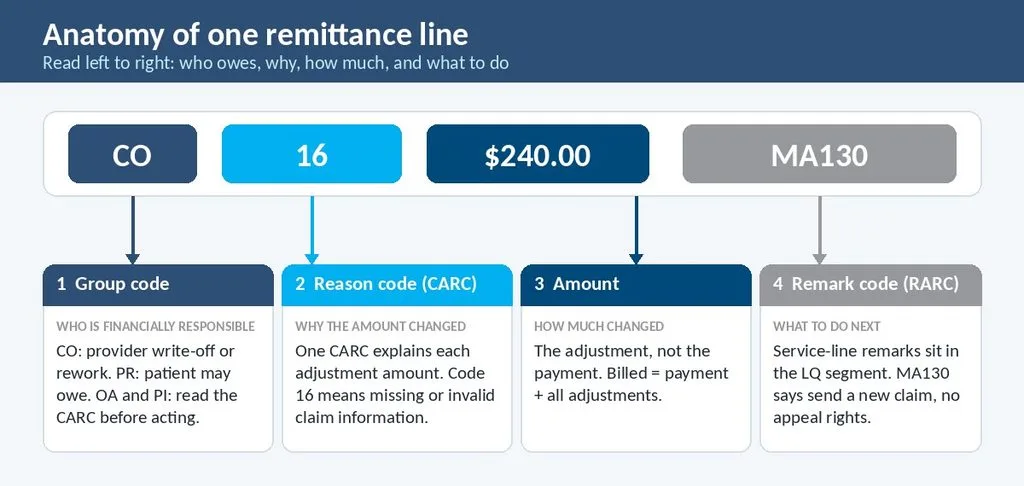
Picture one line on an electronic remittance: CO, 16, $240.00, and a remark code reading MA130. The payer paid nothing, the practice owes the write-off, and the claim needs a new submission, not an appeal. Each of those conclusions comes from a different code. This guide shows how the three code types fit together, who owes what under each group code, and how to turn remits into worklists. A self-assessment checklist near the end scores your own process.
Remittance Code Numbers Worth Keeping at Hand
Seven facts anchor everything below: four published rules or definitions and three practical review targets. Table 1 lists each with its review frequency and source type, so you can tell a mandated rule from a working convention before building a process around it.
Key facts for reading CARCs and RARCs
| Item | Practical target / range | Review frequency | Source type |
| Group codes in use on the 835 | Four: CO, PR, OA, PI (code CR is retired for 005010 and later) | At payer onboarding | Published standard (a): X12, CAQH CORE |
| Reason codes per adjustment amount | One CARC explains each adjustment amount | At each posting | Published standard (a): CMS Pub. 100-04, Ch. 22 |
| Code list update cycle | Three times a year, about March 1, July 1 and November 1 | Every cycle | Published standard (a): CMS Change Request 14410 |
| CORE business scenarios | Four scenarios define allowed code combinations | Yearly | Published standard (a): CAQH CORE |
| Remittance balance check | Billed charge = payment + all adjustments, variance $0.00 | Every posting batch | Practical target (c) |
| Top-CARC concentration review | Rank denials by CARC and read the top three | Monthly | Practical target (c) |
| Denial rate by payer | Compare each payer with its own baseline, not only the blend | Monthly | Practical target (c) |
Source labels: (a) federal rule, CMS instruction or named standards-body definition; (b) named benchmarking data provider; (c) practical target commonly used across industry sources, not a mandated standard; (d) named survey or study. This guide uses no (b) or (d) sources. Verify current rules with your payers.
What Do CARC and RARC Codes Tell You About a Claim?
CARC and RARC codes tell you what the payer did to the claim and why. A claim adjustment reason code explains each reduction, denial or increase in payment, and a remittance advice remark code supplies extra detail the CARC cannot hold. Both appear on the electronic remittance advice (ERA) and on a paper explanation of benefits (EOB).
Neither code is a billing instruction on its own. The CARC names the cause, and the RARC often points to the fix. CMS describes remark codes as further explanation of an adjustment, or as informational messages that a reason code cannot express, in Chapter 22 of the Medicare Claims Processing Manual.
The three code types on a remittance line
| Code type | What it answers | Example | Maintained through |
| Claim adjustment group code | Who is financially responsible? | CO = provider write-off; PR = patient owes | ASC X12 standard |
| Claim adjustment reason code (CARC) | Why was the amount adjusted? | 45: charge exceeds the fee schedule or contracted rate | X12 code list, via committee |
| Remittance advice remark code (RARC) | What more should the biller know? | MA130: claim unprocessable; send a new claim | X12 code list, CMS-led committee |
Examples follow the X12 code lists; confirm current wording on the X12 site before publishing internal training material.
Which codes can pair with which?
A group code always travels with a CARC, and a RARC joins them when more explanation helps. The CAQH CORE rule describes the allowed pattern as group code plus CARC plus one or more RARCs. Some CARCs make the remark code mandatory: the X12 list says CARC 16 needs at least one remark code, which explains why a bare CO-16 should be rare.
Usage limits exist too. According to the X12 CARC list, CARC 85 is used only with group code PR, and CARC 18 only with OA unless state workers’ compensation rules require CO. Knowing these limits helps you spot posting or payer errors quickly.
How One Remittance Line Is Built From Three Code Types?
One remittance line is built left to right: group code, reason code, dollar amount, then any remark code. The amount is the adjustment, not the payment. In the 835 file, service-line remark codes sit in the LQ segment, and claim-level remarks use the MIA segment for inpatient claims or MOA for outpatient claims, as the CMS manual describes.
Medicare’s manual adds a useful rule: current 835 structures allow only one reason code to explain any one adjustment amount. When a service carries two different adjustments, such as a deductible and a fee-schedule reduction, expect two lines with two codes, not one combined code.
In billing audits, a common pattern is that teams read the CARC description in their posting screen and never open the remark code beside it. The CARC says what happened. The RARC frequently says what to change, so the denial worklist loses the one field that routes the claim.
Which Group Code Decides Who Pays: CO, PR, OA or PI?
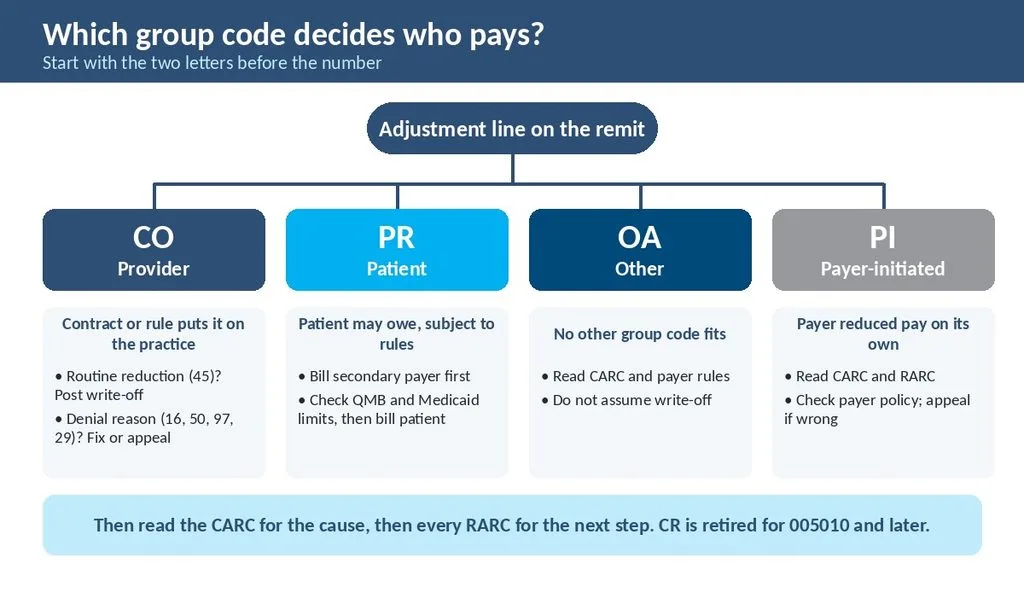
The group code decides who pays: CO assigns the amount to the provider, PR to the patient, OA to no one in particular, and PI to a payer-initiated reduction. Read it first, because it determines whether the amount is a write-off, a patient statement or a rework item.
Claim adjustment group codes
| Code | Name | Plain meaning | Typical posting action |
| CO | Contractual obligation | Provider is responsible under the payer contract or rules | Write off, or appeal when the adjustment is wrong |
| PR | Patient responsibility | Amount may be billed to the patient, subject to rules | Bill secondary payer, then patient |
| OA | Other adjustment | No other group code fits | Review the CARC; do not assume it is a write-off |
| PI | Payer-initiated reduction | Payer reduced payment on its own initiative | Read the CARC and RARC; commonly seen with commercial plans |
Medicare’s Chapter 22 lists CO, OA and PR as the valid Medicare group codes. X12 also lists CR, which it says is not used with version 005010 and later.
Reason and group code interact. The same CARC can carry different meanings for your cash: CARC 45 under CO is a contractual write-off, while CARC 2 under PR is coinsurance the patient owes. Our guide to the CO-45 denial code shows why a high-volume CO line still needs a quick check against your contract.
Do not treat every CO line as a denial. A service-line adjustment can be a routine contractual reduction, while a true denial usually pairs a reason such as 16, 50, 97 or 29 with a zero payment. When the line pays nothing and the amount is the full charge, work it. When the amount equals the expected contractual difference, post it.
How Do RARC Remark Codes Add the Next Step?
RARC remark codes add the next step by saying what was missing, what policy applied or what the payer wants done. Most are supplemental, meaning they explain an adjustment already described by a CARC. A smaller group begins with the word Alert and carries information that is never tied to a specific adjustment.
RARCs use series prefixes such as M, MA and N, followed by a number. The prefix identifies the code series and does not change how you respond. For example, X12 lists M15 as bundled components of the same procedure, MA130 as an unprocessable claim with no appeal rights, and N20 as a service not payable with another service on the same date.
Common CARC and RARC pairings (illustrative of frequent patterns)
| Group-CARC | Typical RARC | What the pair usually signals | First move |
| CO-16 | MA130 | Claim lacks information; unprocessable | Correct the data and submit a new claim; see CO-16 denial code |
| CO-97 | M15 or N20 | Service bundled into another service | Check edits and modifier use; see CO-97 bundling |
| CO-50 | N115 | Not medically necessary; decision based on a Local Coverage Determination | Review the LCD and documentation; see CO-50 medical necessity |
| CO-45 | None required | Charge above fee schedule or contract rate | Post the write-off after comparing it with your contract |
| CO-18 | Varies | Duplicate claim or service (OA, except where state workers’ compensation rules require CO) | Confirm the original claim processed before resubmitting |
Pairings are common patterns, not guarantees; payers choose their own combinations within the CORE-defined sets. Confirm each code’s current text on the X12 list.
Informational Alert codes deserve a separate look. X12 lists N59 as a reminder to refer to the provider manual. Such messages seldom change the payment, yet they can announce billing rule changes, so route them to whoever owns payer updates instead of discarding them.
How Do You Work a Remittance in Six Moves?
Work a remittance in six moves: group code, CARC, RARC, balance, route, record. This sequence takes a line from raw code to a decision, and each move has a condition attached so the team does not rework paid claims or write off fixable denials.
- Read the group code. When it is PR, check for a secondary payer and patient rules before any statement. When it is CO, continue to the reason.
- Read the CARC. When the reason is a routine contractual reduction such as 45, compare with your contract. When it is a denial reason, open the claim.
- Read every RARC on the line. When a remark code names missing data, fix the data. When it cites a policy, pull the policy first.
- Prove the balance. When billed charge does not equal payment plus adjustments, stop and find the missing line before posting.
- Route the line. Send it to a worklist by cause: data fix, authorization, coding, medical necessity, patient billing or contract review.
- Record the code pair. Save the group code, CARC and RARC with the outcome, so the monthly review can rank causes.
Medicare practices can view and print 835 remittances with the free Medicare Remit Easy Print software from CMS, which is designed for professional providers and suppliers. Other payers deliver 835 files through a clearinghouse or portal, so confirm your system displays the full remark code text, not only the CARC description.
Cause-based worklists work best when they follow a defined path from denial to resolution. Our guide to building a denial management workflow describes that structure, and the difference between a denial and a front-end rejection is covered in why claims get rejected.
Do All Payers Use the Same CARC and RARC Codes?
Payers share one national code list but apply it differently. Medicare administrative contractors follow CMS instructions, while Medicare Advantage, Medicaid and commercial plans issue their own remittances under HIPAA transaction rules and their own payer companion guide. Expect the same code to carry different follow-up steps by payer.
How remittance codes show up by payer type
| Payer type | What you will see | Watch-outs | Where to check |
| Original Medicare | 835 or Standard Paper Remit with CO, PR and OA lines; code lists updated on the CMS schedule | Medicare does not report a deactivated code after its deactivation date | CMS Change Requests and your MAC |
| Medicare Advantage | Plan-issued remittance, not MAC-issued; same national code lists | Plan policy drives the action behind each code, so appeal rights follow the plan, not Original Medicare | Plan contract and provider manual |
| Medicaid and CHIP | State or managed care plan remittance; may add state-specific messaging | Cost-sharing and appeal rules differ by state | State Medicaid fee schedule and manual |
| Commercial | 835 with PI lines possible; plan-specific rules behind each code | Same CARC can need different documentation by plan | Payer companion guide |
Illustrative summary; actual remittance content varies by payer and contract. For appeal steps on Medicare denials, see how to appeal a Medicare denial.
What does CAQH CORE add?
CAQH CORE operating rules narrow how health plans combine codes. The Phase III Uniform Use of CARCs and RARCs rule defines four business scenarios: additional documentation needed, additional claim data needed, billed service not covered, and benefit not separately payable. Health plans must use only CORE-listed combinations within those scenarios and may not use deactivated codes.
The rule also requires systems that display 835 data to manual users to show descriptive text for the codes. If your posting screen shows numbers without text, ask your vendor or clearinghouse how it maps code descriptions and whether it displays the full remark text.
How Often Do the Code Lists Change?
The CARC and RARC lists change three times a year, around March 1, July 1 and November 1. CMS tells its contractors to update on that cycle, and its Change Request 14410 (Transmittal 13666, March 25, 2026) set an effective date of July 1, 2026 and an implementation date of July 6, 2026 for the latest Medicare update.
The CMS transmittal also directs updates to Medicare Remit Easy Print and PC Print. For your practice, three tasks follow each cycle: refresh the code text in your billing system, confirm your denial-mapping table drops retired codes, and brief staff on any new code your top payers adopt.
A recurring pattern in remittance reviews is a mapping table last updated years ago, still sending deactivated codes to the wrong queue. Assign one person to check the lists three times a year and record the date reviewed. The task takes minutes and prevents silent misrouting.
Can You Prove a Remittance Balances? Worked Examples
Yes, and the proof is arithmetic: billed charge must equal payment plus every adjustment. Three short examples cover the balance check, the denial rate by payer and the CARC share inside a problem payer. Each gives the formula first, then one walkthrough. All figures are illustrative.
Example 1: balance one line
Formula: billed charge = payment + sum of all adjustments. Illustrative scenario (not an actual client record): a practice bills $240. The allowed amount is $150, so CO-45 posts $90. The payer pays $120, and PR-2 posts $30 of coinsurance. Check: $120 + $30 + $90 = $240. The line balances; any gap means a missing adjustment.
Example 2: denial rate by payer
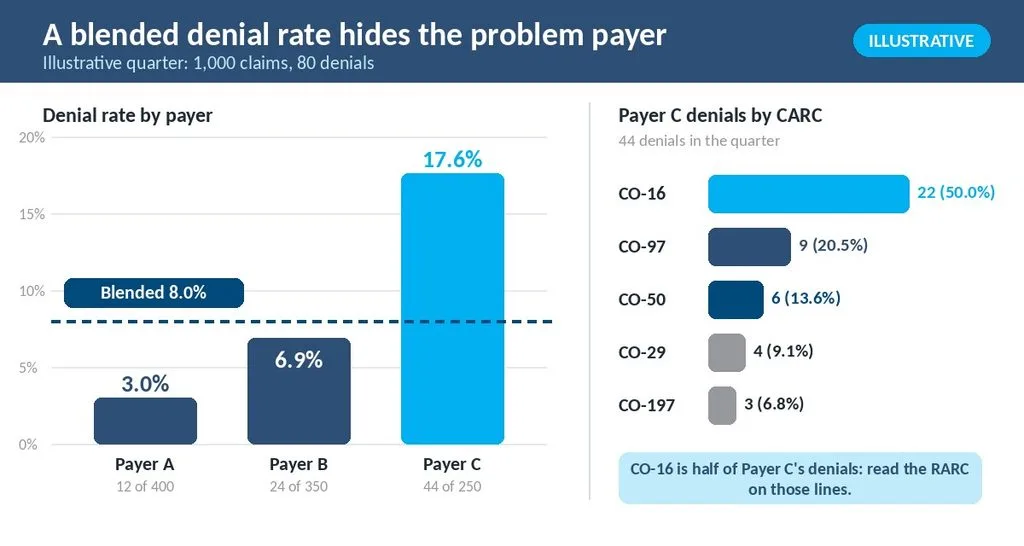
Formula: denial rate = claims with a denial ÷ claims adjudicated × 100. Illustrative scenario (not an actual client record): a practice sends 1,000 claims across three payers and 80 draw a denial, a blended 8.0%. Payer A shows 12 of 400 (3.0%), Payer B 24 of 350 (6.9%) and Payer C 44 of 250 (17.6%).
The blend looks tolerable, yet Payer C is not. Comparing like with like means judging each payer against its own history, because a blended figure can let one payer’s problem hide behind two healthy ones. One high payer is a signal to investigate, not a verdict on the team.
Example 3: CARC share inside the problem payer
Formula: CARC share = denials with that CARC ÷ total denials × 100. In the same illustration, Payer C’s 44 denials split into CO-16 (22), CO-97 (9), CO-50 (6), CO-29 (4) and CO-197 (3). CO-16 is 50% of Payer C’s denials. Reading the remark code on those 22 lines shows whether one missing field is repeating.
Table 6. Illustrative denial mix for Payer C (one quarter)
| Group-CARC | Denials | Share | First question to ask |
| CO-16 | 22 | 50.0% | Which remark code repeats: one missing field or several? |
| CO-97 | 9 | 20.5% | Is a modifier or edit rule being missed? |
| CO-50 | 6 | 13.6% | Does documentation meet the policy the RARC cites? |
| CO-29 | 4 | 9.1% | Was the claim filed late or only received late? |
| CO-197 | 3 | 6.8% | Was the authorization on file and on the claim? |
| Total | 44 | 100.0% | Top three CARCs make up 84.1% of denials |
Illustrative: figures are an example, not client data; actual denial mixes vary by payer, specialty and location. Shares may not sum exactly due to rounding.
How Should You Use These Numbers Correctly?
Use the numbers to find the next question, not to pass or fail a team. Compare payers with their own history, and compare specialties with similar specialties, because a surgical group and a primary care office produce different CARC mixes. One high month is a signal to investigate.
- Compare Medicare with Medicare, and commercial plans with commercial plans.
- Rank denials by CARC first, then by dollars, since a rare code on large claims can cost more than a common one.
- When a CARC spikes after March, July or November, check whether the code list changed before blaming staff.
Reports that group denials by payer and code make this routine, and they let you see a spike within weeks instead of at year end. Our guide to reading billing reports explains the views worth asking for.
How Long Until Code-Based Tracking Pays Off?
Most practices can build a CARC and RARC worklist in a few weeks, while measurable change in repeat denials usually takes a couple of billing cycles. These are general planning ranges, not guarantees, and results vary by payer mix and staffing.
- 2 to 4 weeks: map your top ten code pairs to worklists and refresh code text in your billing system.
- 30 to 90 days: the share of repeat denials from data errors tends to fall as front-end fixes take hold.
- 3 to 6 months: monthly CARC ranking shows whether the top causes have changed, and which payers still need escalation.
Where Do Billing Teams Misread Remittances?
Teams misread remittances when they stop at the first code on the line and never reach the remark code or the balance check. Six mistakes recur in remittance reviews, and each has a simple correction you can add to posting rules.
- Posting only the CARC. Always capture the RARC beside it.
- Treating every CO line as a denial. Check whether the amount equals the expected contractual difference.
- Treating OA as a safe write-off. Read the CARC and payer rules before adjusting.
- Ignoring Alert codes. Route them to the person who tracks payer updates.
- Using an outdated mapping table. Review code lists three times a year.
- Appealing unprocessable claims. When a remark such as MA130 says no appeal rights apply, correct and resubmit.
CARC and RARC Quick Summary
- A group code says who owes, a CARC says why, and a RARC says what more to know.
- Only four group codes are in use on the 835: CO, PR, OA and PI.
- The code lists update three times a year, about March 1, July 1 and November 1.
- Every remittance line should balance: billed charge equals payment plus adjustments.
- Judge denials by payer and by CARC, not by the blended rate alone.
- Practical targets in this guide are working conventions, not mandates from CMS or X12.
Self-Assessment: Does Your Team Read Remits Correctly?
Answer yes or no for your practice.
- Does your posting screen show the full RARC text, not only the CARC?
- Do staff read the group code before deciding whether to write off or bill the patient?
- Do you prove each remittance balances before posting?
- Is every denial routed to a worklist by cause?
- Do you rank denials by CARC at least monthly?
- Do you report denial rate by payer, not only the blended rate?
- Is someone assigned to review code-list updates three times a year?
- Do you treat Alert and OA lines as items to read, not auto-post?
- Can you name your top three CARCs for each major payer?
Scoring guide: 8 to 9 yes answers suggest a mature process; keep reviewing quarterly. 5 to 7 yes answers suggest gaps worth closing in the next 60 days. 4 or fewer suggest remits are costing you recoverable revenue and deserve priority attention.
When Is It Time to Bring in Outside Billing Help?
Outside help makes sense when remittance volume outgrows the people reading it. Watch for these signals:
- Denials are posted and written off with no record of the CARC and RARC behind them.
- Nobody can name the top three denial reasons for each major payer.
- Balances do not tie out, and posting corrections keep reappearing.
- Code-list changes are discovered only after a payer complaint.
- Appeal windows are missed because lines sit unworked.
Look for support that reads full code pairs, builds worklists by cause, reports by payer, and documents what each denial taught. Ask how the vendor handles code-list updates, who reads the remark codes, and whether you receive reports, not only collections totals.
Aspect Billing Solutions is one example. The team provides end-to-end billing and coding, credentialing, eligibility verification and prior authorization, denial management, A/R follow-up and compliance support, with a dedicated agent assigned to each provider. Its denial management and appeals service applies the CARC and RARC workflow described here, and the full range appears on its services page. Results vary by practice. Explore the revenue cycle management service.
Final Thoughts: Read the Code Pair, Then Act
CARC and RARC codes explained simply: the group code assigns responsibility, the reason code names the cause, and the remark code points to the fix. The group code definitions, the one-reason-per-adjustment rule, the three-times-a-year update cycle and the CORE scenarios are published standards. The balance check, top-CARC review and payer comparisons are practical conventions.
The worked examples and Tables 4 to 6 are illustrative. They show a real pattern: a blended denial rate can look acceptable while one payer and one CARC carry the problem. The fix starts with reading the whole line, not just the first code.
Your natural next question is which code pair is costing your practice the most. A monthly CARC and RARC ranking answers it. If you want a team to build that view and work the lines behind it, see the revenue cycle management service from Aspect Billing Solutions.
CARC and RARC FAQs
What is the difference between a CARC and a RARC?
A CARC explains why a payer adjusted a claim or service line, such as a denial or a fee-schedule reduction. A RARC supplements that explanation with detail or a next step. CARCs travel with a group code on every adjustment, while RARCs appear only when the payer adds more information.
What do CO, PR, OA and PI mean?
CO means contractual obligation, so the provider owes the amount. PR means patient responsibility, such as deductible or coinsurance. OA means other adjustment, used when no other group code fits. PI means payer-initiated reduction. Medicare’s manual lists CO, OA and PR as its valid group codes.
How often are CARC and RARC codes updated?
The lists are updated three times a year, around March 1, July 1 and November 1. CMS instructs Medicare contractors to follow that cycle, and the effective date of a given code can be later than the release. Review your billing system’s code text after each cycle.
Where can you find official CARC and RARC definitions?
ASC X12 hosts the CARC and RARC lists, and CMS publishes the Medicare update instructions as Change Requests. Use the X12 pages for current code text and deactivation dates, and your payer’s companion guide for how a plan applies each code to your claims.
What is a good remittance balance variance?
The practical target is zero: billed charge should equal payment plus all adjustments on every line. No body publishes a tolerance, so treat any unexplained difference as a missing adjustment to find before posting. Review variances at each posting batch.
What is a good way to rank denials by CARC?
No national body sets a target. A practical approach is to count denials by group code and CARC each month, read the top three, and compare each payer with its own baseline. Rank by dollars as well as counts, since rare codes on large claims can cost more.
Sources and Methodology
(a) Published standards and definitions: ASC X12 claim adjustment reason code list (group codes CO, CR, OA, PI, PR; usage notes for CARCs 16, 18 and 85) at x12.org; ASC X12 remittance advice remark code list (M15, MA130, N20, N115, N59 and the supplemental and Alert code types) at x12.org; CMS Change Request 14410, Transmittal 13666 (March 25, 2026) on CARC and RARC updates; CMS Change Request 12478, Transmittal 11111 on deactivated codes; CMS Medicare Claims Processing Manual, Pub. 100-04, Chapter 22 (sections 60.1 to 60.3); CMS Medicare Remit Easy Print page; CAQH CORE Phase III 360 Uniform Use of CARCs and RARCs (835) Rule, version 3.0.0 (June 2012), with current code combinations maintained by CAQH CORE.
(b) Named benchmarking data providers: none cited in this guide.
(c) Practical or illustrative targets: the balance check, top-CARC concentration review, payer-level denial comparison, planning ranges and all worked examples are working conventions or illustrations commonly used across industry sources. CMS, AMA, AAPC, MGMA, HFMA and X12 do not mandate them. The pairings in Table 4 are frequent patterns and vary by payer.
(d) Survey and study data: none cited in this guide.
Results vary by practice, specialty, payer mix and state. Figures and code text reflect information available at the time of research in October 2026; CARC and RARC lists, CMS instructions and payer policies change on a regular cycle.