
CPT vs HCPCS vs ICD-10 Differences: A Practical Guide for 2027 Claims
ICD-10-CM reports why a patient was seen, CPT reports what a clinician did, and HCPCS Level II reports drugs, supplies and services that CPT does not describe. A claim line pairs a diagnosis from ICD-10-CM with a procedure from CPT or HCPCS. Each code set has a different owner, format and update schedule.
The CPT vs HCPCS vs ICD-10 differences matter because every claim line carries codes from more than one set, and a mismatch between them is a common route to claim denials. Practice owners and office managers often inherit this vocabulary without a clean explanation of which code answers which question. This guide separates the three systems, shows how they sit together on one claim, and closes with an eight-question self-assessment checklist.
These codes sit at the center of revenue cycle management, the process that carries a visit from check-in to payment. Where a figure comes from a named body, the source is stated; where it is a practical target, the article says so.
Which Facts Should You Know Before Coding a 2027 Claim?
Three release dates and a few claim-form limits cover most of what a billing team must track. The table below lists each fact, how often it changes and what kind of source supports it. Check each release when it lands, so charge masters and scrubber rules match the dates of service on the claim.
Key facts cheat sheet
| Fact | Current value | Update rhythm | Source type |
| ICD-10-CM | FY 2027 set applies to encounters from Oct 1, 2026 through Sep 30, 2027 | Annual, each October 1 | S1 |
| CPT | CPT 2027 takes effect Jan 1, 2027: 299 new, 74 revised, 80 deleted codes | Annual, each January 1 | S1 |
| HCPCS Level II | Quarterly files; the October 2026 file was posted Sep 23, 2026 | Quarterly: Jan, Apr, Jul, Oct | S1 |
| Claim form limits | Up to 12 diagnoses in Item 21; letters A to L in Item 24E; up to four per line | When forms or payer rules change | S2 |
| Coding accuracy target | About 95% or higher of audited claim lines | Monthly or quarterly audit | S3 |
Source types: S1 = named standards body (AMA, CMS, CDC/NCHS). S2 = Medicare Administrative Contractor claim-form guidance. S3 = practical target commonly reported across industry sources; not a CMS or AMA mandate.
CPT vs HCPCS vs ICD-10 Differences at a Glance
ICD-10-CM answers why the patient was seen, CPT answers what the clinician did, and HCPCS Level II answers what else was supplied or furnished. The table compares format, owner and update rhythm, so a biller can identify a code set from a single look at the code.
The three code sets compared
| Feature | ICD-10-CM | CPT (HCPCS Level I) | HCPCS Level II |
| Question answered | Why was the patient seen? | What service did the clinician perform? | What drug, supply or non-physician service was furnished? |
| Format | 3 to 7 alphanumeric characters (E11.9) | 5 digits (99214); Category II and III add a final letter | One letter plus 4 digits (J1100) |
| Maintained by | CDC (NCHS) | American Medical Association | CMS |
| Updates | Annual, October 1 | Annual, January 1 | Quarterly |
| Claim field | Item 21 | Item 24D | Item 24D |
Format and ownership follow definitions from CDC/NCHS, the AMA and CMS. Category II CPT codes end in F and Category III codes end in T.
ICD-10-CM: The Diagnosis Side
ICD-10-CM supplies the diagnosis codes that tell a payer why care was needed, and those codes support medical necessity, the payer’s test of whether a service fits the documented condition. It replaced ICD-9 on October 1, 2015, and CMS lists the annual effective dates. The FY 2027 set applies to encounters from October 1, 2026 through September 30, 2027.
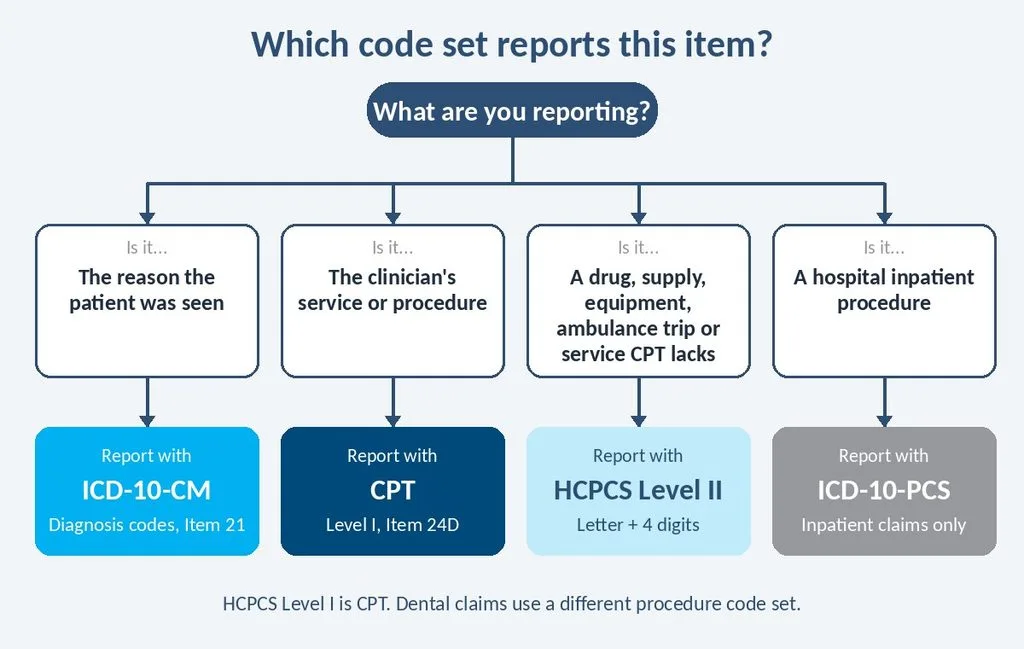
ICD-10-PCS is a separate set for hospital inpatient procedures, so physician office and outpatient professional claims report procedures with CPT or HCPCS instead. In coding reviews, a common pattern is that the note supports a more specific diagnosis than the code entered at charge capture. When the note holds more detail than the charge screen, code from the note, and review common ICD-10 coding errors for the usual gaps.
CPT: The Procedure Side
CPT is the AMA’s set of five-digit procedure codes for services performed by physicians and other qualified professionals. Category I codes (00100 to 99499) describe established services, Category II codes track quality measures, and Category III codes are temporary codes for emerging technology. The AMA’s CPT Editorial Panel meets three times a year to review changes.
CPT modifiers adjust a service without changing its code, such as modifier 25 for a separately identifiable E/M visit. Add a modifier only when the note supports it; this CPT modifiers guide gives examples. When a Category III code describes the service, report it instead of an unlisted Category I code.
HCPCS Level II: The Everything-Else Side
HCPCS Level II is the CMS-maintained code set of one letter plus four digits for drugs, supplies, durable medical equipment, ambulance services and other items CPT does not describe. Examples include J1100 (dexamethasone sodium phosphate, 1 mg) and A0428 (basic life support, non-emergency ambulance transport), which this ambulance billing guide covers. HCPCS Level II also supplies modifiers such as JW, JZ, LT, RT and XS.
Under HIPAA, the federal code set rule names ICD-10-CM for diagnoses, and CPT with HCPCS for physician services and supplies. G2211, an add-on for visit complexity, shows how the sets combine: Medicare uses this G2211 add-on code with CPT office visits 99202 to 99215 and, since 2026, home or residence visits 99341 to 99350.
Is HCPCS the Same as CPT?
Not exactly: HCPCS has two levels, and Level I is CPT while Level II is a separate CMS code set. People often say HCPCS when they mean Level II and CPT when they mean Level I, and both appear in the same procedure field on the claim.
The split matters when a payer rejects a line. When a rejected line starts with a letter, check the current quarterly HCPCS file and the payer’s drug or supply policy before changing anything else; a five-digit numeric code points to the AMA’s CPT rules instead.
How Do Medicare, Medicare Advantage, Medicaid and Commercial Payers Handle These Codes?
All four payer types accept CPT, HCPCS Level II and ICD-10-CM, but each applies its own policy on which codes, modifiers and units it pays. The table gives general guidance only, so verify each payer’s current manual and contract before billing.
Payer differences (general guidance; policies vary)
| Payer | Common practice | Check first |
| Original Medicare | CPT and HCPCS Level II; Medicare-specific G-codes; JW and JZ on Part B single-dose drugs | Your Medicare Administrative Contractor articles and coverage policies |
| Medicare Advantage | Coding generally follows Medicare for covered benefits, with plan-specific prior authorization and billing rules | The plan’s provider manual |
| Medicaid | State programs set fee schedules and may use state-specific modifiers or HCPCS T-codes | Your state Medicaid fee schedule |
| Commercial | CPT-first; some payers do not recognize Medicare-only G-codes | The payer contract and reimbursement policy |
In denial reviews, a recurring pattern is a Medicare G-code sent to a commercial payer that expected a CPT code. When a commercial payer rejects a G-code, ask for its crosswalk or code policy before resubmitting, and store the payer-specific rule in your billing system.
How Do the Three Code Sets Work Together on One Claim?
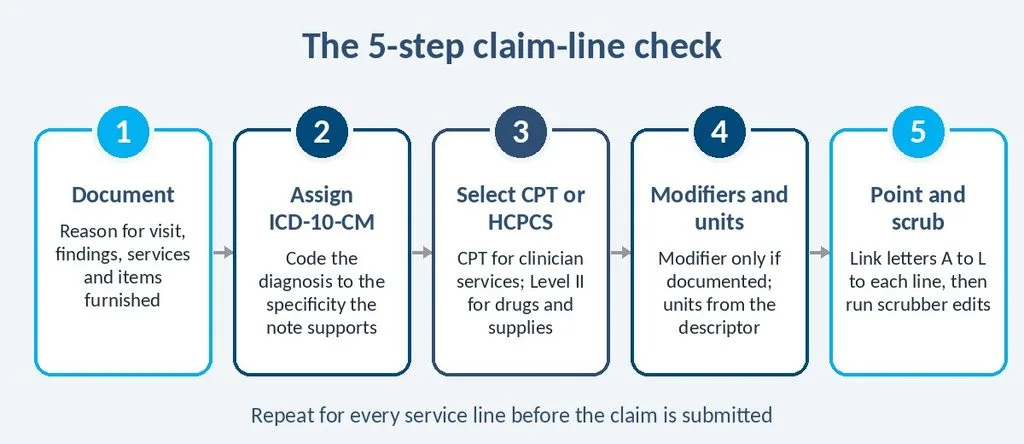
The provider documents the visit, a coder assigns diagnosis and procedure codes, and the CMS-1500 claim form links them so the payer can judge medical necessity. Item 21 holds up to 12 diagnoses, and each service line in Item 24E points to them with letters A through L. Follow these five steps for each encounter:
- Document the encounter. Record the reason for the visit, findings, services and any items furnished; codes can only report what the note supports.
- Assign ICD-10-CM codes. Choose the highest documented specificity when the note names the condition, type or laterality.
- Select procedure codes. Use CPT for the clinician’s services and HCPCS Level II for drugs, supplies, ambulance and payer-specific services.
- Add modifiers and units. Apply a modifier only when documentation supports it, and calculate units from the code descriptor.
- Link and scrub. Point each line to the diagnosis that justifies it using diagnosis pointers, up to four per line, then run the claim through scrubber or clearinghouse edits.
Illustrative scenario (not an actual client record): A Medicare patient with ongoing primary care is seen for hypertension and type 2 diabetes. Item 21 lists I10 (essential hypertension) as A and E11.9 (type 2 diabetes mellitus without complications) as B. Line 1 reports CPT 99214 with pointers A and B. Line 2 reports HCPCS G2211 with the same pointers. The same visit sent to a commercial payer that does not recognize G2211 would drop line 2.
How Do You Calculate Drug Units and Code Accuracy Across the Sets?
Three short calculations catch most code-set errors before a payer does. Each uses a formula and one worked example. The examples illustrate the math rather than state a payer rule, so confirm units and modifier policy with the payer or Medicare Administrative Contractor.
Drug units come from the HCPCS descriptor
Formula: billed units = dose administered ÷ amount in the code descriptor. J1100 is described per 1 mg, so an 8 mg dose bills 8 ÷ 1 = 8 units. In billing audits, a common pattern is that drug lines fail on units rather than on the code itself, which is why this check comes before any other.
Discarded drug and the JW and JZ modifiers
Formula: units on the administered line + units on the discarded line = units in the single-dose container. J0585 is described per 1 unit of botulinum toxin. From a 200-unit vial with 155 units given, bill 155 units on one line and 45 on a separate line with JW, which totals 200. Medicare requires JZ on applicable Part B single-dose drug claims with no waste, effective July 1, 2023. Confirm line layout with your contractor; this botulinum toxin billing guide for neurology shows a full example.
Line accuracy can hide a weak code family
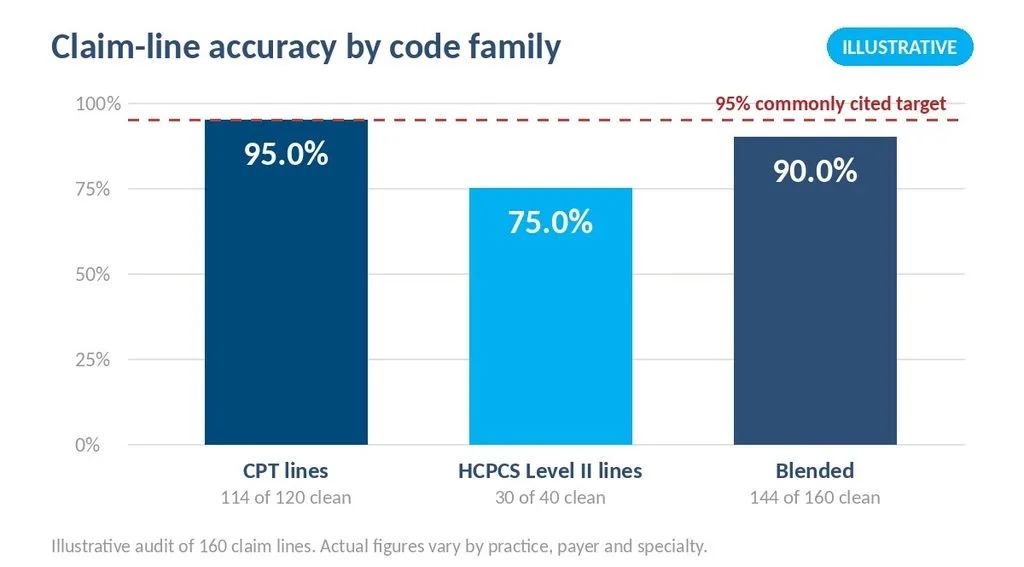
Formula: accuracy = clean lines ÷ audited lines × 100. Illustrative scenario (not an actual client record): a monthly internal coding audit samples 160 lines. CPT lines: 114 of 120 clean = 95.0%. HCPCS Level II lines: 30 of 40 clean = 75.0%. Blended: 144 of 160 = 90.0%. The blended score looks acceptable, yet HCPCS lines are 25% of the sample and produce 10 of the 16 errors, or 62.5%.
How to use these numbers correctly
Compare like for like: CPT office visits against earlier CPT office visits, not against drug lines. One score below the commonly cited 95% target is a signal to investigate, not a verdict, especially in a 160-line sample where a few errors move the result several points.
What Changed for 2027 Claims?
The AMA released CPT 2027 on September 9, 2026, effective January 1, 2027, with 299 new, 74 revised and 80 deleted codes. Run charge-master codes against the deleted list before January 1, and confirm that the October 1 ICD-10-CM load and the latest quarterly HCPCS Level II file are in place.
Which Mistakes Cause Code-Set Mix-Ups, and How Do You Fix Them?
Most code-set errors surface as one of the common reasons for claim denials, and the fix depends on which set caused the problem. Use this list as a monthly review guide, and treat a repeat of any item as a reason to retrain or automate that step.
- Using ICD-10-PCS on a professional claim. Fix: report procedures with CPT or HCPCS unless the claim is for a hospital inpatient stay.
- Choosing unspecified diagnoses out of habit. Fix: code to the detail in the note; when gaps repeat, a specialist review such as ICD-10 coding support services can help.
- Pointing every line to the first diagnosis. Fix: point each service to the diagnosis that justifies it.
- Adding modifiers by habit. Fix: add one only when documentation supports it; these common medical coding mistakes show frequent patterns.
- Ignoring update dates. Fix: load ICD-10-CM changes by October 1, CPT by January 1 and HCPCS files each quarter.
How long does cleanup take?
Planning ranges, not guarantees: loading updates and correcting charge-master mappings often takes a few days to a few weeks, while denial trends tied to code mismatches commonly need one to three billing cycles to show in reports. Practices with many HCPCS drug lines may need longer, and results vary.
Quick Summary
- ICD-10-CM explains why, CPT explains what, and HCPCS Level II explains what else.
- HCPCS Level I is CPT; Level II is the separate CMS letter-led set, and ICD-10-PCS is for hospital inpatient procedures only.
- ICD-10-CM updates each October 1, CPT each January 1, and HCPCS Level II each quarter.
- Drug units come from the descriptor: 8 mg of J1100 bills 8 units.
- A common practical target is about 95% line accuracy, measured by code family; payers differ, so verify G-codes, T-codes and modifiers.
How Well Does Your Practice Handle the Three Code Sets?
Answer yes or no to each question, then count the yeses and use the scoring guide below the list. Each question ties to a date, number or process covered earlier, so a “no” points to a specific section to revisit.
- Do you load the ICD-10-CM update by October 1 each year?
- Do you load the CPT update by January 1 each year?
- Do you load each quarterly HCPCS Level II file when CMS posts it?
- Do coders choose the most specific diagnosis the note supports?
- Do you calculate drug units from the descriptor, such as 8 units for 8 mg of J1100?
- Do you report JW or JZ on applicable Part B single-dose drug claims?
- Do you audit claim lines monthly and track accuracy by code family against a target of about 95%?
- Do you keep a payer-specific list of which G-codes and modifiers each top payer accepts?
Scoring guide
| Yes answers | Result | Next step |
| 7 to 8 | Strong foundation | Keep auditing monthly and recheck after each code release. |
| 4 to 6 | Gaps to close | Fix the “no” items first, starting with drug units and payer rules. |
| 0 to 3 | High risk | Schedule a full coding review before the next code release. |
When Should a Practice Bring In Outside Coding Support?
Outside support makes sense when in-house effort stops keeping pace with code changes or denial patterns. Consider an outside review when two or more of the signals below apply, because a single missed update can be an isolated lapse rather than a pattern:
- Denials citing diagnosis or procedure mismatches keep returning after staff retraining.
- No certified coder reviews claims before submission, or turnover leaves coding gaps.
- New drug, supply or ambulance services have added HCPCS Level II lines your team has not billed before.
- Quarterly or annual code updates reach your system late.
- Monthly audit accuracy stays below the commonly cited 95% target, or no audit exists.
When comparing providers, look for certified coders (such as AAPC or AHIMA credentials), HIPAA-compliant handling of patient data, payer-specific edit rules, reporting by code family and a named contact. Ask how the vendor handles the October, January and quarterly releases.
Aspect Billing Solutions is one example. The company provides HIPAA-compliant billing and coding across ICD-10, CPT and HCPCS, along with credentialing, eligibility verification, prior authorization, denial management, A/R follow-up and compliance support, and assigns a dedicated agent to each provider. Its medical billing and coding services describe the process, and results vary by practice. To see how the pieces connect, read these signs it is time to outsource your medical billing or start with the revenue cycle management service page.
Final Considerations
The CPT vs HCPCS vs ICD-10 differences come down to three questions: why the patient was seen, what the clinician did and what else was furnished. Keep each set in its lane, link them with accurate pointers and update each on its own calendar, and most code-set denials become preventable.
Code-set definitions, formats, owners, update cycles and effective dates come from the AMA, CMS, CDC/NCHS and the federal HIPAA rule, so treat them as firm standards. The 95% accuracy target, the one-to-three billing cycle range and every audit number are practical or illustrative figures, not mandates.
The natural next question is whether your own claims code cleanly across all three sets. Aspect Billing Solutions’ revenue cycle management services cover billing and coding with a dedicated agent assigned to each provider, so a practice can compare its audit results against the targets above.
Frequently Asked Questions
Is HCPCS the same as CPT?
No. HCPCS has two levels. Level I is CPT, maintained by the AMA with five-digit numeric codes. Level II is maintained by CMS with one letter and four digits, covering drugs, supplies, ambulance and other items CPT does not describe. Claims use both in the same procedure field.
What is the difference between ICD-10-CM and ICD-10-PCS?
ICD-10-CM reports diagnoses on claims across care settings and is maintained by the CDC. ICD-10-PCS reports procedures on hospital inpatient claims with seven-character codes, and CMS publishes its updates. Physician offices and outpatient professional claims report procedures with CPT or HCPCS instead.
Do claims need both ICD-10 and CPT codes?
Professional claims normally need both. ICD-10-CM explains why the service was needed, and CPT or HCPCS Level II identifies the service. Diagnosis pointers link them on the CMS-1500. Dental claims use a different procedure code set, so confirm the form and payer rules for your claim type.
What is a good coding accuracy rate?
A commonly cited benchmark is about 95% or higher of audited claim lines coded correctly. That figure is an industry convention, not a CMS or AMA requirement. Measure it by code family, because a blended score can hide a weak area such as HCPCS drug lines.
What is a good clean claim rate?
Many practices aim for a first-pass clean claim rate of roughly 90% to 95% or higher, a range commonly reported across industry sources rather than a mandated standard. Track it by payer and specialty, since a blended rate can hide one payer with frequent code or modifier rejections.
Sources and Methodology
(a) Published standards and definitions from named bodies
- American Medical Association (AMA): CPT overview and code approval process (2026); “AMA releases CPT 2027 code set,” September 9, 2026.
- Centers for Medicare & Medicaid Services (CMS): HCPCS general information, HCPCS Quarterly Update (October 2026 file) and ICD-10 pages (2026).
- CDC National Center for Health Statistics: ICD-10-CM FY 2027 files and official guidelines (2026).
- Code of Federal Regulations: 45 CFR 162.1002, medical data code sets (2026 edition).
- Medicare contractor guidance: Noridian JZ modifier and G2211 pages; First Coast Service Options CMS-1500 data elements (2026).
(b) Named benchmarking data providers
None used. This article cites no proprietary benchmark data.
(c) Practical or illustrative targets from general industry sources
The 95% coding accuracy target and the 90% to 95% clean claim range are commonly reported across industry sources and are not mandated by CMS, the AMA, AAPC, MGMA or HFMA. The audit scenario, drug-unit examples and cleanup time ranges are illustrative planning aids.
(d) Survey or study data
None used.
Results vary by practice, payer and specialty. Figures reflect information available on October 16, 2026; CPT, HCPCS and ICD-10 files and payer policies change, so confirm current releases before billing. Method: review of the top five US search results for the keyword, plus primary-source checks of AMA, CMS, CDC/NCHS and Medicare contractor pages.