
Payment Posting in Medical Billing: Steps, Adjustment Codes and Accuracy Targets for 2026
Payment posting in medical billing is the process of recording insurance and patient payments, contractual adjustments and denials against the correct claim and service line in the practice management system. Posting uses remittance advice to update balances, trigger patient billing and flag denials for follow-up, so accounts receivable reflects what is actually owed.
Every dollar a practice collects must be matched to a claim, a service line and an adjustment before anyone knows what is still owed. This guide explains payment posting in medical billing in plain terms: the documents involved, how adjustment codes drive each entry, a step-by-step daily process, four accuracy calculations and a ten-question self-assessment checklist.
Payment posting key numbers at a glance
Three posting facts come from published sources, and the accuracy targets are practical conventions. Table 1 pairs each number with a review rhythm, so the fixed standards sit apart from the goals a practice chooses for itself. Review the practical rows monthly and the dated rows whenever a code set changes.
Key numbers cheat sheet
| Metric | Practical target/range | Review frequency | Source type |
| Electronic remittance format | All Medicare ERAs use the X12 835, version 5010 | Once, at setup | Published standard |
| CARC and RARC list updates | Three times a year, usually March 1, July 1 and November 1 | Each update | Published standard |
| Medicare general claim filing limit | 12 months from the date of service | Per claim | Published standard |
| Posting turnaround | Within 1 to 2 business days of receiving the remittance | Weekly | Practical target |
| Posting accuracy rate | Commonly targeted near 99%; investigate below about 97% | Monthly sample audit | Practical target |
| Unapplied cash | Commonly kept under about 2% of monthly collections | Weekly | Practical target |
| Deposit reconciliation variance | Zero, or explained the same day | Daily | Practical target |
Source type: Published standard = stated by CMS (remittance advice page and MLN booklet on remittance advice) or a Medicare Administrative Contractor (Noridian). Practical target = commonly cited across industry sources and Aspect Billing Solutions’ working guidelines; no payer, CMS, MGMA or HFMA mandate sets these numbers.
What happens between a payer’s payment and a balance in your system?
A remittance arrives, and posting converts it into ledger entries that match each line. The remittance tells the practice what the payer paid, what it adjusted and why. Payment posting records those amounts, moves the patient’s share to a patient balance and flags any unpaid line for follow-up, which is why it feeds every downstream accounts receivable metric.
Several documents carry this information, and competing guides often blur them. An explanation of benefits (EOB) goes to the patient, while an electronic remittance advice (ERA) goes to the provider. The CMS remittance advice page explains that Medicare sends either an ERA or a standard paper remittance, and that ERAs post automatically while carrying more detail. Table 2 compares the documents.
Documents involved in payment posting
| Document | Sent to | Format | Used for |
| ERA (835) | Provider | Electronic X12 835 file | Automated or reviewed posting of payments, adjustments and denials |
| Standard paper remittance | Provider | Paper | Manual posting; same lines, fields and codes as the ERA |
| EOB | Patient | Paper or portal | Explains the patient’s share; not a posting source for the practice |
| EFT or check | Provider | Bank deposit or paper check | The money; reconciled to the remittance total |
| Provider-level adjustment (PLB) | Provider | Segment at end of the 835 | Takebacks, interest and other amounts not tied to one claim |
Sources: CMS remittance advice page and MLN booklet “Remittance Advice Resources and FAQs.” One remittance usually covers multiple claims and comes with one check or EFT.
How do group codes, CARCs and RARCs decide where each dollar goes?
Adjustment codes tell the poster where each dollar belongs. CMS explains that line-level adjustments use three code sets: group codes assign financial responsibility, claim adjustment reason codes (CARCs) explain the adjustment, and remittance advice remark codes (RARCs) add detail. Read the group code first, because it decides whether the amount is a write-off, a patient balance or a denial to work. The X12 group code list publishes CO, OA, PI and PR.
Group codes and posting actions
| Group code | Meaning (X12 / CMS) | Typical posting action | Watch for |
| CO | Contractual obligation; responsibility assigned to the provider | Post as contractual write-off only when it is a true contract reduction, such as CARC 45; otherwise treat as a denial to work | Writing off denials as contractual |
| PR | Patient responsibility | Move to patient balance or secondary payer; CARC 1 deductible, 2 coinsurance, 3 copay | Billing the patient before secondary is processed |
| OA | Other adjustment | Review the CARC and RARC; do not default to a write-off | Misread informational adjustments |
| PI | Payor-initiated reduction | Review the reason; consider appeal or correction | Unquestioned reductions |
Sources: X12 claim adjustment group code list (CO, OA, PI, PR); CMS remittance advice page (CO assigns responsibility to the provider, PR to the patient; Medicare beneficiaries may be billed only when PR is used); X12 CARC descriptions. Posting actions are practical guidance and vary by payer and system.
Reason codes decide the next action. CARC 45 means the charge exceeds the fee schedule or contracted arrangement, and the CO-45 guide explains when it is a legitimate write-off. CARC-97 means the service is bundle into another payment, covered in the CO-97 bundling guide. CARC 16 means the claim lacks information, and the CO-16 guide shows the fix. The CMS MLN booklet on remittance advice says the CARC and RARC lists update three times a year, so confirm that billing software carries each release.
In billing audits, a common pattern is a CO-cod denial post as a contractual write-off because the group code looked routine. The adjustment disappears from the follow-up queue, and the practice never learns that a payer denied the line. Post CO adjustments as write-offs only after confirming the CARC is a true contract reduction.
How do you post a payment step by step?
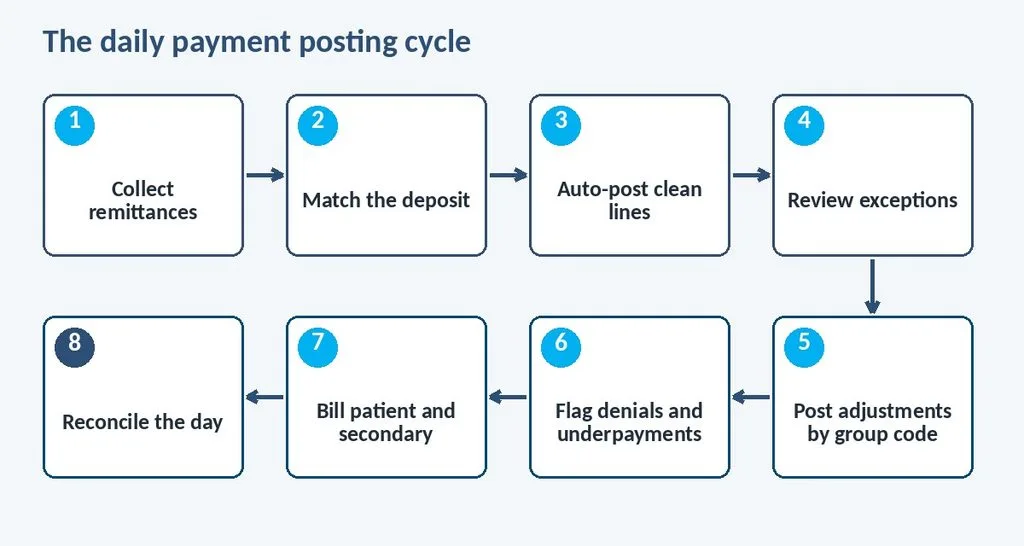
Post in a fixed daily sequence of eight steps, and the cash, ledger and follow-up queue will agree at the end of each day. Practices with an ERA and a clearinghouse can automate steps three and four, while manual and paper remittance workflows need staff review at every step.
- Collect the remittances. Download ERAs from the clearinghouse or payer portal and gather paper remittances and checks. Enrollment with each payer for ERA and EFT is usually required, and a clearinghouse often handles it.
- Match the deposit. Compare each EFT or check to the remittance total before posting anything.
- Auto-post clean lines. Let the system post lines that match an open claim and carry only routine adjustments, such as a CARC 45 reduction.
- Review exceptions manually. Work lines that fail matching, include unfamiliar codes or show a PLB adjustment.
- Post adjustments by group code. Apply CO write-offs only after checking the CARC, and move PR amounts to the patient or secondary payer.
- Flag denials and underpayments. Route every zero-pay or short-paid line to the follow-up queue with its CARC and RARC.
- Bill the patient and secondary. Generate the secondary claim or patient statement for the remaining balance.
- Reconcile the day. Confirm that deposits, remittance totals and posted totals agree, and explain any variance before closing.
Posting speed matters because denials and short payments stay invisible until posted. The guide to slow payments shows how delayed posting stretches the cash cycle. Do not let unposted remittances sit past the practice’s turnaround target, especially near month-end, when they distort A/R reports.
What does a correctly posted payment look like? A worked example
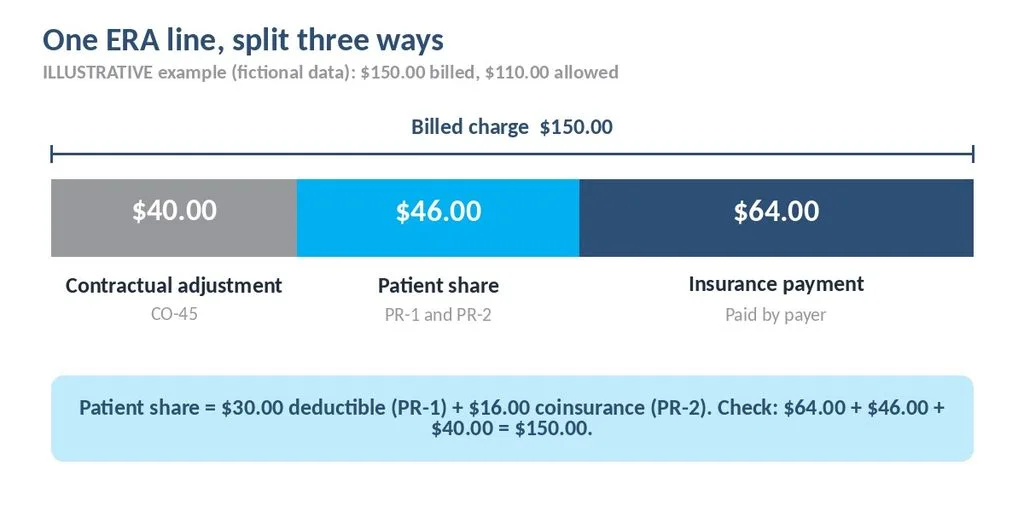
A correctly posted line balances to the penny: payment plus patient share plus adjustment equals the billed charge. Table 4 shows one service line from a fictional ERA, with the amounts split by the codes described above, so posters can check their own entries against the pattern.
Illustrative ERA line posted (fictional data)
| Posting entry | Group and CARC | Amount | Posted to |
| Billed charge, CPT 99213 (sample) | n/a | $150.00 | Charge ledger |
| Contractual adjustment | CO-45 | $40.00 | Write-off (contract reduction) |
| Allowed amount | n/a | $110.00 | Reference only |
| Deductible applied | PR-1 | $30.00 | Patient balance |
| Coinsurance, 20% of $80.00 | PR-2 | $16.00 | Patient balance |
| Insurance payment | n/a | $64.00 | Payment ledger |
Illustrative: fictional data and a hypothetical plan design. Check: $64.00 payment + $46.00 patient share + $40.00 adjustment = $150.00 billed.
Illustrative scenario (not an actual client record): the payer allows $110.00 and applies $30.00 to the deductible. Coinsurance is 20% of the remaining $80.00, or $16.00, so the payer pays $64.00 and the patient owes $46.00. Collecting that share is easier with the front-desk tactics in the patient payment collection strategies.
How does payment posting differ by payer?
Payer type changes the remittance source, the adjustment pattern and the follow-up rules. Table 5 summarizes the main differences. It is illustrative except where a source is named, because contracts, state programs and plan designs differ. Always confirm a payer’s current remittance rules in its provider manual before changing posting rules.
Payer differences (illustrative except where a source is named)
| Payer type | Remittance and posting notes | Patient share | What to check |
| Medicare (fee-for-service) | ERA in X12 835 5010 or paper; provider-level adjustments appear as PLB; Medicare beneficiaries may be billed only when PR is used | PR amounts | MAC portal; PLB at end of ERA |
| Medicare Advantage | Plan-specific ERA enrollment; plan contract governs adjustments and appeals | Set by the plan | Plan remittance guides |
| Medicaid | State-specific remittance format and crossover rules for dual-eligible patients | Often nominal or none | State Medicaid agency |
| Commercial plans | Per-payer ERA enrollment; adjustment patterns vary; frequent PR deductible and coinsurance | Deductible, copay, coinsurance | Contract and remittance advice |
| Self-pay | Posted from patient receipts; no ERA | Full balance after discount | Written discount policy |
Sources: CMS remittance advice page (ERA format, PLB, PR rule). Illustrative where no source is named; actual terms vary by payer and state.
Provider-level adjustments deserve special care. CMS lists examples such as interest for late payment of a clean claim and a deduction for a prior overpayment, and they are not tied to a single claim. When a net payment looks short, scan the end of the ERA for PLB entries. Secondary claims also have filing windows, and Medicare’s general limit is 12 months from the date of service, per Noridian’s timely filing guidance.
Which calculations show whether posting is accurate?
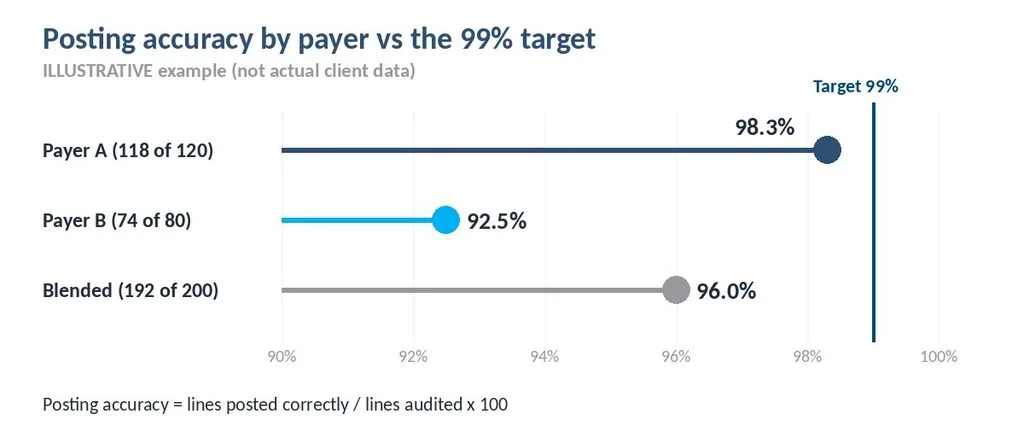
Four short calculations show whether posting is accurate, timely and reconciled. Each example is illustrative, opens with its formula and can be rerun with a practice’s own audit sample and deposit records. Replace every sample figure with real counts before drawing any conclusion.
Example 1: posting accuracy, blended and by payer
Formula: posting accuracy rate = lines posted correctly ÷ lines audited × 100. Illustrative scenario (not an actual client record): an audit samples 200 lines. Payer A has 120 lines with 118 correct, or 98.3%. Payer B has 80 lines with 74 correct, or 92.5%. Blended, 192 ÷ 200 = 96.0%, which hides the payer where the posting rules are probably wrong.
Example 2: unapplied cash rate
Formula: unapplied cash rate = unapplied payments ÷ monthly collections × 100. Illustrative scenario (not an actual client record): $9,000 sits unapplied against $300,000 collected, so the rate is 3.0%. Against a practical goal of about 2%, roughly $3,000 of that balance needs matching to claims or refunding.
Example 3: posting lag
Formula: average posting lag = total days from receipt to posting ÷ number of remittances. Illustrative scenario (not an actual client record): five remittances post in 1, 1, 2, 4 and 2 days, which totals 10 days. The average is 10 ÷ 5 = 2.0 days, but the 4-day remittance shows where the process stalls.
Example 4: deposit reconciliation variance
Formula: variance = bank deposits − posted payments. Illustrative scenario (not an actual client record): deposits total $12,480.00 and posted payments total $12,330.00, so the variance is $150.00, or 1.2% of deposits. Common causes are an unposted check, a PLB takeback or a deposit applied to the wrong date.
How to use these numbers correctly
Compare like with like: one payer against its own history, and one posting method against the same method last month. One missed benchmark is a signal to investigate, not a verdict. When accuracy dips, split the sample by payer, by code type and by poster before retraining anyone or changing a rule.
How long does it take to improve payment posting?
Partial improvement often appears within 30 to 60 days of fixing auto-post rules and daily reconciliation, and a full cleanup commonly takes 90 to 120 days. These are general planning ranges, not guarantees. Quick wins come from exception queues and unapplied cash. Slower gains come from payer enrollment, staff training and old balances, so results vary by volume and payer mix.
Which payment posting mistakes cause the most damage?
Most posting damage traces to six repeatable mistakes, and each has a straightforward fix. Review them quarterly with the underpayment guide nearby, because a missed short payment is often a posting mistake first, and assign each fix to a named owner so the list does not become a wish list.
- Writing off denials as contractual. Post CO adjustments as write-offs only after checking the CARC. Do this on every line that is not a routine reduction.
- Skipping the deposit match. Compare each deposit to its remittance before posting. Our team often sees unmatched checks sit unapplied for weeks.
- Ignoring PLB entries. Review the end of every ERA when the net payment does not match the claim totals.
- Billing patients too early. Wait for the secondary payer’s remittance when the patient has secondary coverage.
- Letting auto-post rules go stale. Update rules after each CARC and RARC release and each payer change.
- Posting without an exception queue. Route unmatched and zero-pay lines to a named owner the same day.
Quick summary
- Payment posting records payments, adjustments and denials against the correct claim line.
- Read the group code first: CO, PR, OA and PI decide the posting action.
- Post CO adjustments as write-offs only when the CARC is a true contract reduction.
- A commonly cited practical target is posting accuracy near 99% and unapplied cash under about 2%.
- Reconcile deposits to remittances every day and check the PLB section.
- Track accuracy by payer, because a blended rate can hide one failing payer.
Self-assessment: is your posting process reliable?
Answer yes or no to each question, using last month’s data wherever a question mentions a rate. The scoring guide below the list shows what the total suggests and what to do next. A “no” is a to-do, not a failure.
- Do you post remittances within 1 to 2 business days of receipt?
- Do you match each deposit to its remittance before posting?
- Do you reconcile deposits to posted payments daily?
- Do you check CARCs before posting any CO adjustment as a write-off?
- Do you review PLB entries at the end of each ERA?
- Is your sampled posting accuracy near 99%, and above 97%?
- Is unapplied cash under about 2% of monthly collections?
- Do you track posting accuracy by payer?
- Do you send every denial and underpayment to a named follow-up queue the same day?
- Do you update posting rules after each CARC and RARC release?
Scoring guide
| Yes answers | What it suggests | Next step |
| 9-10 | Posting process looks reliable | Keep the daily reconciliation and monthly payer-level audit |
| 6-8 | Gaps worth closing | Fix the “no” items first and re-audit in 60 days |
| 0-5 | Revenue and denial risk | Rebuild matching, reconciliation and exception queues |
Scoring is a practical guide, not a published standard.
When does outside billing support make sense?
Outside support makes sense when posting errors start hiding denials and A/R drift, and the signs usually appear in unapplied cash before they appear in write-offs. Consider help when several of these five signals are already present, since each one tends to compound the others:
- Unapplied cash stays above about 3% for two or more months.
- Daily deposits and posted totals disagree, and nobody can explain why.
- Staff write off CO adjustments without checking reason codes.
- Denials are discovered at month-end, not on the day of posting.
- One payer produces most posting exceptions and no one owns its rules.
When evaluating a partner, look for payer-level accuracy reporting, a written exception process, ERA and EFT enrollment support and signed HIPAA safeguards. Aspect Billing Solutions is one example. It provides HIPAA-compliant, end-to-end medical billing and coding, credentialing, eligibility verification and prior authorization, denial management, A/R follow-up and compliance support, with a dedicated agent assigned to each provider. Results vary by practice. A medical billing audit is a practical first step, and the revenue cycle management service page describes the full approach.
Practices can also review how posting feeds accounts receivable days and the wider cash flow tactics for clinics, and how Aspect Billing Solutions’ billing and coding services are organized, before deciding how much to keep in-house, and which steps would free staff time first.
Final Considerations
Payment posting in medical billing looks like data entry, but it is the point where a payer’s decision becomes the practice’s records. Accurate posting protects patient balances, exposes denials early and keeps every A/R metric honest. The fixes are mostly discipline: match deposits, read group codes, check the PLB and reconcile daily.
Firm published standards here are the X12 835 version 5010 ERA format for Medicare, the three-times-a-year CARC and RARC updates, the group code definitions and Medicare’s 12-month filing limit. The 99% accuracy, 2% unapplied cash and 1 to 2 day turnaround targets, the timeframe ranges and every worked example are practical or illustrative.
The natural next question is which payer’s remittances are being posted wrong today. To find out, ask Aspect Billing Solutions for a payment posting review and bring a month of remittances with deposit records, so the review can compare each payer with its own history.
Frequently asked questions
What is payment posting in medical billing?
Payment posting is the process of recording insurance and patient payments, adjustments and denials against the correct claim and service line. Staff use the remittance advice to update balances, bill patients or secondary payers and flag unpaid lines for follow-up. Accurate posting keeps accounts receivable reliable.
What is the difference between an EOB and an ERA?
An EOB, or explanation of benefits, goes to the patient and explains how the claim was processed. An ERA, or electronic remittance advice, goes to the provider in the X12 835 format and carries payments, adjustments and codes. Practices post from the ERA or paper remittance, not the patient’s EOB.
What are CARC and RARC codes?
Claim adjustment reason codes explain why a payer adjusted an amount, and remittance advice remark codes add more specific detail. Group codes such as CO and PR assign responsibility. CMS says the CARC and RARC lists update three times a year, so posting software needs each release.
What is a good payment posting accuracy rate?
Many practices target a sampled posting accuracy rate near 99% and investigate anything below about 97%. These are commonly cited practical targets, not CMS, MGMA or HFMA mandates. Audit a monthly sample, and split results by payer, since a blended rate can hide one weak payer.
How quickly should payments be posted?
A common practical goal is to post remittances within one to two business days of receipt, with deposits reconciled daily. No payer or CMS rule sets that exact window. Faster posting surfaces denials and short payments sooner, which leaves more time to work them before filing limits pass.
Should a practice use automatic payment posting?
Automatic posting suits routine ERA lines that match an open claim, and CMS notes ERAs post automatically with more detail than paper. Staff should still review exceptions, unfamiliar codes and provider-level adjustments. Use automation when the rules are current, and keep a human check on denials.
Sources and methodology
(a) Published standards and definitions from named bodies
- CMS, Health Care Payment and Remittance Advice (ERA and standard paper remittance; X12 835 version 5010; group codes, CARCs, RARCs; PLB examples; Medicare beneficiaries may be billed only when PR is used; last modified September 10, 2024).
- CMS, MLN booklet “Remittance Advice Resources and FAQs” (ERA definition; CARC and RARC lists updated three times per year, usually March 1, July 1 and November 1).
- X12, Claim Adjustment Group Codes (CO, OA, PI, PR) and Claim Adjustment Reason Codes (CARC 1, 2, 3, 16, 45, 97 descriptions).
- Noridian Healthcare Solutions, Timely Filing (Medicare 12-month general filing limit).
(b) Named benchmarking data providers
None. No MGMA, HFMA or other benchmarking-provider figures are cited in this article.
(c) Practical or illustrative targets from general industry sources
- The 99% posting accuracy target, the 97% review threshold, the 2% unapplied cash goal and the 1 to 2 business day turnaround are commonly cited across industry sources and Aspect Billing Solutions’ working guidelines, not mandates.
- The 30 to 60 day and 90 to 120 day improvement ranges are general planning ranges, not guarantees.
- All worked examples, including the sample ERA line and the plan design behind it, are labeled illustrative and use fictional data.
(d) Survey or study data
None. No survey or study data are cited in this article.
Results vary by practice, payer and state. Figures and rules reflect information available in October 2026, and code lists, payer policies and fee schedules change often.