
Low-Cost Internal Medicine Billing for Large Practices in Utah
Low-cost internal medicine billing for large practices in Utah refers to outsourced revenue cycle management priced to stay efficient at high claim volume, typically through percentage-based fees that scale with collections instead of fixed headcount costs. For large internal medicine groups, this model covers claims submission, coding, denial management, and accounts receivable at a lower cost per claim than an oversized in-house billing department. The result is predictable overhead and stronger margins as patient volume grows.
low-cost internal medicine billing for large practices in Utah-A 12-provider internal medicine group in Salt Lake City adds two more physicians, and its billing department suddenly needs another full-time hire just to keep pace. A Provo practice managing claims across SelectHealth, Regence, University of Utah Health Plans, PEHP, and Utah Medicaid managed care plans watches its cost per claim climb every time a biller quits or takes leave. For large Utah internal medicine practices, billing costs don’t stay flat as the practice grows — they often grow faster than revenue, squeezing margins right when scale should be paying off.
This guide explains what low-cost internal medicine billing for large practices in Utah actually looks like, from pricing models that scale with collections to the specific services that keep cost per claim down at volume. It compares in-house staffing costs against outsourced pricing, walks through realistic performance benchmarks, and shows what to look for in a billing partner built for multi-provider groups. Administrators managing a growing practice, and physicians watching overhead eat into revenue, will find a practical, numbers-based framework here.
Why Large Utah Practices Need Low-Cost Billing at Scale?
The Hidden Cost of Scaling an In-House Billing Department
Adding providers to a large internal medicine group multiplies claim volume, but billing staff rarely scale as efficiently as clinical staff. Each new hire adds salary, benefits, training time, and software licensing costs, while medical coding accuracy often dips during onboarding. A billing department sized for last year’s volume falls behind quickly, and accounts receivable starts aging as claims wait longer for follow-up. For large practices, this is the core problem: billing overhead grows in steps, not smoothly, and every step tends to arrive at the worst possible time.
Utah’s Payer Mix and Claim Volume Challenge
Large internal medicine practices in Utah typically bill across SelectHealth, Regence BlueCross BlueShield of Utah, University of Utah Health Plans, PEHP, and Utah Medicaid managed care plans such as Healthy U, Molina, and Health Choice Utah. Each payer applies its own prior authorization rules, timely filing windows, and claim formatting requirements, and high volume means even a small error rate translates into a large dollar amount in denials. A billing partner with existing Utah payer relationships and enough scale to spread technology and expertise costs across many claims can process this volume for less per claim than a practice-run department ever could.
What Low-Cost Internal Medicine Billing Outsourcing Includes?
Low-cost internal medicine billing for large practices in Utah isn’t about cutting corners; it’s about spreading fixed costs like technology, compliance, and specialized expertise across a higher claim volume. A qualified partner manages the full revenue cycle management process end to end. Aspect Billing Solutions details its
full range of medical billing services for practices of every size, including the components that matter most for large multi-provider groups below.
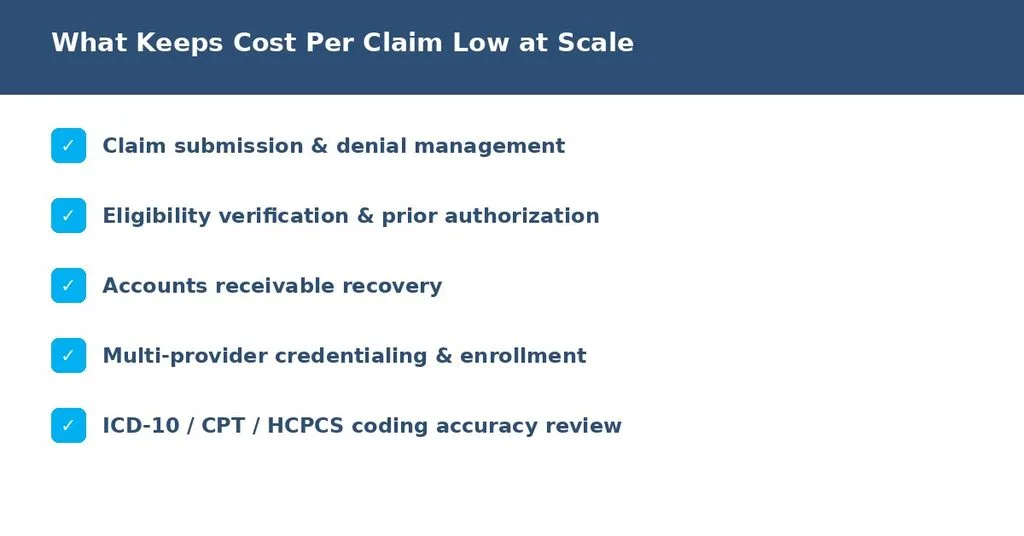
Claim & Denial Management at Volume
At high claim volume, even a 2-3% denial rate represents real revenue. A dedicated billing team scrubs claims before submission, applies payer-specific edits automatically, and appeals denials within Utah’s filing deadlines instead of letting them lapse. This denial management process is what keeps cost per claim low, since recovering a denied claim is far cheaper than writing it off and absorbing the loss.
Eligibility Verification & Prior Authorization
Checking coverage before every visit prevents the most common source of denials across a large patient panel: inactive or mismatched insurance. A billing partner verifies eligibility verification against each Utah payer’s system and secures prior authorization for imaging, infusions, and specialist referrals in advance. At scale, automating this step is one of the biggest drivers of lower cost per claim, since manual verification doesn’t scale efficiently with provider count.
Accounts Receivable Recovery
Large practices generate large accounts receivable balances, and even a modest improvement in follow-up speed recovers meaningful revenue. A dedicated agent monitors AR by payer and claim age, escalating anything past 30 days. Consistent, systematic follow-up — not sporadic batch calls — is what actually moves days in A/R down across a high-volume claim pipeline.
Multi-Provider Credentialing & Enrollment
Growing groups constantly add providers, and every new hire needs active enrollment with each payer before billing can start. Credentialing delays are one of the most expensive hidden costs for large practices, since an un-enrolled provider generates zero reimbursable revenue during the gap. A partner managing CAQH profiles and payer applications at scale, as covered in the comprehensive credentialing and enrollment guide for physician groups, keeps new providers billing sooner.
ICD-10 and CPT Coding Accuracy at Scale
Internal medicine coding for chronic care management, transitional care, and annual wellness visits requires precision that’s hard to maintain across a large, rotating billing staff. A team that codes CPT and HCPCS codes exclusively for internal medicine, at volume, catches errors before submission rather than after a denial. That consistency protects the clean claim rate no matter how many providers are billing, a topic explored further in the guide to internal medicine billing CPT codes.
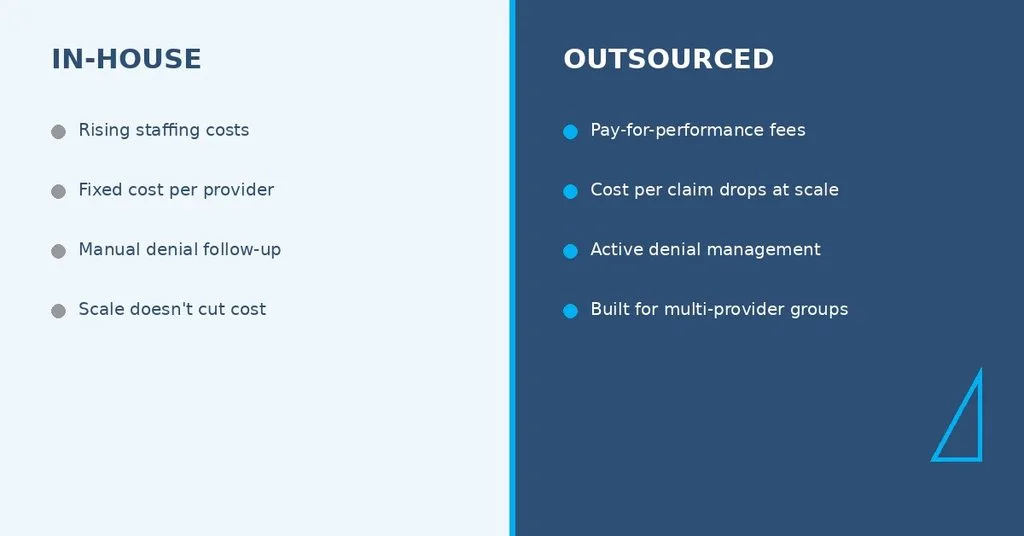
Cost Comparison: In-House vs Outsourced Billing for Large Practices
For a large internal medicine group, the cost question isn’t just salary versus fee — it’s how each model behaves as claim volume grows. The table below compares both approaches across the factors that matter most at scale.
| Factor | In-House Billing | Outsourced Billing |
| Cost as volume grows | Rises in steps with each new hire | Scales smoothly with collections |
| Staffing risk | Turnover disrupts multiple providers at once | Continuous coverage, no single point of failure |
| Utah payer expertise | Builds slowly across a large team | Existing relationships across UT payers |
| Credentialing speed | Often a bottleneck for new hires | Managed in parallel across providers |
| Technology & compliance | Practice funds systems for every seat | Included in the billing partnership |
| Cost per claim at scale | Rarely improves with volume | Typically decreases with volume |
A large practice with strong internal systems may still keep some functions in-house, but the math changes quickly once a group crosses roughly eight to ten providers. At that scale, the fixed costs a billing partner spreads across many clients — technology, compliance, specialized coders — start costing less per claim than building the same infrastructure internally. A closer look at outsourced vs in-house medical billing breaks down this decision in more detail, and the cost breakdown of outsourced medical billing services outlines typical fee structures.
How Pricing Models Keep Costs Low for Large Practices?
Percentage-Based vs Flat-Fee Pricing
Most outsourced billing arrangements use a percentage-of-collections model, which naturally aligns the billing partner’s incentives with the practice’s revenue. Flat-fee or per-claim pricing can work for very high, predictable volume, but percentage-based pricing usually protects large practices better against seasonal dips in claim volume. Details on how these structures work are covered in the guide to understanding outsourced medical billing pricing models, along with the pros and cons of percentage-based medical billing.
What Drives Cost Per Claim Down at Scale?
Three factors consistently lower cost per claim for large practices: automated eligibility checks that remove manual labor, denial prevention that reduces costly rework, and a billing partner large enough to negotiate better clearinghouse and technology rates than an individual practice could on its own. Group size matters here — a practice large enough to warrant dedicated support, but still paying per-provider software and staffing costs internally, is often the best candidate for meaningful savings through outsourcing.
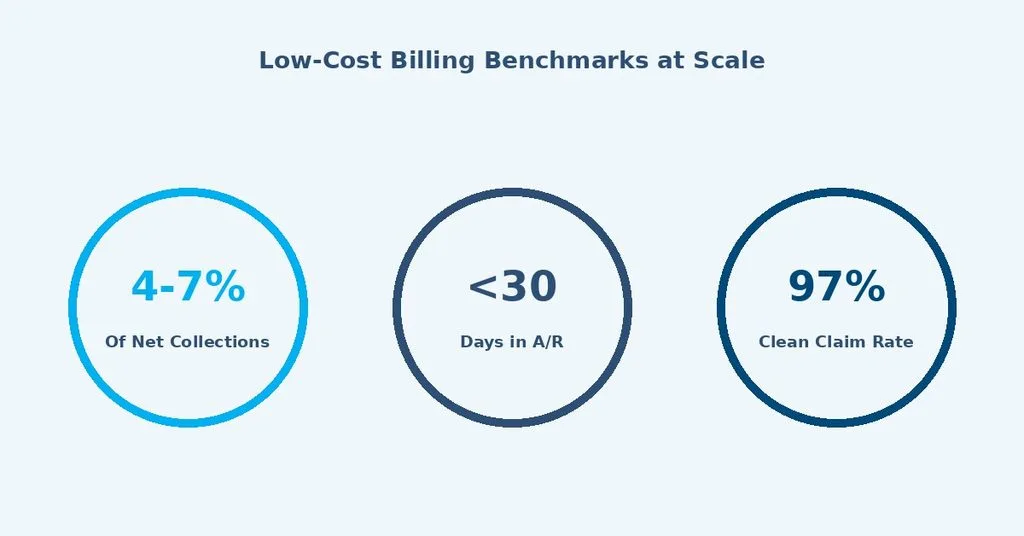
Benchmarks: What Low-Cost, High-Performance Billing Looks Like?
Cost alone doesn’t tell the full story — a cheap billing service that generates denials isn’t actually low-cost. The table below shows benchmarks large internal medicine practices should expect from an efficient billing operation.
| Metric | Underperforming | Low-Cost, High-Performance |
| Fee structure | Flat fee regardless of volume | 4-7% of net collections |
| Clean claim rate | Below 90% | 97% or higher |
| Days in A/R | Over 45 days | Under 30 days |
| Denial rate | Above 8% | Under 4% |
| Credentialing turnaround | 90+ days per provider | 45-60 days per provider |
These figures are guidelines rather than guarantees, since payer contracts and patient mix vary between practices. Large groups should still track them monthly, since a slipping clean claim rate or rising days in A/R at scale represents a much larger dollar impact than the same slip at a small practice. Benchmarking organizations such as the Medical Group Management Association (MGMA) publish comparable data that Utah groups can use to check performance against national norms.
The Aspect Billing Solutions Approach for Large Utah Practices
Aspect Billing Solutions supports large internal medicine groups in Utah with HIPAA-compliant billing built to handle multi-provider volume without multiplying overhead. Every practice is assigned a dedicated agent who coordinates across the full provider roster instead of splitting the account between generalist staff. Services cover claim and denial management, eligibility verification, prior authorization, accounts receivable recovery, and multi-provider credentialing, all built around ICD-10, CPT, and HCPCS coding accuracy. The ultimate guide to outsourcing medical billing and coding outlines this process for practices considering the switch.

Quick Summary
- Low-cost internal medicine billing for large practices in Utah scales cost with collections rather than headcount.
- Utah’s payer mix — SelectHealth, Regence, University of Utah Health Plans, PEHP, and Medicaid managed care — rewards payer-specific expertise.
- Full-service outsourcing covers claim and denial management, credentialing, AR recovery, and coding accuracy at volume.
- Percentage-based pricing typically protects large practices better than flat fees as claim volume fluctuates.
- Track clean claim rate, days in A/R, denial rate, and credentialing turnaround every month.
- Choose a partner built for multi-provider groups, with a dedicated agent and transparent benchmarks.
Final Considerations
Growth shouldn’t force a large Utah internal medicine practice to choose between adding providers and controlling overhead. Low-cost internal medicine billing for large practices in Utah, structured correctly, turns billing from a scaling cost center into a predictable percentage of collections. Practices that treat billing performance as a tracked metric, not a background function, are the ones that actually see cost per claim fall as they grow.
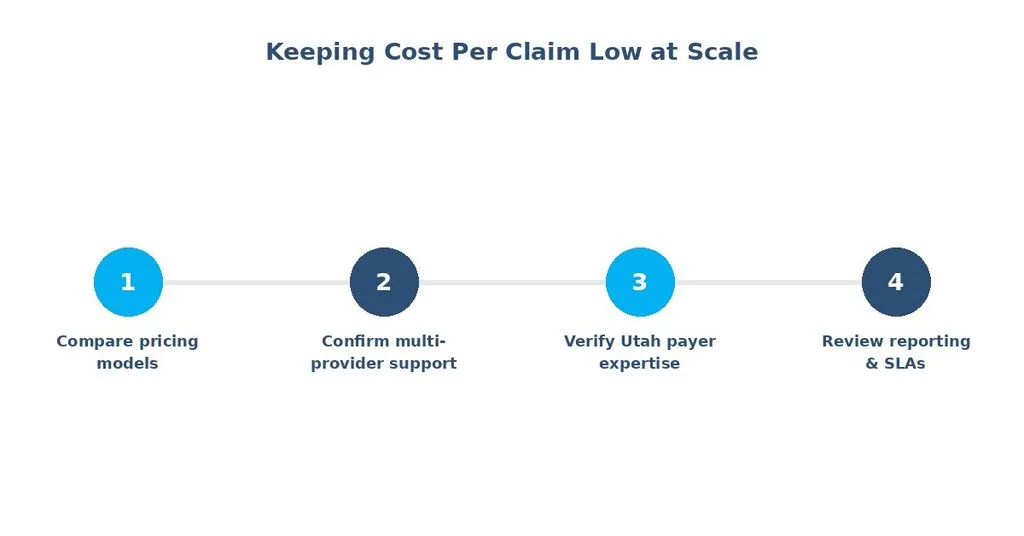
Whether evaluating a first outsourcing partner or replacing one that hasn’t kept pace with growth, the fundamentals stay the same: confirm the pricing model, verify Utah payer experience, and ask for real benchmarks before signing. A partner that can answer those questions clearly, with multi-provider experience, is worth a serious look.
Frequently Asked Questions
low-cost internal medicine billing for large practices in Utah
How much does low-cost internal medicine billing cost for a large Utah practice?
Most arrangements use a percentage of net collections, commonly in the 4-7% range, rather than a flat fee. The exact rate depends on claim volume, payer mix, and included services such as credentialing. Larger practices often negotiate a lower percentage than smaller ones because of the volume they bring.
How does outsourcing actually lower cost per claim as a practice grows?
Outsourced partners spread technology, compliance, and specialized coding expertise across many clients’ claim volume. Which an individual practice can’t replicate internally. As a large group adds providers, the outsourced cost typically grows in proportion to collections. Rather than in step increases tied to new hires.
Can a large practice outsource only part of its billing to save costs?
Yes. Many large groups keep front-desk eligibility checks in-house while outsourcing denial management, credentialing, or AR recovery specifically. A hybrid approach can work well, though full outsourcing usually delivers the largest cost-per-claim reduction at scale.
How Utah’s Medicaid does managed care system affect billing costs?
Utah Medicaid operates through managed care organizations. Including Healthy U, Molina Healthcare, Health Choice Utah, and SelectHealth Community Care, each with its own claims requirements. Details are available on the official Utah Medicaid managed care page. A billing partner unfamiliar with these plans risks denials that raise the effective cost per claim, even under a low headline fee.
What’s a realistic timeline to see cost savings after outsourcing?
Most large practices see measurable improvement in denial rate and days in A/R within two to three billing cycles, roughly 60-90 days. Full cost-per-claim benefits typically become clear once credentialing for all providers is complete and reporting has stabilized.
Does a lower billing fee always mean lower total cost?
Not necessarily. A low percentage fee paired with a high denial rate can cost more in lost revenue than a slightly higher fee with strong clean claim performance. Total cost should be evaluated using net collections after denials, not the headline fee alone.
Major Industry Leader
Aspect Billing Solutions builds HIPAA-compliant medical billing and coding programs for providers across the country, including large internal medicine groups scaling across Utah’s specific payer landscape. Every client is paired with a dedicated agent who manages claims, denials, credentialing, and accounts receivable across the full provider roster. Large Utah practices evaluating outsourcing, or reviewing a billing setup that hasn’t kept pace with growth, can request a free consultation and billing audit to see the true cost per claim. Learn more at www.aspectbillingsolutions.com, or reach the team directly through the contact page to schedule a no-cost billing audit.