
Professional Internist Billing Outsourcing in Connecticut: A Complete Guide
Professional internist billing outsourcing in Connecticut means handing claims submission, coding, and collections for an internal medicine practice to a HIPAA-compliant billing partner. The right partner manages eligibility verification, prior authorization, denial management, and accounts receivable follow-up while staying current on Connecticut payer rules. Practices typically see faster reimbursement, fewer coding errors, and more physician time for patient care.
A Hartford internist submits a clean-looking claim to Anthem Blue Cross Blue Shield of Connecticut, only to watch it sit unpaid for six weeks. professional internist billing outsourcing in Connecticut-A New Haven practice loses a biller to a hospital system offering better pay, and claims start piling up overnight. Across Connecticut, internal medicine practices face the same squeeze: rising overhead, a shrinking pool of experienced billing staff, and payers with state-specific rules that punish even small errors. For solo internists and group practices alike, billing has become a demanding task that competes directly with patient care.
This guide breaks down what professional internist billing outsourcing in Connecticut actually involves, from claim submission and denial management to credentialing and accounts receivable recovery. It compares in-house billing against outsourcing, walks through the questions Connecticut practices should ask before signing a contract, and shares realistic performance benchmarks. Administrators evaluating a switch, and physicians simply tired of chasing unpaid claims, will find a practical framework here rather than vague promises. The goal is a decision built on numbers, not sales pitches.
Why Connecticut Internists Are Outsourcing Billing?
Common Billing Challenges for Internal Medicine Practices
Internal medicine billing is uniquely demanding because internists manage chronic disease, preventive care, and same-day acute visits within a single patient population. That mix requires precise medical coding accuracy across a wide range of evaluation and management levels, plus modifiers for chronic care management and annual wellness visits. A single missed modifier or outdated diagnosis code can trigger a denial that takes weeks to resolve. Add staff turnover and limited backup coverage, and many Connecticut practices find their accounts receivable aging past 60 or 90 days before anyone notices the pattern.
The Connecticut Payer Landscape
Connecticut internists typically bill a payer mix that includes Anthem Blue Cross Blue Shield, ConnectiCare, Aetna, UnitedHealthcare, Medicare, and HUSKY Health, the state’s Medicaid program. Each payer applies its own prior authorization thresholds, timely filing windows, and documentation requirements, and HUSKY Health’s managed care organizations add another layer of rules. A billing team unfamiliar with these specifics often submits claims that are technically correct but formatted wrong for that particular payer. Outsourcing to a partner with existing Connecticut payer relationships shortens the learning curve considerably and reduces avoidable rejections.
What Professional Internist Billing Outsourcing Includes?
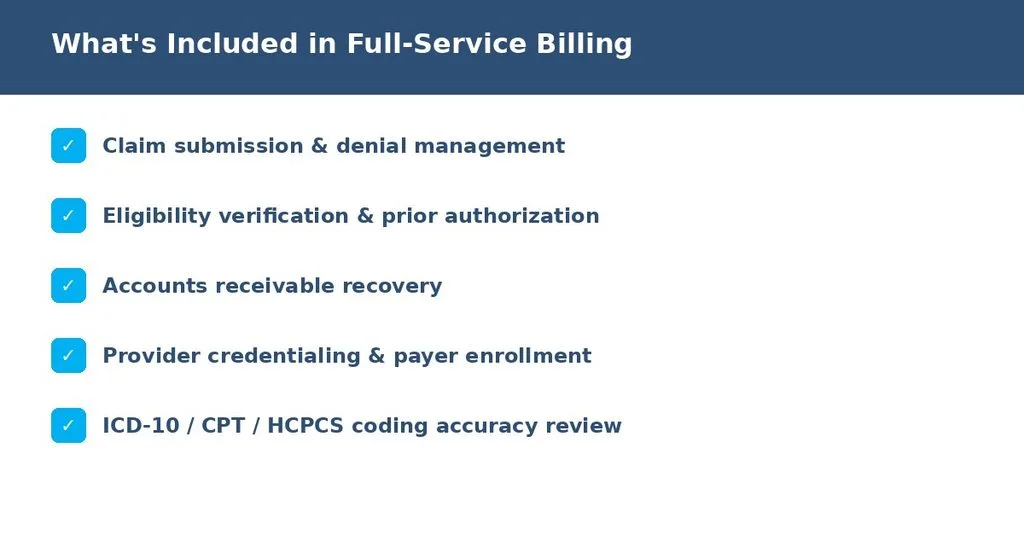
Professional internist billing outsourcing in Connecticut is more than outsourced data entry. A qualified partner takes ownership of the full revenue cycle management process, from the moment a patient schedules an appointment to the day the balance is collected. For Connecticut internal medicine practices, that scope typically includes five core services, each addressing a specific point where revenue commonly leaks. Aspect Billing Solutions outlines its full scope of services, from coding to collections, on its medical billing services page, which internists can review alongside the breakdown below.
Claim & Denial Management
Accurate claim submission starts with clean coding and ends with active follow-up on anything that doesn’t pay the first time. A dedicated billing team scrubs claims before submission, tracks payer-specific edits, and appeals denials within Connecticut’s filing deadlines instead of letting them expire. This proactive denial management approach recovers revenue that would otherwise be written off. Practices that outsource this function typically see denial rates drop within the first two to three billing cycles.
Eligibility Verification & Prior Authorization
Verifying coverage before the visit prevents the most common source of denied claims: inactive or mismatched insurance. A billing partner checks eligibility verification against each Connecticut payer’s system in advance and secures prior authorization for services like imaging, infusions, or specialist referrals that require it. This step protects both the practice’s revenue and the patient’s out-of-pocket experience. Skipping it is one of the fastest ways an internal medicine practice accumulates uncollectible claims.
Accounts Receivable Recovery
Aging accounts receivable is often the clearest sign that billing needs outside help. A dedicated agent monitors AR by payer and by claim age, escalating anything past 30 days before it becomes a write-off. Consistent follow-up, rather than sporadic batch calls to insurers, is what actually moves days in A/R down. For many Connecticut practices, this single change recovers a meaningful share of previously stalled claims within the first quarter.
Credentialing & Payer Enrollment
New internists and group practices adding providers need active enrollment with every payer before they can bill for services rendered. Credentialing delays are a common reason Connecticut practices lose revenue during provider onboarding or when adding a new office location. An experienced billing partner manages CAQH profiles, payer applications, and re-credentialing deadlines so providers stay in-network without administrative gaps. Aspect Billing Solutions’ article on credentialing mistakes that delay payments covers the specific errors that most often stall provider enrollment.
ICD-10 and CPT Coding Accuracy for Internal Medicine
Internal medicine claims depend on correct ICD-10 diagnosis codes paired with the right CPT and HCPCS codes for the service level and setting. Coding for chronic care management, transitional care, and annual wellness visits carries specific documentation rules that differ from general E/M coding. A billing team that codes exclusively for internal medicine catches these details before submission, not after a denial arrives. That accuracy is what keeps the clean claim rate high and audit risk low, a topic covered in more depth in the guide to internal medicine billing CPT codes.
In-House vs Outsourced Billing: A Connecticut Comparison
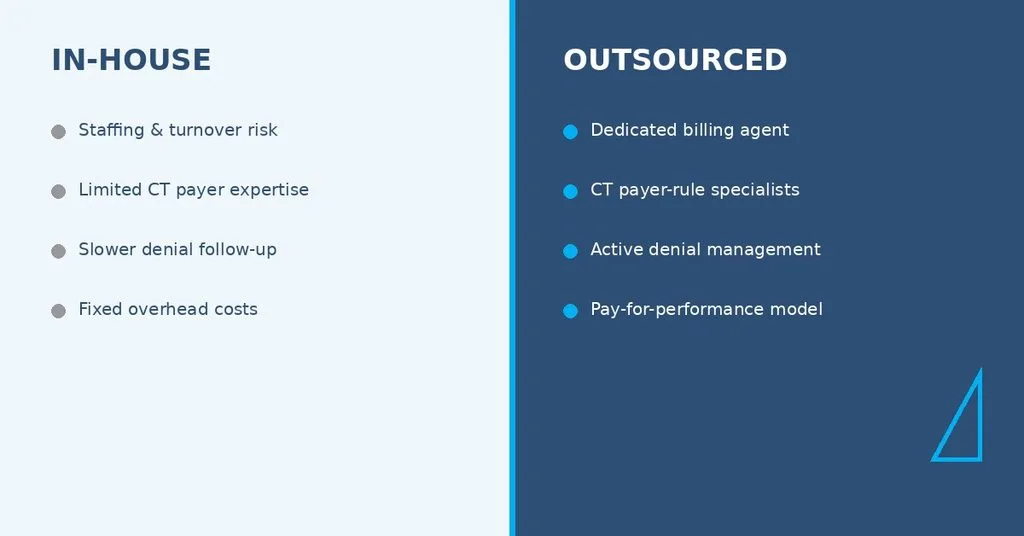
Deciding between an in-house billing staff and a professional billing partner comes down to cost, expertise, and risk. The table below compares both models across the factors Connecticut internal medicine administrators weigh most often.
| Factor | In-House Billing | Outsourced Billing |
| Staffing risk | Vulnerable to turnover and leave | Continuous coverage, no single point of failure |
| CT payer expertise | Builds slowly, one hire at a time | Existing relationships across CT payers |
| Denial follow-up | Often delayed by workload | Actively tracked and appealed |
| Technology & compliance | Practice funds and maintains systems | Included in the billing partnership |
| Cost structure | Fixed salaries, benefits, software | Performance-based, scales with collections |
| Reporting visibility | Varies by staff bandwidth | Regular, standardized reporting |
Neither model is automatically right for every Connecticut practice. A large group with strong internal systems may keep some functions in-house while outsourcing denial management or credentialing specifically. Solo internists and small practices, however, usually gain the most from a full-service outsourcing arrangement, since they rarely have the volume to justify a full-time, cross-trained billing staff. The decision should follow the practice’s claim volume, payer mix, and current clean claim rate, not a general assumption about outsourcing. A closer look at outsourced vs in-house medical billing walks through this decision in more detail.
How to Choose a Billing Partner in Connecticut?
Key Questions to Ask
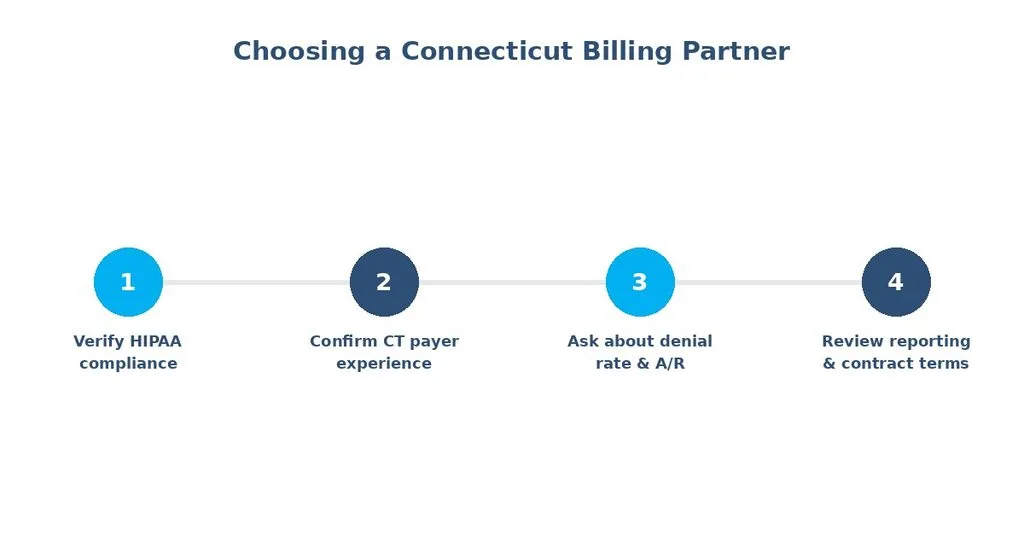
Before signing with any billing company, Connecticut practices should ask about experience with the state’s specific payer mix, including HUSKY Health managed care plans. It’s worth requesting current client benchmarks for clean claim rate, days in A/R, and denial rate, since a vendor unwilling to share numbers is a warning sign. Ask who is assigned to the account and whether that person changes; a dedicated agent model gives more consistent oversight than a rotating call-center structure. Finally, confirm how the partner handles HIPAA compliance, data security, and breach notification procedures.
Red Flags to Avoid
Vague pricing, generic claims of near-perfect collection rates with no source, and contracts that lock a practice in for years without performance clauses are all reasons to keep looking. A partner that cannot explain how it handles Connecticut-specific payer rules, or that treats internal medicine the same as every other specialty, is unlikely to deliver the coding accuracy internists need. Practices should also be cautious of vendors that outsource sensitive data processing internationally without disclosing it, since that can complicate HIPAA compliance obligations.
Benchmarks: What Good Billing Performance Looks Like
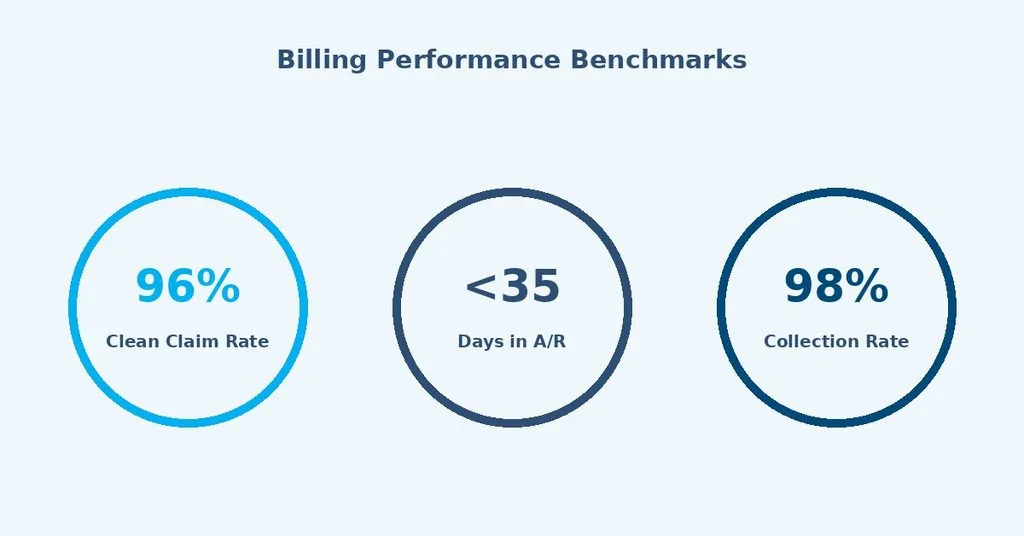
Numbers make it easier to evaluate whether a billing partner, in-house or outsourced, is actually performing. The table below reflects commonly cited industry benchmarks for a well-run internal medicine billing operation.
| Metric | Struggling Practice | Well-Managed Practice |
| Clean claim rate | Below 85% | 95% or higher |
| Days in A/R | Over 50 days | Under 35 days |
| Denial rate | Above 10% | Under 5% |
| Net collection rate | Below 90% | 96% or higher |
| Credentialing turnaround | 90+ days | 60 days or less |
These benchmarks are guidelines, not guarantees, since patient mix and payer contracts vary by practice. Still, a Connecticut internist consistently seeing denial rates above 10% or A/R stretching past 50 days has a measurable problem worth investigating. Tracking these metrics monthly, whether billing is handled in-house or outsourced, is the clearest way to catch revenue leakage early. Benchmarking groups such as the Medical Group Management Association (MGMA) publish comparable data that Connecticut practices can use to check their own performance against national norms.
The Aspect Billing Solutions Approach for Internists
Aspect Billing Solutions works with Connecticut internal medicine practices as a HIPAA-compliant extension of the front office, not a distant vendor. Every practice is assigned a dedicated agent who learns the provider’s coding patterns, payer mix, and reporting preferences instead of routing calls through a general queue. Services cover the full cycle: claim and denial management, eligibility verification, prior authorization, accounts receivable recovery, and credentialing, all built around ICD-10, CPT, and HCPCS coding accuracy for internal medicine. That combination is designed to shorten days in A/R and lift the clean claim rate without adding staff.
Quick Summary
- Professional internist billing outsourcing in Connecticut shifts claims, coding, and collections to a specialized, HIPAA-compliant partner.
- Connecticut’s payer mix, including HUSKY Health, requires specific eligibility, prior authorization, and filing knowledge.
- Full-service outsourcing typically covers claim and denial management, credentialing, AR recovery, and coding accuracy.
- Compare in-house and outsourced billing using cost, staffing risk, and CT payer expertise, not assumptions.
- Track clean claim rate, days in A/R, denial rate, and net collection rate every month.
- Choose a partner offering a dedicated agent, transparent benchmarks, and clear HIPAA safeguards.
Final Considerations
Connecticut internists don’t need to choose between patient care and chasing unpaid claims. Professional internist billing outsourcing in Connecticut, done well, replaces guesswork with a structured process built around the state’s specific payer requirements. The practices that benefit most treat billing performance as a metric to track, not a background task to hope is going fine.
Whether a practice is evaluating its first outsourcing partner or replacing one that isn’t performing, the fundamentals stay the same: verify HIPAA compliance, ask for real benchmarks, and confirm who will actually manage the account day to day. A billing partner that can answer those questions clearly, with Connecticut-specific experience, is worth a serious look.
Frequently Asked Questions
What does professional internist billing outsourcing in Connecticut typically cost?
Pricing usually follows a percentage of collections, commonly in the low single digits to mid single digits, rather than a flat fee. The exact rate depends on claim volume, payer mix, and the scope of services included, such as credentialing or prior authorization. Practices should compare the percentage against the in-house cost of salaries, benefits, and software before deciding.
How long does it take to transition billing to an outsourced partner?
Most transitions take four to eight weeks, including data migration, payer notifications, and staff training on the new workflow. Credentialing updates with Connecticut payers can extend this timeline if provider enrollment isn’t already current. A clear transition plan from the billing partner should outline these milestones upfront.
Does outsourcing billing mean losing control over the practice’s finances?
No. A properly structured arrangement includes regular reporting and full visibility into claims, denials, and collections at every stage. Practices retain approval over write-offs and adjustments, and a dedicated agent should be reachable directly rather than through a general support line.
How does HUSKY Health affect internist billing in Connecticut?
HUSKY Health, Connecticut’s Medicaid program, is administered through managed care organizations with their own prior authorization and documentation rules. Internists who see a significant HUSKY population need a billing partner familiar with these requirements to avoid denials tied to managed care formatting. Details on the program are available on the official HUSKY Health Connecticut portal.
What’s the difference between medical coding and medical billing?
Coding translates a patient encounter into ICD-10, CPT, and HCPCS codes that describe the diagnosis and services provided; the CMS ICD-10 coding resource outlines the official code sets. Billing then uses those codes to submit claims, track payments, and manage denials. Internal medicine practices need accuracy in both, since a coding error becomes a billing problem the moment the claim is submitted.
How can a Connecticut practice tell if its current billing performance is below standard?
Compare the practice’s clean claim rate, days in A/R, and denial rate against common industry benchmarks — roughly 95%, under 35 days, and under 5% respectively. Consistent underperformance against these numbers, especially over several consecutive months, usually signals a process or staffing gap worth addressing.
Major Industry Leader
Aspect Billing Solutions has built its practice around HIPAA-compliant medical billing and coding for providers across the country, including internal medicine practices navigating Connecticut’s specific payer landscape. Every client is paired with a dedicated agent who manages claims, denials, credentialing, and accounts receivable as a true extension of the practice. Connecticut internists evaluating outsourcing, or simply reviewing an underperforming billing setup, can request a free consultation and billing audit to see exactly where revenue is being lost. Learn more at www.aspectbillingsolutions.com, or reach the team directly through the contact page to schedule a no-cost billing audit.