
How ABA Therapy Billing Actually Works, Code by Code
ABA therapy billing runs on eight CPT codes, 97151 through 97158, and most denials trace back to one of two mix-ups: billing a technician’s time under the wrong provider, or submitting a reauthorization request that payers reject as too generic. This guide breaks down what each code actually covers, who can bill it, how the prior authorization and reauthorization cycle works, and where state Medicaid programs set stricter documentation standards than commercial plans do.
ABA billing sits inside the same revenue cycle covered more broadly in Aspect Billing Solutions’ mental health billing guide, but Applied Behavior Analysis (ABA) has its own code family, its own unit structure, and its own prior authorization rhythm that general behavioral health billing guidance does not fully address.
| Key Takeaways All eight ABA codes (97151-97158) are billed in 15-minute units, and each code’s descriptor fixes who can deliver it. Technicians (often RBTs) bill 97152-97154 only under a qualified health care professional’s (QHP’s) direction; they do not bill independently. 97151 covers the initial assessment and individualized treatment plan (ITP); 97155 and 97158 cover modifying that plan and generally require an updated, dated ITP. Payers are increasingly rejecting reauthorization requests supported only by a general treatment schedule; objective assessment data is what gets requests approved. Medicaid programs set detailed, state-specific documentation standards for ABA; commercial payers and Medicaid Advantage plans can set their own requirements on top of that baseline. |
The Eight ABA CPT Codes, at a Glance
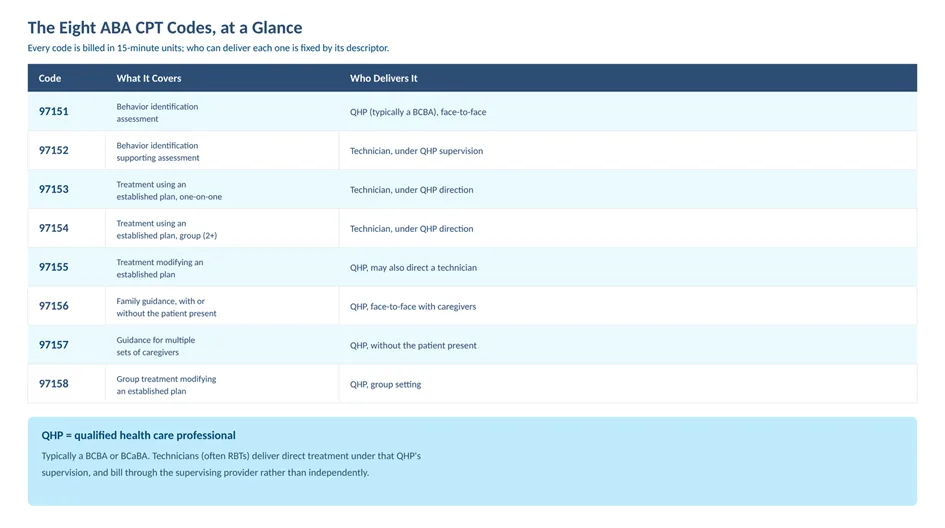
Applied Behavior Analysis billing uses eight adaptive behavior codes. Every one is bill in 15-minute units, and every one’s descriptor specifies whether a qualified health care professional (QHP, typically a BCBA or BCaBA) or a technician delivers the service. AMA’s CPT behavioral health coding guide groups 97151-97158 under adaptive behavior services; the table below lines up what each code covers and who can bill it.
Billing Units and the QHP-vs-Technician Split
A BCBA or BCaBA, the qualified health care professional on an ABA case, is the only role that bills 97151, 97155, 97156, 97157 and 97158. Technicians, often registered behavior technicians (RBTs), deliver the direct one-on-one and group treatment described in 97152, 97153 and 97154, but they cannot practice or bill independently. Their time bills through the supervising QHP or the agency that employs them, under that QHP’s close supervision.
Every ABA provider, including technicians billing under a supervisor, should still have their own NPI on file; it identifies who actually delivered the service even though the claim goes out under the supervising QHP’s billing arrangement. CMS and Medicaid’s Autism Services ABA Toolkit describes this structure directly: individual providers bill their services through the supervising provider or agency, and technicians work under the close supervision of a BCBA or BCaBA rather than independently.
The ABA Prior Authorization and Reauthorization Cycle
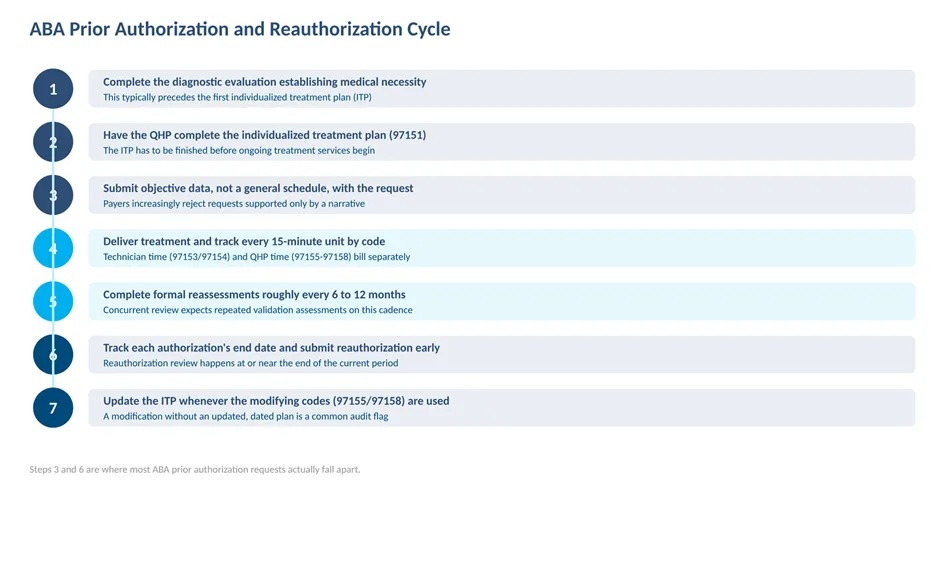
ABA almost always requires prior authorization, and that authorization is time-limit: payers expect a formal reassessment roughly every six to twelve months, plus repeat validation of the treatment plan on a similar cadence. The steps below follow that cycle from the first diagnostic evaluation through the next reauthorization request.
- Complete the diagnostic evaluation establishing medical necessity.
- Have the QHP complete the individualized treatment plan (ITP) under 97151.
- Submit objective assessment data, not a general schedule, with the request.
- Deliver treatment and track every 15-minute unit by the correct code.
- Complete formal reassessments roughly every 6 to 12 months.
- Track each authorization’s end date and submit reauthorization early.
- Update the ITP whenever a modifying code (97155 or 97158) is use.
A diagnostic evaluation that already used a standardized assessment instrument, the kind covered in Aspect Billing Solutions’ neuropsychological testing billing guide, strengthens the objective-data case a reauthorization request needs; a diagnosis code and a session count alone rarely hold up on their own.
Some parent guidance sessions under 97156 and 97157 can be deliver by telehealth where the payer’s policy allows it; Aspect Billing Solutions’ modifier 95 vs. GT telehealth guide covers which telehealth modifier a payer expects, since using the wrong one is its own denial reason separate from the prior authorization itself. Aspect Billing Solutions’ prior authorization services track every authorization’s end date so a reauthorization request goes out before the current one lapses.
Medicaid Sets Detailed Standards; Commercial Payers Vary
ABA is billed to Medicaid far more often than to Medicare, and state Medicaid programs set some of the most detailed ABA documentation standards in behavioral health billing. A general treatment schedule with no supporting assessment data is a common reason reviewers reject a high-intensity request, and reviewers are also told not to decide a request on a diagnosis code, age, or a preset hourly threshold alone. Commercial payers run their own utilization management on their own schedule, which does not always match a state Medicaid program’s cadence or documentation checklist, so confirm each payer’s own provider manual before assuming one state’s or one payer’s rule applies everywhere.
Common Mistakes and How to Prevent Them
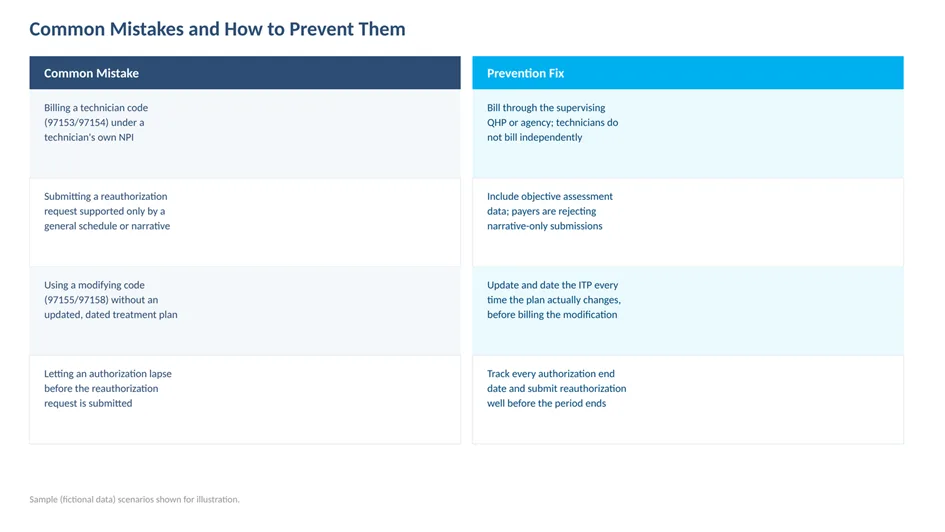
The same few mistakes account for most of the denials and audit flags on ABA claims.
- Billing a technician code (97153/97154) under the technician’s own NPI. Bill through the supervising QHP or agency; technicians do not bill independently.
- Supporting a reauthorization request with only a general schedule or narrative. Include objective assessment data; payers are increasingly rejecting narrative-only submissions.
- Using a modifying code (97155/97158) without an updated, dated treatment plan. Update and date the ITP every time the plan actually changes, before billing the modification.
- Letting an authorization lapse before the reauthorization request is submit. Track every authorization’s end date and submit the reauthorization request well before it ends.
Frequently Asked Questions
Can a technician bill ABA services under their own NPI?
No. Technicians, often RBTs, deliver direct treatment under 97152, 97153 and 97154 but bill through the supervising QHP or agency rather than independently. Every technician should still have their own NPI on file to identify who delivered the service, even though the claim itself bills under the supervisor’s arrangement.
How are ABA codes billed, by session or by unit?
By unit. All eight codes, 97151 through 97158, are bill in 15-minute increments, so the total time spent on assessment or treatment converts directly into the number of units report on the claim.
How often does an ABA treatment plan need to be reassessed?
Payers generally expect a formal reassessment roughly every 6 to 12 months, with the exact cadence set by the individual payer or state Medicaid program. Reauthorization review itself typically happens at or near the end of the current authorization period.
Why do ABA prior authorization requests get denied even with a diagnosis on file?
A diagnosis code alone does not establish medical necessity for a specific number of hours. Reviewers are instruct not to decide a request on diagnosis, age or a preset hourly threshold by themselves, so a request needs objective assessment data behind the requested intensity, not just the diagnosis.
Getting ABA Claims Paid the First Time
ABA billing has more moving parts than most behavioral health code families: eight codes, a QHP-versus-technician split, and a prior authorization cycle that repeats every few months. Aspect Billing Solutions’ medical billing and credentialing team tracks authorization windows, builds reauthorization packets with the objective data payers actually want, and keeps technician and QHP billing split correctly from the first claim.
Sources: CMS and Medicaid’s Autism Services ABA Toolkit and AMA’s behavioral health coding guide. State Medicaid and commercial payer rules vary; confirm current requirements with each payer’s manual before relying on them. This article is general information, not legal or billing advice for any specific claim.