
Do Interstate Compacts Replace Payer Credentialing?
No. An interstate licensure compact lets a clinician practice across state lines on the strength of one home-state license, but it does not enroll that clinician with a single payer in the new state. Payer credentialing is a separate step on its own timeline, and treating the two as the same thing is how practices end up seeing patients they cannot actually bill for. This guide compares PSYPACT, the Counseling Compact, and the Social Work Licensure Compact, then walks through where payer credentialing still has to happen on top of each one.
Interstate compacts are one piece of the broader credentialing picture covered in Aspect Billing Solutions’ mental health credentialing guide. Aspect Billing Solutions’ existing multi-state credentialing guide covers the general multi-state process; this guide goes further into the three behavioral health-specific compacts themselves, since each one sets its own scope and its own mechanism.
| Key Takeaways PSYPACT covers licensed psychologists, the Counseling Compact covers licensed professional counselors, and the Social Work Licensure Compact covers licensed social workers; each covers one profession only. None of these compacts replace payer credentialing. A compact authorization lets a clinician practice in another state; billing a payer there is still a separate enrollment step. Every compact requires the clinician to hold an active, unencumbered license in their home state; losing that license invalidates the compact authorization everywhere at once. PSYPACT uses a two-step process: an ASPPB E.Passport, then the PSYPACT Commission’s own authorization to practice interjurisdictional telepsychology. The Social Work Licensure Compact had not yet opened applications as of this writing; practices should confirm current status with the compact’s own commission before relying on it. |
Three Behavioral Health Compacts, One Rule in Common
PSYPACT, the Counseling Compact, and the Social Work Licensure Compact each give one specific profession a way to practice across state lines without a separate full license in every state. The mechanism differs by compact, but the dependency on a clean home-state license does not.
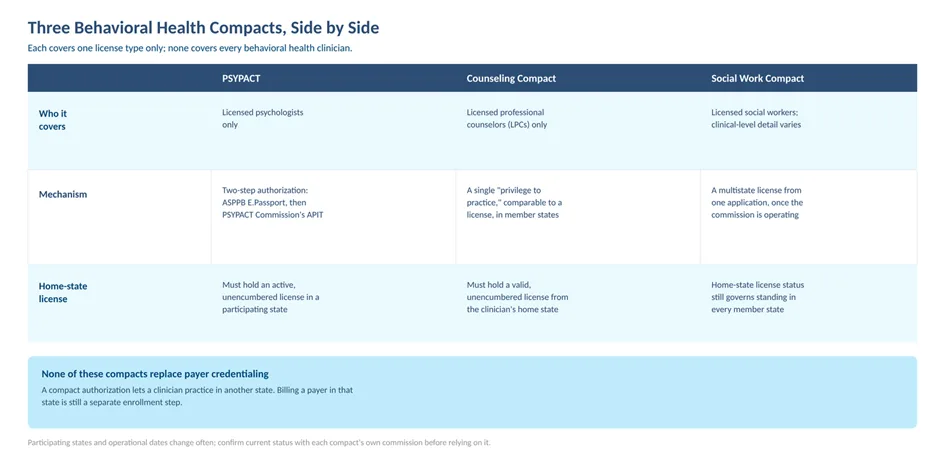
PSYPACT, run jointly by the Association of State and Provincial Psychology Boards (ASPPB) and the PSYPACT Commission, is the most established of the three and covers licensed psychologists only. A psychologist who wants to practice under PSYPACT in another member state first applies for an ASPPB E.Passport, then applies to the PSYPACT Commission for Authority to Practice Interjurisdictional Telepsychology (APIT). Both the clinician’s home-state license and their physical location in a participating state have to check out before either step completes.
The Counseling Compact works differently: a licensed professional counselor who qualifies receives a single privilege to practice, comparable to holding a license, in every other member state at once, rather than applying state by state. The compact requires a valid, unencumbered home-state license, the ability to practice independently, and a clean FBI background check. It covers licensed professional counselors specifically and does not extend to marriage and family therapists or creative-arts therapists.
The Social Work Licensure Compact is the newest of the three and, as of this writing, had not yet opened applications; it was still working through the rulemaking states need to complete before the compact can issue its single multistate license. Once operational, it is built around the same one-application model as the Counseling Compact: a social worker licensed in a member state applies once and gains a multistate license recognized across every other participating state, rather than repeating the licensing process state by state.
Checklist for Cross-State Telehealth Credentialing
The steps below separate what a compact actually settles from what still has to happen on the payer side before a practice can bill for a cross-state telehealth visit.
- Confirm the clinician’s home-state license is active and unencumbered.
- Identify which compact, if any, covers that clinician’s specific license type.
- Confirm the patient’s state has actually joined that compact.
- Complete the clinician’s own compact authorization or privilege.
- Start payer credentialing in the patient’s state as its own step.
- Confirm the specific payer’s own telehealth policy allows this setup.
- Track the home-state license and every compact renewal date.
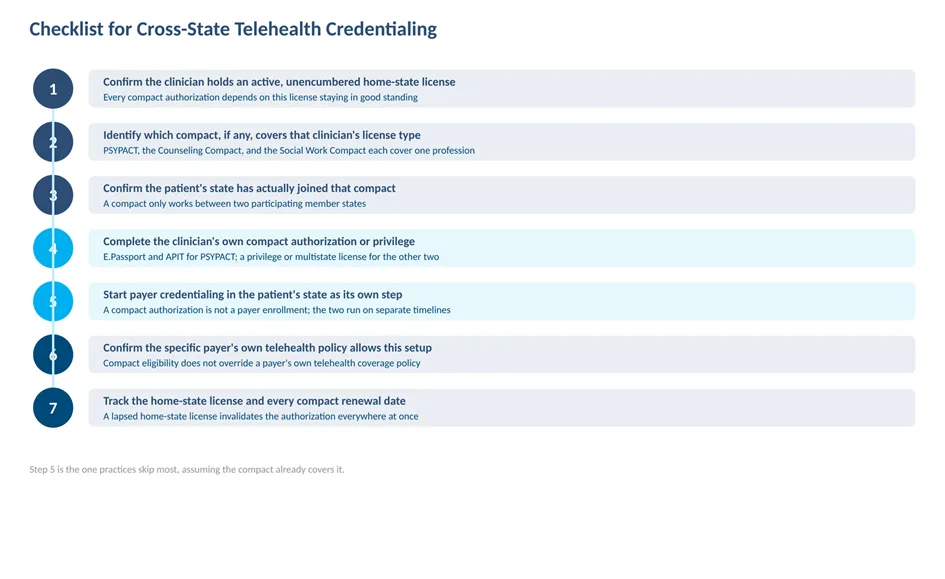
Step 2 matters more than it looks. A psychologist’s PSYPACT authorization has no bearing on a licensed clinical social worker at the same practice; the social worker’s own credentialing, covered in Aspect Billing Solutions’ LCSW credentialing guide, follows the Social Work Licensure Compact’s own timeline instead, which as of this writing had not yet opened applications in most states.
Step 4 looks similar across the three compacts but is not identical. Aspect Billing Solutions’ psychologist credentialing guide covers the psychologist-specific steps that sit underneath PSYPACT’s E.Passport and APIT authorization; a counselor or social worker applying under their own compact does not go through either of those two applications.
Step 5 is the step this article exists to underline. Aspect Billing Solutions’ multi-state credentialing guide covers payer credentialing across states in general; a compact authorization shortens the licensure side of that process but does not shorten or replace the payer enrollment side at all.
Common Mistakes and How to Prevent Them
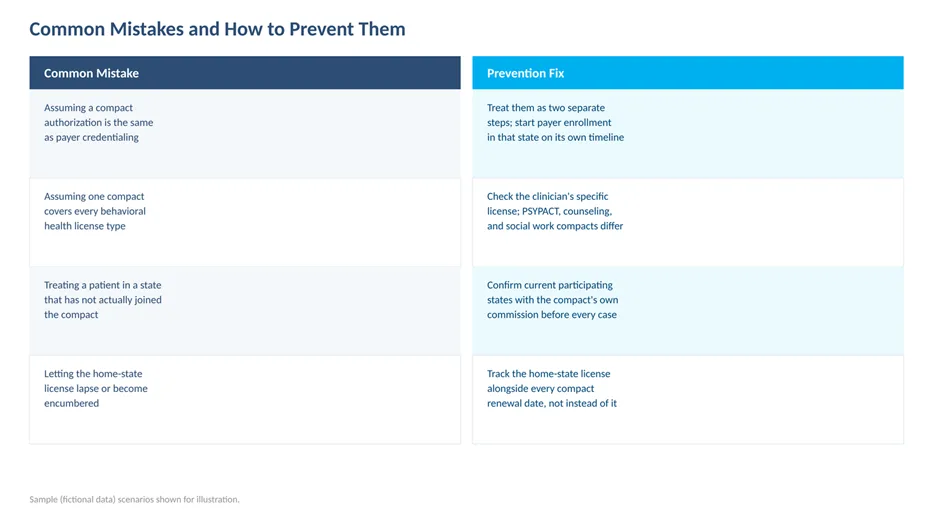
The same handful of mistakes account for most of the confusion practices run into with these compacts.
- Assuming a compact authorization is the same as payer credentialing. Treat them as two separate steps; start payer enrollment in that state on its own timeline.
- Assuming one compact covers every behavioral health license type. Check the clinician’s specific license; PSYPACT, counseling, and social work compacts differ.
- Treating a patient in a state that has not actually joined the compact. Confirm current participating states with the compact’s own commission before every case.
- Letting the home-state license lapse or become encumbered. Track the home-state license alongside every compact renewal date, not instead of it.
Frequently Asked Questions
Does PSYPACT or the Counseling Compact replace Medicaid or commercial payer credentialing?
No. These compacts authorize a clinician to practice in another state; they do not enroll that clinician with any specific payer there. Payer credentialing in the patient’s state is still a separate step that has to happen before claims can go out.
Can a licensed marriage and family therapist use the Counseling Compact?
No. The Counseling Compact covers licensed professional counselors specifically. Marriage and family therapists, art therapists, and other related license types are not covered by this compact.
What happens to a compact authorization if the home-state license lapses?
The authorization stops being valid. Every compact in this comparison ties its authorization directly to an active, unencumbered home-state license, so a lapsed or restricted license affects standing in every participating state at once, not just the home state.
Is the Social Work Licensure Compact active yet?
As of this writing, the compact had not yet opened applications and was still completing the rulemaking member states need to finish first. Confirm current status directly with the compact’s own commission before relying on it for a specific case.
Keeping Compacts and Credentialing on Separate Tracks
An interstate compact can shorten the licensure side of practicing across state lines, but it never shortens the payer side. Aspect Billing Solutions’ medical billing and credentialing team tracks home-state license status, compact renewal dates, and payer credentialing timelines together, so a cross-state telehealth visit never outruns what has actually been enrolled.
Sources: the Association of State and Provincial Psychology Boards (ASPPB), the PSYPACT Commission, the Counseling Compact Commission, and the Social Work Licensure Compact Commission. Participating states and operational status change often; confirm current status directly with each compact’s own commission before relying on it. This article is general information, not legal or billing advice for any specific case.