
Optum Behavioral Health Credentialing for Therapists
Optum behavioral health credentialing is how therapists, psychologists and other behavioral clinicians join the network that handles UnitedHealthcare’s mental health benefits. You apply through Optum’s Provider Express site, and Optum publishes a range of 30 to 120 days for individual clinicians. This guide covers who qualifies, each application step, the documents to prepare, realistic timelines, recredentialing and the errors that cause delays.
| Key takeaways Behavioral health clinicians join through Optum’s Provider Express, not UnitedHealthcare’s medical onboarding tool.Optum credentials clinicians licensed to practice independently; supervised clinicians generally cannot apply on their own.A complete, attested CAQH profile that matches the application is required in most states.Optum’s published range is 30 to 120 days, and the contract must be returned within 7 days.Recredentialing happens every 36 months; CAQH re-attestation is due every 120 days. |
What Optum Behavioral Health Credentialing Covers
UnitedHealthcare sends mental health and substance use practitioners to Optum. Its UnitedHealthcare credentialing FAQ directs them to Optum Behavioral Health Solutions and Provider Express, while medical providers use a separate onboarding tool. Applying in the wrong place is one of the simplest ways to lose weeks.
Credentialing is one step in a longer chain. Optum verifies your qualifications, offers a contract, and then loads you into its systems with an effective date. Only after that last step should you treat members as in network. If you want the whole process handled for you, our insurance credentialing service for providers covers applications, follow-up and renewals.
Once you are in network, claims follow UnitedHealthcare’s billing rules; our carrier guide to billing UnitedHealthcare explains those.
Who Can Join: Optum Eligibility Requirements
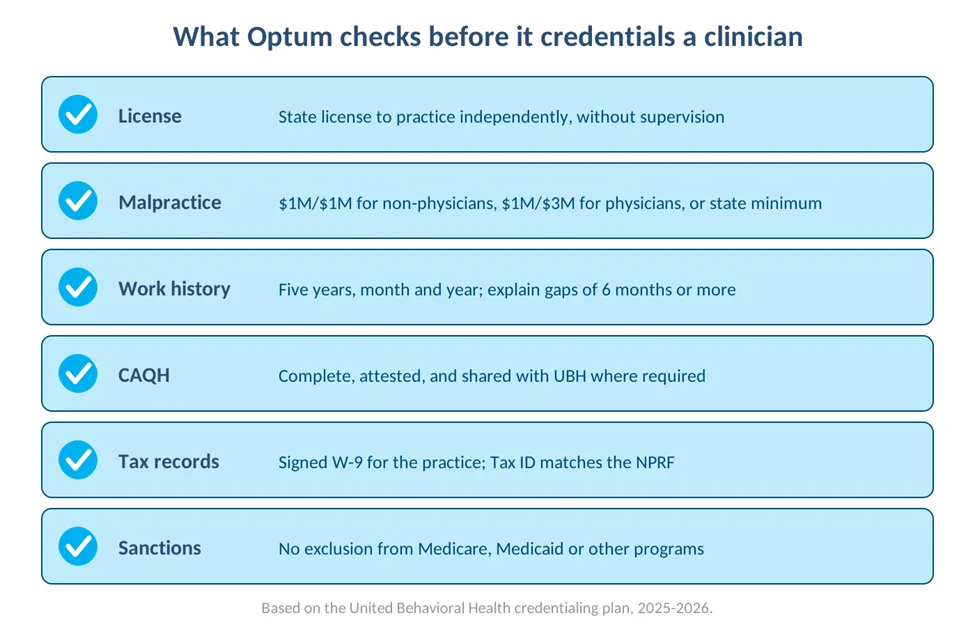
Optum’s rules come from the United Behavioral Health credentialing plan for 2025-2026, published on Provider Express. It accepts psychiatrists and other physicians, licensed psychologists, licensed social workers, professional counselors, marriage and family therapists, mental health counselors, nurses with prescriptive authority under state rules, physician assistants and behavior analysts.
The key condition is independence. Applicants must hold a license to practice without supervision, with narrow exceptions in the plan for master’s-level psychiatric clinical nurse specialists, physician assistants and behavior analysts. A therapist still working under a supervisor generally cannot be credentialed as an individual clinician.
| Requirement | What the Optum plan asks for |
| License | Active state license to practice independently |
| Malpractice insurance | At least $1M/$1M for non-physicians and $1M/$3M for physicians, or the state minimum |
| Work history | Five years, by month and year, with an explanation for any gap of six months or more |
| Sanctions | Not excluded from Medicare, Medicaid or other federal or state programs |
| Network need | Optum decides which clinicians to accept and may weigh network need and access |
How to Get Credentialed with Optum, Step by Step
Optum’s Individually Credentialed Clinicians page sets out the application path. In practice it runs in six steps.
- Confirm eligibility. Check your license level, your state and whether Optum’s network in your area is accepting your specialty.
- Finish CAQH. Complete and attest the profile, authorize United Behavioral Health to view it, and make sure group, location and Tax ID details match what you will enter.
- Submit the New Provider Request Form (NPRF). Register or log in to Provider Express and open Join Our Network. Answer yes to the Medicare-eligible question if it applies, and enter a Medicaid ID if you have one.
- Answer requests quickly. Optum sends missing items, such as ownership disclosures, through DocuSign.
- Sign the contract. Return it within 7 days of the day Optum sends it.
- Confirm your effective date. Wait until data loading is complete before you bill members as in network.
Your CAQH profile is the base of the whole file; our article on the role of CAQH in credentialing explains how payers use it.
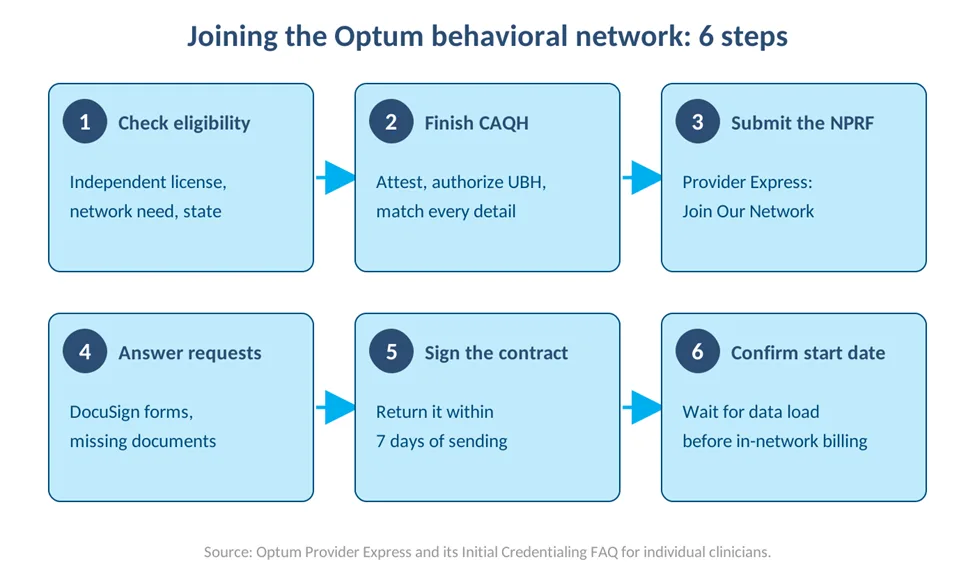
In short: prepare CAQH first, apply through Provider Express, then track the contract and effective date.
Documents to have ready
- Individual NPI and state license details
- CAQH ID, with the profile attested and shared
- Current professional liability insurance certificate
- W-9 signed, dated and completed for the practice, with a Tax ID that matches the NPRF
- Five-year work history and Medicaid ID, if you have one
- Clinician Specialty Attestation Form, when your specialty requires it
How Long Optum Credentialing Takes
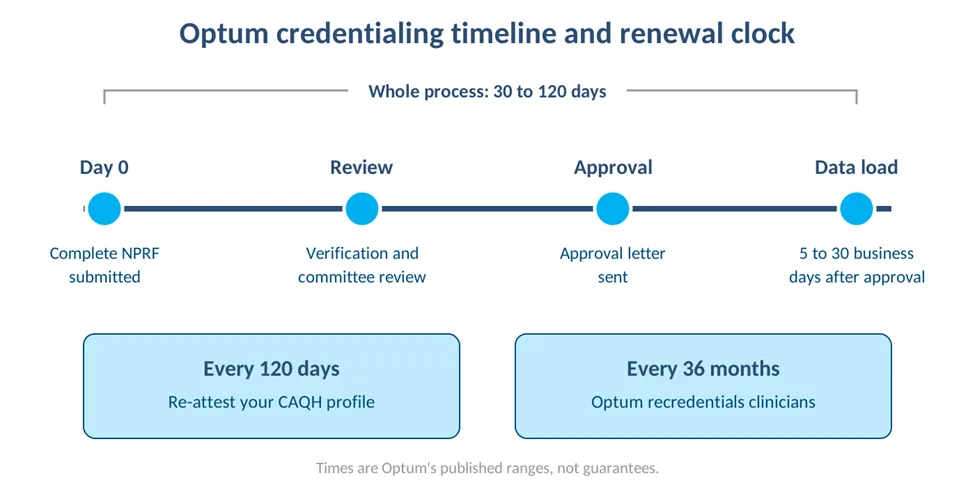
Optum’s Initial Credentialing FAQ for individual clinicians gives a range of 30 to 120 days. That window covers primary source verification, Optum’s quality review, committee review and data loading. Data loading alone takes 5 to 30 business days from the date of the approval letter.
These are ranges, not promises. Mismatched data, missing documents and slow replies push files to the long end. For ways to shorten the wait across payers, see our guide on how to get credentialed with insurance panels fast.
Staying in Network: Recredentialing and Updates
The credentialing plan sets recredentialing every 36 months, or sooner if state law requires it. UnitedHealthcare also asks clinicians to re-attest CAQH every 120 days, which lets the cycle start without extra paperwork. Keep your license, malpractice dates and practice locations current between cycles.
Recredentialing checks the same items as the first review, but on a fixed clock. Our comparison of re-credentialing and initial enrollment explains the differences.
Common Optum Credentialing Delays and Fixes
Optum names several problems that slow applications. Most are avoidable with a final check before you submit.
| Problem | Fix |
| CAQH profile incomplete, expired or not shared | Re-attest and authorize United Behavioral Health before applying |
| CAQH data does not match the NPRF | Correct CAQH first, then reopen the application |
| Unsigned W-9 or wrong Tax ID | Use a signed W-9 for the practice that matches the NPRF |
| No current liability certificate | Attach a certificate with today’s coverage dates |
| Slow reply to DocuSign requests | Check email daily and respond within days |
| Contract returned late | Sign and return it within 7 days |
Many of these issues affect every payer, not only Optum. Our list of credentialing mistakes that delay payments covers the rest.
Frequently Asked Questions
Is Optum credentialing the same as UnitedHealthcare credentialing?
Not for behavioral health. UnitedHealthcare directs mental health and substance use practitioners to Optum, which runs its own application through Provider Express. Medical providers use UnitedHealthcare’s separate onboarding process. If you treat both medical and behavioral conditions, confirm with each team which network and application apply to your services.
Can a pre-licensed or associate therapist join Optum?
Generally not as an individual clinician. Optum’s credentialing plan requires a license to practice independently, with narrow exceptions for a few provider types. Whether a group can bill for an associate’s sessions depends on the plan and state rules, so ask Optum before scheduling. Once the associate earns an independent license, they can apply through Provider Express in their own name.
Do I need CAQH to join Optum?
In most states, yes. Optum says CAQH participation is required in the majority of states, and your CAQH ID goes on the application. The profile must be complete, attested and shared with United Behavioral Health, and its details must match the NPRF. Some states use their own credentialing portal instead, so check your state’s rules.
What happens if Optum does not need more clinicians in my area?
Optum decides which clinicians it accepts and can weigh network need and geographic access. If your application is declined, state law sets your appeal rights for an initial denial. You can still see UnitedHealthcare members out of network if their plan allows it, and reapply later when needs change.
Final Considerations
Optum behavioral health credentialing rewards preparation: an independent license, a clean CAQH profile and a complete NPRF move the file faster than any follow-up call. After approval, your billing setup decides how quickly money arrives; our mental health billing guide covers that next stage.
If you would rather hand off the paperwork, our credentialing team works with each provider through a dedicated agent. Reach us through our contact page when you are ready.
Sources: UnitedHealthcare Credentialing FAQs (2026); Optum Provider Express, Individually Credentialed Clinicians; Optum Initial Credentialing for Individual Clinicians FAQ; United Behavioral Health and its Affiliates Credentialing Plan 2025-2026. This article is general information, not legal advice.