
What BCBA Credentialing Actually Requires
BCBA credentialing is actually three separate processes that get treated as one: BACB certification, state licensure, and payer enrollment. A BCBA can hold an active certification and still not be able to bill, because the practice’s own state requires a license the certification alone does not satisfy. This guide separates the three layers, walks through the credentialing steps in order, and covers where BCaBAs and RBTs fit into the same picture.
This sits inside the broader process covered in Aspect Billing Solutions’ mental health credentialing guide, which walks through payer enrollment for behavioral health providers generally. BCBA credentialing adds a layer most other behavioral health roles do not have: a national certifying board sitting alongside, not instead of, state licensure.
| Key Takeaways BCBA credentialing has three separate layers: BACB national certification, state licensure, and payer enrollment, and they are not interchangeable. Most states (39 states plus Washington, D.C., per CMS’s own review of state Medicaid ABA programs) require a state license or registration on top of BACB certification. A BCaBA cannot practice independently or hold full caseload responsibility; an RBT cannot bill independently and must be supervised by a BCBA, BCBA-D, or LBA.Every ABA provider, including an RBT billing under a supervisor, should have their own individual NPI on file. CAQH ProView profiles need re-attestation on a recurring cycle, commonly every 120 days, to stay active with payers that pull credentialing data from it. |
Certification, Licensure, and Enrollment Are Three Different Things
BACB certification proves a behavior analyst completed the required education and passed the Behavior Analyst Certification Board’s exam. It does not, by itself, authorize anyone to bill a payer. State licensure is a separate requirement, regulated and enforced by the state’s own licensing board, and most states layer it on top of BACB certification rather than accepting certification in its place. Payer enrollment, the Medicaid or commercial credentialing file itself, is a third, later step that depends on the first two already being in order.
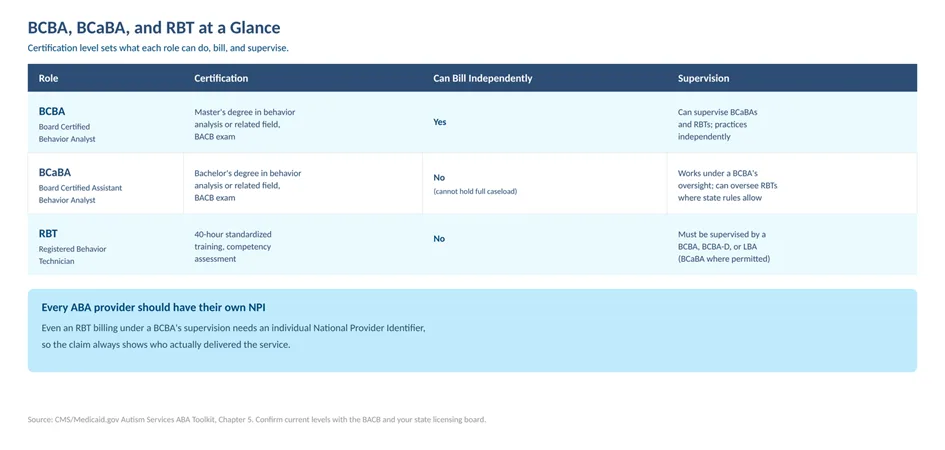
Certification level also decides what each role on the team can actually do. The table below lines up BCBA, BCaBA, and RBT side by side.
Where State Licensure Comes in for BCBAs
Federal rules set no ABA-specific provider qualifications of their own, so states fill that gap themselves. CMS and Medicaid’s Autism Services ABA Toolkit found that most states, 39 plus Washington, D.C., rely on BACB certification plus a state license or registration under the state’s behavior analyst practice act. Typical licensure requirements include holding the BCBA credential and completing a background check, on top of whatever the license application itself asks for. Before billing a single claim, confirm the practice’s own state licensing board requirement rather than assuming BACB certification alone is sufficient.
Credentialing Steps for a New BCBA
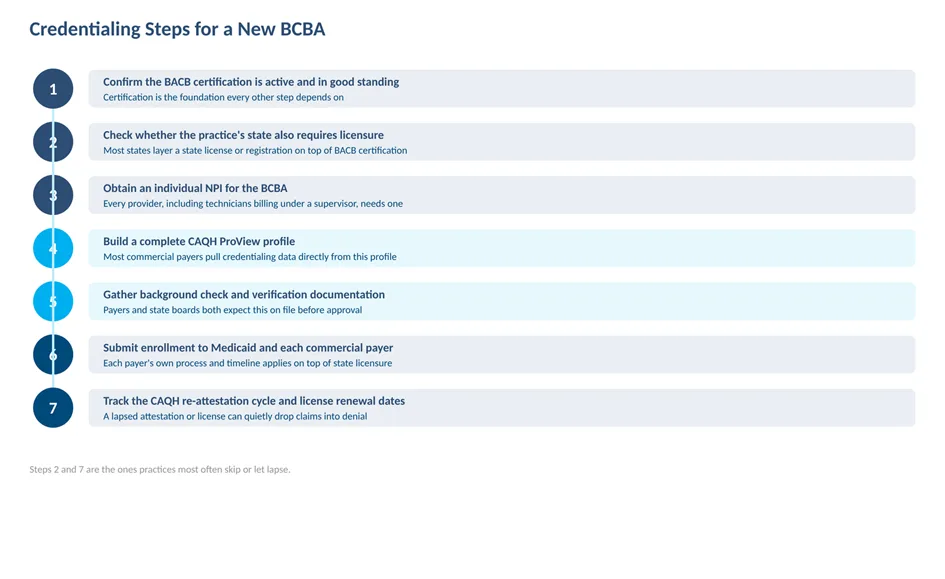
The steps below follow the order a credentialing team should actually work through before a new BCBA bills a first claim.
- Confirm the BACB certification is active and in good standing.
- Check whether the practice’s state also requires licensure.
- Obtain an individual NPI for the BCBA.
- Build a complete CAQH ProView profile.
- Gather background check and verification documentation.
- Submit enrollment to Medicaid and each commercial payer.
- Track the CAQH re-attestation cycle and license renewal dates.
Step 4 is worth its own guide: Aspect Billing Solutions’ overview of the role of CAQH in credentialing covers how most commercial payers pull their credentialing data directly from that one profile, which is why an incomplete or stale CAQH record stalls enrollment with every payer at once rather than just one.
Step 6 varies by payer type. Aspect Billing Solutions’ guide to Medicare vs. Medicaid credentialing differences covers how enrollment timelines and documentation expectations diverge between the two programs; ABA is billed to Medicaid far more often than to Medicare, so confirm the state Medicaid program’s own enrollment checklist rather than assuming a Medicare-style process applies.
Common Mistakes and How to Prevent Them
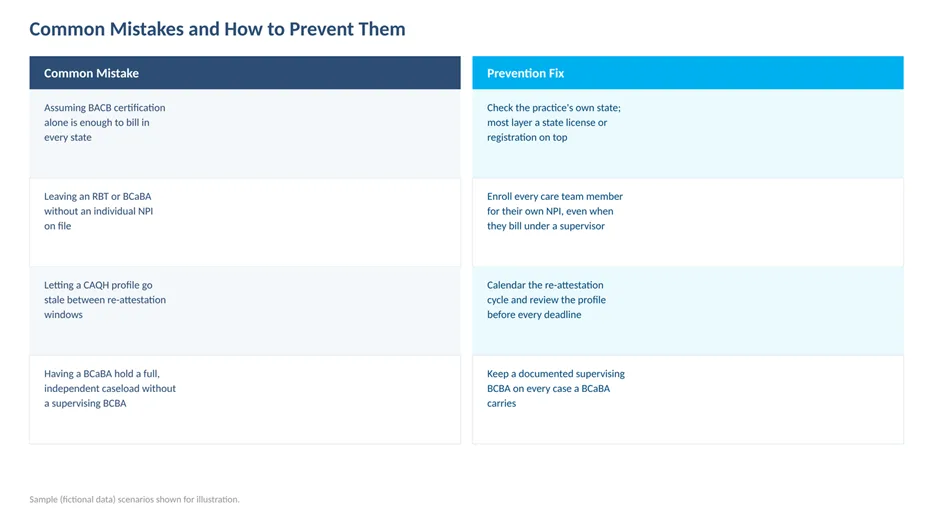
The same few mistakes account for most of the credentialing delays and claim denials tied to a BCBA’s own enrollment.
- Assuming BACB certification alone is enough to bill in every state. Check the practice’s own state; most layer a state license or registration on top.
- Leaving an RBT or BCaBA without an individual NPI on file. Enroll every care team member for their own NPI, even when they bill under a supervisor.
- Letting a CAQH profile go stale between re-attestation windows. Calendar the re-attestation cycle and review the profile before every deadline.
- Having a BCaBA hold a full, independent caseload without a supervising BCBA. Keep a documented supervising BCBA on every case a BCaBA carries.
None of this replaces the billing side of the same program. Aspect Billing Solutions’ ABA therapy billing guide covers the CPT codes, billing units, and prior authorization cycle a credentialed BCBA’s practice still has to get right on every claim, once enrollment itself is in place.
Frequently Asked Questions
Is BACB certification the same thing as a license to practice ABA?
No. BACB certification is a national credential issue by the Behavior Analyst Certification Board. A state license or registration is a separate requirement set and enforced by that state’s own licensing board, and most states require both before a BCBA can bill.
Can a BCaBA bill independently?
No. A BCaBA cannot practice independently or hold full caseload responsibility; they work under a BCBA’s oversight. An RBT cannot bill independently either and must be supervised by a BCBA, BCBA-D, or LBA, with BCaBA supervision allowed only where the state permits it.
Does an RBT need their own NPI if they bill under a supervising BCBA?
Yes. Every ABA provider should have an individual NPI on file, even a technician billing through a supervising provider’s arrangement, so the claim identifies who actually delivered the service.
How often does a CAQH ProView profile need to be updated?
CAQH profiles need periodic re-attestation to stay current with payers, commonly on a cycle of around 120 days. Confirm the exact cadence and any state-specific rule with CAQH and each payer’s own provider manual, since a lapsed attestation can stall claims with every payer pulling from that profile at once.
Getting BCBA Credentialing Right the First Time
BCBA credentialing only works end to end when certification, licensure, and payer enrollment are tracked as three separate, ongoing requirements rather than one. Aspect Billing Solutions’ medical billing and credentialing team sets up and maintains BCBA, BCaBA, and RBT credentialing files correctly from the first enrollment, so a claim never rests on a license, NPI, or CAQH attestation an auditor would reject.
Sources: CMS’s Autism Services ABA Toolkit (Chapter 5, Applied Behavior Analysis Provider Qualifications, Credentialing and Enrollment, and Ownership). State licensing board and payer rules vary; confirm current requirements with the BACB, the practice’s state licensing board, and each payer’s manual before relying on them. This article is general information, not legal or billing advice for any specific claim.