
Mental Health ICD-10 Codes for Therapy Claims
Mental health ICD-10 codes are the diagnosis codes that tell a payer why a therapy service was medically necessary. Most come from the F01-F99 chapter, and the right one depends on what the clinician confirmed and documented on the date of service. This guide covers the codes therapy practices bill often, the official rules that decide specificity and sequencing, how diagnoses link to CPT lines on the claim, and the coding mistakes behind many therapy denials.
| Key takeaways Therapy claims must carry ICD-10-CM codes; the FY2027 code set covers dates of service from October 1, 2026 to September 30, 2027.Code only what the clinician confirmed. “Rule out,” “probable” and “suspected” diagnoses are not coded in outpatient care.Use the most specific code the note supports; unspecified codes are acceptable when the record lacks detail.Point each service line to the diagnosis that service treated.Z codes can be first-listed under the official guidelines, but each plan decides what it covers. |
How Mental Health ICD-10 Codes Work on Therapy Claims
CPT codes describe the therapy service; ICD-10-CM codes explain the reason for it. Payers compare the two before they pay, so a strong note with a weak diagnosis code can still be denied.
Diagnosis coding is one piece of the therapy revenue cycle. For codes, payer rules and workflows in one place, start with our mental health billing guide for practices.
Most behavioral health diagnoses sit in Chapter 5 of ICD-10-CM (F01-F99, mental, behavioral and neurodevelopmental disorders). Social and family factors, such as conflict with a partner, sit in the Z55-Z65 range of Chapter 21. If the difference between diagnosis and procedure code sets is new to your team, read how CPT, HCPCS and ICD-10 codes differ.
DSM-5-TR names versus ICD-10-CM codes
Clinicians usually diagnose with DSM-5-TR criteria, and the DSM-5-TR lists an ICD-10-CM code next to each diagnosis. The claim itself must carry the ICD-10-CM code, because HIPAA names ICD-10-CM as the standard diagnosis code set for electronic claims. The names do not always match: DSM persistent depressive disorder maps to F34.1, titled dysthymic disorder. Bill the code and keep the clinical name in the note.
Annual code updates
ICD-10-CM changes every October 1. CMS posts each year’s files on its ICD-10 code files page, and the FY2027 set applies to encounters from October 1, 2026 through September 30, 2027. Always code from the set that is valid on the date of service, not the date you send the claim, and review the yearly addendum for any code your practice bills often.
Common Mental Health ICD-10 Codes by Category
The table lists codes that outpatient therapy practices bill often. It is a starting point, not a substitute for the full code set or the clinician’s documented diagnosis.
| Category | Code | ICD-10-CM title | Billing note |
| Anxiety | F41.1 | Generalized anxiety disorder | Common first-listed code for GAD |
| Anxiety | F41.0 | Panic disorder | Use when panic disorder is diagnosed |
| Anxiety | F41.9 | Anxiety disorder, unspecified | Only when the type is not documented |
| Depression | F32.A | Depression, unspecified | Note says “depression” without MDD detail |
| Depression | F32.1 | Major depressive disorder, single episode, moderate | Single episode with severity stated |
| Depression | F33.1 | Major depressive disorder, recurrent, moderate | Recurrent episodes with severity stated |
| Depression | F34.1 | Dysthymic disorder | DSM persistent depressive disorder |
| Trauma and stress | F43.10 | Post-traumatic stress disorder, unspecified | Acute or chronic not stated |
| Trauma and stress | F43.12 | Post-traumatic stress disorder, chronic | Chronic course documented |
| Trauma and stress | F43.21 | Adjustment disorder with depressed mood | Pick the subtype the note names |
| Trauma and stress | F43.23 | Adjustment disorder with mixed anxiety and depressed mood | Both features documented |
| Trauma and stress | F43.81 | Prolonged grief disorder | Diagnosis must be documented, not assumed |
| Mood | F31.81 | Bipolar II disorder | Confirmed diagnosis only |
| Obsessive-compulsive | F42.2 | Mixed obsessional thoughts and acts | Code DSM obsessive-compulsive disorder here |
| ADHD | F90.0 / F90.2 | ADHD, predominantly inattentive type / combined type | Presentation must be documented |
| Social factor | Z63.0 | Problems in relationship between spouse or partner | Coverage varies by plan |
F32.A, F32.9 or F33: which depression code?
These three are easy to mix up. F32.A means depression with no further detail. F32.9 means a single episode of major depressive disorder with severity not stated. F33 codes are for recurrent major depressive disorder, and an Excludes1 note means F32 and F33 codes are not reported together. Choose the one that matches the wording in the note, and ask the clinician to clarify when the record is unclear.
Official Rules That Decide Which Code You Bill
Three guidelines settle most therapy coding questions. They come from the CMS FY2027 ICD-10-CM Official Guidelines for Coding and Reporting, which HIPAA-covered entities must follow.
Code to the highest specificity documented. Report a code to its full number of characters and the most detail the record supports. Unspecified codes are acceptable when the clinician has not documented the type, episode or severity, but do not pick a more specific code than the note supports.
Do not code uncertain diagnoses. In outpatient care, diagnoses written as “rule out,” “probable” or “suspected” are not coded. Code the signs and symptoms documented that day, then update the claim diagnosis once the clinician confirms a condition.
Report one substance code per substance. When a note documents use, abuse and dependence of the same substance, the guidelines direct you to a single code: dependence outranks abuse, and abuse outranks use. “In remission” codes need the provider’s documentation.
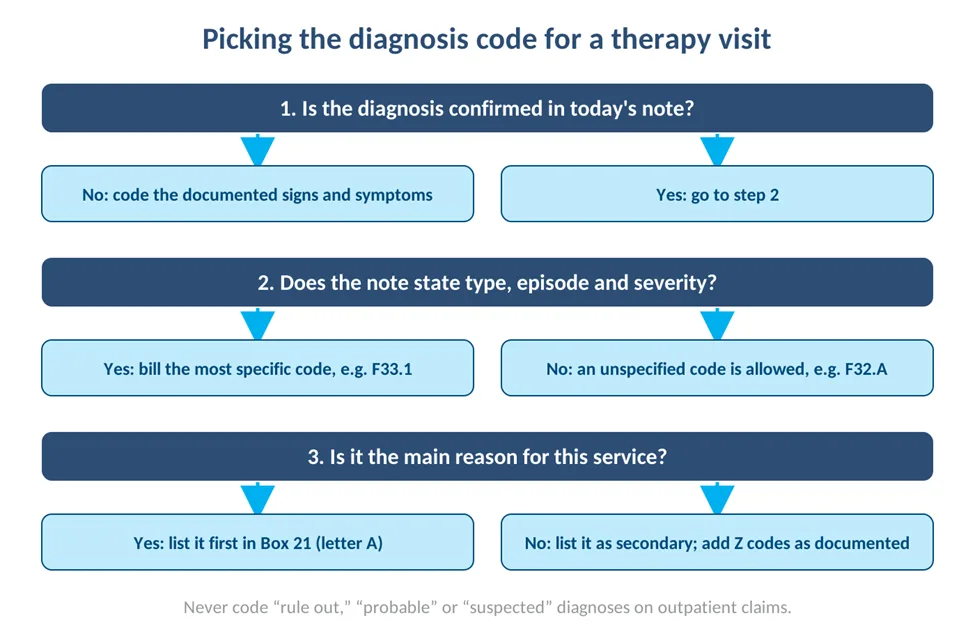
In short: confirm the diagnosis, match the code to the detail in the note, and list the main reason for the service first.
Sequencing and Linking Diagnoses on the Claim
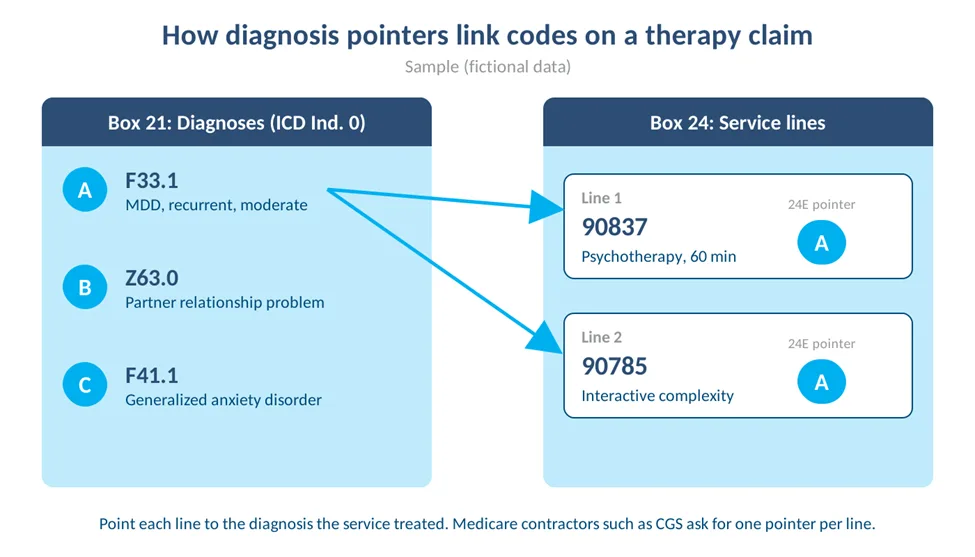
On the CMS-1500, Box 21 holds up to 12 diagnosis codes, lettered A through L, with ICD indicator 0 for ICD-10. List first the condition that was the main reason for the service. Box 24E then points each service line to the diagnosis letter it treated. The CGS Medicare CMS-1500 form tutorial asks for one pointer per line on Medicare claims; commercial plans set their own rules in their provider manuals.
For a box-by-box walkthrough of the whole form, see our guide to filling out the CMS-1500.
Where Z codes fit
Z55-Z65 codes record social factors such as relationship or housing problems, and they may be assigned whenever the record documents them. Never add an F code the clinician did not diagnose just to make a Z code payable.
Worked example
Sample (fictional data). A client with recurrent major depressive disorder, moderate, attends a 55-minute session focused on low mood and conflict with a partner. The clinician also notes ongoing generalized anxiety disorder, addressed briefly.
- Box 21: A = F33.1, B = Z63.0, C = F41.1.
- Line 1: 90837, pointer A, because depression was the main focus.
- If interactive complexity was documented, line 2: 90785, pointer A.
- Change the codes to match your own clinician’s note; this sample shows the order, not a default.
Mental Health ICD-10 Coding Mistakes and How to Fix Them
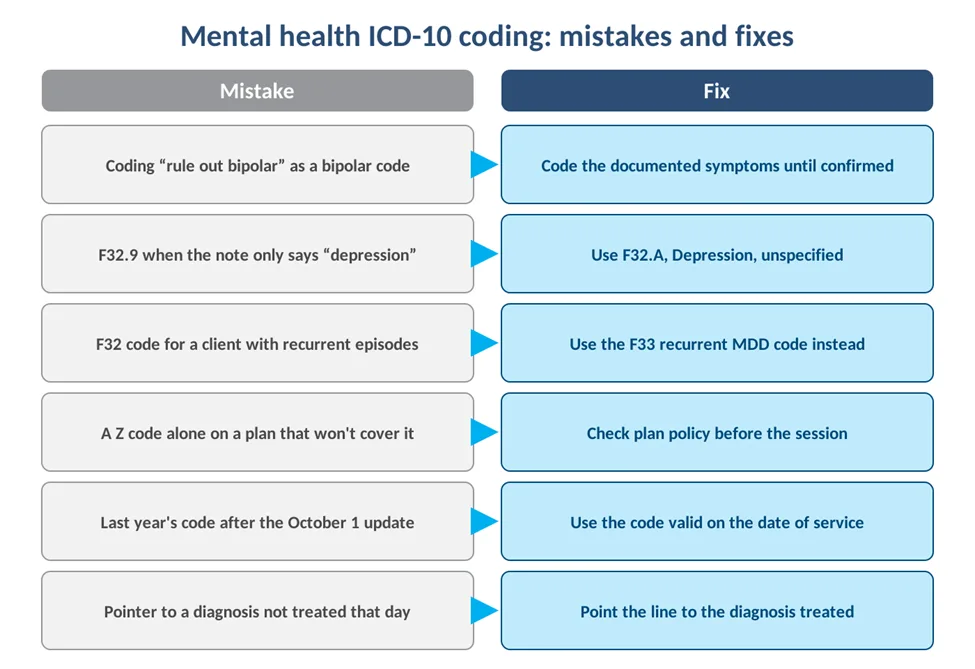
Most diagnosis-related therapy denials trace back to a short list of habits. When a payer decides the diagnosis does not support the service, the remittance usually shows a medical necessity reason; our guide to the CO-50 denial code explains how to work those.
- Rule-out diagnosis coded: code the documented symptoms instead.
- F32.9 for a note that only says depression: use F32.A.
- F32 code for recurrent episodes: use the matching F33 code.
- Z code alone on a plan that excludes it: check coverage at intake.
- Last year’s code after October 1: update your EHR pick list from the addendum.
- Pointer to a diagnosis not treated that day: point to the diagnosis the session addressed.
Many of these errors are not unique to therapy. Our article on common ICD-10 coding errors and accurate reimbursement covers the general patterns, and our note on CMS behavioral health directives for therapists explains wider Medicare rules for therapy billing.
Frequently Asked Questions
What is the most common ICD-10 code for therapy?
There is no single answer, because it depends on each practice’s caseload. Anxiety codes such as F41.1, adjustment disorder codes in F43.2, and depression codes in F32 and F33 appear on many therapy claims. The right code is always the one the clinician diagnosed and documented for that date of service, not the one billed most often.
Can a Z code be the primary diagnosis on a therapy claim?
The official guidelines allow most Z codes, including Z55-Z65 social factor codes, to be first-listed or secondary depending on the encounter. Whether the plan pays is a separate question. Some plans do not cover services when a Z code is the only diagnosis, so check coverage before the first session and bill only what was documented.
Can I bill a rule-out diagnosis while testing continues?
No. Outpatient coding rules say diagnoses documented as rule out, probable or suspected are not coded. Code the signs and symptoms the clinician recorded that day. Once testing or assessment confirms a condition, use that diagnosis on claims for later dates of service, and keep the earlier claims as they were coded.
How often should the diagnosis on therapy claims change?
Update the claim diagnosis whenever the clinician’s documentation changes: a new diagnosis, a change in severity, remission, or a resolved condition. Also check every code your practice uses after the October 1 code set update. A diagnosis that never changes across months of treatment can draw questions in a payer audit.
Final Considerations
Accurate mental health ICD-10 codes start in the note: a confirmed diagnosis, documented severity and a clear reason for each session. When the code, the pointer and the CPT line tell the same story, claims are easier to pay.
If your team wants help, our medical billing and coding service pairs each provider with a dedicated agent who reviews coding before claims go out. When you are ready, reach us through our contact page.
Sources: CMS FY2027 ICD-10-CM Official Guidelines for Coding and Reporting; CMS ICD-10 code files; CGS Medicare CMS-1500 form tutorial; HIPAA code set standards, 45 CFR 162.1002. This article is general information, not legal or coding advice.