
Why Mental Health Claim Denials Happen and How to Fix Them
Mental health claim denials usually trace back to a short list of causes: the wrong provider type or network status, missing authorization, a diagnosis or time record that does not support the code, or a benefit limit. Reading the denial code tells you which one you are facing. This guide covers the codes therapy practices see most, what each means for behavioral health, how to decide between fixing and appealing, a sample appeal letter and prevention steps.
| Key takeaways Start with the claim adjustment reason code (CARC) and any remark code; they point to the cause.Behavioral health carve-outs send many claims to the wrong payer or out of network.Provider type denials hit counselors, associates and new hires more than any other group.Time-based psychotherapy codes need start and stop times that match the code billed.Fix data errors with a corrected claim; appeal only when you disagree with a payer decision. |
Why Mental Health Claims Get Denied More Often
Behavioral health billing has features most medical billing does not: many plans route mental health to a separate company, payers recognize different license types, psychotherapy codes depend on minutes, and visit limits or authorization rules can apply. Each adds a way for a clean-looking claim to fail. For the coding basics behind these claims, see our complete practice guide to mental health billing.
Denials arrive on the explanation of benefits (EOB) or electronic remittance advice (ERA) as a group code, such as CO for contractual obligation or PR for patient responsibility, plus a reason code and often a remittance advice remark code (RARC). Our explainer on CARC and RARC codes covers how to read them.
The Denial Codes Therapy Practices See Most
The definitions below are paraphrased from the CMS Blue Button list of claim adjustment reason codes, which mirrors the standard X12 code set.
| CARC | What it means | Common therapy cause | First fix |
| 16 | Claim lacks information or has a billing error | Missing rendering NPI, taxonomy or referring provider | Correct and resubmit |
| 11 | Diagnosis does not fit the procedure | Z code or physical diagnosis on a psychotherapy line | Correct the diagnosis order |
| 50 | Not medically necessary per the payer | Notes do not show symptoms, goals or progress | Appeal with records |
| 97 | Paid as part of another service | Two psychotherapy services on one date | Check edits; appeal if separate |
| 119 | Benefit maximum reached | Annual session limit used | Bill patient if contract allows |
| 170 | Not paid for this provider type | Counselor or associate type not covered by the plan | Rebill under eligible provider only if they treated |
| 185 | Rendering provider not eligible | Clinician not credentialed or linked to group | Finish credentialing; resubmit |
| 197 | Authorization absent | No auth for IOP, testing or extra sessions | Request retro auth or appeal |
| 109 | Not covered by this payer | Behavioral health carved out to another company | Send to the carve-out payer |
| 242 | Not provided by a network provider | Clinician out of network with the BH vendor | Check network status |
| 204 | Not covered by the patient’s plan | Plan excludes the service, such as couples therapy | Check contract, then bill patient |
| 29 | Filing time limit expired | Late claim after a carve-out redirect | Appeal only with proof of timely filing |
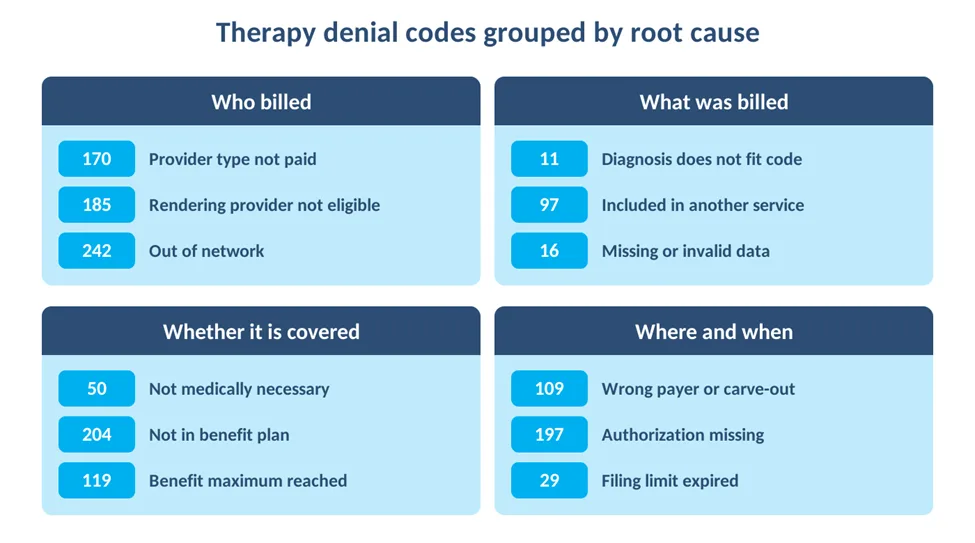
In short, the graphic groups the twelve codes into four root causes: who billed, what was billed, whether it is covered, and where and when it was sent.
Behavioral Health Denials Up Close
Provider type and network denials (170, 185, 242)
These hit counselors, marriage and family therapists, associate-level clinicians and new hires hardest. Medicare has paid marriage and family therapists and mental health counselors only since January 1, 2024, and many commercial and Medicaid plans still limit which license types they pay. Never move a claim to a different clinician’s NPI unless that clinician actually provided the service.
Medical necessity and time (50, 11)
Psychotherapy notes need a diagnosis, current symptoms, treatment goals and progress, and time-based codes need start and stop times. A 90837 claim with no recorded times, or a primary diagnosis that does not support therapy, invites a denial. Our page on the CO-50 medical necessity denial shows how to answer it.
Bundling and same-day services (97)
Same-day combinations, such as individual and group psychotherapy for one patient, or psychotherapy with health behavior intervention, often trigger edits. Our guide to CO-97 bundling and NCCI edits explains when a modifier is appropriate.
Authorization, carve-outs and deadlines (197, 109, 29)
Plans that require authorization for therapy beyond a set number of visits, psychological testing or intensive outpatient care deny claims without it; see our explainer on the CO-197 authorization denial. When the plan carves behavioral health out, the medical plan returns the claim, and the delay can push it past the filing limit, covered in our CO-29 timely filing guide.
Fix, Appeal or Bill the Patient?
Not every denial needs an appeal. Sorting each one first saves time and protects filing deadlines.
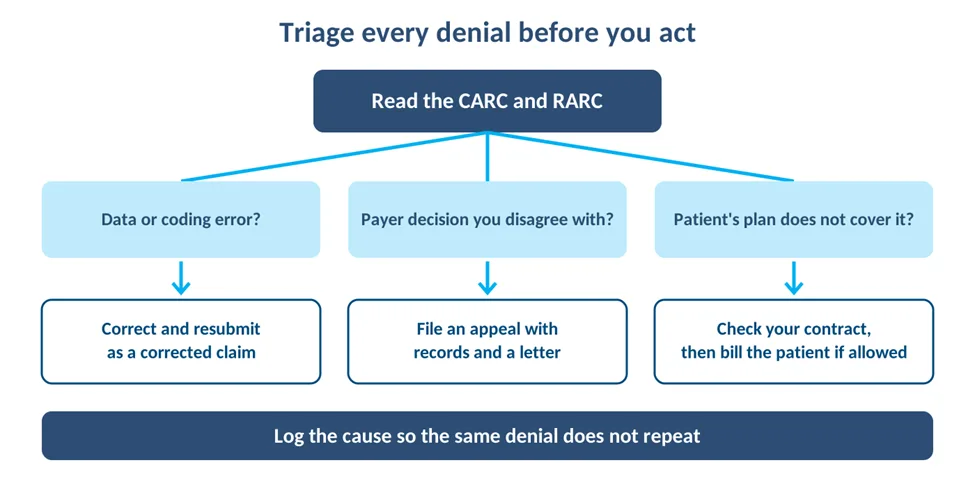
Data and coding errors, including most CO-16 denials, are fixed with a corrected claim; our CO-16 denial guide lists the usual missing fields. Appeals are for payer decisions you can dispute with records, such as medical necessity. Non-covered services become patient balances only when your contract and the patient’s notice allow it.
Sample appeal letter for a medical necessity denial
Sample (fictional data). Replace the names, dates, claim details and clinical facts with the patient’s real information, and attach the notes you cite.
To the Appeals Department, Lakeside Health Plan
Re: Appeal of denied claim for Jordan Ellis, member ID LHP-000000-SAMPLE, date of service March 12, CPT 90837, CARC 50
We request reconsideration of the denial of psychotherapy provided by Maya Torres, LCSW. Mr. Ellis is being treated for major depressive disorder, recurrent, moderate (F33.1). The enclosed treatment plan shows measurable goals, and the progress notes for the past six sessions document persistent low mood, missed work days and a PHQ-9 score that has fallen from 19 to 14 since treatment began.
The March 12 session lasted 56 minutes, with start and stop times recorded in the note, and used cognitive behavioral interventions tied to the plan’s goals. Continued weekly psychotherapy is medically necessary to maintain progress and prevent relapse. Please reprocess the claim for payment.
Sincerely, Billing Manager, Riverbend Counseling Group
For Medicare appeals, including deadlines and levels, see our step-by-step guide to appealing a Medicare denial.
How to Prevent Repeat Denials
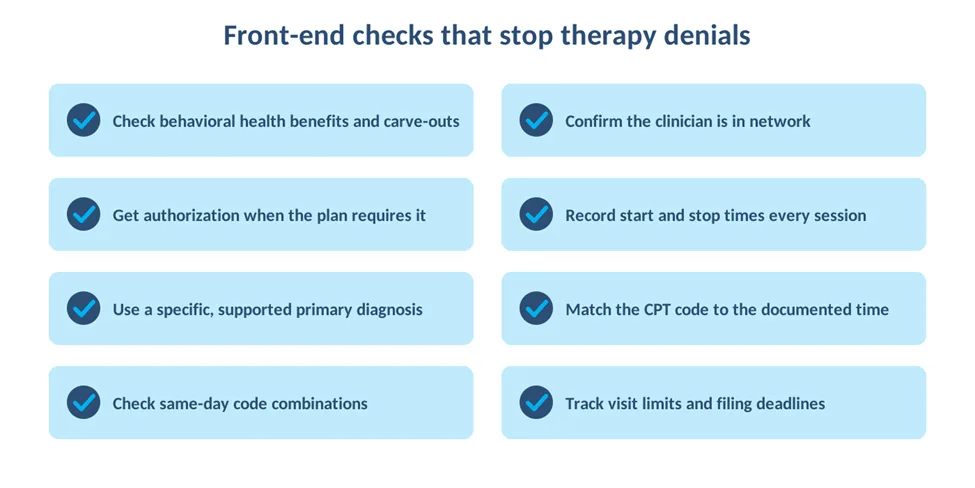
Most fixes sit at the front end: benefits checks that identify carve-outs and visit limits, credentialing checks before scheduling, authorization tracking and note templates that capture time and progress. The CMS Medicare Mental Health booklet is a useful reference for which practitioners Medicare pays and what records it expects.
Track denials by code each month. If one code keeps returning, the cause is a process, not a single claim.
Frequently Asked Questions
What is the most common reason mental health claims are denied?
It varies by practice, but eligibility and network problems, missing authorization and documentation that does not support medical necessity are frequent causes. Behavioral health carve-outs add another, because claims sent to the medical plan instead of the mental health vendor are returned. Review your own denials by code to find your top cause.
Should I appeal or resubmit a denied therapy claim?
Resubmit a corrected claim when the denial comes from your own data or coding error, such as a missing NPI or wrong diagnosis order. Appeal when the payer made a decision you disagree with and you have records to support the service, such as a medical necessity denial. Appealing a data error usually wastes time.
Why was my 90837 claim denied?
Common reasons include missing start and stop times, notes that do not support a 53-minute or longer session, payer limits on extended sessions or a diagnosis that does not support psychotherapy. Check the CARC and any remark code, confirm your documentation shows the time and clinical need, and appeal with the notes if they support the code.
What does CO-170 mean for therapists?
CO-170 means the payer does not pay this service when billed by your provider type. It often appears when a plan does not cover a counselor, marriage and family therapist or associate-level clinician. Confirm the plan’s covered license types and your credentialing status; do not rebill under another clinician unless they provided the service.
Can I bill the patient for a denied therapy session?
Only in some cases. Network contracts usually bar billing patients for denials caused by provider errors, such as missing authorization. Services the plan does not cover, or sessions past a benefit limit, may be billable when your contract allows it and the patient was informed in advance. Check your contract and any state rules first.
Final Considerations
Mental health claim denials follow patterns. Read the code, group it by cause, fix what is yours to fix and appeal what the record supports. Then change the front-end step that let it through.
Aspect Billing Solutions is a HIPAA-compliant billing and coding company that assigns a dedicated agent to each provider. If denials are piling up, see our denial management service or send us a message through our contact page.
Sources: CMS Blue Button reason code list (X12 CARC descriptions); CMS MLN1986542, Medicare Mental Health (March 2026). This article is general billing information, not legal advice. Payer rules differ, so check each payer’s policies and your contracts.