
Family Psychotherapy Billing: When to Use 90846 vs 90847
90846 vs 90847 comes down to one question: was the patient in the room? Use 90847 when the identified patient takes part in the family session, and 90846 when you meet with family members without the patient. Both codes describe about 50 minutes of family psychotherapy aimed at treating the patient’s condition. This guide covers code choice, time, Medicare rules, couples work, telehealth, documentation and the errors that cause denials.
These codes sit inside a wider set of psychotherapy rules, which our mental health billing services guide covers from intake to payment.
| Key takeaways 90847 means the patient attended; 90846 means only family members attended.Both codes need at least 26 minutes of face-to-face time.Bill one line under the identified patient, never one per family member.Medicare pays only when the session’s main purpose is treating the patient’s condition. |
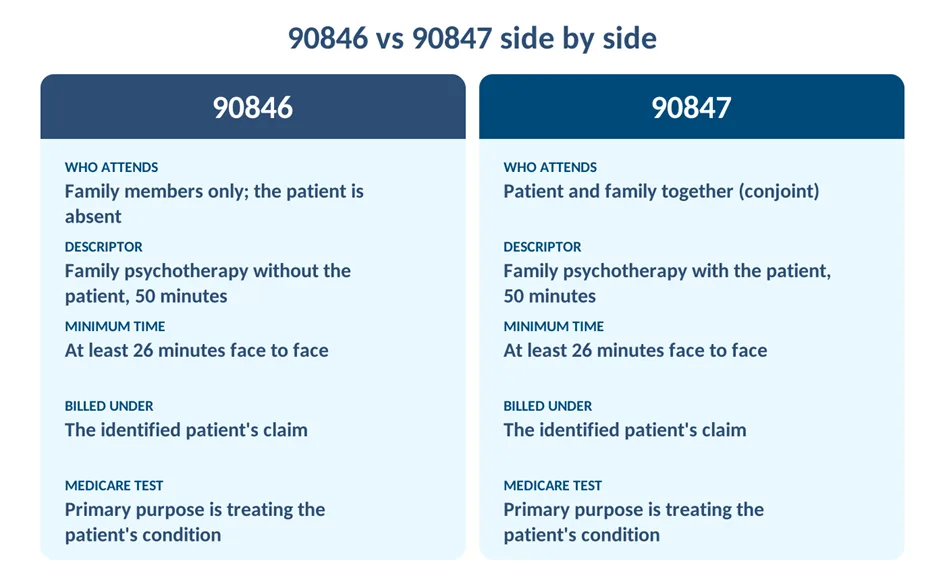
90846 vs 90847 at a glance
The AMA CPT code set defines both codes as family psychotherapy of about 50 minutes. The only wording difference is whether the patient is present, and that one fact decides the code.
| Feature | 90846 | 90847 |
| Who attends | Family members without the patient | The patient with family members (conjoint session) |
| Typical use | Coaching parents or a spouse to manage the patient’s symptoms | Working on the patient’s interaction with family in real time |
| Minimum time | 26 minutes face to face | 26 minutes face to face |
| Whose claim | The identified patient | The identified patient |
| Medicare test | Primary purpose is treating the patient’s condition | Primary purpose is treating the patient’s condition |
How to choose the right family psychotherapy code
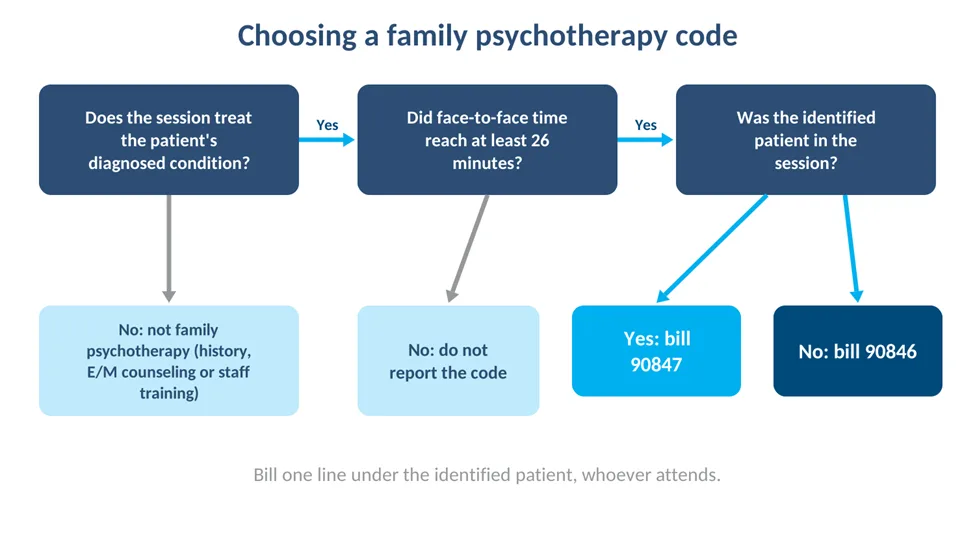
Work through four checks before the claim goes out. The flowchart shows the same logic.
- Confirm the purpose. The session must treat the identified patient’s diagnosed condition. Taking a family history, E/M counseling or training professional caregivers is not family psychotherapy.
- Check the time. Record face-to-face minutes. Under the CPT time rule, a 50-minute code needs at least 26 minutes.
- Check attendance. Patient present means 90847. Family only means 90846. Note who attended and for how long.
- Bill one line. Report a single unit under the identified patient, whatever the family’s size.
Medicare rules for family psychotherapy
Medicare covers family psychotherapy with or without the patient present when it is reasonable and necessary, according to the CMS Medicare mental health booklet. The session’s main goal must be treating the beneficiary’s condition, not the family’s own problems.
Contractors add specific limits. The Noridian mental health billing page notes that multiple-family group therapy (90849) is generally not covered and that marriage counseling is never covered. A Wisconsin Physicians Service billing article adds that these codes do not apply to family history-taking, E/M counseling, or work with professional caretakers and staff.
Medicare-enrolled physicians, psychologists, clinical social workers, nurse practitioners, physician assistants, and, since January 1, 2024, marriage and family therapists and mental health counselors can bill these services within their state scope. Commercial plans set their own rules in their contracts and provider manuals, so check each payer’s policy. Our therapist’s guide to CMS behavioral health directives covers the wider Medicare picture.
Couples therapy and the identified patient
Payers pay for treating a diagnosed mental health condition, not for relationship help in general. In couples work, name one partner as the identified patient, bill under that partner and tie every goal to that partner’s diagnosis. Sessions that address only relationship distress are often non-covered, and they tend to return as CO-50 medical necessity denials.
Telehealth for family sessions
Medicare lists 90846 and 90847 as telehealth services and covers behavioral telehealth on a permanent basis, including when the patient is at home. Audio-only care is allowed when the patient cannot use video or does not want to. Place of service and modifier rules differ by payer, as our comparison of telehealth modifiers 95 and GT explains.
Documentation that supports 90846 and 90847
A family session note should let a reviewer see the patient, the purpose and the time without guessing. Include:
- The identified patient and the diagnosis being treated
- Everyone who attended, their relationship to the patient and whether the patient was present
- Start and stop times or total face-to-face minutes
- Interventions and how each one targets the patient’s symptoms
- Progress toward treatment-plan goals and the next step
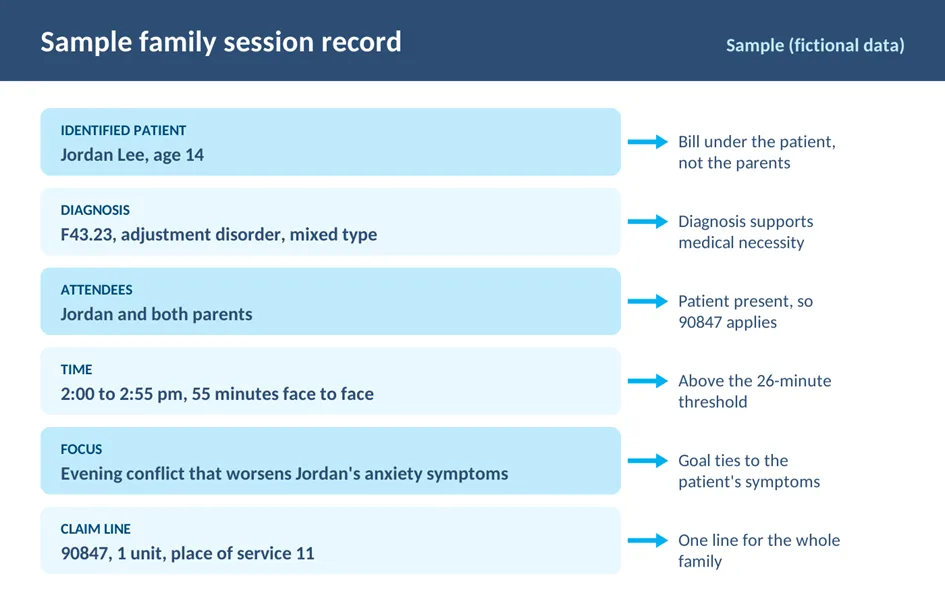
Sample (fictional data): Jordan Lee, age 14, attends with both parents from 2:00 to 2:55 pm. Diagnosis F43.23, adjustment disorder, mixed type. The therapist works on evening conflict that worsens Jordan’s anxiety and sets a calm-down plan for home. Claim: 90847, one unit, place of service 11. Replace the names, times, diagnosis and goals with your own session details.
If a patient also has an individual session the same day, keep separate notes with separate times and check payer edits first; our guide to NCCI bundling edits and fixes explains how same-day pairs are reviewed.
Common 90846 and 90847 billing mistakes
| Mistake | Fix and prevention |
| One unit billed per family member | Bill one line under the identified patient |
| 90847 billed when the patient was absent | Match the code to attendance recorded in the note |
| Session under 26 minutes | Do not report the code; record actual minutes every time |
| Notes read like relationship coaching | Tie each intervention to the patient’s diagnosis and goals |
| 90849 sent to Medicare as routine | Expect a denial and check coverage before scheduling |
| 90785 added out of habit | Add interactive complexity only when CPT and the payer allow it with the family code |
Frequently asked questions
What is the difference between 90846 and 90847?
90846 is family psychotherapy without the patient present, and 90847 is family psychotherapy with the patient present. Both describe about 50 minutes, need at least 26 minutes of face-to-face time and are billed under the identified patient. Choose the code based on whether the patient attended the session.
How many minutes do I need to bill 90847?
At least 26 minutes of face-to-face time, which is past the midpoint of the 50-minute descriptor. Record start and stop times or total minutes in the note. If the session ends before 26 minutes, do not report 90847, and check whether another service fits what actually happened.
Does Medicare pay for couples therapy?
Medicare does not cover marriage counseling. It does cover family psychotherapy, including sessions with a spouse, when the main purpose is treating the beneficiary’s diagnosed mental health condition. The note must show how the session addresses that condition, and the claim goes under the beneficiary.
Can I bill 90847 for each family member who attends?
No. Family psychotherapy is one service for the identified patient, so you report one unit on that patient’s claim no matter how many relatives join. Billing each family member separately is a common cause of denials and overpayment findings.
Can LMFTs bill 90846 and 90847 to Medicare?
Yes. Since January 1, 2024, Medicare-enrolled marriage and family therapists can bill Medicare directly for services that diagnose and treat mental illness, within their state license. They must be enrolled and approved before billing, and the usual family psychotherapy rules apply.
Final Considerations
90846 vs 90847 is a simple choice once attendance, time and purpose are clear in the note. Keep one line per session, tie goals to the patient’s diagnosis and check each payer’s limits on group and couples work.
If you want family therapy claims checked before they go out, our medical billing and coding services assign a dedicated agent to your practice, or you can send our team a message to talk it through.
Sources: AMA CPT code set; CMS, Medicare Mental Health (MLN1986542); Noridian Medicare, Mental Health billing guidance; Wisconsin Physicians Service, Billing and Coding: Psychiatry and Psychology Services (A57480). This article is general information, not legal advice. Confirm current rules with each payer.