
What Is a Superbill in Medical Billing? Fields, Uses and Rules for 2026
A superbill is an itemized visit summary listing provider and patient details, the date of service, CPT procedure codes, ICD-10-CM diagnosis codes and charges. Patients submit a superbill to an insurer to request reimbursement, usually for out-of-network care. A superbill is not a claim form, and practices do not send one to a payer in place of a CMS-1500.
A patient who pays out of pocket usually leaves with one document that decides whether an insurer reimburses them: the superbill. This guide answers what is a superbill in medical billing, which fields it must carry, how it differs from a claim form, and what Medicare and commercial plans expect. It also explains why superbill code lists go stale each year, and it ends with a ten-question self-assessment checklist that a practice manager can score in about ten minutes.
Superbill key numbers at a glance
Seven figures matter most when issuing and reviewing superbills, and four of them come from named published sources. Table 1 pairs each figure with a review rhythm, so the dates and rates can live on a billing checklist instead of in staff memory. Review the practical rows monthly and the dated rows whenever a code set changes.
Key numbers cheat sheet
| Metric | Practical target/range | Review frequency | Source type |
| Medicare general claim filing limit | 12 months from the date of service | Every Medicare-covered visit | Published standard |
| Patient-submitted out-of-network window | Varies by plan: 90 days (extendable) at HealthPartners; one year at Blue Shield of California | At intake and each plan change | Payer policy |
| Medicare processing time for a patient-filed claim | Allow at least 60 days | Per claim | Published standard |
| ICD-10-CM annual update | Effective October 1; FY2027 added 238 codes, revised 4 and deleted 21 | Every October | Named analysis |
| CPT annual update | Effective January 1; 2026 had 288 new, 46 revised and 84 deleted codes | Every January | Named report |
| Superbill completeness rate | Commonly targeted near 100%; investigate anything below 95% | Monthly sample audit | Practical target |
| Superbill turnaround | Within 1 to 3 business days of the visit | Weekly | Practical target |
Source type: Published standard = stated by CMS, Medicaid.gov or a Medicare Administrative Contractor. Payer policy = published by the named plan and not universal. Named analysis or report = counts reported by the AAPC (via Physicians Practice) and Wolters Kluwer (on the AMA release). Practical target = Aspect Billing Solutions’ working guideline, not a mandate.
What is a superbill in medical billing, and what is it not?
A superbill is an itemized record of one patient visit that a practice gives to the patient, and it works as supporting documentation rather than a claim. The CMS-1500 is a standardized claim form, while superbill layouts vary by practice and software. Many practices use encounter form and superbill interchangeably, though some reserve the first term for the in-visit checklist a clinician marks.
The distinction matters because payers process claims, not superbills. A patient mails or uploads the superbill, and the plan treats it as an itemized bill attached to a member-filed request. Definitions of related terms appear in Aspect Billing Solutions’ medical billing terminology guide. Table 2 shows how a superbill differs from four documents it is often confused with.
Superbill vs invoice, claim, receipt and EOB
| Document | Created by | Goes to | Purpose | Submitted to a payer? |
| Superbill | Practice | Patient | Itemized visit record with codes and charges | By the patient, if the plan accepts itemized bills |
| CMS-1500 claim | Practice or biller | Payer | Standard professional claim for payment | Yes, filed by the practice |
| Invoice or statement | Practice | Patient | Requests a patient balance | Rarely, because codes are often missing |
| Receipt | Practice | Patient | Proves payment | Only if itemized with codes |
| Explanation of benefits (EOB) | Payer | Patient and practice | Explains how a claim was processed | No |
Sources: HealthPartners and Blue Shield of California member-claim instructions; NUCC (CMS-1500). Plan requirements vary.
Anatomy of a superbill: every field and why payers ask for it
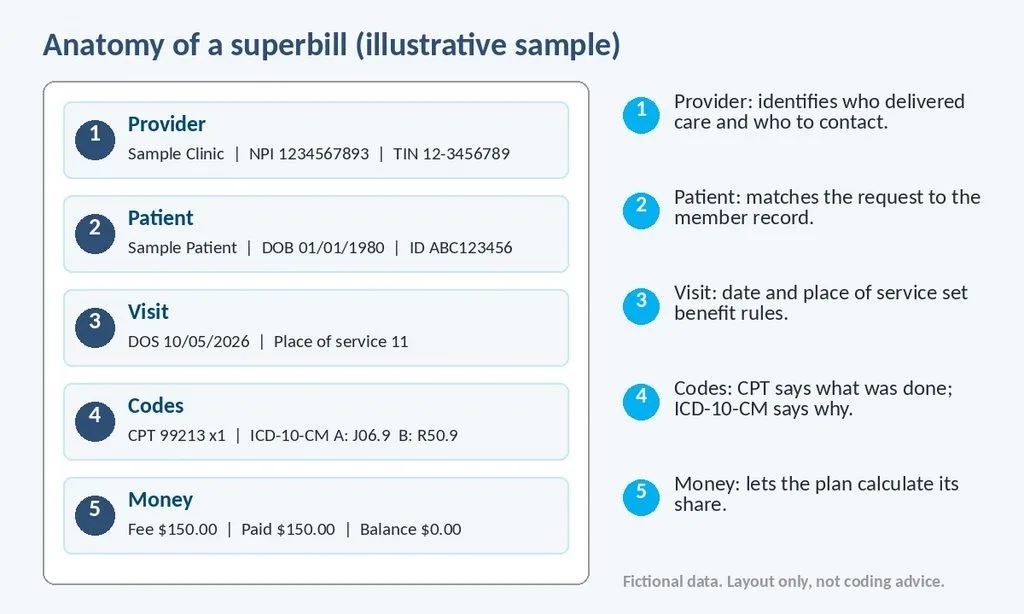
A usable superbill carries five groups of data: provider, patient, visit, codes and money. Payers differ on exact requirements, but two published member instructions and Medicare’s patient-filing packet agree on most of the core fields in Table 3. Treat the table as a baseline, then add anything a specific plan requests in its own member instructions.
Superbill fields and why payers ask for them
| Group | Field | Why the payer needs it |
| Provider | Practice name, address, phone; rendering provider; NPI (the 10-digit National Provider Identifier); tax ID | Identifies who delivered the care and who to contact; Blue Shield of California and HealthPartners both ask for provider identifiers |
| Patient | Name, date of birth, member ID | Matches the request to the right member record |
| Visit | Date of each service; place of service code or description | Sets benefit rules and payment level; Medicare also asks for the place of each service |
| Codes | CPT procedure code with modifiers and units; ICD-10-CM diagnosis codes linked to each service | Shows what was done and why; plans cannot judge medical necessity without both |
| Money | Fee per line, total, amount the patient paid, balance | Lets the plan calculate its share; Blue Shield asks for the amount paid |
| Extras | Signature and date, referral details where relevant | Practice policy or plan preference; not universal |
Sources: HealthPartners out-of-network claim instructions; Blue Shield of California non-participating provider guidance; CMS-1490S instructions. Requirements vary by plan.
Illustrative scenario (not an actual client record): Table 4 shows a one-service superbill with fictional data. The codes illustrate layout only, and real superbills must be coded from the visit documentation against the current code sets, never copied from a sample or from an old template.
Illustrative sample superbill (fictional data)
| Field | Sample entry |
| Practice and provider | Sample Clinic, 100 Example Street; Sample Provider, NPI 1234567893 (sample), tax ID 12-3456789 (sample) |
| Patient | Sample Patient, date of birth 01/01/1980, member ID ABC123456 (sample) |
| Date and place of service | 10/05/2026; place of service 11 (office) |
| Diagnoses | A: J06.9 acute upper respiratory infection, unspecified; B: R50.9 fever, unspecified |
| Service line | 99213 office visit, established patient, 1 unit, diagnosis pointers A and B, charge $150.00 |
| Payment summary | Total $150.00; paid by patient $150.00; balance $0.00 |
Illustrative: fictional data for layout only, not a real record or coding advice.
In billing audits, a common pattern is a superbill that lists a diagnosis but never links it to a service line, which leaves the plan guessing which condition supported which charge. Link every service to at least one diagnosis, and keep the order consistent with the visit note.
Who uses superbills, and when should a practice issue one?
Practices issue superbills when the patient, not the practice, will ask the insurer for payment. That setup is common wherever the practice is outside the plan’s network or does not bill insurance at all. The list below shows the main groups and the condition that triggers a superbill for each.
- Out-of-network clinicians. Issue a superbill when the patient pays the practice directly and plans to claim reimbursement. The out-of-network claim billing guide covers the practice-side options.
- Cash-pay and retainer practices. A concierge medicine or direct-pay practice issues superbills for visits its patients may submit themselves.
- Therapists and behavioral health clinicians. Many solo providers rely on superbills, as the mental health billing guide explains for plan-specific rules.
- In-network practices. Do not substitute a superbill for a claim. When a payer contract requires the practice to file, file the CMS-1500 or its electronic equivalent.
From visit to reimbursement: the superbill workflow
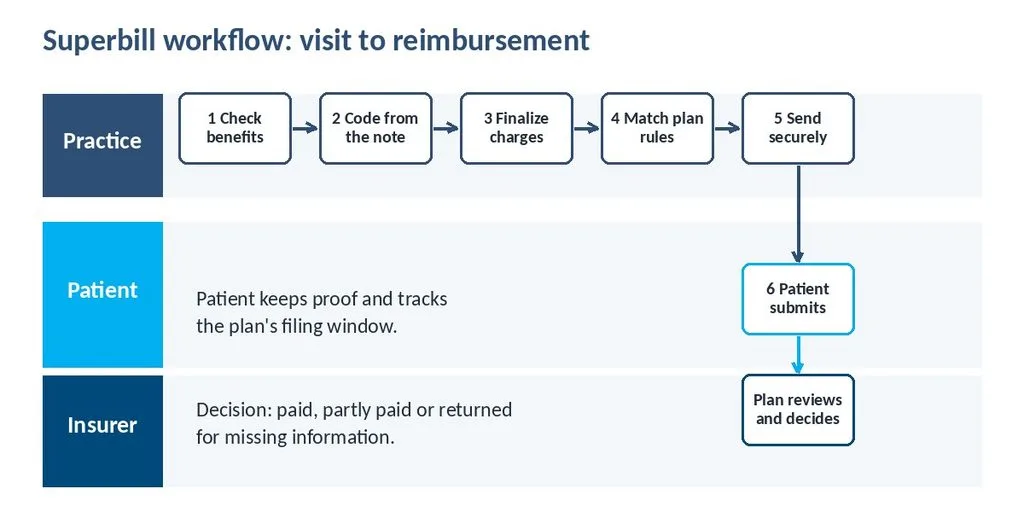
The workflow runs in six steps, and the practice owns the first four. Following them in order prevents the most common cause of returned requests, which is a superbill issued before the charges and codes are final. Adjust the sequence only when a plan’s own instructions require it.
- Check benefits first. Confirm the patient’s out-of-network benefits, remaining deductible and filing window before the visit. Use an eligibility verification routine when volume allows.
- Code from the note. Assign CPT and ICD-10-CM codes from the signed visit documentation, not from the encounter form alone.
- Finalize charges, then issue. Generate the superbill only after charges post. Aim for 1 to 3 business days after the visit.
- Match the plan’s rules. Compare the superbill with the plan’s member instructions. Some plans want their own claim form plus an itemized bill; others accept the itemized bill alone.
- Deliver it securely. Send the superbill through a channel the patient has agreed to (see the privacy section below).
- Patient submits and tracks. The patient files within the plan’s window, and the practice answers coding questions if the plan asks.
Front-desk habits decide whether steps one and three happen. The front-end RCM workflow guide walks through check-in to claim submission, and the guide to patient responsibility at the front desk covers collecting payment at the visit. Practices with an EHR can also build superbills from charge data, as EHR integration explains.
Superbill rules by payer: Medicare, Medicare Advantage, Medicaid and commercial plans
Superbill rules differ sharply by payer, and Medicare works differently from commercial plans. Table 5 summarizes the patterns billers meet most often, using published sources where available. Always confirm the current rule with the plan or contractor, because policies and member materials change between plan years.
Payer differences (illustrative except where a source is named)
| Payer type | How superbills and itemized bills are handled | Window or time limit | What to check |
| Medicare (fee-for-service) | Providers are expected to file claims. A patient files the CMS-1490S with an itemized bill and a reason the provider did not file. Under a Medicare private contract, neither side submits a claim | 12 months from date of service; allow 60 days for processing | Provider enrollment and opt-out status |
| Medicare Advantage | The plan’s evidence of coverage and provider contract govern; out-of-network coverage varies by plan type | Set by the plan | Plan type and member materials |
| Medicaid | State-specific; do not assume reimbursement for member-submitted requests | State-specific | State Medicaid agency rules |
| Commercial plans | Plan-specific. HealthPartners states no claim form is needed; Blue Shield of California asks for a claim form plus an itemized bill | 90 days (extendable) at HealthPartners; one year at Blue Shield of California | Member claim instructions for each plan |
Sources: CMS-1490S instructions; Noridian private contract guidance; Medicaid.gov (Medicare timely filing); HealthPartners; Blue Shield of California. Illustrative where no source is named; actual rules vary by plan and state.
For Medicare, the CMS-1490S instructions list what an itemized bill must show: the date and place of each service, a description and charge for each service, the provider’s name and address, and the diagnosis if possible. For commercial plans, read the member claim page before promising a patient a result. When superbill requests keep coming back across several plans, an outside review such as Aspect Billing Solutions’ billing and coding services can trace the pattern.
Why superbill code lists go stale every year
Superbill code lists go stale twice a year, because ICD-10-CM changes take effect on October 1 and CPT changes take effect on January 1. CMS states that the FY 2027 ICD-10-CM files apply to discharges from October 1, 2026 through September 30, 2027, and the CMS ICD-10 page posts the files.
The counts are large enough to matter. The AAPC’s analysis, reported by Physicians Practice in July 2026, counts 238 new, 4 revised and 21 deleted ICD-10-CM codes for FY 2027. Wolters Kluwer, reporting the AMA release, counts 288 new, 46 revised and 84 deleted CPT codes for 2026. Physicians Practice also noted that I42.0 expands into I42.00, I42.01 and I42.09, so a template still printing I42.0 would be invalid after October 1.
Our team often sees practices update the EHR code set but leave a printed or spreadsheet superbill template untouched. Update the template whenever the October and January releases take effect, and review the common ICD-10 coding errors while doing so.
Four calculations that show whether superbills are working
Four simple calculations show what a superbill is worth to a patient and whether a practice’s superbills are accurate. Each example is illustrative, and each opens with its formula so the arithmetic can be rerun on real numbers. Replace the sample figures with your own plan allowances, request counts and dates before drawing any conclusion.
Example 1: estimated reimbursement
Formula: reimbursement = (plan’s allowed amount − remaining deductible) × plan’s coinsurance share. The allowed amount is the maximum the plan recognizes for the service. Illustrative scenario (not an actual client record): the patient pays $150.00 for the sample visit, the plan allows $110.00, $40.00 of deductible remains, and the plan pays 60% of out-of-network allowed charges. Reimbursement = ($110.00 − $40.00) × 0.60 = $42.00, so the patient’s net cost is $108.00. With the deductible met, the plan pays $66.00 and the net cost is $84.00.
Example 2: superbill completeness rate
Formula: completeness rate = superbills with every required field ÷ superbills reviewed × 100. Illustrative scenario (not an actual client record): a monthly audit samples 50 superbills, and 41 carry every field in Table 3. The rate is 41 ÷ 50 = 82.0%. The nine misses split into five without a tax ID, three without a place of service and one without diagnosis pointers, which points to a template fix rather than a staff problem.
Example 3: acceptance rate by plan
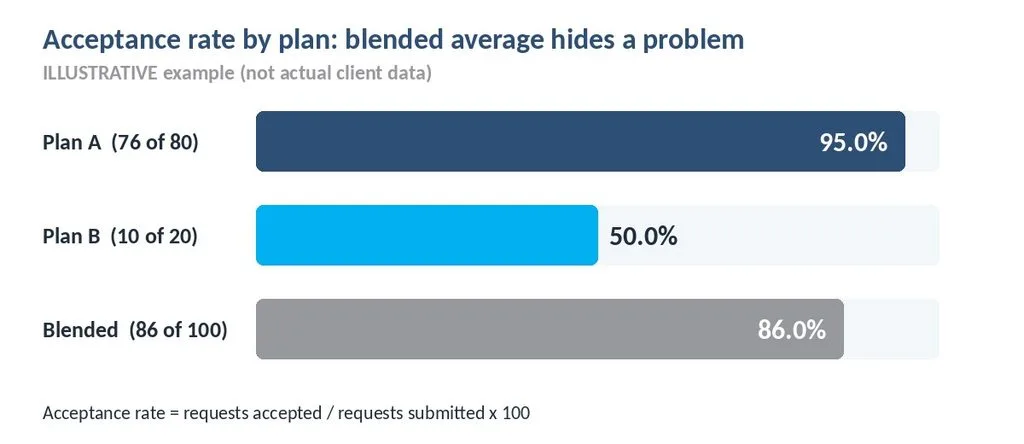
Formula: acceptance rate = patient requests paid or accepted ÷ requests submitted × 100. Illustrative scenario (not an actual client record): patients submit 80 requests to Plan A and 76 are accepted, which is 95.0%. They submit 20 to Plan B and 10 are accepted, which is 50.0%. Blended, 86 ÷ 100 = 86.0%. The blended figure looks acceptable, yet half of Plan B requests fail, so a plan-specific field or form is probably missing.
Example 4: filing window check
Formula: deadline = date of service + the plan’s window. Illustrative scenario (not an actual client record): a patient is seen on October 5, 2026 and the plan states a 90-day window, as HealthPartners does. Ninety days later is January 3, 2027, so the superbill should reach the patient well before the holidays. A plan with a one-year window leaves far more room, which is why the window belongs in the benefits check.
How to use these numbers correctly
Compare like with like: one plan against its own history, and one specialty against similar specialties. One missed benchmark is a signal to investigate, not a verdict. When a rate drops, pull the returned requests by plan and by missing field before changing the template.
How long does it take to fix a superbill process?
Template and field fixes often show results within 2 to 4 weeks, and a full cleanup commonly takes 60 to 90 days. These are general planning ranges, not guarantees. Partial results arrive once the template carries every required field and the October or January code updates are loaded. Full results arrive after staff habits, plan-specific rules and patient instructions are also settled, and slower plans push the timeline longer.
Superbill mistakes that get patient requests returned
Most returned requests trace to six repeat mistakes, and each has a straightforward fix. Many overlap with general coding errors, so the same discipline that reduces denials also protects superbills. Review the list quarterly, and add any plan-specific reasons for return that your patients report.
- Outdated codes. Reload the October and January code updates into every template. Do this before the first visit billed under the new year or quarter.
- Missing provider identifiers. Print the NPI and tax ID on every superbill, because plans ask for them. Do this when onboarding a new provider.
- Unlinked diagnoses. Point each service line to a diagnosis. Check this on every superbill in the monthly audit.
- Wrong place of service. Match the code to where care happened. Telehealth is a common slip: POS 10 is telehealth in the patient’s home and POS 02 is telehealth elsewhere.
- Superbill issued before charges finalize. Our team often sees front desks print the superbill at checkout and then adjust the claim later, so the two disagree. Issue it after charges post.
- A superbill used as a Medicare claim. Medicare expects the provider to file, and patients use the CMS-1490S with an itemized bill. Direct patients accordingly.
Protecting patient privacy when you send a superbill
A superbill contains protected health information, so send it through a channel the patient has agreed to. HHS says providers may email patients, including over unencrypted email, if they take reasonable precautions, and an HHS HIPAA FAQ adds that patients can request a more secure option. Confirm the address, limit the information to what the request needs, and offer a portal or mail if the patient prefers. The HIPAA compliance checklist covers the wider safeguards.
Quick summary
- A superbill is an itemized visit record, not a claim form.
- Core fields: provider and NPI, tax ID, patient, date and place of service, CPT, ICD-10-CM and charges.
- Medicare expects providers to file; patients use the CMS-1490S with an itemized bill.
- Commercial plans differ, so check each plan’s instructions and filing window.
- Update templates every October and January.
- Track completeness near 100% and acceptance by plan, not just the blended rate.
Self-assessment: is your superbill process reliable?
Answer yes or no to each question, using last month’s numbers wherever a question mentions a rate. The scoring guide below the list shows what the total suggests and what to do next. A “no” on any single item is a to-do, not a failure.
- Does every superbill carry the provider’s NPI and tax ID?
- Does every service line link to a diagnosis?
- Is a place of service code printed on every superbill?
- Were your templates updated for the October 1 ICD-10-CM release?
- Do you issue superbills only after charges are final?
- Do you issue superbills within 1 to 3 business days of the visit?
- Is your sampled completeness rate at or near 100%, and above 95%?
- Do you track acceptance or return rates by plan?
- Do you check each patient’s out-of-network benefits and filing window before the visit?
- Do you send superbills through a channel the patient has agreed to?
Scoring guide
| Yes answers | What it suggests | Next step |
| 9-10 | Process looks reliable | Keep the monthly audit and update templates each October and January |
| 6-8 | Gaps worth closing | Fix the “no” items first and re-audit in 60 days |
| 0-5 | High risk of returned requests | Rebuild the template and review plan rules before the next billing cycle |
Scoring is a practical guide, not a published standard.
When does outside billing support make sense?
Outside support makes sense when the in-house approach has hit its limits, and the limit usually shows up in returned requests before it shows up in cash. Do not wait if several of these five signals are already present, since each one tends to compound the others over a few billing cycles:
- Patients report that plans keep returning superbills for missing information.
- The practice mixes in-network and out-of-network patients and cannot tell which path each visit needs.
- Templates drift from the current code sets after each October and January update.
- Nobody on staff owns plan-specific filing rules and windows.
- Staff turnover or growth is pulling the front desk away from accuracy checks.
When evaluating any partner, look for experience with both in-network claims and out-of-network documentation, a written process for code-set updates, HIPAA safeguards with a signed business associate agreement, and plan-level reporting. Aspect Billing Solutions is one example. It provides HIPAA-compliant, end-to-end medical billing and coding, credentialing, eligibility verification and prior authorization, denial management, A/R follow-up and compliance support, with a dedicated agent assigned to each provider. Results vary by practice. Details are on its revenue cycle management service page.
Final Considerations
Asking what is a superbill in medical billing is really asking who files the request and what proof the payer needs. A superbill answers the second half: it is the itemized proof a patient carries to the plan. It works only when the codes are current, the identifiers are complete and the plan’s rules were checked first.
Firm published standards in this guide are Medicare’s 12-month filing limit, the CMS-1490S itemized bill requirements, the October 1 ICD-10-CM and January 1 CPT effective dates, and the plan instructions quoted from HealthPartners and Blue Shield of California. The completeness targets, turnaround goals, timeframe ranges and every worked example are practical or illustrative.
The natural next question is whether your current superbill template would pass a plan’s checklist today. To find out, request a superbill and billing review from Aspect Billing Solutions and bring a recent sample with identifiers removed, so the review can compare it with the fields and plan rules described above.
Frequently asked questions
What is a superbill in medical billing?
A superbill is an itemized record of a patient visit that lists the provider, patient, date, CPT procedure codes, ICD-10-CM diagnosis codes and charges. Practices give it to patients so they can ask their insurer for reimbursement. It supports a request for payment but does not replace a claim form.
Is a superbill the same as an invoice or a claim form?
No. An invoice asks the patient for a balance and often lacks codes. A claim form, such as the CMS-1500, is filed by the practice and processed by the payer. A superbill sits between them: an itemized record with codes that the patient may submit if the plan accepts it.
Can a patient submit a superbill to Medicare?
Providers are expected to file Medicare claims. When a provider does not, the patient can file the CMS-1490S with an itemized bill and an explanation, and should allow at least 60 days for processing. If the provider has a Medicare private contract, neither side submits a claim, and Medicare will not pay.
What is a good completeness rate for superbills?
Many practices aim for a sampled completeness rate near 100% and treat anything below 95% as a signal to investigate. That target is a practical guideline, not a payer or CMS mandate. Audit a monthly sample, and track which fields go missing most often so the template can be fixed.
What is a good turnaround time for issuing a superbill?
A common practical goal is one to three business days after the visit, once charges are final. Plan windows can be short, such as 90 days at HealthPartners, so a slow superbill eats into the patient’s time. Check the plan’s window during the benefits check.
Does a superbill guarantee reimbursement?
No. Reimbursement depends on the patient’s out-of-network benefits, remaining deductible, the plan’s allowed amount and whether the plan accepts the document. A complete, current superbill improves the odds of a clean review, but each plan decides. Verify benefits and filing rules before the visit, not after.
Sources and methodology
(a) Published standards and definitions from named bodies
- CMS, Patient’s Request for Medical Payment (CMS-1490S) instructions for Part B (itemized bill contents; allow at least 60 days).
- CMS, ICD-10 codes page (FY 2027 ICD-10-CM files apply October 1, 2026 through September 30, 2027).
- Medicaid.gov, FAQ on Medicare’s general timely filing period (12 months, Affordable Care Act).
- Noridian Healthcare Solutions, Private Contracts with Medicare Beneficiaries (no claim submission under a private contract).
- HHS, HIPAA FAQ 570 on emailing patients (reasonable safeguards; patient preference).
(b) Named benchmarking data providers
None. No MGMA, HFMA or other benchmarking-provider figures are cited in this article.
(c) Practical or illustrative targets from general industry sources
- The completeness target (near 100%, investigate below 95%) and the 1 to 3 business day turnaround are Aspect Billing Solutions’ practical guidelines.
- The 2 to 4 week and 60 to 90 day improvement ranges are general planning ranges, not guarantees.
- All worked examples and the sample superbill are labeled illustrative and use fictional data.
- Plan examples: HealthPartners individual and family out-of-network claim instructions (90-day window, extendable; no claim form required) and Blue Shield of California non-participating provider guidance (one-year window; claim form plus itemized bill).
(d) Survey or study data
- AAPC analysis of FY 2027 ICD-10-CM changes (238 new, 4 revised, 21 deleted), as reported by Physicians Practice, July 2026.
- Wolters Kluwer report on the AMA 2026 CPT release (288 new, 46 revised, 84 deleted), February 2026.
Results vary by practice, payer and state. Figures and rules reflect information available in October 2026, and codes, fee schedules and payer policies change annually.