
Neurology E/M Coding 99213 99214 Documentation Tips
For an established neurology patient, 99213 requires low medical decision making or at least 20 minutes of total time. 99214 requires moderate decision making or at least 30 minutes. Decision making is met when two of three elements reach the level billed: problems, data, and risk. Many practices aim for 95% or higher accuracy on internal E/M audits, a practical target rather than a mandate.
Neurologists routinely manage chronic, shifting conditions, yet many visits that support 99214 get billed as 99213. Others get upcoded without the notes to back them. Both cost money, one through lost revenue and the other through audit risk. These neurology E/M coding 99213 99214 documentation tips explain how medical decision making and total time decide the level. Each section includes neurology examples and worked calculations. A self-assessment checklist near the end helps you check your own notes.
Neurology E/M Numbers at a Glance
| Metric | Practical Target/Range | Review Frequency | Primary Source |
| 99213 by time | 20 minutes or more | Per visit | CPT (AMA) descriptor |
| 99214 by time | 30 minutes or more | Per visit | CPT (AMA) descriptor |
| MDM level rule | 2 of 3 elements met | Per visit | CPT (AMA) guidelines |
| Prolonged service, established | 99417: 55 min; G2212: 69 min | Per visit | CPT (AMA); CMS rule |
| Internal E/M audit accuracy | 95% or higher | Quarterly | Commonly reported range |
| E/M denial rate | 5% or lower | Monthly | Commonly reported range |
| 99214 share variance by provider | Within ~15 points of peers | Quarterly | Illustrative target |
Table 1. “CPT (AMA)” and “CMS rule” are official definitions or Medicare policy. “Commonly reported range” is widely cited, not mandated. “Illustrative target” is a working goal to verify against your own data.
How Medical Decision Making Sets the Level?
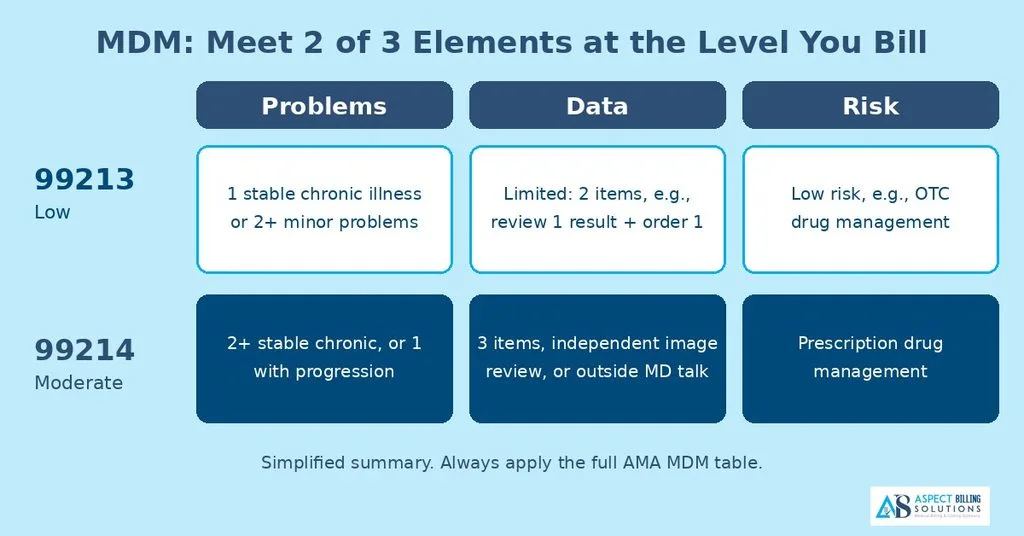
Since 2021, history and exam no longer determine office E/M levels. They only need to be medically appropriate. The level comes from decision making, built on three elements: problems addressed, data reviewed, and risk of management. Two of the three must reach the level you bill. Neurology fits moderate complexity often, because prescription drug management counts as moderate risk. Our neurology CPT codes guide covers the wider code set.
What a 99213 Looks Like in Neurology?
A level three visit typically involves one stable chronic illness, such as well-controlled migraine, with limited data. Prescription refills raise risk to moderate, but one moderate element alone is not enough. With problems at low and data minimal, decision making stays low.
Worked example — scoring a 99213. Rule: the level equals the second-highest of the three elements. Problems: one stable migraine = low. Data: none reviewed = minimal. Risk: prescription renewed = moderate. Sorted, the elements are moderate, low, minimal, so the second-highest is low. Bill 99213.
What Pushes a Visit to 99214?
Two or more stable chronic illnesses, such as epilepsy and migraine, reach moderate problems. So does one chronic illness with progression, like a Parkinson’s patient with worsening freezing. Data reaches moderate through independent interpretation of a test billed by someone else, such as personally reviewing MRI images. Document that interpretation in your own words, not just “MRI reviewed.”
Neurology Documentation Phrases That Help
State the status of each problem addressed: stable, worsening, or not at goal. Name the data you reviewed and what it changed. Record the medication decision and its monitoring, such as ordering levels for an antiseizure drug. Avoid cloned documentation copied forward from prior visits, which auditors flag as unsupported.
Coding by Time, Add-Ons, and Modifiers
Counting Total Time Correctly
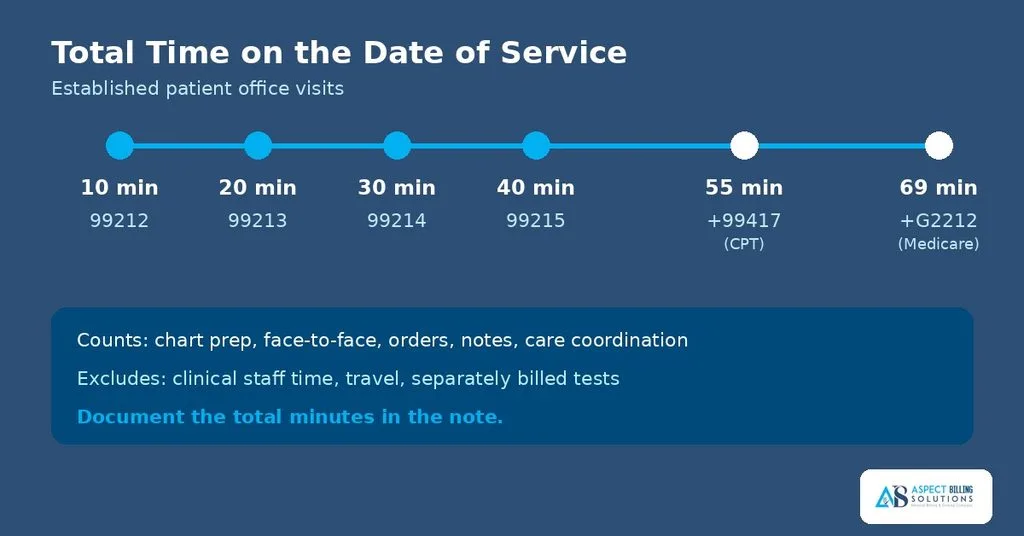
Total time includes everything the physician does on the date of service: chart prep, the visit, orders, documentation, and coordination. It excludes clinical staff time, travel, and separately billed services like EEG interpretation. Time often helps in neurology, where counseling on seizure safety or disease-modifying therapy runs long.
Worked example — time-based level. Formula: pre-visit review + face-to-face + same-day post-visit work. Eight minutes reviewing outside records, 17 minutes with the patient, and 7 minutes documenting total 32 minutes. That meets the 30-minute threshold for 99214. Record the total in the note.
Prolonged Services: 99417 vs. G2212
Beyond 99215, CPT adds 99417 once total time reaches 55 minutes. Noridian’s Medicare E/M guidance confirms Medicare uses G2212 instead, starting at 69 minutes for established patients. Prolonged codes apply only when the base level was chosen by time.
Worked example — prolonged units. A Medicare visit documents 75 minutes. Since 75 is at least 69, bill 99215 plus one G2212. A commercial payer following CPT would pay 99215 plus one 99417.
G2211 and Modifier 25
The G2211 complexity add-on fits neurologists managing a single serious or complex condition over time, such as multiple sclerosis. CMS guidance (MLN MM13473) denies G2211 when the E/M carries modifier 25, except with certain same-day preventive services. So a same-day Botox injection or nerve block usually rules out G2211. See our neurology modifiers guide for modifier 25 rules.
Tracking E/M Accuracy Across Your Practice
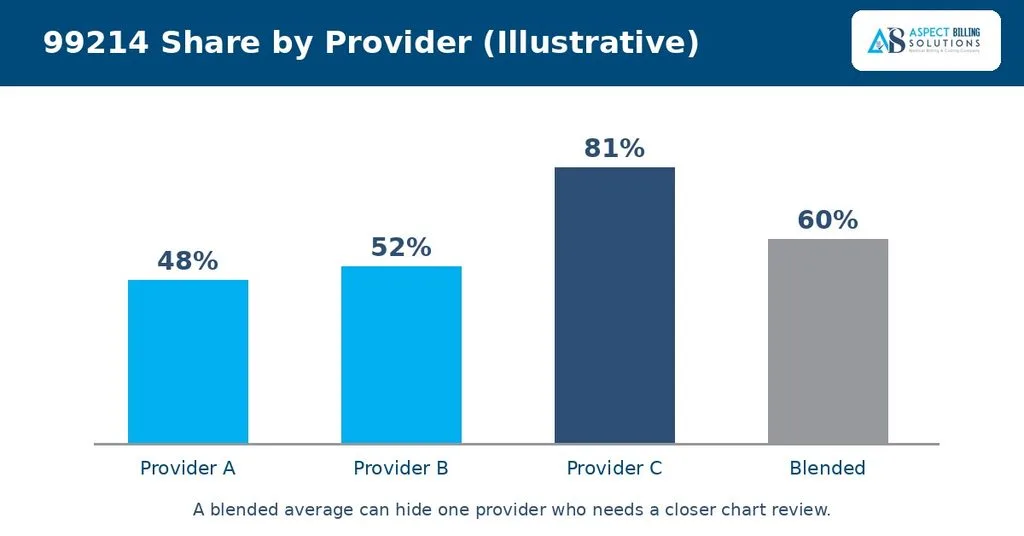
Two measures show whether documentation supports your levels. The audit accuracy rate equals charts coded correctly ÷ charts audited × 100; 47 of 50 correct is 94%, just under a commonly reported 95% target. E/M level distribution equals visits at one level ÷ all established visits.
| Provider | Established visits | 99214 visits | 99214 share |
| Provider A | 250 | 120 | 48% |
| Provider B | 250 | 130 | 52% |
| Provider C | 240 | 195 | 81% |
| Blended | 740 | 445 | 60% |
Table 2. Illustrative figures, not from a named source. Actual distributions vary by subspecialty and patient mix; verify against your own data.
The blended 60% looks unremarkable. Provider C, however, sits far above peers. That may reflect sicker patients or unsupported notes. Review a sample of charts before drawing conclusions. If audits show levels left on the table, our guide to fixing under-coded claims explains recovery steps, and a medical billing audit can test your notes objectively.
Comparing Your E/M Figures Fairly
A benchmark only works like-for-like. Compare providers with similar subspecialties, patient complexity, payer mix, and reporting periods. A headache clinic and an MS center will never share one distribution. One outlier quarter is a prompt to review charts, not proof of error.
How Quickly Documentation Fixes Pay Off?
| Fix | Early signs | Fuller results |
| MDM-focused note template | 30–45 days | 90 days |
| Time documentation habit | Next billing cycle | 60 days |
| G2211 capture workflow | Next billing cycle | 60–90 days |
| Provider coding education | 30–60 days | 3–6 months |
Table 3. General planning ranges only, not a guarantee for any specific practice.
Neurology E/M Coding 99213 99214 Documentation Tips: Recap
- 99213 needs low MDM or 20+ minutes; 99214 needs moderate MDM or 30+ minutes.
- Two of three MDM elements must reach the level billed.
- Medicare starts G2212 at 69 minutes; CPT starts 99417 at 55.
- G2211 is not paid with modifier 25 except certain preventive services.
- 95% audit accuracy and 5% denials are commonly reported targets, not mandates.
Check Your Own E/M Documentation
Answer yes or no, then count your yes answers.
- Do notes state the status of each problem addressed?
- Is independent image or tracing review written in your own words?
- Is prescription drug management documented with its monitoring plan?
- Do time-based notes record total minutes on the date of service?
- Is staff time excluded from total time?
- Are prolonged codes billed only on time-based visits?
- Is G2211 withheld when modifier 25 applies to a procedure?
- Is internal audit accuracy 95% or higher?
- Is each provider’s 99214 share reviewed against peers quarterly?
Scoring: 8–9 yes = strong documentation. 5–7 = targeted fixes needed. 0–4 = a full E/M audit is overdue.
When Outside Coding Support Makes Sense?
If these neurology E/M coding 99213 99214 documentation tips are hard to apply consistently, watch for these signs. Payers downcode 99214s repeatedly. Providers default to 99213 out of audit fear. G2211 is never billed, or billed with modifier 25. Nobody has audited E/M charts in a year. Good support offers certified coders, pre-bill chart review, provider-level reporting, and education tied to real notes. Aspect Billing Solutions follows that structure, assigning a dedicated agent to each provider across end-to-end revenue cycle management: coding, billing, credentialing, denial management, and HIPAA compliance. Results vary by practice.
Final Considerations
Accurate levels come from clear decision making or recorded time, not long notes. Applied consistently, these neurology E/M coding 99213 99214 documentation tips protect revenue and audit standing together.
The time thresholds, the two-of-three MDM rule, 99417, G2212, and G2211 restrictions are published AMA or CMS standards. The 95% audit accuracy and 5% denial figures are commonly reported ranges. Provider variance targets are illustrative.
Frequently Asked Questions
What is the main difference between 99213 and 99214?
99213 reflects low decision making or 20+ minutes. 99214 reflects moderate decision making or 30+ minutes.
Does prescription drug management make a visit 99214?
Not alone. It sets risk at moderate, but a second element, problems or data, must also reach moderate.
Do history and exam still affect the level?
No. They must be medically appropriate, but only decision making or time selects the level.
Can I count time reviewing an MRI?
Yes, if you review it on the date of service and do not bill the interpretation separately. Staff time never counts.
Can neurologists bill G2211?
Yes, for ongoing care of a serious or complex condition. It is generally not paid when the E/M carries modifier 25.
What is a good E/M audit accuracy rate?
Many practices aim for 95% or higher, a commonly reported target. It is not a regulatory standard.
What is a good 99214 share for a neurologist?
No official figure exists. Compare against peers with a similar subspecialty and patient mix, and investigate large gaps.
How long should a 99214 visit take?
By time, at least 30 total minutes on the date of service. By decision making, time does not matter.
Sources and Methodology
(a) Published standards: AMA CPT office E/M descriptors and MDM guidelines; CMS policy on G2212, G2211, and modifier 25 (MLN MM13473); Noridian Medicare E/M guidance.
(c) Practical and illustrative targets: audit accuracy and denial figures are commonly report ranges; provider variance and all work examples are illustrative.
(b, d) Named benchmarking providers and survey data: none used. Actual results vary by practice; figures reflect information available in September 2026.