
Neuropsychological Testing Billing CPT 96132 96133 Guide
Neuropsychological testing billing (CPT 96132, 96133) covers the clinician’s evaluation work: data integration, interpretation, clinical decision-making, and the written report. CPT 96132 reports the first hour, and add-on code 96133 reports each additional hour. Test administration and scoring are billed separately under 96136 through 96139, and time thresholds decide how many units you may report.
Neuropsychological testing billing CPT 96132 96133-Time-based testing codes look simple until a payer asks for start and stop times. One miscounted hour can reduce a claim or trigger a denial. This guide explains how neurology and neuropsychology practices bill 96132 and 96133, including time thresholds, companion codes, medical necessity, and authorization. Worked examples show the math, and a short self-check near the end scores your workflow. Terms like CPT and qualified health care professional (QHP) are explained plainly.
Testing Codes and Time Thresholds at a Glance
Quick-reference numbers for neuropsychological testing billing
| Metric | Practical Target/Range | Review Frequency | Primary Source |
| 96132, first hour | Minimum 31 minutes | Every claim | [G] APA Services summary of CPT time rules |
| 96133, each added hour | Unit 1 at 91 total minutes; unit 2 at 151 | Every claim | [G] Same source |
| 96136 or 96138, first 30 minutes | Minimum 16 minutes | Every claim | [G] Same source |
| 96137 daily unit limit | 11 units per provider, per patient, per date (MUE) | Annually | [C] Cited in state fee-dispute decisions |
| Authorization lead time | Start 2-4 weeks before testing | Each case | [D] Illustrative target |
| Time-related denial rate | Under 5% | Monthly | [D] Illustrative target |
Source labels: [A] = published rule from a named body; [G] = society guidance, not a payer mandate; [C] = commonly reported, and MUE tables change; [D] = illustrative practical target.
Three Calculations Before the Rules
Example 1: Evaluation hours
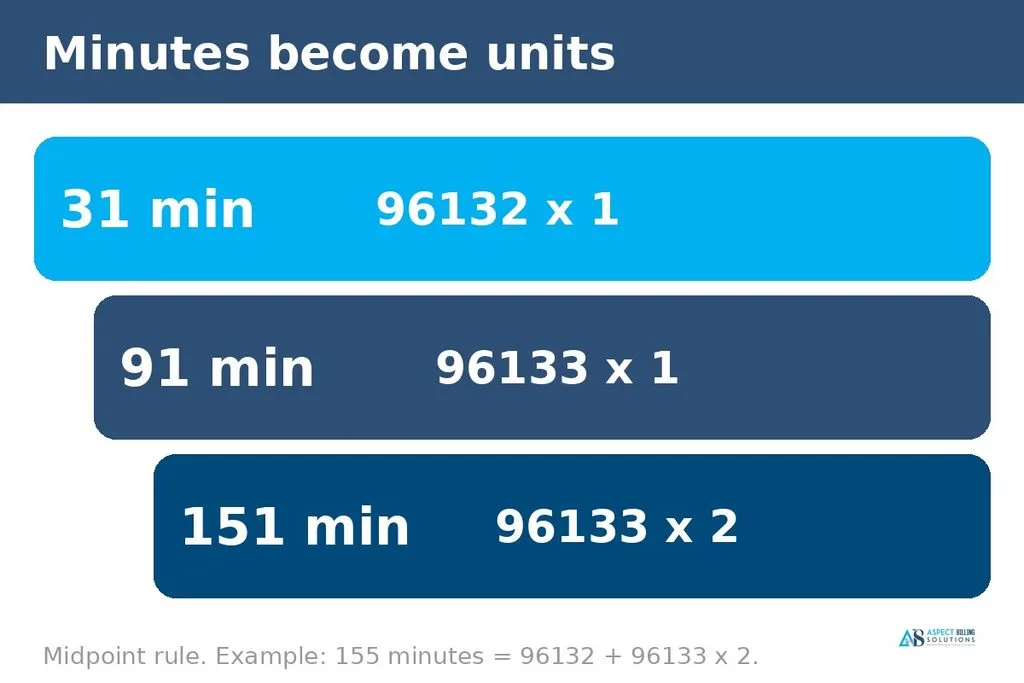
Formula: a further unit is reached once more than half of the next hour is worked. A clinician spends 155 minutes on evaluation. Minute 91 earns the first 96133 unit, and minute 151 the second. The claim shows 96132 × 1 and 96133 × 2.
Example 2: Administration units
Formula: each 30-minute unit is reached at 16 minutes into it. A technician administers tests for 140 minutes. Units arrive at 16, 46, 76, 106, and 136 minutes, giving five. Report 96138 × 1 and 96139 × 4.
Example 3: Expected payment
Formula: payment = base rate + (add-on rate × add-on units). Using illustrative rates of $120 and $95 [D], 96132 plus two 96133 units equals $120 + $190 = $310, less than three times the base rate.
What 96132 and 96133 Actually Pay For?
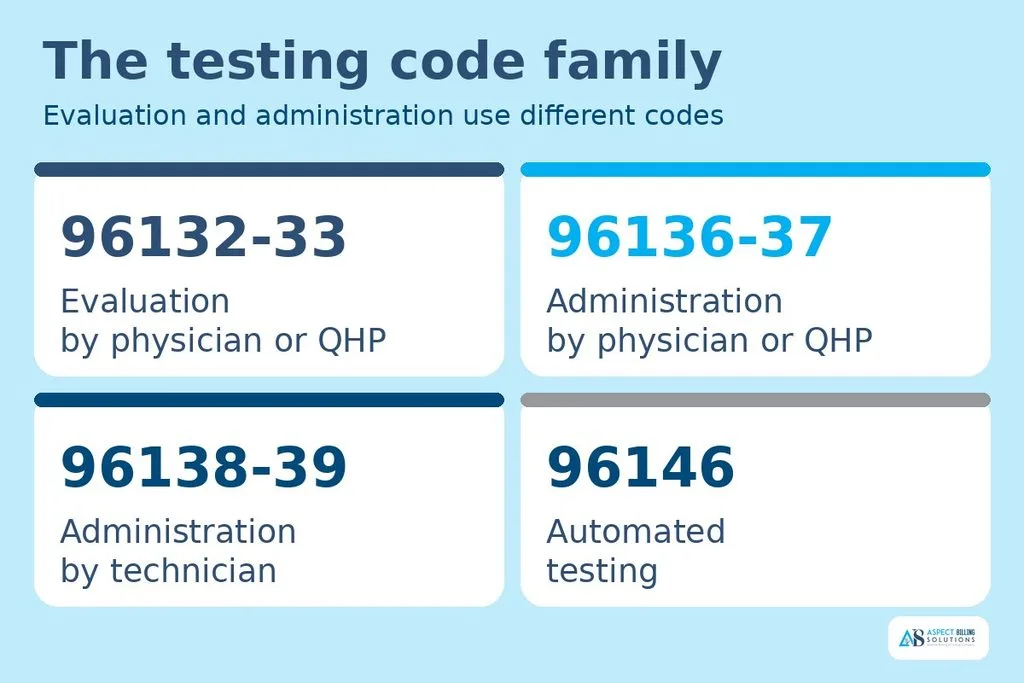
Codes 96132 and 96133 pay for the professional’s thinking, not the testing itself. CPT 96132 covers integration of patient data, interpretation of standardized results, clinical decision-making, treatment planning, and the report, plus feedback when performed. The add-on code 96133 reports each additional hour and never stands alone. The APA Services guidance notes that evaluation services are always billed alongside test administration codes. Only a physician or other qualified health care professional may report them. That also separates 96132 from 96116, a neurobehavioral status exam that needs no standardized battery.
Companion Codes
- 96136 and 96137: administration and scoring by the physician or QHP, per 30 minutes.
- 96138 and 96139: the same work by a supervised technician.
- Same-day overlap: NCCI expects interview and evaluation services to be distinct, without duplicated time.
For wider coding context, see our neurology CPT codes guide and neurology modifiers guide.
Proving Necessity and Securing Approval
Medicare contractors judge testing on medical necessity, not diagnosis alone. CMS billing and coding article A57780 describes 96132 through 96139 as testing that characterizes neurocognitive effects of medical disorders [A]. Commercial plans add their own rules, and prior authorization is common; one Blue plan requires it for managed care but not PPO. Verify at scheduling. Our prior authorization services can own that step. Document the referral question, history, tests with editions, start and stop times, scores, and the signed report.
Illustrative comparison of authorization expectations
| Payer Type | Prior Auth Typically | Evidence Emphasized |
| Original Medicare | Generally none; LCD criteria apply | Neurocognitive concern, management impact |
| Medicare Advantage | Commonly yes | Referral question, prior evaluations |
| Commercial HMO or POS | Often yes | Necessity, planned tests, unit counts |
| Commercial PPO | Varies by plan | Necessity and clinical documentation |
Illustrative comparison, not from one named source. Actual rules vary by payer and contract; verify in each payer portal.
Where Testing Claims Stall?
Testing claims usually stall on time, authorization, or overlap. State fee-dispute decisions show payers reducing 96133 and 96137 when start and stop times are missing. Duplicated interview time can trigger NCCI bundling. An MUE is the most units CMS expects one provider to report for one patient on one date of service [A]. Claim-line MUEs let extra medically necessary units go on separate lines with a modifier; date-of-service MUEs sum every line, per the CMS NCCI FAQ. A solid denial management workflow sorts each denial by cause and payer.
Common testing denial patterns (triggers are commonly reported)
| Reason (CARC) | Typical Trigger | Practical Fix |
| CO-197: authorization absent | Testing began without approval | Verify at scheduling |
| CO-151: units not supported | Units exceed documented time | Reconcile time log before release |
| CO-97: bundled service | Interview or visit time duplicated | Separate time by service |
| CO-16: information missing | No start and stop times | Make times required fields |
Example 4: Denial rate
Formula: denial rate = time-related denials ÷ testing claims × 100. Nine denials on 120 claims gives 9 ÷ 120 × 100 = 7.5%, above the illustrative 5% goal.
The Blended Average Trap
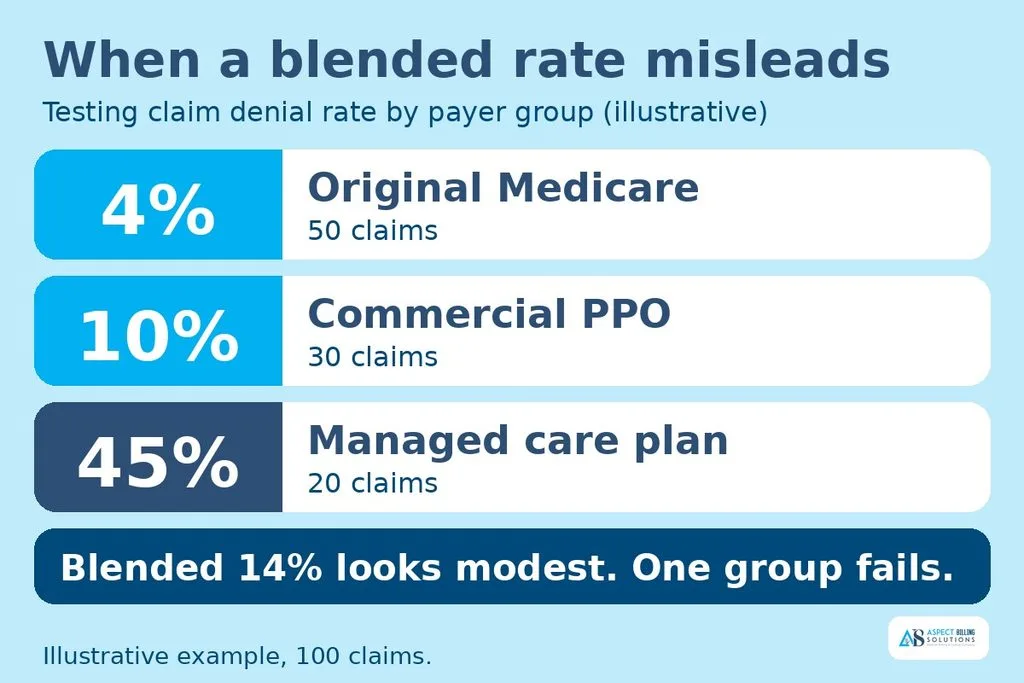
Illustrative scenario (not an actual client record): a practice submits 100 testing claims. Original Medicare has 50 claims with 2 denials (4%). A commercial PPO has 30 with 3 (10%). A managed care plan has 20 with 9 (45%). Overall, 14 ÷ 100 gives 14%, which looks modest. Yet nearly half of managed care claims fail.
When Time Records and Payers Disagree?
A payer may reduce 96133 units, deny 96137 under an MUE, or question necessity. Start with the remittance reason, then match your response. For time reductions, send the start and stop log and the signed report. A claim-line MUE, resubmit extra units on separate lines with the appropriate modifier only when the record supports them; date-of-service edits sum all lines. For necessity, cite the referral question and its effect on management. Original Medicare allows 120 days to request a redetermination and 180 days for the next level, per the CMS Claims Processing Manual [A]. For a peer-to-peer, bring the referral question, tests given, and time log.
Judging Your Numbers Fairly
A benchmark helps only when compared like for like. Match payer mix, provider type, case mix, and reporting period first. One missed target is a signal to investigate, not a verdict on your team.
Realistic Timelines for Cleanup
Table 4. General planning ranges (not a guarantee for any practice)
| Fix | Early Signs | Fuller Results |
| Start and stop time template | 2-4 weeks | 2-3 months |
| Authorization check at scheduling | 4-8 weeks | About 3 months |
| Payer-level denial review | 60-90 days | 4-6 months |
Recap in Five Lines
- 96132 needs 31 minutes; 96133 units start at 91 and 151 total minutes.
- Bill evaluation and administration on their own codes, without duplicated time.
- Confirm authorization at scheduling; 2-4 weeks is an illustrative lead time.
- Track denials by payer; under 5% is an illustrative goal.
Test Your Own Workflow
- Do you record start and stop times for every service? (Yes / No)
- Do you apply the 31-minute rule to 96132 and 96133? (Yes / No)
- Do you use the 16-minute rule for each 30-minute unit? (Yes / No)
- Do you report 96133 only with 96132? (Yes / No)
- Are evaluation and administration billed on separate codes? (Yes / No)
- Do you confirm authorization before testing begins? (Yes / No)
- Is the referral question documented? (Yes / No)
- Do you avoid duplicating interview time across services? (Yes / No)
- Do you review denials by payer monthly? (Yes / No)
Scoring guide: 8-9 yes answers suggest a strong process. 5-7 point to gaps worth fixing this quarter. 4 or fewer means a full workflow review is due.
Knowing When to Hand Off the Work?
- Time-based claims keep getting reduced or denied.
- Authorizations are missing when testing starts.
For testing claims, look for support that checks start and stop times against every time-based unit before submission, confirms authorization for multi-hour batteries, and keeps clinician enrollment current with each payer. Aspect Billing Solutions is one example of this structure. It provides HIPAA-compliant US medical billing and coding (ICD-10, CPT, HCPCS). Services include claim and denial management, eligibility verification, prior authorization, accounts receivable, and credentialing. Each provider gets a dedicated agent, so one person learns each payer’s time-documentation expectations. Fit and results vary by practice. See its revenue cycle management service or our credentialing guide.
Final Considerations
Testing revenue depends on minutes you can prove.
The code descriptors and Medicare necessity criteria are published standards [A], and the CPT time rules come via society guidance [G]. Check the MUE value against current tables. The 5% denial goal, illustrative rates, lead times, and timeframes are practical targets [C][D].
Frequently Asked Questions
Neuropsychological testing billing CPT 96132 96133
What is CPT 96132 used for?
A neuropsychological evaluation by a physician or QHP: data integration, interpretation, and the report, for the first hour.
Can 96133 be billed without 96132?
No. It is an add-on code and must accompany 96132.
How many minutes earn each unit?
96132 needs 31 minutes. The first 96133 unit begins at 91 total minutes, and the next at 151.
Who can bill 96132 and 96133?
Physicians and other qualified health care professionals, such as licensed neuropsychologists. Verify payer enrollment.
How does 96132 differ from 96116?
96132 involves a standardized battery and formal report. 96116 is a status exam without one.
What is a good documentation standard for testing time?
Record start and stop times for each service, by clinician, in the same record as scores and the report.
What is a good denial rate for testing claims?
An illustrative goal is under 5% for time-related denials, tracked monthly by payer.
What is a good lead time for testing authorization?
Many practices start 2-4 weeks ahead, an illustrative range.
Sources and How We Built This Guide
- (a) Published standards [A]: CPT descriptors; CMS article A57780 and LCD L34520; CMS NCCI FAQ; CMS Claims Processing Manual, Chapter 29; X12 reason codes. Society guidance [G]: APA Services summary of CPT time rules.
- (b) Named benchmarking data providers: none used.
- (c) Commonly reported or illustrative [C][D]: the 96137 MUE value, lead times, the 5% goal, rates, a Blue plan policy example, and timeframes.
- (d) Survey data: none used.
Results vary by practice. Figures reflect information available at research time (September 2026); confirm current CPT, MUE, and payer policies.