
Migraine & Headache Treatment Billing & Prior Authorization
Migraine and headache treatment billing and prior authorization means matching each therapy to the right benefit, codes, and approval before care begins. Botox, infusions, and nerve blocks are usually billed by the practice under the medical benefit. Many oral and self-injected drugs run through the pharmacy benefit instead. Clean claims pair documented headache days and prior therapies with authorization dates that match the service date.
Migraine care spans pills, injections, infusions, and nerve blocks, and each follows different billing and approval rules. This guide sorts therapies by benefit channel, then covers CPT and HCPCS coding, authorization packets, denials, and fix timelines. Worked examples show where averages mislead, and a process audit near the end scores your workflow.
Migraine Billing Numbers Worth Pinning Up
Quick-reference numbers for migraine treatment billing and authorization
| Metric | Practical Target/Range | Review Frequency | Primary Source |
| Chronic migraine definition | 15+ headache days monthly for 3+ months | Intake and reauthorization | [A] IHS definition, as cited in a Cigna policy |
| Botox chronic migraine dose | 155 units, 31 sites, every 12 weeks | Each cycle | [A] FDA-approved label |
| Decision time, in-scope payers | 7 calendar days standard; 72 hours expedited | Every request | [A] CMS-0057-F (drugs excluded) |
| Prior preventive failures often required | Two, sometimes three | Each new request | [C] Commonly reported |
| Injectable authorization lead time | Start 3-6 weeks ahead | Every cycle | [C] Commonly reported |
| Weekly time on authorizations | About 13 hours, physician plus staff | Quarterly | [S] AMA physician survey |
| Authorization-related denial rate | Under 5% (practical goal) | Monthly | [D] Illustrative target |
Source labels: [A] = published definition or rule from a named body; [S] = named survey; [C] = commonly reported, not body-mandated; [D] = illustrative practical target.
Which Benefit Pays: Medical vs. Pharmacy Channels?
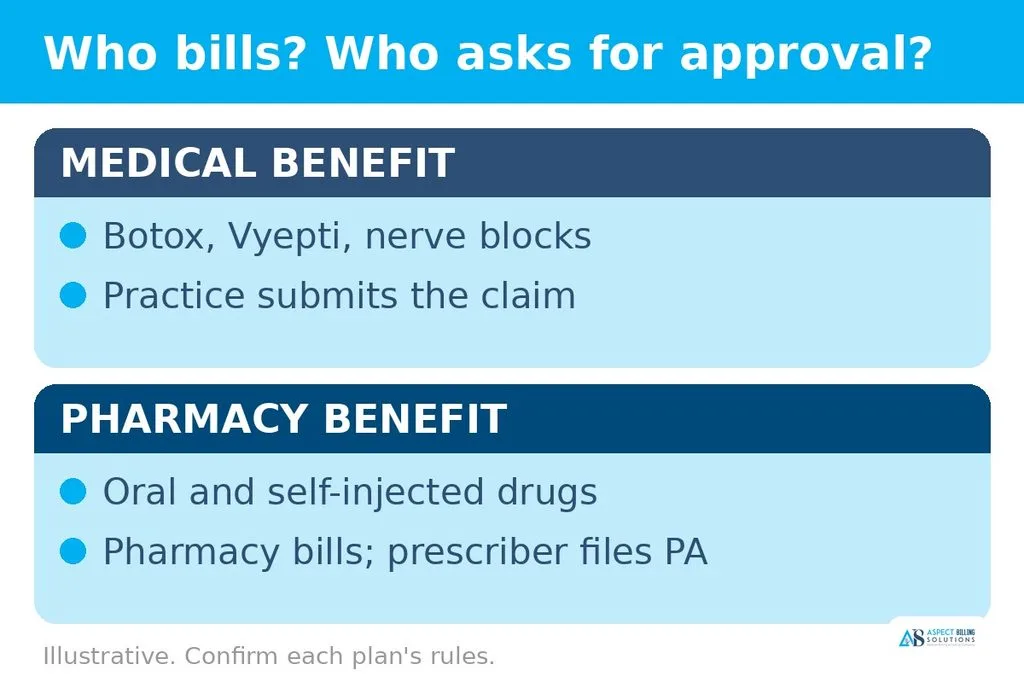
The first billing question is not the code. It is the benefit. Medical benefit services, such as Botox, infusions, and nerve blocks, are billed by the practice on a claim. Pharmacy benefit drugs, including many oral medicines and self-injected CGRP antibodies, are billed by the dispensing pharmacy. For those drugs, your job is the prior authorization request, not the claim. CMS’s prior authorization rule sets 7-day and 72-hour decision windows for Medicare Advantage, Medicaid, and some exchange plans [A]. It excludes drugs, original Medicare, and many employer plans.
Illustrative comparison of benefit channels
| Therapy | Usual Benefit | Practice Bills? | Prior Auth Typically |
| Oral acute or preventive drugs | Pharmacy | No | Commonly, with step therapy |
| Self-injected CGRP antibodies | Pharmacy | No | Commonly yes |
| Botox (64615 + J0585) | Medical | Yes | Commonly yes |
| Vyepti infusion (J3032) | Medical | Yes | Varies by payer |
| Nerve blocks (64405, 64450) | Medical | Yes | Varies; some plans limit coverage |
Illustrative comparison, not from one named source. Some plans route injectables through specialty pharmacy, so verify each contract. CMS requires prior authorization for hospital outpatient 64615 with J0585.
How to Check the Channel Before Prescribing?
- Look the drug up in the member’s formulary or medical policy.
- Ask provider services whether it falls under the pharmacy or medical benefit, and log the call reference.
- Confirm authorization criteria and any specialty pharmacy requirement.
Coding the Visit and the Treatment
Once the channel is clear, code each service separately. Botox uses CPT 64615 once per session plus J0585 per unit; see [INTERNAL LINK: Botox injection billing for neurology (CPT 64615, J0585)]. Vyepti bills J3032 per milligram plus an infusion administration code. Occipital blocks use 64405 for the greater occipital nerve, 64450 for other peripheral nerves, and 64400 for trigeminal branches. Bilateral block reporting varies by payer. Our nerve block CPT guide and neurology CPT codes guide add detail.
Worked Examples: Timing and Labor
Example 1: Earliest safe booking date
Formula: booking date = submission date + decision window + buffer days. Submit March 2, allow 7 days, and add a 3-day buffer: March 12. Plans outside the rule often take longer.
Building an Approval-Ready Authorization Packet
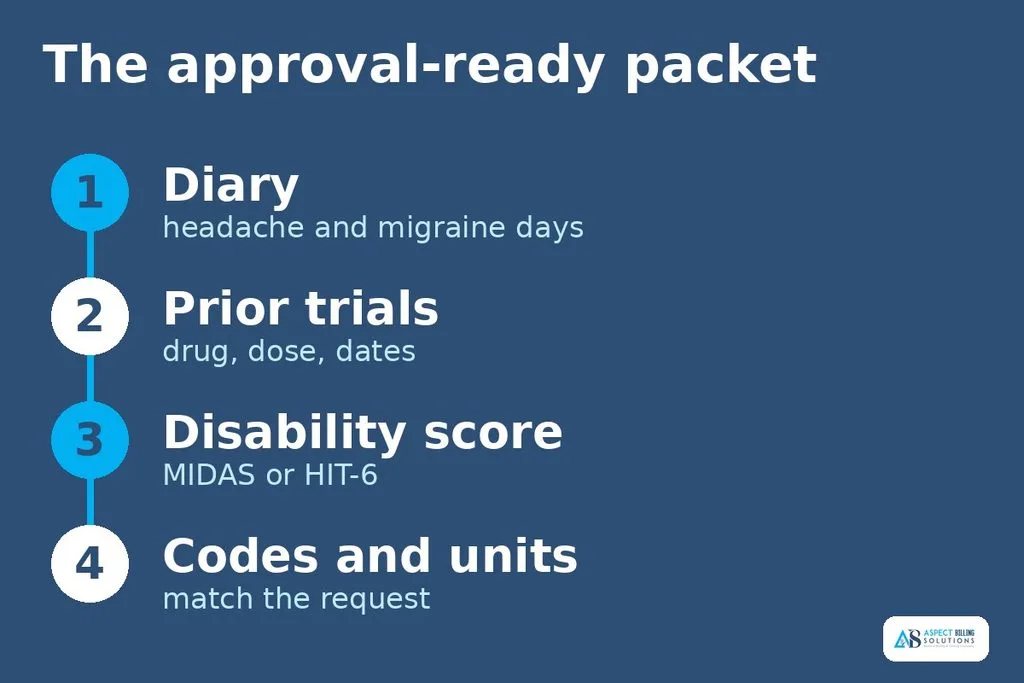
The AMA physician survey reports that 95% of physicians see care delays from prior authorization [S]. Reviewers usually want the same core evidence, shown in the graphic below. Start with headache and migraine days from a diary covering about three months. Add prior preventive trials with drug, dose, dates, and reason stopped. Then attach a disability score and the exact codes requested. Our prior authorization services show how a dedicated team can own this workload.
Renewals need proof of benefit. For Botox, many payers commonly ask for roughly a 50% cut in headache days [C]. Use one template for baseline and follow-up scores.
Example 2: Yearly cost of authorization labor
Formula: annual cost = weekly hours × hourly cost × 52. Using the AMA average of 13 hours [S] and an illustrative $28 hourly cost [D], 13 × $28 = $364 weekly, or $18,928 yearly.
Denials, Appeals, and the Blended Average Trap
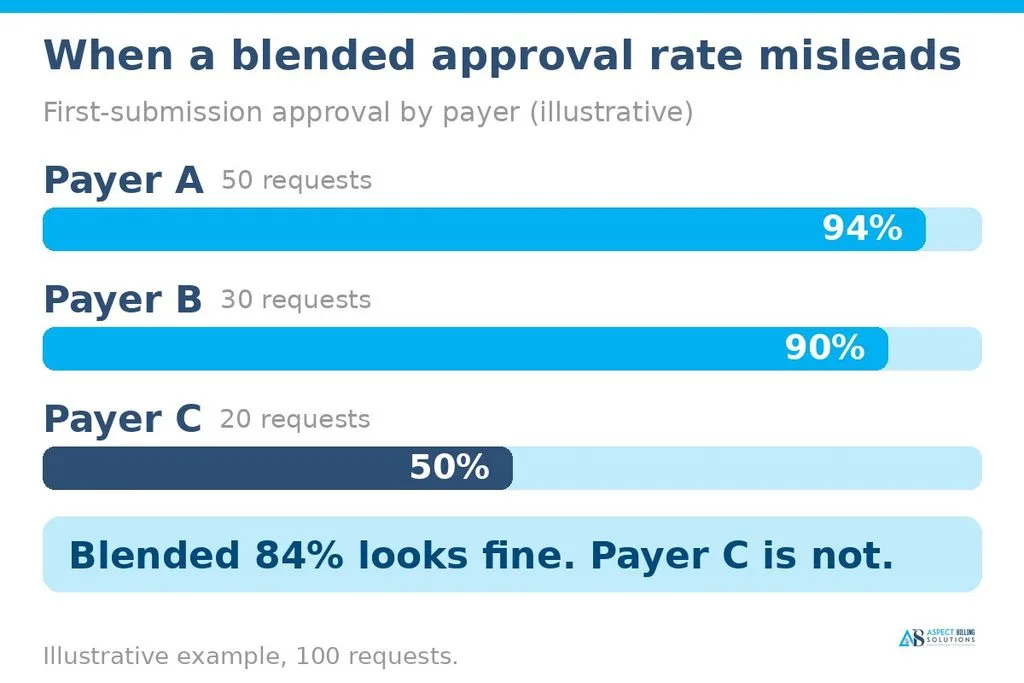
Most migraine denials trace to authorization or documentation gaps. A solid denial management workflow sorts each denial by cause and payer. Our appeals guide outlines the steps. Watch payer-level results rather than totals, because blended rates hide failing plans.
Table 3. Common denial patterns (triggers are commonly reported)
| Reason (CARC) | Typical Trigger | Practical Fix |
| CO-197: authorization absent | Service date outside approved dates | Verify dates at scheduling |
| CO-50: not medically necessary | Criteria evidence missing | Use the packet checklist |
| CO-11: diagnosis mismatch | Diagnosis does not fit the code | Add a scrubber pairing rule |
Example 3: Denial rate
Formula: denial rate = authorization-related denials ÷ claims submitted × 100. Nine such denials on 150 claims gives 9 ÷ 150 × 100 = 6%, above the illustrative 5% goal.
The Blended Average Trap
Illustrative scenario (not an actual client record): a practice files 100 authorization requests. Payer A approves 47 of 50 (94%). B approves 27 of 30 (90%). Payer C approves 10 of 20 (50%). Overall, 84 ÷ 100 gives 84%, which looks respectable. Yet half of Payer C’s requests fail, and only a payer-level view shows it.
When a Payer Disagrees?
Migraine denials often cite step therapy or missing criteria. Ask for the specific reason in writing. CMS-0057-F requires specific denial reasons for Medicare Advantage, Medicaid, and federal-exchange plans, but only on non-drug requests [A]. Then request the written criteria and answer point by point: diary days, preventives that failed or were contraindicated with doses and dates, and disability scores. Ask for a peer-to-peer with a neurologist reviewer. In the AMA survey, only 16% of participating physicians said plan reviewers were often or always appropriately qualified [S]. Calendar the appeal deadline from the denial letter.
Comparing Like With Like
A benchmark helps only when compared fairly. Match payer mix, benefit channel, therapy mix, and reporting period first. One missed target is a signal to investigate, not a verdict.
What to Expect From a Fix?
Table 4. General planning ranges (not a guarantee for any practice)
| Fix | Early Signs | Fuller Results |
| Authorization log with expiry alerts | 2-4 weeks | 2-3 months |
| Standard packet template | 4-8 weeks | 3-4 months |
| Payer-level denial review | 60-90 days | 4-6 months |
The Short Version
- Identify the benefit channel first; pharmacy drugs need a request, not a claim.
- Book injections after the payer window plus a buffer; 3-6 weeks is a commonly reported range.
- Track denials by payer; under 5% is an illustrative goal [D].
Ten-Minute Process Audit
Migraine and headache treatment billing and prior authorization–Before the visit
- Do you know which benefit each therapy uses? (Yes / No)
- Do notes record headache and migraine days over three months? (Yes / No)
- Are prior preventive trials documented with dose and dates? (Yes / No)
- Do you confirm authorization dates before every service? (Yes / No)
At the visit
- Do claim units match the documented dose? (Yes / No)
- Do you code nerve blocks by the specific nerve treated? (Yes / No)
After the claim
- Do you track decisions against payer deadlines? (Yes / No)
- Do you review denials by payer monthly? (Yes / No)
- Is your authorization-related denial rate under about 5%? (Yes / No)
Scoring guide: 8-9 yes answers suggest a strong process. 5-7 point to gaps worth fixing this quarter. 4 or fewer means a full workflow review is due.
When the Front Desk Needs Reinforcements?
- The same payer keeps denying or delaying requests.
- Approvals expire before injection or infusion dates.
For migraine care, look for support that tracks which drugs sit under the pharmacy or medical benefit, keeps the diary and prior-trial packet current, and watches authorization expiry against injection and infusion dates. Aspect Billing Solutions is one example of this structure. It provides HIPAA-compliant US medical billing and coding (ICD-10, CPT, HCPCS). Services include claim and denial management, eligibility verification, prior authorization, accounts receivable, and credentialing. Each provider gets a dedicated agent, so one person learns your payers’ criteria. Fit and results vary by practice. See its revenue cycle management service for details.
Final Considerations
Migraine billing rewards sorting before coding. Decide the benefit channel, assemble the packet, confirm dates, and review results by payer.
Firm published standards [A] include the IHS headache definitions, the labeled Botox dose, code descriptors, and CMS decision windows for in-scope payers. The 5% denial goal, $28 hourly cost, lead times, step-therapy counts, and timeframes are practical or illustrative targets [C][D].
Frequently Asked Questions
Migraine and headache treatment billing and prior authorization
Does Botox for migraine need prior authorization?
Commonly yes for commercial and Medicare Advantage plans, and in hospital outpatient settings under CMS rules.
Does the practice bill for CGRP drugs?
Usually not for pharmacy-benefit drugs. The pharmacy bills, and the practice submits the authorization request.
Which code reports an occipital nerve block?
CPT 64405 reports the greater occipital nerve. Use 64450 for other peripheral nerves and 64400 for trigeminal branches.
How is Vyepti billed?
Report J3032 per milligram plus an infusion administration code.
What is a good prior authorization approval rate?
An illustrative goal is about 90% on first submission, tracked by payer.
What is a good turnaround time for migraine prior authorization?
In-scope payers must decide standard requests within 7 days, but drugs are excluded. Plan 3-6 weeks for injectables.
What is a good documentation standard for migraine approvals?
About three months of headache days, prior therapies, and a disability score, updated each cycle.
Can an office visit be billed on injection day?
Only when separately identifiable, using modifier 25.
Where These Figures Come From?
- (a) Published standards [A]: IHS definitions as cited in a Cigna policy; FDA-approved BOTOX label; CMS-0057-F fact sheet; CMS hospital outpatient FAQ; CPT and HCPCS descriptors; X12 reason codes.
- (b) Named benchmarking data providers: none used.
- (c) Commonly reported or illustrative [C][D]: step-therapy counts, lead times, 5% and 90% goals, the $28 cost, and timeframes, from industry guides.
- (d) Survey data [S]: AMA physician prior authorization survey (2025), for the 95% and 13-hour figures.
Results vary by practice. Figures reflect information available at research time (September 2026); confirm current payer policies.