
Economical Neurology Billing Outsourcing in Florida
Economical neurology billing outsourcing in Florida means paying a fair, transparent rate — commonly 4% to 10% of collections — for a partner whose collection rate and denial management more than offset the fee. The lowest percentage on paper is not always the cheapest option once denied claims, write-offs, and in-house overhead are counted. A genuinely economical partner is judged on net revenue after fees, not the fee alone.
economical neurology billing outsourcing in Florida, comparing prices for neurology billing in Florida usually starts and ends with one number: the percentage fee. That number tells only part of the story. A lower fee from a vendor with a higher denial rate can cost a practice more in lost revenue than a slightly higher fee. From a partner that actually collects what is owed. This guide breaks down what neurology billing really costs in Florida — in-house and outsourced. Walks through the math with worked examples, and ends with a self-assessment. Checklist so you can score your current setup against the same numbers.
Florida Neurology Billing: Cost & Performance at a Glance
| Metric | Practical Range | Review Frequency | Primary Source |
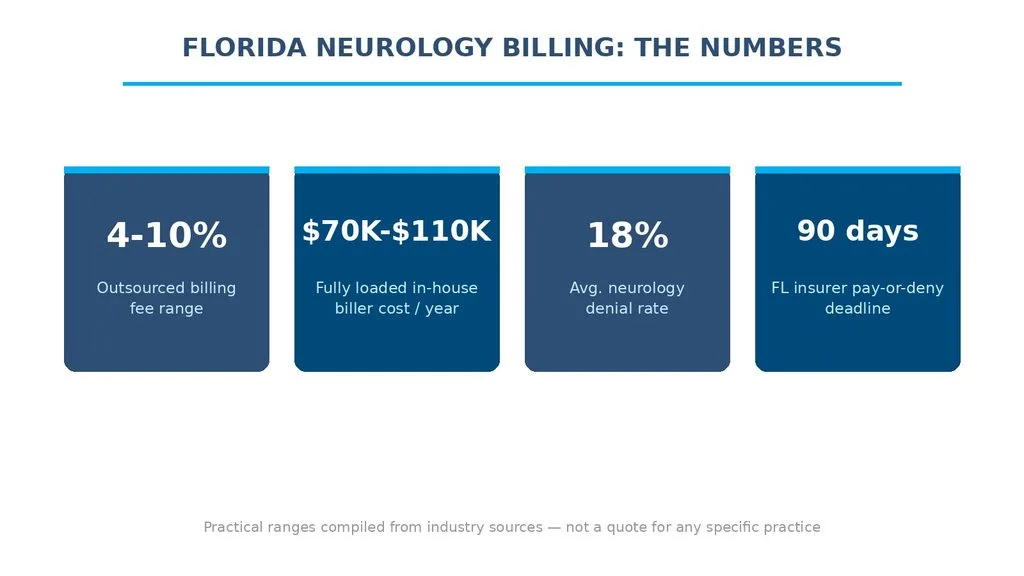
| Outsourced billing fee | Commonly 4%-10% of collections; often 6%-8% for neurology specifically | At contract review | Commonly reported across industry billing-cost comparisons |
| Fully loaded in-house biller cost | Roughly $70,000-$110,000/year per biller (salary, benefits, software, turnover) | Annually | U.S. Bureau of Labor Statistics wage data + commonly reported overhead ranges |
| Outsourced vs. in-house collection rate | Outsourced commonly 93%-97%; in-house commonly 85%-90% | Monthly | Commonly reported across industry cost-comparison analyses |
| Neurology-specific denial rate | ~18% commonly reported average, vs. 5%-10% for other specialties | Monthly | MGMA benchmarking (commonly reported) |
| Clean claim rate | 95%-98% target; 98%+ best-in-class | Monthly | MGMA / HFMA |
| Florida electronic claim deadline | Insurer must pay, deny, or contest within 20 days; resolve within 90 days | Statutory, not a KPI | Florida Statutes §627.6131 / §641.3155 (Florida DFS) |
Source key: “MGMA / HFMA” = a published benchmarking figure from that named association. “Commonly reported” = a figure repeated consistently across multiple industry cost-comparison publications rather than one named body’s official standard. Florida statutory deadlines are legal requirements, not performance targets to hit or miss.
Why “Economical” Doesn’t Mean Cheapest?
The billing fee is the number every quote leads with, but it is not the number that determines your total cost of billing. A vendor charging 4% with a high denial rate can leave more money on the table than a vendor charging 7% with strong collections. The real comparison is what lands in the bank after fees, denials, and write-offs — not the percentage printed on the contract.
What In-House Neurology Billing Actually Costs?
Formula: Fully Loaded In-House Cost = Base Salary + Benefits & Payroll Taxes (roughly 25%-35%) + Software & Clearinghouse Fees + Training + Amortized Turnover Cost.
Worked example: a Florida solo neurology practice pays a biller $58,000 in base salary. Benefits and payroll taxes at 30% add $17,400. Billing software and clearinghouse fees run $9,600 a year, training adds $3,500, and an amortized share of turnover risk adds roughly $8,000. Total: about $96,500 a year for one biller — before that person has processed a single neurology-specific EEG or EMG claim.
What Outsourced Neurology Billing Costs in Florida?
Most billing companies price outsourced neurology billing one of three ways: a percentage of collections (commonly 4%-10%, often 6%-8% for neurology given its coding complexity), a per-claim fee ($4-$10 per claim, higher for EEG- and EMG-heavy practices), or a flat monthly fee ($1,500-$8,000, depending on practice size). A practice collecting $600,000 a year at a 7% fee pays about $42,000 annually — well under the $96,500 in-house figure above, though the comparison is only fair once collection-rate differences are factored in.
A fuller line-by-line breakdown of these numbers is available in the true cost of medical billing: in-house vs. outsourcing.
The Math Behind the Price Tag
Formula: Net Revenue After Billing = (Gross Charges × Collection Rate) − Billing Cost.
Worked example: a practice with $600,000 in gross charges compares two vendors. Vendor A charges a 4% fee but, based on a commonly cited industry collection-rate range for less specialized billing operations, collects around 86% of charges: $600,000 × 0.86 = $516,000, minus a $24,000 fee, nets $492,000. Vendor B charges 7% but collects closer to 95%, a range commonly cited for specialized, denial-focused billing: $600,000 × 0.95 = $570,000, minus a $42,000 fee, nets $528,000 — $36,000 more than the “cheaper” option, despite the higher fee.
These collection-rate figures are commonly cited in industry cost-comparison analyses rather than pulled from a single named study, and actual rates vary by practice, payer mix, and specialty. The math itself, however, applies regardless of the exact percentages: the fee is only one side of the equation.
Why the Lowest Percentage Isn’t Always the Cheapest Option?
The table below illustrates how fee percentage and collection rate combine to determine what actually lands in a practice’s account.
Illustrative — not pulled from a single named data source or a specific vendor. Actual figures vary; verify against quotes and reported performance for your own practice.
| Vendor Profile | Fee | Illustrative Collection Rate | Illustrative Net on $600K |
| Lowest-fee vendor | 4% | 86% | $492,000 |
| Mid-tier vendor | 7% | 95% | $528,000 |
| Premium vendor | 9% | 97% | $528,000 |
In this illustration, the premium vendor’s higher collection rate does not translate into more net revenue than the mid-tier vendor once its higher fee is subtracted — a reminder that neither the lowest fee nor the highest fee is automatically the most economical choice. The only way to know is to run the math on your own numbers.
Florida-Specific Factors That Affect Your Billing Costs
Florida’s Claim Payment Deadlines
Under Florida Statutes §627.6131 and §641.3155, a health insurer or HMO must acknowledge an electronically filed claim within 24 hours, pay it or notify the provider of denial or contest within 20 days, and pay or deny the claim within 90 days of receipt — failure to do so within 120 days creates an uncontestable obligation to pay. Non-electronic claims follow a slower timeline: acknowledgment within 15 days and payment or denial within 120 days. Overdue payments accrue 12% annual interest. These deadlines only help a practice that has already submitted a clean, complete claim.
Florida Medicaid’s Statewide Medicaid Managed Care Program
Florida Medicaid delivers most coverage through the Statewide Medicaid Managed Care (SMMC) program, administered by the Agency for Health Care Administration (AHCA). Neurology services routed through SMMC plans follow each plan’s own prior authorization rules rather than one uniform statewide process, which means authorization tracking has to be organized by plan, not treated as a single Medicaid category.
Regional Cost Variation Within the State
In-house billing costs are not uniform across Florida. Practices in South Florida metro markets — Miami, Fort Lauderdale, West Palm Beach — often face a higher cost of living than the statewide average used in generic national salary comparisons, which pushes in-house biller wages above the baseline figures cited earlier. Practices in smaller markets may see the opposite. This is one more reason a generic national cost comparison undersells or oversells the case for outsourcing depending on where in Florida a practice is located.
What to Actually Look for in an Economical Billing Partner?
Transparent, All-In Pricing
A quote that excludes setup fees, statement fees, or credentialing charges is not actually the price — it is a partial price. Ask what is and is not included before comparing a percentage across vendors.
Neurology-Specific Coding and Denial Management
Neurology denial rates are commonly reported near 18%, roughly double the 5%-10% range across other specialties, largely due to EEG, EMG, and imaging authorization requirements. A vendor without specific neurology experience is more likely to land on the expensive side of that gap, regardless of what its fee percentage looks like on paper.
Credentialing Speed
Slow credentialing is an invisible cost: every week a provider sits outside a payer’s network is a week of claims that cannot be billed at all. A vendor’s fee percentage says nothing about how quickly it gets a new provider credentialed.
For more on where neurology claims commonly go wrong, see neurology billing with proven strategies.
Denial workflow specifics are covered in building an effective denial management workflow.
Credentialing delays and how to avoid them are covered in credentialing mistakes that delay payments.
For applicable codes, see neurology billing CPT codes and neurology billing CPT modifiers.
How Aspect Billing Solutions Approaches “Economical”?
The criteria above only matter if a billing partner actually operates that way. Here is the specific gap Aspect Billing Solutions’ process is built to close at each point:
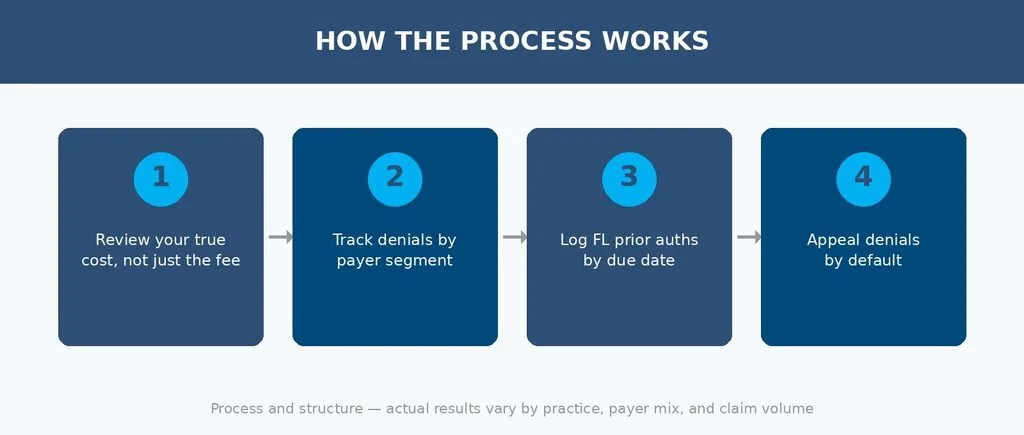
- Most vendors quote one blended percentage before seeing your claim mix. Aspect’s free consultation reviews your actual collections and payer mix first, because the right fee structure depends on your specific volume, not a generic rate card.
- A lower fee that comes with a higher denial rate can cost more than it saves. Aspect tracks denials by payer segment — commercial, Medicaid managed care, Medicare Advantage — so a spike in one segment does not hide inside a comfortable blended average.
- Prior authorization numbers and expiration dates are logged against the scheduled date of service, including for Florida Medicaid managed care plans routed through SMMC.
- Credentialing status is reviewed on a set quarterly cycle rather than only after a claim bounces for an out-of-network denial — closing the invisible cost of a slow credentialing process.
- A dedicated agent is assigned to each provider, covering claim and denial management, eligibility verification, prior authorization, accounts receivable follow-up, and credentialing from one point of contact.
This is a description of process and structure, not a performance guarantee or a promise of the lowest fee in Florida. Actual results and pricing depend on a practice’s claim volume, payer mix, and starting point — which is exactly why the consultation starts with your numbers rather than a generic quote.
Reading These Numbers the Right Way
A fee comparison is only meaningful compared like-for-like: same specialty, a similar claim volume, a comparable payer mix, and services actually included in the quote. Comparing a flat monthly fee for a low-volume solo practice against a percentage-based quote for a five-provider group will mislead more than it informs. A single low fee quote is a starting point for questions, not a decision by itself — ask what collection rate and denial rate the vendor is actually running before comparing it to your in-house numbers.
How Long Before Switching Pays Off?
| Milestone | What to Expect | General Timeframe |
| Transition overlap | Outgoing and incoming billing processes run in parallel so open claims stay tracked | 30-60 days |
| Denial rate improvement | Meaningful drop as authorization and documentation gaps close | 60-90 days |
| Collection rate stabilization | Net revenue gap between old and new setup becomes clearly visible | 90-150 days |
| Full cost comparison | Enough data to confidently compare true net cost against the old setup | 120-180 days |
These are general planning ranges based on commonly reported billing-transition patterns, not a guarantee for any specific practice. A practice with an existing A/R backlog or several open credentialing applications may take longer to see the full financial picture, while a cleaner starting position can show results faster.
Bottom Line for Florida Neurology Practices
- The billing fee percentage is not the total cost — collection rate and denial management usually matter more.
- Fully loaded in-house billing commonly runs $70,000-$110,000 a year per biller, well above the base salary alone.
- Outsourced neurology billing commonly runs 4%-10% of collections, often 6%-8% given coding complexity.
- Florida’s prompt pay statutes (§627.6131 / §641.3155) only help once a claim is clean and properly submitted.
- A lower fee with a higher denial rate can cost more net than a higher fee with strong collections — always run the actual math.
- Expect a 30-60 day transition and a clearer full cost picture within four to six months.
Is Your Current Setup Actually Economical?
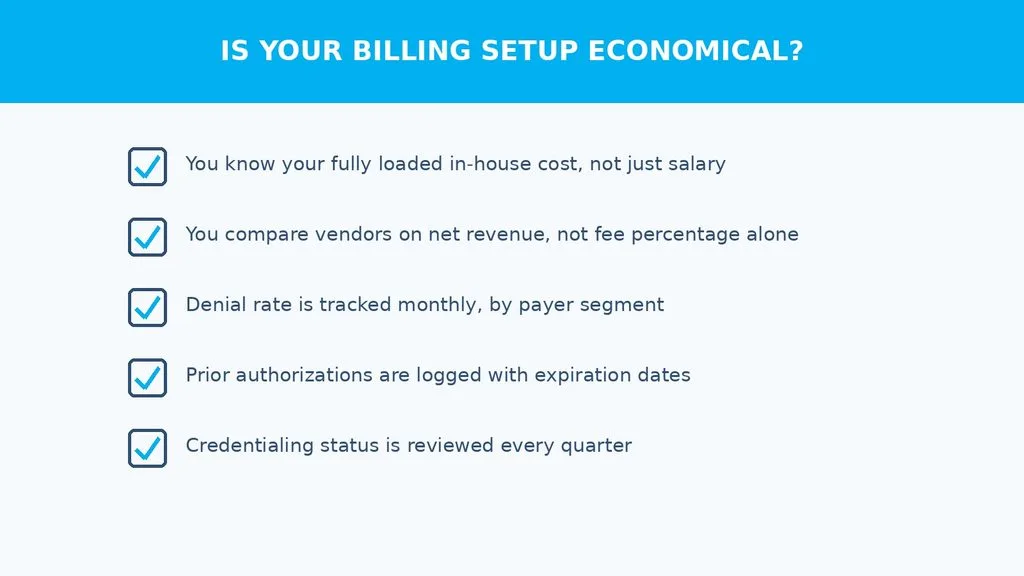
Answer yes or no to each question, then check the scoring guide below.
- 1. Do you know your fully loaded in-house billing cost, not just the biller’s salary?
- 2. Do you compare billing vendors on net revenue after fees, not fee percentage alone?
- 3. Is your denial rate tracked monthly, broken out by payer segment?
- 4. Is your clean claim rate at or above 95%?
- 5. Are prior authorization numbers and expiration dates logged before the date of service?
- 6. Is credentialing status reviewed at least once per quarter for every payer?
- 7. Do you know what services are actually included in your current billing fee?
- 8. Have you calculated what a 5-10 point collection-rate gap would be worth on your own claim volume?
- 9. Do denied claims get appealed by default rather than written off?
- 10. Could you name your current billing setup’s true annual cost off the top of your head?
Scoring: 8-10 “yes” answers suggests you have a clear, accurate picture of your true billing costs. 5-7 suggests some real numbers are missing from the comparison, often the fully loaded in-house cost or the collection-rate gap. 0-4 suggests your current cost comparison is likely based on incomplete numbers, and a fuller review is worth prioritizing.
When Outsourcing Starts to Make Financial Sense?
A few signals tend to show up together when in-house billing has become the more expensive option, even if it doesn’t look that way on paper:
- Denial rate has stayed above 10% for more than one reporting quarter.
- Billing staff turnover keeps resetting institutional knowledge of payer-specific rules.
- Nobody has calculated the fully loaded cost of the in-house billing role, only the salary.
- Credentialing applications regularly slip past their target completion date.
- Reporting shows one blended collection number rather than a breakdown by payer or CPT code.
When those signals appear together, the in-house option is usually costing more than its line-item salary suggests — the gap just doesn’t show up until someone runs the full comparison described earlier in this guide.
Illustrative scenario (not an actual client record):
using the $600,000 collections example from earlier in this guide, closing a 9-percentage-point collection-rate gap — from 86% up to 95% — is worth roughly $54,000 a year before fees are even subtracted. Even after a 7% fee ($42,000), that leaves a net improvement in the range of $12,000 to $36,000 depending on the starting fee, on top of whatever the in-house role itself was costing. This is hypothetical math to illustrate scale, not a projection for any specific practice’s results.
Aspect Billing Solutions provides HIPAA-compliant medical billing and coding for US healthcare providers. Including Florida neurology practices, covering claim and denial management, eligibility verification, prior authorization, accounts receivable follow-up, and credentialing. The company offers a free, no-commitment consultation that reviews your actual collections, fee structure, and denial rate before any quote is given. If your current setup has never had that full comparison run against it, that consultation is the fastest way to find out what you are actually paying.
Learn more at aspectbillingsolutions.com.

Final Considerations
Economical neurology billing in Florida is not about finding the lowest percentage — it’s about finding the partner whose total cost, fee plus missed collections, is actually the lowest for your specific practice. The fee is easy to compare. The collection rate and denial management behind it take more digging, but they matter more.
A few numbers in this guide are firm, published figures: MGMA and HFMA’s benchmark ranges for denial rate and clean claim rate, U.S. Bureau of Labor Statistics wage data, and Florida Statutes §627.6131 and §641.3155’s claim payment deadlines. Others, like the vendor-comparison table and the collection-rate figures, are illustrative or commonly reported industry ranges rather than a specific claim about any vendor’s actual performance. Keep that distinction in mind when comparing your own numbers against anything in this guide.
Whichever path a Florida neurology practice takes, running the full math — fee, collection rate, and denial rate together — before signing anything is the single habit most likely to reveal what “economical” actually means for that practice.
Frequently Asked Questions
Economical neurology billing outsourcing in Florida
What is a good percentage to pay for outsourced neurology billing?
A range of 4% to 10% of collections is commonly cited industry-wide, with neurology specifically often landing at 6% to 8% given its coding complexity. The right number for your practice depends more on what collection rate and denial management come with that fee than on the percentage alone.
Is outsourcing neurology billing cheaper than hiring in-house staff in Florida?
Often, yes, once the fully loaded cost of an in-house biller — salary, benefits, software, training, and turnover — is counted rather than just the salary line. A fully loaded in-house biller commonly runs $70,000 to $110,000 a year, compared with 4% to 10% of collections for outsourced billing, though the comparison depends on your specific claim volume.
What is a good denial rate for a neurology practice?
A denial rate under 10% is a commonly cited practical target, with top-quartile practices reporting under 5%, per MGMA and HFMA benchmarking. Neurology practices often run higher than this due to EEG, EMG, and imaging authorization requirements.
What is a good clean claim rate for a small practice?
A clean claim rate of 95% or higher is the commonly cited target, with best-in-class practices reaching 98% or above. A rate meaningfully below 90% usually points to front-end issues like eligibility verification or coding accuracy, regardless of practice size.
How does Florida’s prompt pay law affect how fast I get paid?
Under Florida Statutes §627.6131 and §641.3155, insurers must acknowledge electronic claims within 24 hours and pay, deny, or contest them within 20 days, with a full resolution deadline of 90 days. That protection only helps once a claim is clean and complete — it does not speed up a claim that gets denied for a documentation or authorization gap.
Does Florida Medicaid require prior authorization for neurology services?
Florida Medicaid delivers most coverage through the Statewide Medicaid Managed Care (SMMC) program, and prior authorization requirements for neurology services vary by the specific managed care plan rather than following one uniform statewide rule. Checking each plan’s own authorization list is necessary rather than assuming a single Medicaid standard applies.
What’s included in a typical neurology billing outsourcing fee?
Coverage varies by vendor, but commonly includes claim submission, denial follow-up, and payment posting at minimum; eligibility verification, prior authorization, and credentialing are sometimes bundled and sometimes billed separately. Always ask for a written breakdown of what is and is not included before comparing a quoted percentage across vendors.
How long does it take to see savings after switching to outsourced billing?
A transition typically overlaps old and new billing processes for 30 to 60 days, with a clearer full financial picture emerging over four to six months as denial rates and collection rates stabilize under the new setup.
Should a solo Florida neurology practice outsource billing?
The decision usually comes down to claim volume and the true cost of maintaining dedicated in-house billing staff for that volume. Practices without the claim volume to justify a full-time, benefits-eligible biller often find outsourcing costs less than the fully loaded cost of that role.
Are per-claim fees or percentage-based fees better for neurology practices?
Per-claim fees ($4-$10 per claim, commonly higher for EEG- and EMG-heavy practices) can work well for practices with predictable, high claim volumes, while percentage-based fees (4%-10%) align the vendor’s incentives with collections. Which is more economical depends on your average claim value and volume — running both models against your actual numbers is the only reliable way to tell.
Sources & Methodology
(a) Published standards and definitions: Florida Statutes §627.6131 and §641.3155 (Florida Department of Financial Services), which set claim acknowledgment, payment, and denial deadlines for health insurers and HMOs; MGMA and HFMA definitions of denial rate and clean claim rate; U.S. Bureau of Labor Statistics wage data for medical billing specialists.
(b) Named benchmarking data providers: MGMA Cost and Revenue Report benchmarking figures and HFMA’s MAP Keys benchmarking framework, as cited across industry revenue-cycle publications.
(c) Practical and illustrative targets: The vendor-comparison table, the in-house cost worked example, and the collection-rate figures used throughout this article are illustrative, compiled from patterns commonly reported across multiple industry billing-cost comparison publications rather than pulled from one named data source. Actual figures vary by practice and vendor, and should be verified directly.
(d) Survey data: No additional named survey data was used beyond the sources listed above.
Actual results and costs vary by practice, claim volume, payer mix, and vendor. Figures in this article reflect information available at the time of research (September 2026) and are not a guarantee or quote for any specific practice.