
Professional Neurology Billing Specialists in Pennsylvania
A professional neurology billing specialist is one whose expertise can actually be verified: coders and billers holding recognized credentials (CPC, CPB, or CPMA from AAPC), a tracked coding accuracy rate broken out by procedure type rather than one blended number, and a documented process for Pennsylvania-specific requirements — HealthChoices’ five-zone Medicaid structure, the state’s clean-claim payment deadline, and Medicare Jurisdiction L. “Professional” should be a checklist, not an adjective.
Professional neurology billing specialists in Pennsylvania-Almost every billing company’s website calls itself “professional.” The word is nearly meaningless as a search term because nothing forces a company to prove it. This guide treats “professional” as something specific and checkable: real credentials, a coding accuracy rate tracked by procedure type, and demonstrated fluency in Pennsylvania’s regulatory landscape — not a marketing adjective. It walks through what to verify, covers the state-specific factors a professional partner has to track, and ends with a self-assessment checklist so you can score your current billing setup against the same standard.
Professional-Grade Neurology Billing: the Baseline
What “Professional-Grade” Should Look Like, in Numbers?
| Metric | Practical Range | Review Frequency | Primary Source |
| Coding accuracy rate | 95% minimum; top performers 97%-98%+ | Monthly, by procedure type | AAPC accuracy benchmark |
| First-pass / clean claim rate | 95%-98% target; 98%+ best-in-class | Monthly | HFMA (MAP Keys) / MGMA DataDive |
| Neurology-specific denial rate | ~18% average reported, vs. 5%-10% for other specialties | Monthly | Attributed to MGMA benchmarking by industry publications* |
| Coding-error revenue leakage | Commonly reported at 3%-5% of net revenue annually | Annually | Attributed to MGMA by multiple industry publications* |
| Pennsylvania clean-claim payment deadline | Insurer must pay within 45 days of a clean claim (30 days for participating providers per contract) | Statutory, not a KPI | 40 P.S. §991.2166 / 31 Pa. Code §154.18 |
Source key: “AAPC” and “HFMA / MGMA” = a published benchmarking figure directly attributable to that named body. “*Attributed by industry publications” = secondary sources name MGMA as the origin, but this guide has not independently located and confirmed the primary MGMA report and table for these two rows; treat them as reported estimates. Pennsylvania’s deadline is a legal requirement, not a performance target, and may not apply to self-funded employer plans governed by federal ERISA law rather than state insurance law.
What “Professional” Should Actually Mean?
Anyone can put the word “professional” in a headline. What separates a genuinely professional billing partner from a marketing claim is whether its expertise can be checked against something external — a credential, a tracked number, a documented process — rather than taken on faith.
Credentials That Actually Signal Expertise
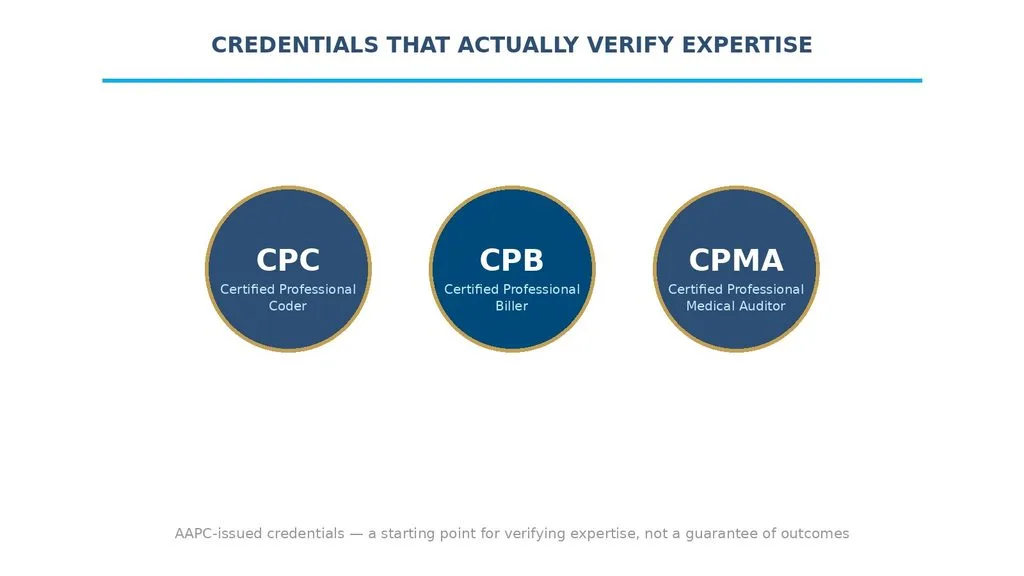
AAPC, the leading U.S. medical coding and billing certification body, issues several credentials worth asking about directly: CPC (Certified Professional Coder) validates CPT, ICD-10-CM, and HCPCS coding proficiency; CPB (Certified Professional Biller) focuses on the billing and claims side of the cycle; and CPMA (Certified Professional Medical Auditor) certifies the ability to audit coding and documentation for compliance and revenue leakage. None of these credentials guarantee outcomes, but they are independently verifiable — a legitimate biller can produce a credential number you can check, where a vague claim of “years of experience” cannot be checked at all.
Why Neurology Specifically Raises the Bar?
Neurology coding is more failure-prone than most specialties because a single encounter often combines several distinct services: a high-complexity E/M visit, EEG interpretation, and electrodiagnostic testing (EMG and nerve conduction studies), each governed by its own CPT family and its own National Correct Coding Initiative (NCCI) bundling rules. NCCI edits — which determine whether two procedure codes can be billed together, and which modifier is required if so — are updated quarterly by CMS, so a coder’s knowledge has to stay current rather than static. A generalist biller handling neurology as one specialty among many is more exposed to this complexity than one who tracks it specifically.
Why One Accuracy Number Can Hide a Weak Spot?
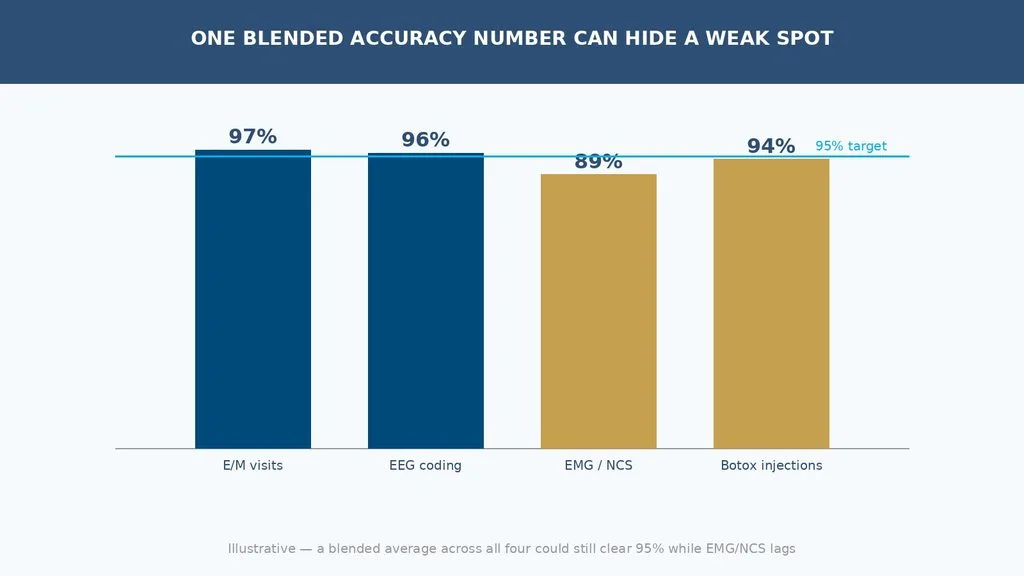
A practice can report a blended coding accuracy rate above the 95% AAPC benchmark while one specific procedure category quietly drags down revenue. Because EMG and NCS billing carries the heaviest NCCI bundling risk in neurology, it is the category most likely to sit meaningfully below the overall average — and a single blended number won’t show you that.
Accuracy by Procedure Category — an Illustrative Comparison
| Procedure Category | Illustrative Coding Accuracy | vs. 95% Target |
| E/M visits | 97% | Above target |
| EEG coding | 96% | Above target |
| EMG / NCS | 89% | Below target |
| Botox injections (chronic migraine) | 94% | Below target |
Illustrative — not pulled from a single named data source or a specific practice. Actual figures vary by practice, payer mix, and coder; verify against your own accuracy audit.
In this illustration, the blended average across all four categories would still land above 95%, masking a real problem in EMG/NCS coding specifically. A professional billing partner reports accuracy broken out by procedure type for exactly this reason — a passing overall grade can hide a failing one underneath it.
The Math Behind Professional-Grade Billing
Coding-Error Revenue Leakage
Formula: Estimated Annual Leakage ≈ Net Revenue × Coding Error Rate (commonly cited at 3%-5%, attributed to MGMA by multiple industry sources).
Worked example: a Pennsylvania neurology practice with $2.4 million in annual net revenue, at the midpoint 4% commonly cited rate, is looking at roughly $96,000 a year in coding-error-driven leakage — denials, underpayments, and write-offs traceable to coding rather than payer behavior. Closing even half that gap through verified-credential coding and procedure-level accuracy tracking is a five-figure annual difference for a practice this size.
NCCI Bundling and Modifier 59
EMG and NCS performed at the same encounter are frequently billed together, but whether a modifier is required depends on the current NCCI edit status for those specific code pairs, which CMS updates quarterly — the same pair of codes can require modifier 59 (or its more specific successor, XU or XS) in one quarter’s edit table and not the next. Modifier 59 must be supported by documentation showing each service was separately, medically necessary and distinctly performed; applying it as a default rather than a documented exception is itself an audit trigger.
Worked example: a practice bills a complete needle EMG alongside a 9-nerve NCS panel for a suspected peripheral neuropathy workup. If the current NCCI edit bundles that pair and modifier 59 is omitted, the claim is likely to deny or pay for only one service. A coder who checks the live edit table — rather than assuming last quarter’s rule still applies — is the difference between one clean claim and a denial requiring rework.
Pennsylvania’s Prompt-Pay Cash Flow Impact
Formula: Cash Flow Exposure ≈ Average Weekly Charges × (Payment Deadline in Weeks).
Worked example: a practice billing $40,000 a week in neurology claims, paid on Pennsylvania’s standard 45-day clean-claim deadline, is carrying roughly $257,000 in claims outstanding at any given time under that statutory window alone (45 days ≈ 6.4 weeks × $40,000). A biller who negotiates or qualifies for the 30-day participating-provider deadline instead cuts that outstanding balance by nearly a third — a real, calculable cash-flow difference, not just a compliance detail.
Pennsylvania-Specific Factors a Professional Partner Tracks
The 45-Day (or 30-Day) Clean-Claim Deadline
Under 40 P.S. §991.2166 and 31 Pa. Code §154.18, a licensed insurer or managed care plan must pay a clean claim within 45 days of receipt — reduced to 30 days for providers who have signed a participation agreement with that payer. Medical Assistance (MA) and CHIP managed care plans follow the same 45-day standard. The distinction between the 45-day and 30-day deadlines depends entirely on whether a provider is in-network with that specific payer, which makes credentialing status directly relevant to cash flow, not just network access.
HealthChoices’ Five Zones
Pennsylvania delivers Medicaid managed care through HealthChoices, organized into five geographic zones — Southeast, Southwest, Lehigh/Capital, Northeast, and Northwest — each with its own roster of participating managed care organizations. A plan operating in the Southeast zone (Philadelphia and its suburbs) is not necessarily available in the Northwest zone (Erie and the surrounding counties), so which MCOs a neurology practice needs to credential with depends on where in Pennsylvania its patients live, not a single statewide list. Plan rosters shift periodically; the current list should be verified against Pennsylvania’s Department of Human Services directly rather than assumed static.
Medicare Jurisdiction L: Novitas Solutions
Novitas Solutions is the Medicare Administrative Contractor for Jurisdiction L, which covers Pennsylvania alongside Delaware, Maryland, New Jersey, and the District of Columbia, under a contract most recently re-awarded in 2021. A professional partner tracks Novitas-specific Local Coverage Determinations and claim edits separately from commercial and HealthChoices workflows, since Medicare rules for neurology diagnostic testing don’t always mirror commercial payer policy.
What to Actually Verify in a Billing Partner?
Ask for Credential Numbers, Not Just Claims
A legitimate CPC, CPB, or CPMA holder can provide a credential ID that can be checked. “Certified staff” without a specific credential named is not yet verifiable.
Ask How Accuracy Is Tracked
A partner that only reports one blended accuracy number across all procedure types cannot show you where the risk actually concentrates. Ask specifically how EMG/NCS and Botox injection coding are audited relative to routine E/M coding.
Ask About Zone- and Payer-Specific Process
A partner unfamiliar with HealthChoices’ zone structure, or unable to name Novitas Solutions as the Medicare contractor, likely has not billed for Pennsylvania neurology practices at meaningful volume.
For the coding side of this in more depth, see neurology billing CPT codes and neurology billing CPT modifiers.
A deeper look at coding accuracy specifically is covered in accurate neurology billing strategies.
For what a compliance audit actually checks, see the ultimate guide to medical billing compliance audits.
Credentialing delays specifically are covered in credentialing mistakes that delay payments.
How Aspect Billing Solutions Approaches “Professional-Grade”?
The criteria above only matter if a billing partner actually operates that way. Aspect Billing Solutions’ process is built around a few specific, checkable commitments:
- A dedicated agent per provider, credentialed and trained specifically on neurology coding rather than rotated across unrelated specialties.
- Coding accuracy tracked by procedure category — E/M, EEG, EMG/NCS, and injection codes reviewed separately, not folded into one blended number.
- HealthChoices zone and Novitas Jurisdiction L requirements tracked as distinct, Pennsylvania-specific workflows rather than generic Medicaid/Medicare handling.
- Current NCCI edit tables checked before EMG/NCS claims go out, rather than relying on a modifier rule that may have changed in the latest quarterly update.
This describes process and structure, not a performance guarantee — actual results depend on a practice’s starting point, payer mix, and claim volume. A free consultation starts with a look at your own coding accuracy and payer mix rather than a general promise.
Using These Numbers Correctly
A coding accuracy or denial-rate benchmark is only meaningful compared like-for-like: similar procedure mix, comparable payer blend, and the same reporting period. A single missed benchmark in one month is a signal to investigate, not a verdict on the whole billing relationship — but a benchmark that’s consistently missed on the same procedure category, month after month, points to a real gap rather than noise.
How Long Improvement Typically Takes?
General Timeline to Professional-Grade Billing
| Milestone | What to Expect | General Timeframe |
| Credential and process verification | Confirm coder credentials, current NCCI edit tables in use, and PA-specific workflows | 1-2 weeks |
| Procedure-level accuracy baseline | First audit establishes accuracy by procedure category, not just overall | 30-45 days |
| Denial rate improvement | Measurable drop as documentation and modifier gaps close | 60-90 days |
| Full performance picture | Enough data across procedure categories to confirm the gap is closed, not just improved once | 120-180 days |
These are general planning ranges based on commonly reported billing-transition patterns, not a guarantee for any specific practice. A practice with an existing credentialing backlog or unresolved NCCI-related denials may take longer to see the full financial picture.
Quick Summary
- “Professional” should mean verifiable credentials (CPC/CPB/CPMA), not a marketing adjective.
- AAPC’s coding accuracy benchmark is 95% minimum, with top performers at 97%-98%+ — tracked by procedure type, not one blended number.
- EMG/NCS coding carries neurology’s highest NCCI bundling risk and is the category most likely to sit below a practice’s overall accuracy average.
- Pennsylvania’s clean-claim deadline is 45 days generally, 30 days for participating providers — credentialing status directly affects cash flow.
- HealthChoices’ five zones mean the relevant Medicaid MCO roster depends on where a practice’s patients live.
- Novitas Solutions administers Medicare Jurisdiction L for Pennsylvania, Delaware, Maryland, New Jersey, and D.C.
Is Your Billing Partner Actually Professional-Grade?
Answer yes or no to each question, then check the scoring guide below.
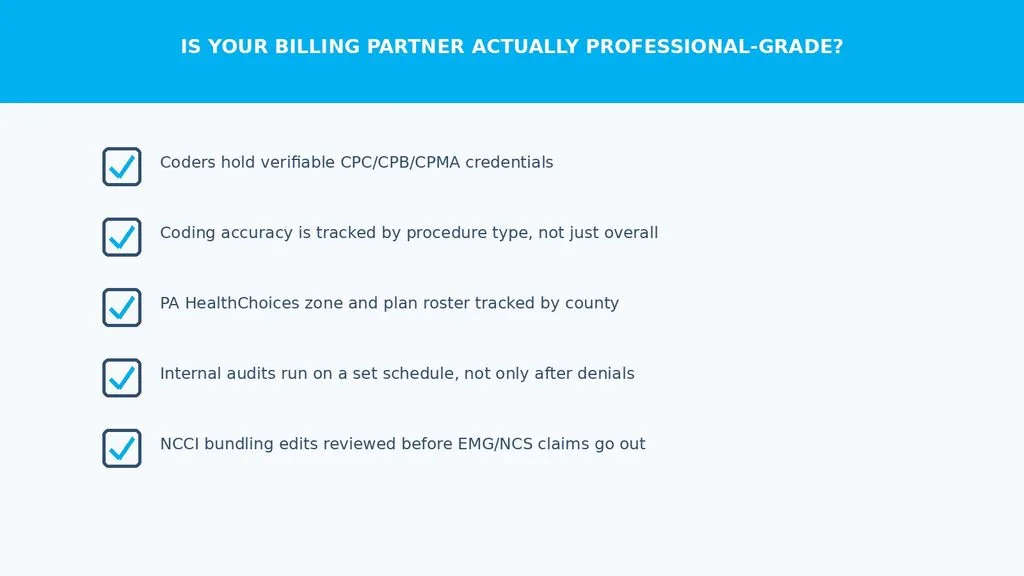
- Can your billing partner provide specific CPC, CPB, or CPMA credential numbers for the staff on your account?
- Is your coding accuracy tracked by procedure type, not just one overall number?
- Is your EMG/NCS coding accuracy specifically audited, given its higher NCCI bundling risk?
- Does your partner check current NCCI edit tables before submitting EMG/NCS claims, rather than relying on outdated rules?
- Do you know your practice’s actual coding accuracy rate, or only its denial rate?
- Is your HealthChoices zone and MCO roster tracked specifically, not treated as generic Medicaid?
- Does your partner know Novitas Solutions is your Medicare Administrative Contractor?
- Are you credentialed as a participating provider with your top payers, to qualify for PA’s 30-day deadline instead of 45?
- Is your billing partner’s compliance audit process documented and scheduled, not only reactive to denials?
- Could your billing partner explain, specifically, what distinguishes their coding from a generalist biller’s?
Scoring: 8-10 “yes” answers suggests your current partner meets a genuinely professional, verifiable standard. 5-7 suggests some real gaps exist, often around procedure-level accuracy tracking or PA-specific workflow depth. 0-4 suggests the word “professional” in your current relationship is closer to marketing language than a checkable standard, and a fuller review is worth prioritizing.
When to Consider a Change?
A few signals tend to show up together when a current billing setup has stopped being genuinely professional-grade, even if it still uses the word:
- Your partner cannot name a specific credential (CPC/CPB/CPMA) for the person coding your claims.
- Denials cluster specifically around EMG, NCS, or Botox injection claims rather than spreading evenly.
- Nobody can tell you your coding accuracy rate broken out by procedure type — only an overall denial rate.
- Your partner is unfamiliar with HealthChoices zones or cannot name your Medicare Administrative Contractor.
- Coding audits happen only after a denial pattern emerges, never on a set schedule.
Illustrative scenario (not an actual client record): using the leakage example from earlier in this guide, a $2.4 million practice at the commonly cited 4% coding-error leakage rate is losing roughly $96,000 a year. If EMG/NCS coding specifically is running well below the practice’s blended accuracy average — as illustrated earlier — a disproportionate share of that leakage likely concentrates in electrodiagnostic claims specifically. This is hypothetical math to illustrate scale, not a projection for any specific practice’s results.
Aspect Billing Solutions provides HIPAA-compliant medical billing and coding for US healthcare providers, including Pennsylvania neurology practices, covering claim and denial management, eligibility verification, prior authorization, accounts receivable follow-up, and credentialing — through a dedicated agent per provider. The company offers a free, no-commitment consultation that starts by reviewing your actual coding accuracy and payer mix before any quote is given.
Learn more at aspectbillingsolutions.com.

Final Considerations
“Professional” is a word every billing company can claim and almost none can prove. Treating it as a checklist — verifiable credentials, procedure-level accuracy tracking, and demonstrated fluency in Pennsylvania’s specific rules — turns a marketing adjective into something a practice can actually evaluate before signing a contract.
A few numbers in this guide are firm, published figures: AAPC’s coding accuracy benchmark, HFMA and MGMA’s clean claim rate ranges, and Pennsylvania’s 40 P.S. §991.2166 / 31 Pa. Code §154.18 clean-claim payment deadlines. Others, including the neurology-specific denial rate and coding-error revenue leakage figures, are attributed to MGMA by secondary industry sources rather than confirmed against a primary named report, or are explicitly illustrative. Keep that distinction in mind when comparing your own numbers against anything in this guide.
Frequently Asked Questions
Professional neurology billing specialists in Pennsylvania
What makes a neurology billing specialist genuinely “professional” rather than just calling themselves that?
Verifiable credentials such as AAPC’s CPC, CPB, or CPMA, a coding accuracy rate tracked by procedure type rather than one blended number, and demonstrated familiarity with state-specific rules — for Pennsylvania, that means HealthChoices’ zone structure and Novitas Solutions as the Medicare contractor.
What is a good coding accuracy rate for a neurology practice?
AAPC sets 95% as the minimum acceptable coding accuracy benchmark, with top-performing practices reaching 97%-98% or higher. Because neurology coding spans several distinct code families, accuracy is more useful tracked by procedure type than as one overall number.
What is a good denial rate for a neurology practice in Pennsylvania?
A denial rate under 10% is a commonly cited practical target industry-wide, with top-quartile practices under 5%. Neurology-specific denial rates are often reported higher, closer to 18%, largely due to EMG/NCS bundling complexity and prior authorization requirements — though this specific figure is attributed to MGMA by secondary sources rather than independently confirmed here.
How long does Pennsylvania give insurers to pay a claim?
Under 40 P.S. §991.2166 and 31 Pa. Code §154.18, licensed insurers and managed care plans must pay a clean claim within 45 days of receipt, reduced to 30 days for providers who are participating (in-network) with that specific payer. Self-funded employer plans governed by federal ERISA law may not be covered by this state deadline.
How does HealthChoices work for neurology practices in Pennsylvania?
HealthChoices is Pennsylvania’s Medicaid managed care program, organized into five geographic zones — Southeast, Southwest, Lehigh/Capital, Northeast, and Northwest — each with its own roster of participating managed care organizations. A practice needs to credential with the specific plans operating in the zones where its patients live, not a single statewide list.
Who processes Medicare claims for Pennsylvania neurology practices?
Novitas Solutions is the Medicare Administrative Contractor for Jurisdiction L, which covers Pennsylvania, Delaware, Maryland, New Jersey, and the District of Columbia, under a contract most recently re-awarded in 2021.
Do EMG and nerve conduction studies always need a modifier to bill together?
It depends on the current NCCI edit status for the specific code pair, which CMS updates quarterly — sometimes no modifier is needed because the codes are treated as complementary, and sometimes modifier 59 (or a more specific successor like XU) is required to indicate distinct, separately documented services. A professional coder checks the live edit table rather than assuming a fixed rule.
What credentials should I ask a billing company for?
Ask specifically for AAPC credentials: CPC (Certified Professional Coder) for coding accuracy, CPB (Certified Professional Biller) for claims and billing expertise, or CPMA (Certified Professional Medical Auditor) for compliance and audit capability. A legitimate holder can provide a checkable credential number.
Is a higher billing fee worth it for more experienced neurology coders?
It depends on whether that experience is verifiable and shows up in measurable results — coding accuracy by procedure type, denial rate trends, and credentialing turnaround — rather than assumed from years in business alone. The fee itself doesn’t answer that question; the checklist in this guide is meant to.
How long does it take to see improvement after switching to a more specialized billing partner?
Credential and process verification typically happens in the first one to two weeks, with a procedure-level accuracy baseline established within 30 to 45 days. Confirming a sustained denial-rate improvement, rather than a one-time bump, generally takes four to six months of stable reporting.
Sources & Methodology
(a) Published standards and definitions, verified directly against the primary source:
- 40 P.S. §991.2166 and 31 Pa. Code §154.18 — Pennsylvania’s 45-day (30-day for participating providers) clean-claim payment deadline. Full text: codes.findlaw.com/pa/title-40-ps-insurance/pa-st-sect-40-991-2166 and law.cornell.edu/regulations/pennsylvania/31-Pa-Code-SS-154-18
- Pennsylvania Department of Human Services — HealthChoices zone structure and current MCO directory. pa.gov (Medicaid Managed Care Organization Directory, HealthChoices program pages)
- CMS Medicare Administrative Contractor records confirming Novitas Solutions as the Jurisdiction L (PA, DE, MD, NJ, DC) Part A/B contractor, most recently re-awarded 2021.
(b) Named benchmarking data providers, cited but not independently re-verified against the primary report:
AAPC’s published 95% minimum coding accuracy benchmark (97%-98%+ for top performers), cited consistently across multiple independent training and industry publications. HFMA’s MAP Keys framework and MGMA DataDive Practice Operations benchmarking for clean claim rate. The neurology-specific 18% denial rate and the 3%-5% coding-error revenue leakage figures are both attributed to MGMA by multiple secondary industry publications; this guide located that attribution in secondary sources but did not independently confirm either figure against MGMA’s original report and tables, so both should be treated as reported estimates rather than confirmed primary statistics.
(c) Practical and illustrative content:
The procedure-category accuracy comparison table and the worked-example dollar figures are explicitly labeled illustrative — built to demonstrate how a blended average can hide a subgroup problem, not drawn from a specific practice’s real data.
(d) Survey data:
No additional named survey data was used beyond the sources listed above.
Legal note: 40 P.S. §991.2166 applies to Pennsylvania-licensed insurance products; self-funded employer plans are generally governed by federal ERISA law instead and may not be covered by this state deadline. This is general information, not legal advice.
Actual results vary by practice, coder, payer mix, and claim volume. Figures in this article reflect information available at the time of research (September 2026) and are not a guarantee for any specific practice.