
Trusted Neurology Billing Company in North Carolina
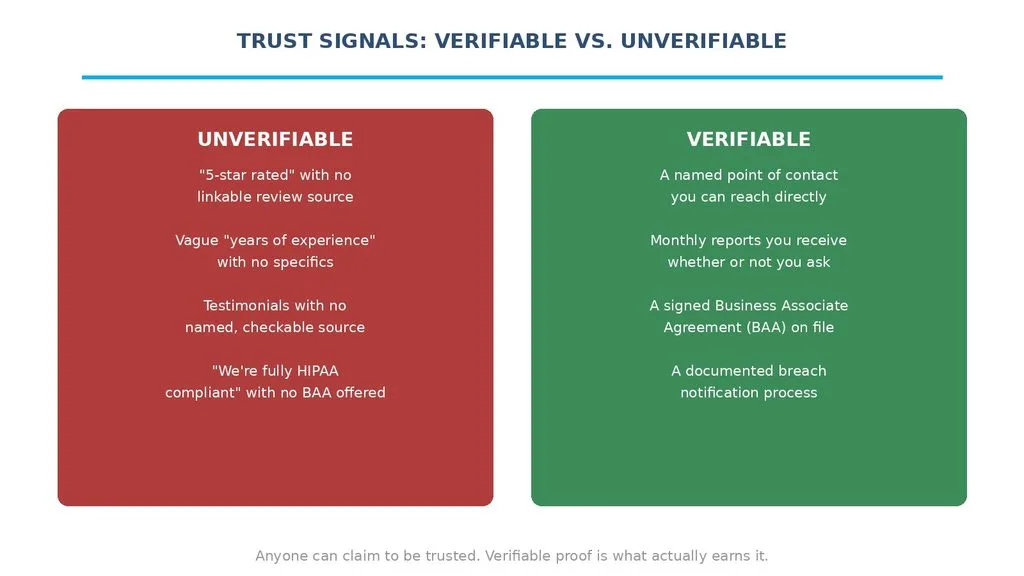
A trusted neurology billing company in North Carolina is one whose trustworthiness can be verified, not just claimed: a named point of contact you can reach directly, claims and denial reports you receive on a set schedule without having to ask, a signed Business Associate Agreement and documented data-security practices, and response times tracked by inquiry type rather than hidden inside one blended average. “Trusted” should be something a vendor can prove, not just say.
“Trusted” is the single easiest word for any billing company to put on its homepage, and the hardest for a prospective client to check from a homepage alone. A five-star badge with no linkable source, a vague claim of “years of experience,” or a testimonial with no named, checkable author don’t actually tell you anything verifiable. This guide treats trust as something that has to be demonstrated — through transparency, accountability, and documented security practices — walks through North Carolina’s specific claim-payment rules, and ends with a self-assessment checklist so you can score your current billing relationship on what it can actually prove.
What a Trustworthy Partner Should Be Able to Show You?
Verifiable Trust Signals, in Numbers
| Metric | Practical Range | Review Frequency | Primary Source |
| Reporting cadence a trustworthy partner provides | Monthly at minimum, without the client having to request it | Ongoing | Illustrative / practical industry norm |
| HIPAA breach notification deadline | No later than 60 days following discovery of a breach | As triggered by an incident | HIPAA Breach Notification Rule, 45 C.F.R. § 164.404 |
| Clean claim / first-pass acceptance rate | 95%-98% target; 98%+ best-in-class | Monthly | HFMA (MAP Keys) / MGMA DataDive |
| Neurology-specific denial rate | ~18% average reported, vs. 5%-10% for other specialties | Monthly | Attributed to MGMA benchmarking by industry publications* |
| North Carolina clean-claim payment deadline | 30 calendar days to pay, deny, or request more information; 18% annual interest on late payment | Statutory, not a KPI | N.C. Gen. Stat. § 58-3-225 |
Source key: “HFMA / MGMA” and the HIPAA citation = a published standard directly attributable to that named body. “*Attributed by industry publications” = secondary sources name MGMA as the origin, but this guide has not independently located and confirmed the primary MGMA report and table for this row; treat it as a reported estimate. The reporting-cadence row is an illustrative practical norm, not a published standard from any single named body. North Carolina’s deadline is a legal requirement, not a performance target, and may not apply to self-funded employer plans governed by federal ERISA law rather than state insurance law.
“Trusted” Should Be Provable, Not Just Claimed
Nothing stops a billing company from putting the word “trusted” in its title tag. What separates a genuinely trustworthy partner from a marketing claim is whether trust-related practices can actually be checked: a named contact instead of an anonymous queue, a security posture backed by a signed document instead of a sentence, and reporting you receive proactively instead of reporting you have to request.
Transparency: Do You See Your Own Numbers?
A trustworthy partner sends claims, denial, and collection reports on a predictable schedule, whether or not the news is good that month. A partner that only surfaces numbers when specifically asked — or only shares them when they’re favorable — is asking for trust rather than earning it through visibility.
Accountability: Is There a Real Person Behind the Account?
A dedicated, named point of contact who can be reached directly is a structural trust signal — you know who is accountable when something goes wrong. A rotating support queue with no consistent contact means accountability is diffused across whoever happens to answer, which is harder to verify and harder to hold to a standard.
Documented Security: Is HIPAA Compliance an Actual Document?
“We’re fully HIPAA compliant” is a sentence. A signed Business Associate Agreement (BAA) and a documented breach-notification process are artifacts you can point to. Under the HIPAA Breach Notification Rule, a covered entity or business associate must notify affected individuals without unreasonable delay and no later than 60 days following discovery of a breach — ask any billing partner directly whether they have a documented process for meeting that deadline, not just whether they say they’re compliant.
Why a Good Average Response Time Can Hide a Slow Category?
A vendor can advertise a fast average response time while one specific, less frequent inquiry type — the one that matters most when it happens — lags far behind. Credentialing status updates are a common example: they come up less often than routine claim-status questions, so they carry less weight in a blended average, even when they take dramatically longer to resolve.
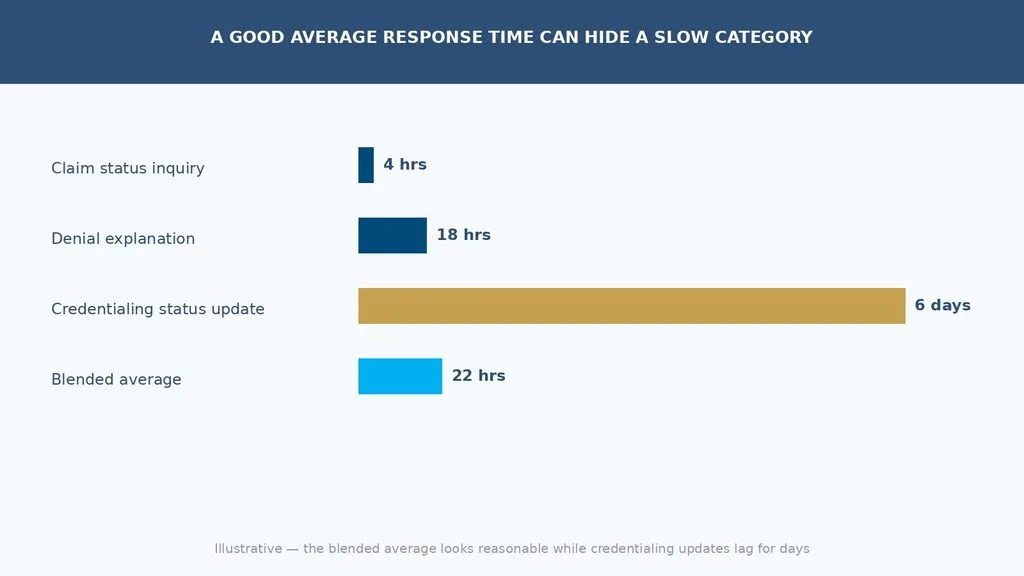
In this illustration, claim-status and denial-explanation inquiries are common and fast, so they dominate a blended average — while credentialing status updates, which happen less often but matter enormously when a new provider is waiting to bill, take six days. A trustworthy partner reports response time by inquiry type for exactly this reason: a fast blended average can hide the one category most likely to cost you real revenue.
The Math Behind Verifiable Trust
The Cost of a Blind Spot
Formula: Cost of Delayed Detection ≈ Weekly Revenue Exposure × Weeks Until a Problem Is Visible.
Worked example: a North Carolina neurology practice generating $11,500 a week in charges works with a vendor that only shares performance reports when specifically requested. If a denial-rate spike goes undetected for six weeks before the practice happens to ask for a report, roughly $69,000 in claims have moved through the pipeline without anyone catching the problem in real time — compared to a vendor sending monthly reports proactively, where the same spike would likely surface within four weeks at most.
North Carolina’s Prompt-Pay Interest
Formula: Interest Owed = Claim Amount × 18% (annual) × (Days Late ÷ 365).
Worked example: a $2,500 claim paid 20 days after North Carolina’s 30-day deadline (so 20 days late) accrues interest of $2,500 × 0.18 × (20 ÷ 365) ≈ $25 under N.C. Gen. Stat. § 58-3-225(e). Individually modest, but a vendor that actively tracks this deadline per claim — rather than treating it as background law — is demonstrating exactly the kind of verifiable diligence “trusted” should mean.
Credentialing Delay as a Trust Test
Formula: Revenue Cost of a Slow Credentialing Update ≈ Weekly Billable Revenue × Weeks of Delay.
Worked example: if a new provider’s credentialing status update takes 6 days to confirm instead of same-day, and that delay repeats across several payers over a multi-week onboarding, a practice can lose several weeks of billable revenue for that provider — a delay that’s invisible unless a partner reports credentialing turnaround specifically, rather than folding it into a generic “response time” average.
North Carolina-Specific Factors a Trusted Partner Tracks
The 30-Day Prompt-Pay Deadline
Under N.C. Gen. Stat. § 58-3-225, an insurer must, within 30 calendar days of receiving a claim, send payment, a notice of denial, or notice that the proof of loss is inadequate or incomplete. Claims unpaid in violation of this timeline accrue interest at an annual rate of 18%, per subsection (e). As with similar laws in other states, this deadline governs state-regulated insured health benefit plans; self-funded employer plans are generally governed by federal ERISA rules instead.
NC Medicaid Managed Care
North Carolina transitioned most Medicaid coverage from fee-for-service to managed care on July 1, 2021, under an initiative called Medicaid Transformation. Coverage now runs through several tracks: Standard Plans (statewide and regional prepaid health plans, including AmeriHealth Caritas of North Carolina, Blue Cross and Blue Shield of North Carolina, UnitedHealthcare of North Carolina, and WellCare of North Carolina statewide, plus Carolina Complete Health in specific regions), separate BH I/DD Tailored Plans for beneficiaries with significant behavioral health needs or intellectual/developmental disabilities, and NC Medicaid Direct (fee-for-service) for certain populations who remain outside managed care. A neurology practice’s Medicaid-covered patients could fall under any of these tracks, and a trustworthy partner tracks which one applies rather than treating “NC Medicaid” as one category. This roster shifts periodically and should be verified against NC Medicaid’s own site before being relied on.
Medicare Administrative Contractor
North Carolina’s Medicare Part A/B claims are processed by a CMS-designated Medicare Administrative Contractor whose jurisdiction covers North Carolina alongside neighboring states. This guide has not independently re-confirmed the current contractor’s name and exact jurisdiction letter at the time of writing due to a research-tool outage; verify directly against CMS’s published MAC directory before relying on it.
What to Actually Verify Before Trusting a Vendor?
Ask for a Named Contact, Not a Department
“You’ll have a dedicated account manager” is only verifiable once you have that person’s name and direct line, not a general support address.
Ask to See a Sample Report Before Signing
A vendor confident in its transparency should be willing to show what a monthly report actually looks like, not just describe that reporting exists.
Ask for the BAA, Not Just the Compliance Claim
A signed Business Associate Agreement is a specific, checkable document. “We’re HIPAA compliant” without one is a sentence, not a safeguard.
For what a compliance audit actually checks, see the ultimate guide to medical billing compliance audits.
Credentialing delays specifically are covered in credentialing mistakes that delay payments.
For the coding side of accuracy and trust, see accurate neurology billing strategies.
How Aspect Billing Solutions Approaches “Trusted”?
The criteria above only matter if a billing partner is willing to be measured against them. Aspect Billing Solutions’ process is built around a few specific, checkable commitments:
- A dedicated agent assigned to each provider — a named contact, not a rotating support queue.
- Monthly claims and denial reporting provided proactively, not only when requested.
- A signed Business Associate Agreement and documented HIPAA-compliant data-handling practices for every client relationship.
- Credentialing status tracked and reported specifically, separate from general claim-status response times.
This describes process and structure, not a performance guarantee — actual results depend on a practice’s starting point, payer mix, and claim volume. A free consultation is a chance to ask for the specifics in this guide directly, before any commitment is made.
Using These Numbers Correctly
A denial rate or response-time benchmark is only meaningful compared like-for-like: similar claim volume, comparable payer mix, and the same reporting period. A single slow week is a signal to ask a question, not a verdict on the whole relationship — but a category that’s consistently slow, or a report that consistently arrives late, is a pattern worth acting on.
How Long It Takes to Confirm Trust?
General Timeline to a Verified Trust Relationship
| Milestone | What to Expect | General Timeframe |
| Contact and documentation confirmed | Named point of contact assigned; BAA and reporting cadence established | 1-2 weeks |
| First full reporting cycle | First monthly report received, covering claims, denials, and A/R | 30 days |
| Response-time baseline | Response times tracked and reported by inquiry type | 30-60 days |
| Full trust picture | Enough reporting cycles to confirm consistency, not just a good first month | 120-150 days |
These are general planning ranges based on commonly reported billing-transition patterns, not a guarantee for any specific practice. Trust, like reliability, is confirmed over several reporting cycles rather than a single good month.
Quick Summary
- “Trusted” should be provable: a named contact, proactive reporting, a signed BAA, and response times tracked by category.
- A fast blended response-time average can hide a slow category like credentialing updates, which matter most when they happen.
- North Carolina’s 30-day prompt-pay deadline (N.C. Gen. Stat. § 58-3-225) carries 18% annual interest on late payment for insured plans.
- NC Medicaid runs through Standard Plans, separate BH I/DD Tailored Plans, and NC Medicaid Direct fee-for-service — not one uniform category.
- HIPAA requires breach notification no later than 60 days after discovery — ask whether a vendor has a documented process, not just a compliance claim.
- Expect a named contact and first full report within 30 days, and a confirmed trust picture within four to five months.
Is Your Billing Partner Actually Trusted?
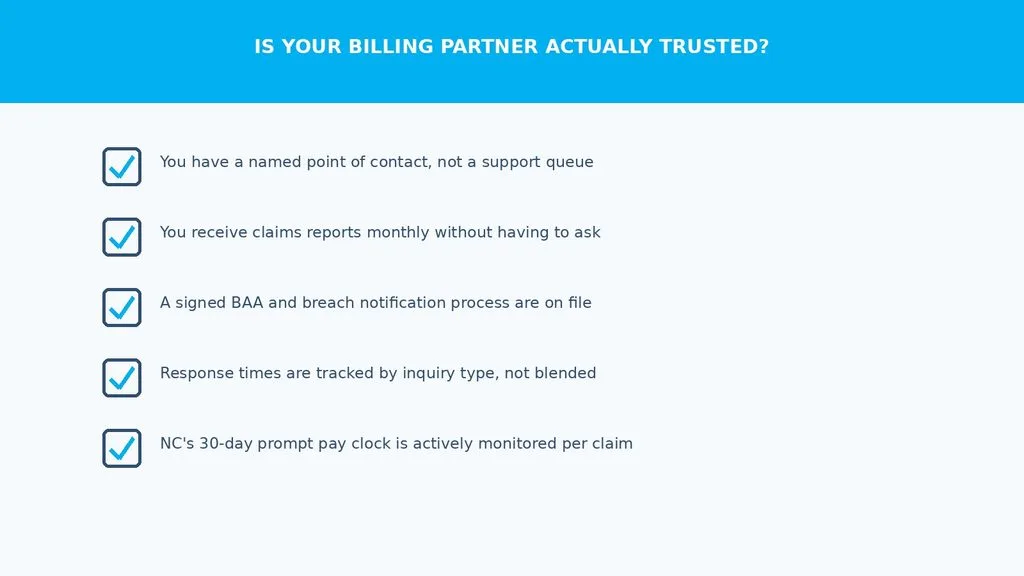
Answer yes or no to each question, then check the scoring guide below.
1. Do you have a named point of contact you can reach directly?
2. Do you receive claims and denial reports on a set schedule without having to ask?
3. Has your vendor signed a Business Associate Agreement with your practice?
4. Does your vendor have a documented breach-notification process?
5. Are response times tracked by inquiry type, not just one blended average?
6. Is North Carolina’s 30-day prompt-pay deadline actively tracked per claim?
7. Do you know which NC Medicaid track (Standard Plan, Tailored Plan, or Direct) your Medicaid patients fall under?
8. Could your vendor show you a sample report right now, not just describe one?
9. Are any testimonials or ratings your vendor cites linkable to a real, checkable source?
10. If something went wrong tomorrow, do you know exactly who at your billing company would be accountable?
Scoring: 8-10 “yes” answers suggests your current partner meets a genuinely verifiable standard of trust. 5-7 suggests some real gaps exist, often around proactive reporting or documented security practices. 0-4 suggests “trusted” in your current relationship is closer to a marketing claim than something you could actually prove, and a fuller review is worth prioritizing.
When to Consider a Change?
A few signals tend to show up together when a current billing relationship has stopped being genuinely trustworthy, even if it still uses the word:
- You have to ask for reports rather than receiving them on a schedule.
- There’s no single named person you can reach — just a general inbox or support line.
- Your vendor has never provided or discussed a signed BAA.
- Credentialing updates take noticeably longer than routine claim-status responses, with no explanation.
- Testimonials or ratings your vendor cites can’t be traced to a real, checkable source.
Illustrative scenario (not an actual client record): using the blind-spot example from earlier in this guide, a practice that only requests performance reports quarterly instead of monthly could miss a developing denial-rate problem for two extra months — potentially tens of thousands of dollars in claims moving through the pipeline before anyone catches it. This is hypothetical math to illustrate why proactive reporting matters, not a projection for any specific practice’s results.
Aspect Billing Solutions provides HIPAA-compliant medical billing and coding for US healthcare providers, including North Carolina neurology practices, covering claim and denial management, eligibility verification, prior authorization, accounts receivable follow-up, and credentialing — through a dedicated agent per provider. The company offers a free, no-commitment consultation where you can ask directly for the specifics covered in this guide before any commitment is made.
Learn more at aspectbillingsolutions.com.

Final Considerations
“Trusted” is a word every billing company can put on its homepage, and almost none can prove without being asked directly. Treating it as a checklist — a named contact, proactive reporting, a signed BAA, and response times broken out by category — turns a marketing adjective into something a practice can actually verify before signing anything.
A few numbers in this guide are firm, published figures: North Carolina’s N.C. Gen. Stat. § 58-3-225 prompt-pay deadline and interest rate, the HIPAA Breach Notification Rule’s 60-day requirement, and HFMA/MGMA’s clean claim rate benchmarks. Others, including the neurology-specific denial rate figure, are attributed to MGMA by secondary industry sources rather than confirmed against a primary named report, and the response-time and blind-spot examples are explicitly illustrative. One detail — North Carolina’s current Medicare Administrative Contractor — could not be independently re-verified at the time of writing and should be confirmed before this article is finalized for publication.
Frequently Asked Questions
Trusted neurology billing company in North Carolina
What makes a neurology billing company genuinely “trusted” rather than just calling itself that?
Verifiable practices: a named point of contact, claims and denial reports delivered on a set schedule without being requested, a signed Business Associate Agreement, and response times tracked by inquiry type rather than folded into one average. Trust should be something you can check, not just something a vendor states.
How long does North Carolina give insurers to pay a claim?
Under N.C. Gen. Stat. § 58-3-225, an insurer must pay, deny, or request additional information within 30 calendar days of receiving a claim. Claims paid late accrue interest at an annual rate of 18%.
Does North Carolina’s prompt pay law apply to self-funded employer health plans?
Generally no. Like similar laws in other states, North Carolina’s prompt-pay statute governs state-regulated insured health benefit plans; self-funded employer plans are typically governed by federal ERISA rules instead.
How does NC Medicaid Managed Care work for neurology practices?
Since July 1, 2021, most NC Medicaid coverage runs through Standard Plans (several statewide and regional prepaid health plans), with separate BH I/DD Tailored Plans for beneficiaries with significant behavioral health or developmental needs, and NC Medicaid Direct fee-for-service for certain populations who remain outside managed care.
What does HIPAA require if a billing company has a data breach?
Under the HIPAA Breach Notification Rule (45 C.F.R. § 164.404), affected individuals must be notified without unreasonable delay and no later than 60 days following discovery of the breach. Ask any billing partner whether they have a documented process for meeting this deadline.
What is a good denial rate for a neurology practice?
A denial rate under 10% is a commonly cited practical target, with top-quartile practices reporting under 5%. Neurology practices often run higher due to EEG, EMG, and imaging authorization requirements, so the trend and its stability matter more than any single month’s figure.
What is a good clean claim rate for a neurology practice?
A clean claim rate of 95% or higher is the commonly cited target, with best-in-class practices reaching 98% or above, per HFMA and MGMA benchmarking.
Should I ask a billing company for references before signing?
Yes — and ask for references you can actually contact directly, not just testimonials printed on a website. A vendor confident in its track record should be comfortable connecting you with a current client.
What questions should I ask about data security before trusting a billing vendor?
Ask whether they’ll sign a Business Associate Agreement, what their documented breach-notification process looks like, and how quickly they’d meet HIPAA’s 60-day notification requirement if an incident occurred. Specific, checkable answers are the trust signal — a general compliance claim is not.
How long does it take to confirm whether a billing partner is actually trustworthy?
A named contact and documentation should be in place within one to two weeks, with a first full monthly report following within 30 days. Confirming consistency — reports arriving on schedule, response times holding steady — generally takes four to five months of stable reporting.
Sources & Methodology
(a) Published standards and definitions, verified directly against the primary source:
- N.C. Gen. Stat. § 58-3-225 — the 30-day claim payment/denial deadline and 18% annual interest penalty for insured health benefit plans. Full text available via the North Carolina General Assembly (ncleg.gov) and the NC Department of Insurance’s Prompt Pay Guidance.
- HIPAA Breach Notification Rule, 45 C.F.R. § 164.404 — the 60-day maximum notification deadline following discovery of a breach.
- NC Medicaid Managed Care / Medicaid Transformation structure (Standard Plans, BH I/DD Tailored Plans, NC Medicaid Direct), launched July 1, 2021, as documented by NC DHHS and corroborated by independent healthcare-policy reporting and peer-reviewed research.
(b) Named benchmarking data providers, cited but not independently re-verified against the primary report:
HFMA’s MAP Keys framework and MGMA DataDive Practice Operations benchmarking for clean claim rate. The neurology-specific 18% denial rate figure is attributed to MGMA by multiple secondary industry publications. This guide located that attribution in secondary sources but did not independently confirm. It against MGMA’s original report and tables. So it should be treated as a reported estimate rather than a confirmed primary statistic.
(c) Details flagged as unverified at time of writing: This guide could not confirm North Carolina’s specific current Medicare Administrative Contractor and jurisdiction. Letter against a live primary source due to an intermittent search-tool outage during research. Live SERP research for this exact focus keyword was similarly affected; the competitive-landscape description. In this guide is based on the consistent pattern observed across this article series’ prior state research. Rather than a freshly re-confirmed check of this specific result page. Both should be verified. The MAC directly against CMS’s published MAC directory, and the SERP with a fresh live search — before this article is finalized for publication.
(d) Practical and illustrative content: The response-time-by-inquiry-type comparison and the cost-of-a-blind-spot worked example are explicitly labeled illustrative — built to demonstrate the underlying concepts, not drawn from a specific vendor’s real performance data.
(e) Survey data: No additional named survey data was used beyond the sources listed above.
Legal note: N.C. Gen. Stat. § 58-3-225 applies to North Carolina-regulated insured health benefit plans. Self-funded employer plans are generally governed by federal ERISA law instead. This is general information, not legal advice.
Actual results vary by practice, vendor, payer mix, and claim volume. Figures in this article reflect information available at the time of research (September 2026) and are not a guarantee for any specific practice.