Trusted Internal Medicine Revenue Cycle Management in Alabama
A trusted internal medicine revenue cycle in Alabama depends on a billing partner that manages eligibility verification, coding, claims submission, denial appeals, and accounts receivable inside one HIPAA-compliant workflow. For Alabama practices, that means fewer rejected claims, faster reimbursement, and predictable cash flow, even with state-specific Medicaid and regional Medicare rules in play.
Every internal medicine practice in Alabama eventually hits the same wall: claims come back denied, accounts receivable keeps aging past 90 days, and front desk staff spend more time chasing insurance companies than greeting patients. A single billing error, missed prior authorization, or outdated payer rule can delay reimbursement by weeks. For solo physicians and small group practices, that delay isn’t just an inconvenience; it directly affects payroll, supply orders, and the ability to invest in new equipment. Revenue cycle problems rarely announce themselves loudly. They show up quietly, in a shrinking bank balance and a growing pile of unresolved claims.
This guide breaks down what a trusted internal medicine revenue cycle in Alabama actually requires, from eligibility verification and prior authorization to denial management and credentialing. It also covers the state-specific payer rules that trip up practices working with Alabama Medicaid, Blue Cross Blue Shield of Alabama, and regional Medicare Administrative Contractors. You’ll find a side-by-side comparison of in-house versus outsourced billing, benchmark numbers to measure your own performance against, and a look at how Aspect Billing Solutions structures its dedicated-agent model for internal medicine providers across the state.
Why Internal Medicine Practices in Alabama Struggle With Revenue Cycle Management?
Internal medicine billing carries more complexity than many other specialties. A single visit might involve chronic care management, multiple diagnosis codes, and overlapping CPT codes for preventive and problem-focused services performed the same day. Alabama practices also serve a high share of Medicare and Medicaid patients, which means claims must satisfy strict medical necessity documentation and local coverage rules. Add staff turnover in the billing office, aging practice management software, and payer rule changes that arrive with little notice, and denial rates climb quickly. Industry data compiled by MGMA shows claim denial rates trending upward across practices nationally, making disciplined claims management essential rather than optional.
Coding Complexity in Internal Medicine
Internal medicine physicians manage multiple chronic conditions per visit, which increases coding complexity. Coders must correctly sequence ICD-10 diagnosis codes, apply appropriate modifiers, and avoid unbundling errors that trigger automatic denials. A missed modifier on an evaluation and management code paired with a minor procedure can cost a practice hundreds of dollars per claim. Practices unsure about correct code sets can reference the AMA’s official CPT resources directly, though this rarely replaces coders who specialize in internal medicine. For a deeper breakdown, see our internal medicine CPT coding guide.
Staffing Gaps and Turnover
Billing staff turnover is a persistent problem for small and mid-sized Alabama practices. When an experienced biller leaves, institutional knowledge about specific payer quirks leaves with them. New hires need weeks of training before they can independently work denials or verify eligibility accurately. During that gap, claims pile up, appeal deadlines get missed, and accounts receivable ages past the point where recovery becomes difficult. Outsourcing removes this single point of failure by spreading the workload across a trained, redundant team instead of one person.
What a Trusted Internal Medicine RCM Partner Should Deliver?
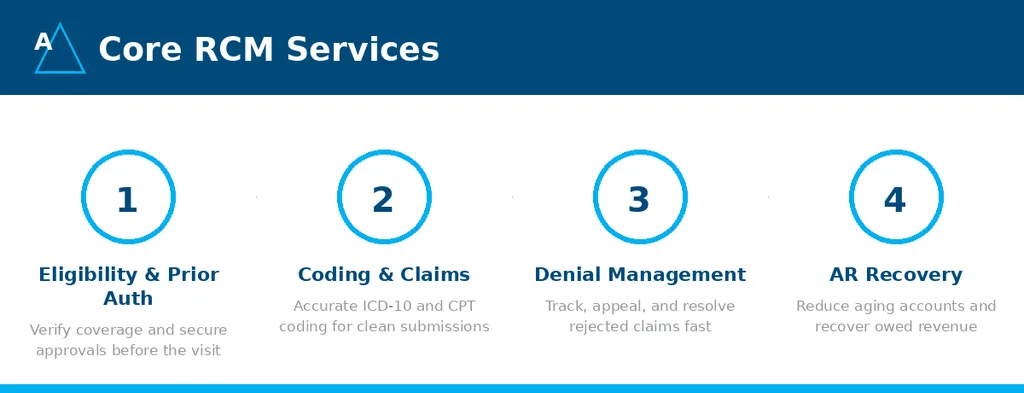
Not every billing company understands the nuances of internal medicine. A trusted partner combines specialty-specific coding knowledge with full-cycle revenue cycle management, covering everything from the first eligibility check to the final collected dollar. You can review Aspect Billing Solutions’ full range of medical billing services to see how each piece fits together. Below are the four pillars that separate a dependable RCM partner from a generic billing vendor.
Claims & Denial Management
Clean claim submission starts with accurate coding and ends with a systematic process for tracking every claim to payment. A strong denial management program doesn’t just resubmit rejected claims; it identifies root causes, whether that’s a missing modifier, an eligibility mismatch, or an authorization gap, and corrects the underlying workflow. Alabama practices working with a dedicated denial team typically see appeal turnaround measured in days, not weeks, which keeps cash flow steady instead of stalling at the payer’s desk.
Eligibility Verification & Prior Authorization
Confirming active coverage before the appointment prevents a large share of denials before they happen. Eligibility verification checks copay, deductible status, and plan-specific coverage rules, while prior authorization confirms that a planned service or referral meets payer requirements in advance. For internal medicine, where referrals to specialists and diagnostic imaging are common, skipping this step is one of the fastest ways to generate unpaid claims and frustrated patients who receive unexpected bills.
Accounts Receivable Recovery
Aging accounts receivable is where revenue quietly disappears. A disciplined AR recovery process works claims in 30-, 60-, and 90-day buckets, escalating unresolved balances before timely filing limits expire. Practices without a dedicated AR follow-up process often write off recoverable revenue simply because no one had time to call the payer. A trusted RCM partner treats AR follow-up as a daily task, not an end-of-month cleanup project.
Credentialing & Payer Enrollment
Credentialing delays can keep a new physician from billing insurance for months after their start date. A reliable partner manages payer enrollment, CAQH profile maintenance, and re-credentialing deadlines proactively, so Alabama practices don’t lose revenue while a provider waits to go in-network. This matters most for practices adding associates or opening a second location, where credentialing timelines directly determine how soon the new provider can see paying patients.
Alabama-Specific Billing Considerations for Internal Medicine
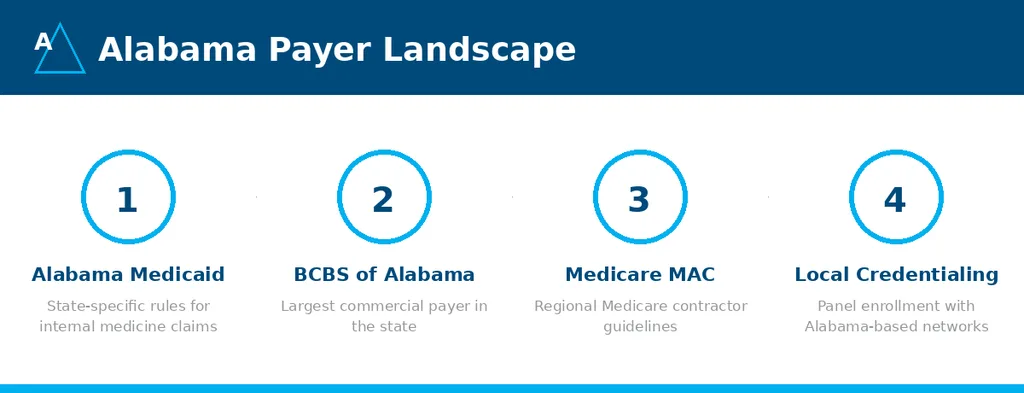
Trusted Internal Medicine Revenue Cycle in Alabama-Billing rules aren’t identical across states, and Alabama has its own mix of payer requirements that internal medicine practices need to track. From Medicaid coverage policies to the regional Medicare Administrative Contractor, local knowledge directly affects how quickly claims get paid. A billing partner unfamiliar with Alabama-specific edits will generate avoidable denials, no matter how strong their general coding skills are.
Alabama Medicaid and Commercial Payer Rules
Alabama Medicaid applies specific coverage policies for chronic disease management, preventive visits, and referral requirements that differ from neighboring states. General program information is publicly available through Medicaid.gov, though state-level policy manuals go further than the federal overview. Blue Cross Blue Shield of Alabama, the state’s largest commercial payer, maintains its own medical necessity documentation standards and timely filing windows. Practices that treat every payer the same tend to see higher denial rates on Alabama Medicaid claims specifically, since state Medicaid programs update policy manuals without much advance notice. Family medicine practices face similar issues, covered in our guide to family practice revenue cycle management in Alabama.
Regional Medicare Administrative Contractor Guidelines
Alabama providers submit Medicare claims through a regional Medicare Administrative Contractor (MAC), which publishes Local Coverage Determinations that affect what’s considered medically necessary for specific diagnosis and procedure code combinations. Internal medicine practices billing chronic care management, annual wellness visits, or transitional care management codes need coders who actively monitor MAC bulletins. Missing an LCD update is one of the most common reasons Medicare claims come back denied for Alabama-based internal medicine providers.
In-House vs. Outsourced Revenue Cycle Management
Alabama practice administrators evaluating whether to keep billing in-house or outsource to a specialized partner should weigh cost, control, and consistency. The table below compares both approaches across the factors that matter most for internal medicine practices managing a steady mix of Medicare, Medicaid, and commercial claims.
| Factor | In-House Billing | Outsourced RCM (Aspect Billing Solutions) |
| Staffing risk | High — turnover disrupts workflow | Low — team-based coverage |
| Coding expertise | Varies by hire | Specialty-trained coders |
| Denial follow-up | Often delayed | Daily, systematic tracking |
| Technology cost | Practice pays for software & licenses | Included in service |
| Credentialing support | Usually a separate task | Integrated into the service |
| Reporting visibility | Manual, inconsistent | Regular AR & performance reports |
| Scalability | Requires new hires to grow | Scales with practice volume |
Key Revenue Cycle Benchmarks for Internal Medicine Practices
Benchmarking your practice against industry norms helps identify where revenue is leaking. The figures below reflect commonly cited targets for internal medicine practices and can serve as a starting point for evaluating your current billing performance.
| Metric | Healthy Benchmark | Warning Sign |
| Clean claim rate | 90% – 95% | Below 85% |
| Days in accounts receivable | Under 40 days | Over 60 days |
| Denial rate | 5% – 10% | Above 10% – 15% |
| Net collection rate | 95%+ | Below 90% |
| Credentialing turnaround | 60 – 90 days | Over 120 days |
How Aspect Billing Solutions Supports Internal Medicine Practices in Alabama?
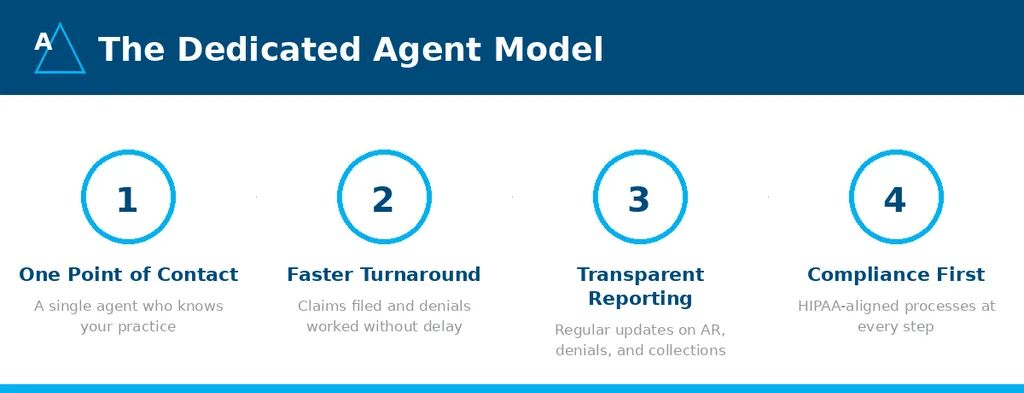
Aspect Billing Solutions provides HIPAA-compliant medical billing and coding built specifically for practices navigating Alabama’s payer landscape. Rather than routing internal medicine claims through a generic call center, every client is assigned a dedicated agent who learns the practice’s payer mix, documentation habits, and recurring issues. This model closes the knowledge gap that usually appears when practices manage billing in-house or work with high-turnover outsourced vendors.
The Dedicated Agent Model
A dedicated agent functions as an extension of the practice’s front office, not a rotating queue of unfamiliar representatives. Because the same person manages eligibility checks, claims, and denial follow-up over time, they recognize payer patterns specific to Alabama Medicaid and regional commercial plans faster than a generalist team would. Practices get one phone number and one point of accountability instead of explaining their situation to a new representative every time an issue comes up.
What Your Dedicated Agent Handles Daily?
Day to day, the dedicated agent verifies eligibility ahead of scheduled visits, reviews coding for accuracy before submission, tracks every claim through adjudication, and works denials as soon as they post. They also monitor credentialing deadlines and flag re-enrollment windows before they lapse. This consistent, hands-on oversight is what separates a dedicated agent model from a shared-inbox billing service where claims sit unattended until someone happens to notice them. You can find answers to more process questions on our frequently asked billing questions page.
Quick Summary-Trusted Internal Medicine Revenue Cycle in Alabama
- Internal medicine billing in Alabama involves complex coding, Medicare/Medicaid overlap, and frequent payer rule changes.
- A trusted RCM partner covers eligibility verification, prior authorization, coding, denial management, AR recovery, and credentialing.
- Alabama Medicaid, BCBS of Alabama, and the regional Medicare Administrative Contractor each apply distinct rules that affect claim approval.
- Outsourcing reduces staffing risk and adds specialty-trained coders plus daily denial follow-up.
- Benchmark your practice: aim for a 90%+ clean claim rate, under 40 days in AR, and a denial rate below 10%.
- Aspect Billing Solutions assigns a dedicated agent to each practice for consistent, accountable revenue cycle support.
Final Considerations
Revenue cycle management isn’t a back-office afterthought for internal medicine practices in Alabama; it’s the mechanism that determines whether the clinical work physicians do actually turns into collected revenue. Every denied claim, delayed credentialing application, and unverified eligibility check chips away at cash flow that could otherwise fund staff, equipment, and growth. Practices that treat billing as a strategic function, rather than a task to minimize cost on, tend to see measurably better collection rates over time.
The state-specific factors covered here, Alabama Medicaid policy, BCBS of Alabama requirements, and regional Medicare Administrative Contractor rules, aren’t optional knowledge for a billing partner serving Alabama providers. They’re the difference between a claim that gets paid on the first submission and one that sits in appeals for months. Whether you keep billing in-house with better training or move to a specialized outsourced partner, the goal stays the same: fewer denials, faster reimbursement, and a revenue cycle that supports the practice instead of draining it.
If your practice is losing time and revenue to denials, aging AR, or credentialing delays, it may be worth having a specialist review your current process. A short audit often reveals fixable gaps that are costing more than most administrators realize, and addressing them early prevents a bigger cash flow problem down the road.
Frequently Asked Questions
Trusted Internal Medicine Revenue Cycle in Alabama
What does revenue cycle management include for an internal medicine practice?
Revenue cycle management covers every step from scheduling and eligibility verification through coding. Claims submission, denial management, and final payment posting. For internal medicine, it also includes credentialing and prior authorization. Since chronic care and referral-heavy visits generate more administrative touchpoints than a typical primary care visit.
How long does internal medicine credentialing take in Alabama?
Credentialing timelines in Alabama typically range from 60 to 120 days. Depending on the payer and how complete the initial application is. Delays usually come from missing CAQH documentation or slow follow-up, both of which a dedicated billing partner can help prevent.
Why do internal medicine claims get denied more often than other specialties?
Internal medicine visits frequently involve multiple diagnoses. Chronic care management codes, and overlapping preventive and problem-focused services on the same day. This complexity increases the chance of coding errors, modifier issues, or missing documentation, which are common denial triggers.
Is outsourcing medical billing HIPAA-compliant?
Yes, as long as the billing partner follows HIPAA safeguards for handling protected health information. Including secure data transmission, access controls, and signed business associate agreements. Aspect Billing Solutions structures its processes around HIPAA compliance for every client engagement.
What’s a good denial rate for an internal medicine practice?
Most benchmarks put a healthy denial rate under 5 to 10 percent of submitted claims. A rate consistently above 10 to 15 percent usually signals a coding, eligibility, or documentation problem worth investigating.
Does Alabama Medicaid have different billing rules than other states?
Yes. Alabama Medicaid maintains its own coverage policies, referral requirements, and documentation standards that can differ from neighboring states’ Medicaid programs. Billing teams unfamiliar with these state-specific rules often see higher denial rates on Medicaid claims specifically.
Major Industry Leader
Aspect Billing Solutions has built its reputation on HIPAA-compliant medical billing and coding for practices that need more than a generic vendor. Every internal medicine client in Alabama works with a dedicated agent. who understands the state’s Medicaid rules, regional Medicare guidelines. And major commercial payers, backed by full support across claim and denial management. Eligibility verification, prior authorization, accounts receivable, and credentialing. If aging AR, rising denials, or credentialing delays are holding your practice back. A free revenue cycle consultation can identify exactly where revenue is being lost.
Visit Aspect Billing Solutions to schedule your free audit, or reach the team directly through the contact page to start the conversation.