
Mental Health Provider Credentialing: A Step-by-Step Guide
Mental health provider credentialing is how health plans confirm a clinician’s license, training and history before adding them to a network. Every license type follows the same core path, but Medicare, Medicaid and commercial plans each apply their own rules. This guide walks through the steps, shows what changes for each type of clinician, and lists the mistakes that stall approvals. If you would rather hand off the paperwork, our credentialing service handles it for you.
| Key takeaways Credentialing verifies you; contracting sets your terms. You bill in network only after both are done.Your license, NPI, taxonomy code and CAQH profile must match each other exactly.Since January 1, 2024, Medicare also enrolls marriage and family therapists and mental health counselors.Get a written effective date from each payer before you schedule insured sessions. |
Who can be credentialed: requirements by license type
Each license type has its own Medicare path and payment level. Commercial plans set their own eligibility rules in the provider manual, so confirm those before you apply.
| Provider type | Medicare billing | Confirm with each plan |
| Psychiatrist (MD/DO) | Bills as a physician | Board status and prescriber registrations |
| Clinical psychologist | Bills directly when licensed to practice psychology in the state | Doctoral license and testing scope |
| Clinical social worker (LCSW) | Bills directly and accepts assignment | Independent clinical license level |
| Psychiatric NP or PA | Bills under own NPI, in collaboration with or under a physician | Collaboration or supervision agreement on file |
| Counselor (LPC, LMHC) or family therapist (LMFT) | Enrolls and bills directly since January 1, 2024 | Independent licensure and supervised hours |
Medicare does not pay every type the same share of the Physician Fee Schedule (PFS), the national rate list for physician services. The CMS Medicare mental health booklet sets the percentages below. Commercial rates come from your contract, not from this chart.
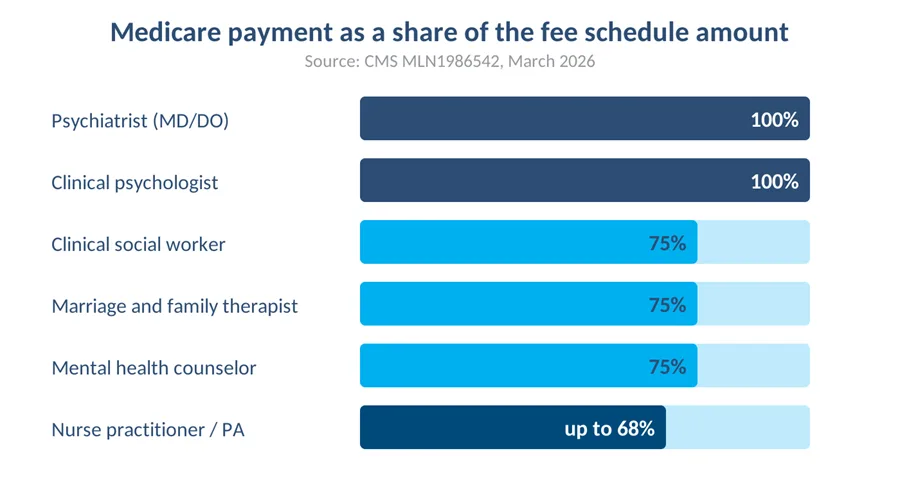
Text summary: psychiatrists and clinical psychologists are paid 100 percent, social workers, counselors and family therapists 75 percent, and nurse practitioners and PAs up to 68 percent of the PFS amount.
Mental health provider credentialing step by step
The path below works for any license type. Start at least a few months before your first insured session, because approval times depend on the payer.
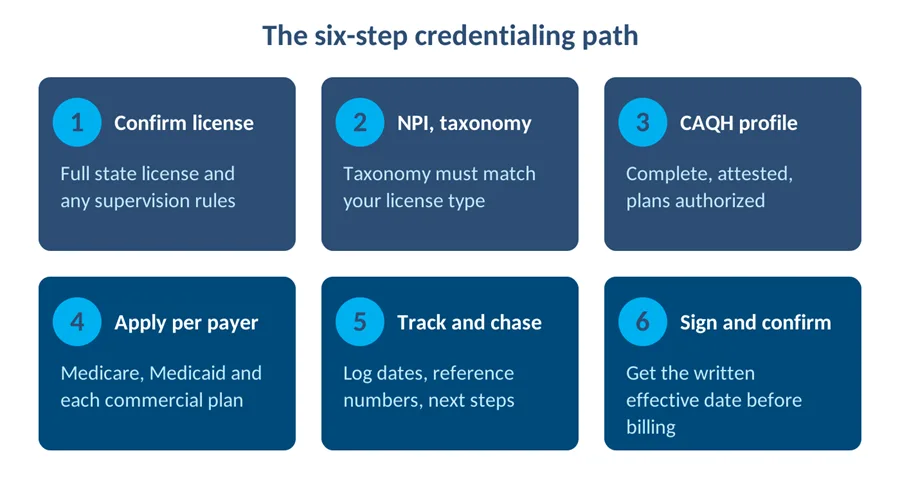
Text summary: confirm your license, set up your NPI and taxonomy, complete CAQH, apply to each payer, track follow-ups, then sign and confirm your effective date.
- Confirm you qualify. Hold a full state license for the services you bill. Plans differ on associate-level or pre-licensed clinicians, so read each provider manual before you apply.
- Set up your NPI and taxonomy. Apply through NPPES, the National Plan and Provider Enumeration System, and pick the taxonomy code that matches your license. Covered providers must report NPI data changes within 30 days under the HIPAA NPI rule.
- Complete your CAQH profile. CAQH ProView stores your provider data once so many plans can read it. Upload current documents, attest, and authorize each plan. It does not replace applications; see how CAQH fits into credentialing.
- Apply to each payer. Medicare uses PECOS or the paper CMS-855I form. Medicaid runs through your state program, and Medicaid approval does not enroll you in Medicare. Our guide to Medicare and Medicaid credentialing differences compares the two.
- Track every application. Log submission dates, reference numbers and follow-up calls so nothing sits unanswered.
- Sign and confirm. Review the contract’s rates, authorization rules and termination terms. Load the effective date into your billing system only after the payer confirms it in writing.
Medicare enrollment for counselors and family therapists
Medicare began paying marriage and family therapists (MFTs) and mental health counselors (MHCs) directly for services on or after January 1, 2024. The CMS enrollment FAQ for MFTs and MHCs requires a qualifying master’s or doctoral degree, a state license or certification, and at least two years or 3,000 hours of post-master’s supervised clinical experience.
Use taxonomy code 106H00000X for MFTs and 101YM0800X for MHCs. If supervised hours are not part of your licensure, CMS asks for letterhead statements from your employer and your licensing body. Group practices can have clinicians reassign benefits to the group once both are enrolled.
Medicare, Medicaid and commercial plans compared
| Payer type | Who sets the rules | Where you apply | What to check |
| Medicare | CMS and your Medicare Administrative Contractor (MAC) | PECOS or paper CMS-855I | Specialty, supervision records, group reassignment |
| Medicaid | Your state program | State enrollment portal | State licensure rules and managed care plan requirements |
| Commercial | Each plan’s contract and manual | Plan portal, often through CAQH | Fee schedule, telehealth terms, authorization rules |
Some commercial plans route behavioral health through a separate vendor, which can mean a second application. Ask each plan who handles mental health network enrollment before you submit.
Common mistakes that delay credentialing
Most delays come from small data problems, not from the clinician’s qualifications.
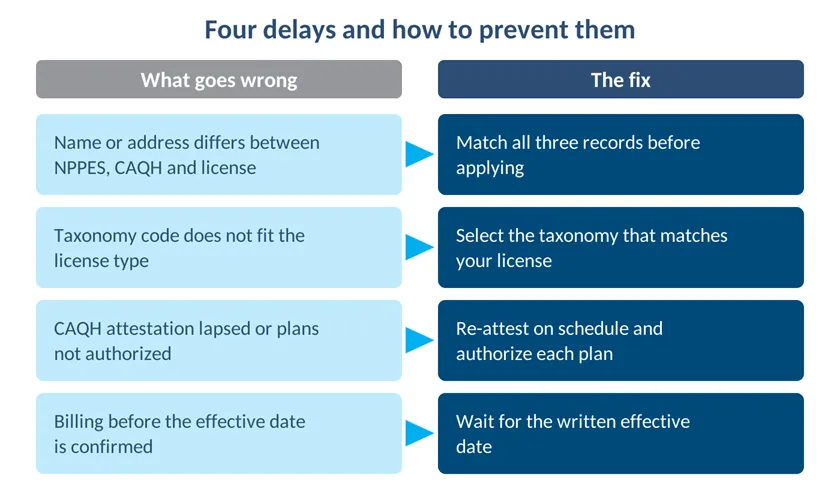
Text summary: match your name and address across NPPES, CAQH and your license, choose the right taxonomy, keep CAQH attested, and wait for a written effective date before billing.
Two more causes are missing supervision paperwork for counselors and family therapists, and no follow-up after submission. Our list of other credentialing errors that delay payments covers the rest.
Sample credentialing tracker
Sample (fictional data). Copy these columns into a spreadsheet and replace each row with your own payers and dates.
| Payer | Submitted | Last contact | Status | Next step |
| Medicare (PECOS) | Aug 4 | Sep 15 | Approved, effective date received | Load effective date into billing system |
| State Medicaid | Aug 18 | Oct 1 | More documents requested | Send supervision letter by Oct 9 |
| Commercial plan A | Sep 8 | Oct 6 | Under review | Call provider relations Oct 20 |
| Commercial plan B | Sep 8 | Oct 6 | Contract sent | Review rates and sign |
Credentialing is not one-and-done. Plans recheck provider data periodically, and license or malpractice renewals must be reported. Learn the difference between re-credentialing and initial enrollment so renewals never lapse.
Frequently asked questions
How long does mental health credentialing take?
It varies by payer and by how complete your application is. Plans publish their own timelines, and commercial approvals often take months rather than weeks. Medicare web applications are generally processed faster than paper ones. Submit early, follow up on a set schedule, and avoid booking insured sessions until you have a written effective date.
Can a pre-licensed or associate therapist be credentialed?
Plans differ, so read each provider manual before applying. Medicare enrolls marriage and family therapists and mental health counselors only after they hold a state license or certification and have completed the required supervised experience. Many commercial plans also expect full licensure, so confirm the rule before promising a client in-network rates.
Can LMFTs and counselors bill Medicare now?
Yes. Since January 1, 2024, Medicare pays marriage and family therapists and mental health counselors directly when they meet CMS enrollment requirements: a qualifying master’s or doctoral degree, a state license or certification, and at least two years or 3,000 hours of post-master’s supervised clinical experience. Addiction counselors who meet those requirements may enroll as counselors.
Do I need to apply to every payer separately?
Yes. Each payer runs its own application, verification and contract, even when it pulls your data from CAQH. A complete profile saves typing, but it does not enroll you. Medicaid enrollment also does not enroll you in Medicare, so plan a separate application for each program.
What is the difference between credentialing and contracting?
Credentialing is the plan’s verification of your license, training and history. Contracting sets your participation terms and fee schedule. You are not ready to bill in network until both are finished and the plan confirms your effective date. Read the rate, authorization and termination terms before you sign.
Final Considerations
Mental health provider credentialing goes faster when your license, NPI and CAQH data match before the first application goes out. Once you are approved, accurate claims are the next step; our mental health billing guide covers codes, documentation and payer rules.
Our credentialing service gathers your documents, completes each insurer’s application, follows up, and keeps renewals current. Send a message through our contact page and our team will reply within 24 hours.
Sources: CMS Medicare Mental Health booklet (MLN1986542, March 2026); CMS Marriage and Family Therapists and Mental Health Counselors FAQ; 45 CFR 162.410. This article is general information, not legal or billing advice. Confirm current rules with each payer.