
Charge Capture in Medical Billing: Process, Metrics and Fixes for 2026
Charge capture in medical billing is the revenue cycle process that records every billable service, procedure, drug and supply from a patient encounter as a charge, so it can be coded and billed. Practical targets commonly cited by HFMA include entering charges within 3 days of service and keeping missing charges under 1% of visits.
Missed and late charges rarely show up as denials, so many practices never see them. A service that was delivered but never charged leaves no claim to deny, no remittance to review and no balance to chase. This guide explains how charge capture works in a physician practice, where charges most often leak, which metrics expose the gaps, and how to fix them. A ten-question self-assessment checklist near the end scores your process in a few minutes.
Key Numbers Cheat Sheet
Charge capture numbers at a glance
| Metric | Practical target/range | Review frequency | Source type |
| Charge lag (date of service to charge entry) | 3 days or fewer; HFMA’s KPI article cites 3 to 5 days | Weekly | [B] PwC benchmark published by HFMA; [B] HFMA |
| Missing charges | 1% or fewer of completed visits | Daily reconciliation, monthly review | [B] PwC benchmark published by HFMA |
| Late charges | 2% or less of total charges | Monthly | [B] HFMA |
| Revenue lost to charge capture issues (hospitals) | Up to 1% of potential annual net revenue | Annual estimate | [S] HFMA-published consultant analysis |
| Medicare timely filing | 12 months from the date of service | Annually | [P] CMS |
[P] = published standard from CMS. [B] = named benchmarking source (HFMA, or PwC benchmarks published by HFMA). [S] = study or analysis data with a named publisher. Hospital-derived figures are shown as context; physician practice results vary by specialty, payer mix and workflow.
What is charge capture in medical billing?
Charge capture is the step that turns documented care into billable charges: the provider records what was done, and the practice converts that record into codes, units and fees on the patient’s account. It sits between documentation and claim submission, and everything downstream depends on it.
Three related steps are often confused. Charge capture records that a billable service happened. Charge entry puts the charge into the practice management system with codes, units, modifiers and fees. Coding review checks that the codes match the documentation. In many practices the EHR combines the first two when the provider signs the note, but the responsibilities stay distinct.
What counts as a charge
A charge is any separately billable item: an office or hospital visit, a procedure, an injection and its drug, a test or interpretation, supplies billed separately, and time-based monthly services such as chronic care management. Each one needs documentation that supports the code and units billed.
Charge capture and compliance
Good charge capture records what was done, not what could be billed. Adding charges during reconciliation that the record does not support creates overbilling risk. The goal is completeness and accuracy together: every documented service charged, and nothing charged that was not documented.
How does the charge capture process work in a medical practice?
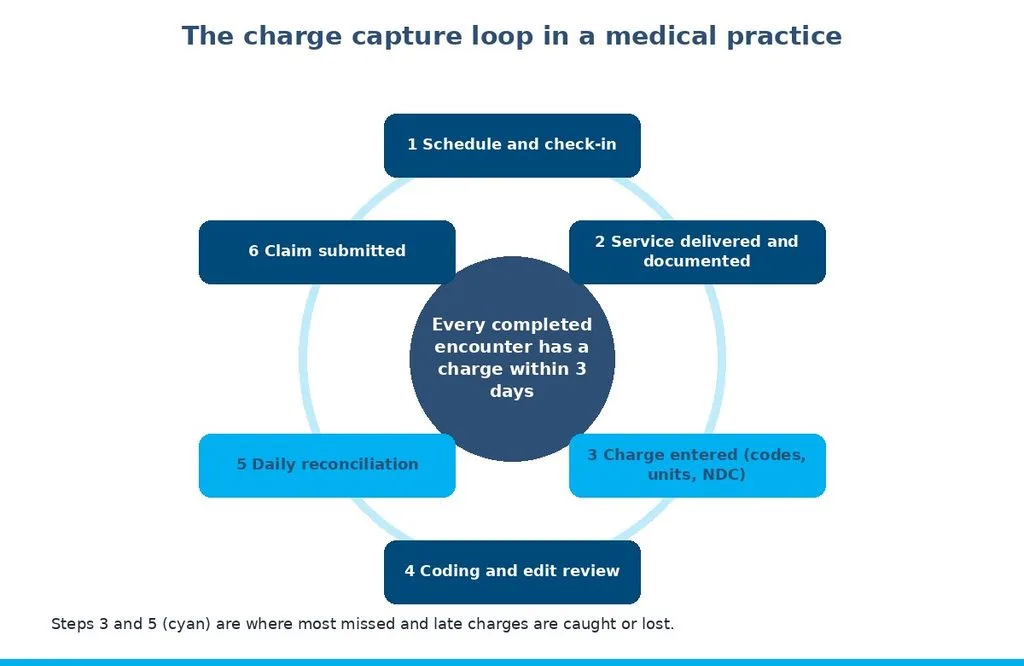
The process runs as a loop from scheduling to claim submission, closed each day by charge reconciliation. Charges are created when services are documented, entered and reviewed, and reconciliation confirms that every completed encounter produced a charge.
- Scheduling and check-in create the encounter that should later carry a charge.
- The provider delivers and documents the service, including drugs, supplies, time and add-on services.
- Charges are entered, often generated by the EHR when the note is signed, with codes, units, modifiers and any NDC.
- Coders or charge review staff check codes against the documentation and run edits.
- Daily reconciliation compares completed encounters with posted charges and follows up on any gaps.
- Clean charges move to claim submission.
Integration matters at step 3, where EHR charge routing hands charges to billing. When the EHR and billing system do not pass charges cleanly, items such as drugs or in-office tests can drop out silently; our guide to EHR and billing data exchange explains common interface gaps.
Where do physician practices most often miss charges?
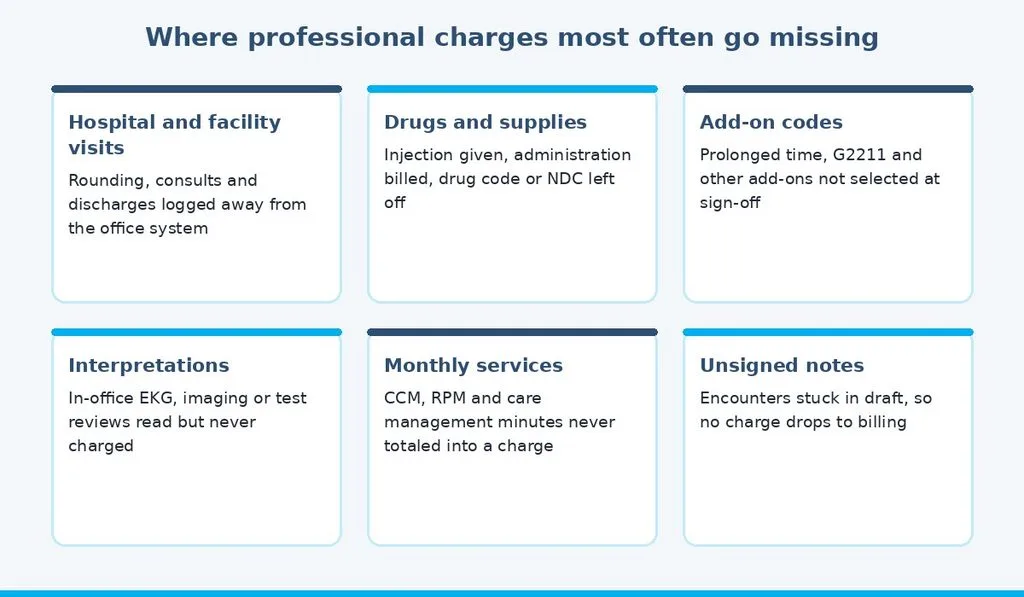
Practices most often miss charges for services delivered outside the main office workflow or attached to another service: hospital visits, drugs and supplies, add-on codes, interpretations, monthly care management time, and notes left unsigned. Each of these produces no automatic signal when it is missed.
Hospital and facility visits
Rounding, consults and discharge visits are often recorded on paper cards, phone notes or a separate hospital system. Without a dependable handoff to billing, these charges arrive late or not at all. A mobile charge capture app lets physicians enter them at the bedside.
Drugs, supplies and injections
A common gap is billing the injection administration code without the drug code, or omitting the units or NDC a payer requires. Our injection administration coding guide covers how the administration and drug lines pair.
Add-on and time-based codes
Add-ons such as prolonged services or the G2211 visit complexity code depend on the provider selecting them at sign-off. The CY 2026 Medicare Physician Fee Schedule extended G2211 to home and residence visits, which adds another place to check. Our prolonged services billing guide covers time thresholds.
Monthly services
Chronic care management, remote physiologic monitoring and similar services accumulate time or device days across a month. If nobody totals them, no charge is created. CPT 2026 added remote monitoring codes for shorter monitoring periods, described in AAPC’s CPT 2026 code set overview, which makes monthly tracking more important. See our guides on chronic care management billing and remote patient monitoring billing.
Unsigned notes
Many EHRs hold the charge until the provider signs the note. A backlog of unsigned notes therefore looks like low volume rather than a billing problem. Tracking open encounters by provider each day exposes it quickly.
In billing reviews, a common pattern is a practice with strong office charge capture and a separate, informal process for hospital work. Office visits post the same day, while hospital charges wait on paper cards for weeks, and some never arrive.
Which charge capture metrics should a practice track?
Track four core metrics: charge lag, missing charge rate, late charge percentage and charges per encounter. Benchmarks published by HFMA put charge lag at 3 days or fewer, missing charges at 1% or fewer of visits, and late charges at 2% or less of total charges.
Table 2. Core charge capture metrics
| Metric | Formula | Practical target | What a miss usually means |
| Charge lag | Total days from date of service to charge entry ÷ encounters | 3 days or fewer | Unsigned notes, hospital charge handoff, staffing |
| Missing charge rate | Completed encounters with no charge ÷ completed encounters | 1% or fewer | No daily reconciliation or broken interfaces |
| Late charge percentage | Charges posted after the claim or cutoff ÷ total charges | 2% or less | Charges entered after the claim was sent |
| Charges per encounter | Charge lines ÷ encounters, by provider and visit type | Close to peers for the same visit type | Drugs, tests or add-ons not captured |
Targets from PwC benchmarks published by HFMA and HFMA’s KPI guidance; charges per encounter is a practical comparison, not a published standard.
HFMA’s article on KPIs providers should be tracking notes that complete charges are typically captured within 3 to 5 days of service and that late charges should not exceed 2% of all charges. These metrics also feed broader dashboards; our list of key revenue cycle dashboard metrics shows where they fit.
How do you calculate charge capture metrics? Worked examples
Each metric is a simple ratio, but it should be calculated by provider, setting and visit type, not only practice-wide. A blended average can look healthy while one provider or location carries most of the problem.
Worked example 1: charge lag by setting
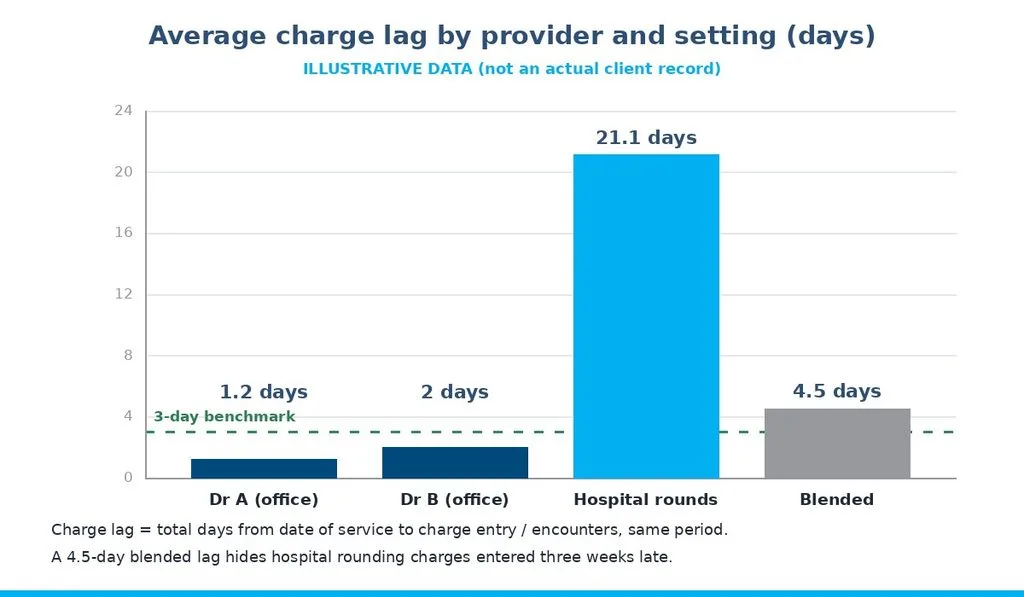
Formula: total days from date of service to charge entry ÷ number of encounters. Illustrative scenario (not an actual client record): Dr A posts 900 office encounters at 1.2 days each (1,080 lag days), Dr B 800 at 2.0 days (1,600), and hospital rounding charges for 300 encounters average 21.1 days (6,330). The blended lag is 9,010 ÷ 2,000, or about 4.5 days.
The blended figure looks only slightly high. The real problem is hospital rounding at three weeks, which risks timely filing for payers with short deadlines and delays cash by a month.
Worked example 2: missing charge rate
Formula: completed encounters with no charge ÷ completed encounters. Illustrative scenario: the schedule shows 2,400 completed encounters in a month, and 2,352 have posted charges. The 48 missing encounters equal a 2.0% missing charge rate, double the 1% benchmark. At an average of $120 per encounter, that is $5,760 for the month.
Worked example 3: late charge percentage
Formula: charges posted after the claim was submitted or after the billing cutoff ÷ total charges. Illustrative scenario: $18,000 of $600,000 in monthly charges posted late, or 3%, above the 2% benchmark. Late charges often require corrected claims and can trigger duplicate-claim edits.
Worked example 4: charges per encounter
Formula: charge lines ÷ encounters, for one visit type and provider. Illustrative scenario: for established diabetes follow-ups, Dr A averages 2.6 charge lines per visit and Dr B 1.4. The gap does not prove an error, but it justifies checking whether Dr B’s in-office tests, such as a point-of-care hemoglobin A1c (CPT 83036), are documented and charged.
How should you interpret these numbers?
Compare like with like: the same setting, visit type, provider group and period. Office visits, hospital work and monthly services move through different workflows, so a single practice-wide lag hides more than it shows. Treat one missed benchmark as a reason to trace encounters, not as a verdict.
Read the metrics together. Low charge lag with a high missing charge rate means charges that arrive do so quickly, but some never arrive. Normal lag with low charges per encounter points to items left off the charge rather than delays. Before changing workflows, run an internal medical billing compliance audit on a sample of encounters to confirm whether the gaps are missed charges, undercoding or documentation.
How do payer rules affect charge capture?
Payer rules turn late charges into lost charges once filing deadlines pass, and they decide how a late charge must be added to a claim that has already been sent. Encounter data also matters for payers that do not pay per service.
Table 3. Illustrative payer considerations for charge capture
| Payer type | Filing deadline | Adding a late charge | Why capture still matters |
| Medicare | 12 months from date of service | Corrected or new claim per MAC instructions | Payment per service; audit trail |
| Medicare Advantage | Plan contract, often shorter than Medicare | Plan corrected-claim rules | Encounter data supports risk adjustment and quality |
| Medicaid | State-specific | State corrected-claim rules | Managed care encounter reporting |
| Commercial | Contract-specific, often 90 to 180 days | Payer corrected-claim rules | Payment per service; contract compliance |
Illustrative summary; filing limits and corrected-claim rules vary by payer, state and contract. Confirm each payer’s deadlines in your contracts.
For capitated or value-based contracts, a zero-paid encounter still needs to be captured and reported. Missing encounter data can understate patient risk and quality performance, which affects payment even when no fee-for-service claim is paid.
What does good charge capture look like in practice? Lessons from HFMA
The clearest published example comes from hospitals, but the lessons apply to practices: measure missing charges daily, assign ownership, and fix the workflow that produced the gap rather than chasing charges one at a time.
HFMA reported that Novant Health uncovered $7.5 million in recoverable net revenue in 15 months after adopting a charge integrity system, at a point when it was seeing more than 1,200 missing-charge errors a week. A separate HFMA analysis of capturing all charges estimates hospitals lose as much as 1% of potential annual net revenue to charge capture issues.
Those are hospital figures, and a physician practice has fewer charge types and simpler workflows. The same revenue leakage mechanism applies, though: missed charges cluster in a few predictable places, and daily reconciliation is what finds them.
What is the step-by-step process for improving charge capture?
Improve charge capture in the order that finds the biggest gaps first: measure, reconcile daily, fix the source workflows, then audit. The steps below fit most small and mid-size practices.
- Calculate baseline charge lag, missing charge rate and late charge percentage by provider and setting.
- Start daily reconciliation: compare every completed encounter with posted charges and assign follow-up for gaps.
- Track unsigned notes daily and set a sign-off expectation, such as within 24 to 48 hours.
- Move hospital and off-site charges into a dependable channel, such as a mobile app or same-day handoff.
- Build EHR prompts or charge templates for drugs, supplies, in-office tests and common add-ons.
- Set up monthly totaling for time-based services such as CCM and remote monitoring.
- Audit a sample of encounters each quarter to confirm charges match documentation in both directions.
Practices that find many visits coded too low as well as missing should address both; our guide on how to fix under-coded claims covers the coding side.
How long does it take to improve charge capture?
Daily reconciliation and unsigned-note tracking can start within days, while workflow changes and stable metrics take a few months. Treat these as general planning ranges, not guarantees.
Reconciliation reports and an unsigned-note list are often running within 1 to 2 weeks. EHR templates, drug and supply prompts and a new hospital charge workflow usually take 4 to 8 weeks. Charge lag and missing charge rates typically show partial improvement within the first month and settle over one to two quarters as habits change.
What are the most common charge capture mistakes?
The most common mistakes are relying on denials to reveal problems, skipping daily reconciliation, and treating charge capture as a billing-only task. Each has a straightforward control.
Waiting for denials to reveal problems
Missing charges never produce a denial. Only reconciliation between the schedule and posted charges exposes them.
Reconciling weekly or monthly instead of daily
The longer the gap, the harder it is to recover details such as units, drugs or time. Reconcile each business day.
Leaving hospital charges on a separate track
Paper cards and personal notes delay or lose charges. Use one channel with a clear owner and deadline.
Adding charges the note does not support
Reconciliation should prompt the provider to complete documentation, not let staff add charges on their own. Unsupported charges are an overbilling risk.
Ignoring fee schedule maintenance
A charge priced below what a payer allows can leave money uncollected. Review the practice fee schedule at least annually, when the Medicare Physician Fee Schedule and contracts update.
A pattern that shows up repeatedly in practice reviews is treating charge capture as the billing team’s job alone. Providers control documentation, sign-off and add-on selection, so the metrics should be shared with them by provider, not only reported to the billing office.
Quick Summary
- Charge capture turns documented care into billable charges and determines everything downstream.
- Missed charges never trigger denials; daily reconciliation is the only reliable way to find them.
- Benchmarks published by HFMA: charge lag of 3 days or fewer, missing charges at 1% or fewer of visits, late charges at 2% or less.
- Hospital visits, drugs and supplies, add-ons, monthly services and unsigned notes are the usual leakage points.
- Calculate every metric by provider and setting, because blended averages hide the problem area.
Self-Assessment Checklist
Answer yes or no for your practice:
- Do you reconcile completed encounters against posted charges every business day?
- Is your average charge lag 3 days or fewer in every setting, including hospital work?
- Is your missing charge rate 1% or lower?
- Are late charges 2% or less of total charges?
- Do you track unsigned notes by provider every day?
- Do hospital and off-site charges reach billing through a single dependable channel?
- Do charge templates prompt for drugs, supplies and in-office tests?
- Are CCM, remote monitoring and other monthly services totaled and charged each month?
- Do you compare charges per encounter by provider for the same visit types?
- Do quarterly audits confirm that charges match documentation in both directions?
Scoring: 9 to 10 yes answers means strong charge capture controls; keep monthly reviews. 6 to 8 yes answers means targeted gaps; fix the “no” items within one quarter. 5 or fewer means charges are likely being missed or delayed; prioritize daily reconciliation and a charge audit.
When should a practice consider professional support?
Consider outside support when charge capture problems persist after you have set up reconciliation and sign-off rules. These signals usually mean the in-house approach has reached its limits:
- Missing charges stay above 1% of visits for two or more months.
- Hospital or off-site charges regularly arrive more than a week late.
- Nobody owns daily reconciliation when staff are out.
- Charges per encounter vary widely between providers for the same visit types.
- Monthly services such as CCM or remote monitoring are delivered but not billed consistently.
When evaluating help, look for teams that reconcile encounters to charges daily, report lag and missing charges by provider and setting, work with providers on documentation, and audit charges against the record. A medical billing audit service can establish a baseline before you change workflows.
Aspect Billing Solutions is one example of this kind of partner. Its medical billing and coding services cover end-to-end billing and coding, credentialing, eligibility verification and prior authorization, denial management, A/R follow-up and compliance support, with a dedicated agent assigned to each provider. Results vary by practice, specialty and payer mix. You can review how the team handles revenue cycle management for medical practices.
Final Considerations
Charge capture in medical billing is where revenue is either recorded or quietly lost. Because missing charges never produce a denial, the only defense is a daily check that every completed encounter has a charge, backed by provider-level metrics.
Some figures here are published benchmarks: charge lag of 3 days or fewer, missing charges at 1% or fewer of visits and late charges at 2% or less, from HFMA and PwC benchmarks published by HFMA. The 1% revenue loss estimate and the Novant Health results are hospital data. Medicare’s 12-month filing limit is a CMS rule. All worked-example figures are illustrative.
The natural next question is how your own encounters compare. Pull one month of schedules and posted charges, calculate the four metrics by provider and setting, and score the checklist. If the gaps are larger than your team can close, explore charge capture and revenue cycle support from Aspect Billing Solutions.
Frequently Asked Questions
What is the difference between charges capture and charge entry?
Charge capture records that a billable service was provided, usually through the provider’s documentation and sign-off. Charge entry puts that charge into the billing system with codes, units, modifiers and fees. Many EHRs combine both when a note is signed, but the steps have different owners and different error types.
What is a good charge lag in medical billing?
A practical target is 3 days or fewer from date of service to charge entry, based on PwC benchmarks published by HFMA; HFMA’s KPI guidance cites 3 to 5 days. Measure lag separately for office visits, hospital work and monthly services, because a blended average can hide one slow workflow.
What is a good missing charge rate?
A commonly cited benchmark is 1% or fewer of completed visits with no charge, from PwC benchmarks published by HFMA. Calculate it daily by comparing completed encounters on the schedule with posted charges. A higher rate usually points to unsigned notes, hospital charge handoffs or interface failures between the EHR and billing system.
How much revenue do practices lose to poor charge capture?
HFMA-published analysis estimates hospitals lose as much as 1% of potential annual net revenue to charge capture issues. No named national figure exists for physician practices, so each practice should measure its own missing charge rate and multiply missed encounters by its average charge per encounter.
What causes missed charges in a physician practice?
The most common causes are hospital visits recorded outside the office system, drugs and supplies left off injection claims, add-on codes not selected, monthly services such as CCM not totaled, and notes left unsigned. Daily reconciliation between the schedule and posted charges catches most of them.
Does charge capture matter under value-based or capitated contracts?
Yes. Even when a service is not paid per claim, the encounter must be captured and reported. Medicare Advantage and Medicaid managed care plans use encounter data for risk adjustment and quality measurement, so missing encounters can reduce payment and understate patient complexity.
Sources and Methodology
(a) Published standards and definitions: CMS Medicare timely filing rule (12 months from date of service); CY 2026 Medicare Physician Fee Schedule final rule (CMS-1832-F) for G2211 home and residence visits; AMA CPT 2026 code set changes for remote monitoring as summarized by AAPC.
(b) Named benchmarking data providers: HFMA, “7 KPIs providers should be tracking” (charge capture within 3 to 5 days; late charges at or below 2%); PwC revenue cycle benchmarks published by HFMA (charge lag of 3 days or fewer; missing charges at or below 1% of visits; late charges at or below 2% of gross revenue).
(c) Practical or illustrative targets: charges per encounter comparison, sign-off expectations, timeframes to improvement and all worked-example figures are practical or illustrative and not client records. Payer filing deadlines other than Medicare are general patterns; confirm with each contract.
(d) Survey or study data: HFMA-published consultant analysis estimating hospitals lose up to 1% of potential annual net revenue to charge capture issues; HFMA case report on Novant Health ($7.5 million in recoverable net revenue in 15 months; more than 1,200 weekly missing-charge errors before the change).
Results vary by practice, specialty, payer mix and workflow. Figures reflect information available at the time of research (October 2026). CPT, HCPCS and ICD-10 codes, the Medicare Physician Fee Schedule and payer contracts change at least annually, so review this guidance each year.