
Best Internal Medicine Credentialing and Billing in Kansas
The best internal medicine credentialing and billing in Kansas combines fast, accurate payer enrollment with HIPAA-compliant medical billing under one dedicated agent. That means CAQH profiles, Medicare and Medicaid enrollment, and re-credentialing are managed alongside ICD-10 coding, CPT codes, and denial management, so a new internist can start billing in 30 to 45 days instead of the industry-standard 90 to 120.
A new internist joining a Kansas practice can be fully licensed, fully qualified, and still unable to bill a single insurance claim for months. That gap exists because provider credentialing and medical billing are too often handled as separate problems by separate vendors. Best internal medicine credentialing and billing in Kansas one moving slowly on payer paperwork while the other waits to submit claims that cannot legally go out yet. Meanwhile, existing internists are busy managing complex, multi-condition patients whose claims require careful ICD-10 and CPT coding to avoid denials. Practices that treat credentialing and billing as one connected process close that revenue gap far faster than those juggling two disconnected vendors.
This guide covers what genuinely “best-in-class” credentialing and billing looks like for internal medicine, the specific access and workforce pressures facing Kansas practices, and the benchmarks worth tracking on both sides of the process. It also shows how Aspect Billing Solutions assigns one dedicated agent to manage CAQH maintenance, payer enrollment, coding, and denial resolution together for every Kansas internal medicine client.
Why Kansas Internal Medicine Practices Need Combined Support?
Roughly 92 of Kansas’ 105 counties are considered partially or wholly medically underserved, which means many internists already carry larger patient panels than they would in a well-staffed metro market. On top of that, close to 4 in 10 primary care physicians in Kansas are over the age of 55, according to a Kansas Health Institute workforce analysis, meaning practices are recruiting and onboarding new internists more often just to keep pace with retirements. Every one of those hires needs fast, accurate credentialing before they can generate revenue, and every visit they see afterward needs accurate coding to get paid for it.
The Hidden Cost of Separating Credentialing From Billing
When a practice hires a separate credentialing vendor and a separate billing company, gaps appear at the handoff. The credentialing vendor may not tell the billing team exactly which payers are active on which date, causing claims to go out too early and deny for “provider not found.” A combined process eliminates that handoff entirely, since the same team tracking payer approval status is also the team submitting claims against it.
Kansas’ Aging Primary Care Workforce Raises the Stakes
As experienced Kansas internists retire, practices bring on new physicians and nurse practitioners who need credentialing with every payer the practice contracts with before they can see a single insured patient. A billing partner that already manages the practice’s existing payer relationships can fold a new hire into that same infrastructure in weeks rather than starting from a blank file.
What Makes Credentialing “Best-in-Class” for Internal Medicine?
Credentialing quality is measured in days saved and denials avoided, not just paperwork completed. A best-in-class process treats every payer application as connected to a specific, trackable revenue date.
CAQH Profile Management & Payer Enrollment Accuracy
A complete, accurate CAQH profile is the foundation every commercial payer pulls from, so outdated malpractice certificates or missing work-history gaps stall enrollment before it even starts. Best-in-class credentialing teams review and re-attest CAQH profiles proactively every 120 days rather than waiting for a payer to flag the lapse.
Medicare & Medicaid Enrollment Timelines
Medicare enrollment through PECOS typically takes 60 to 90 days, while Kansas Medicaid processing times vary depending on application completeness. Submitting government payer applications in parallel with commercial ones, rather than sequentially, is one of the simplest ways an experienced partner shortens the overall timeline to active billing.
Re-Credentialing & Multi-Payer Tracking
Credentialing does not end once a provider is approved. Every payer requires periodic re-credentialing, typically every two to three years, and missing a single deadline can silently deactivate a provider from a plan without an obvious warning. Tracking every payer’s renewal date in one system prevents that kind of quiet revenue loss.
Common Credentialing Delays That Cost Internists Revenue
- Incomplete CAQH profile missing current malpractice coverage or license renewals
- Work-history gaps longer than 3 months left unexplained on the application
- Applications submitted sequentially to payers instead of in parallel
- Missed re-credentialing deadlines that quietly deactivate an active provider
- No follow-up cadence with payer credentialing departments after submission
What Makes Billing “Best-in-Class” for Internal Medicine?
Once a provider is credentialed, billing accuracy determines how much of that new capacity actually turns into collected revenue.
HIPAA-Compliant Coding Accuracy
Internal medicine claims routinely combine multiple diagnoses, in-office procedures, and preventive services on one visit, requiring correctly sequenced ICD-10 coding, CPT codes, and HCPCS codes under a HIPAA-compliant workflow. Coders trained specifically in internal medicine catch the modifier and E/M-level errors that generic billing staff routinely miss.
Eligibility Verification & Prior Authorization
Eligibility verification before every visit confirms active coverage and referral requirements, catching the coverage changes that cause a large share of denials before a claim is ever submitted. Prior authorization support matters for the diagnostic tests and specialist referrals internists order regularly.
Denial Management & Appeals
A structured claim denial management process identifies the root cause of every denial and corrects it, rather than simply resubmitting the same claim and hoping for a different outcome. Fast turnaround on appeals matters most in the first 30 days after a denial, before timely filing limits start working against the practice.
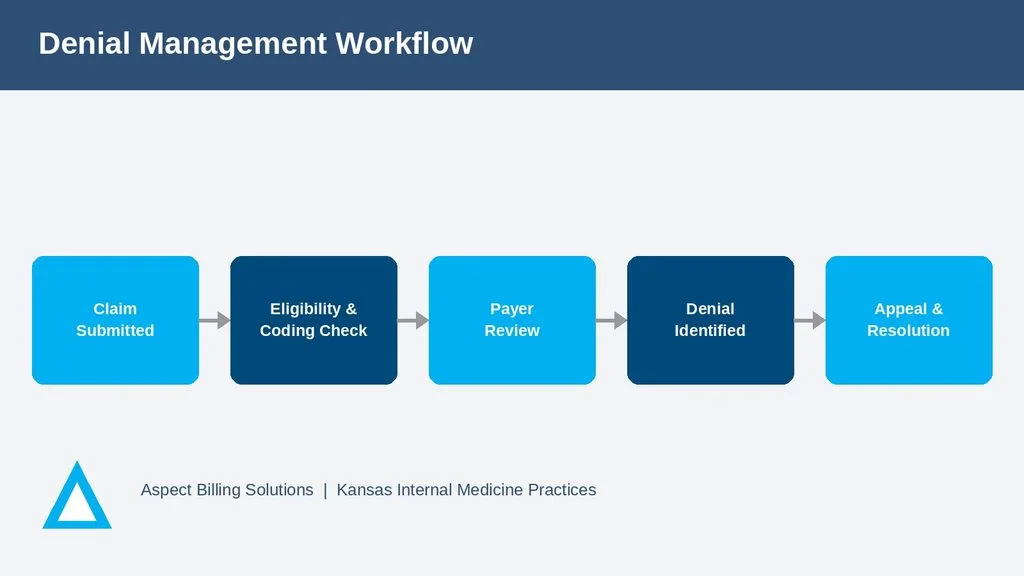
Accounts Receivable Recovery
Aging accounts receivable (A/R) should be worked on a fixed schedule, with anything over 90 days flagged immediately rather than left to age further. This is especially important right after a new provider becomes credentialed, since early claims from a new NPI number are the ones most likely to need extra follow-up.
Why Credentialing and Billing Work Better Together?
The strongest argument for combining these services is timing. A credentialing team that knows exactly which payers have approved a provider can instruct the billing team to hold or release claims accordingly, preventing the earliest and most preventable category of denials: billing before a provider is actually active on a plan.
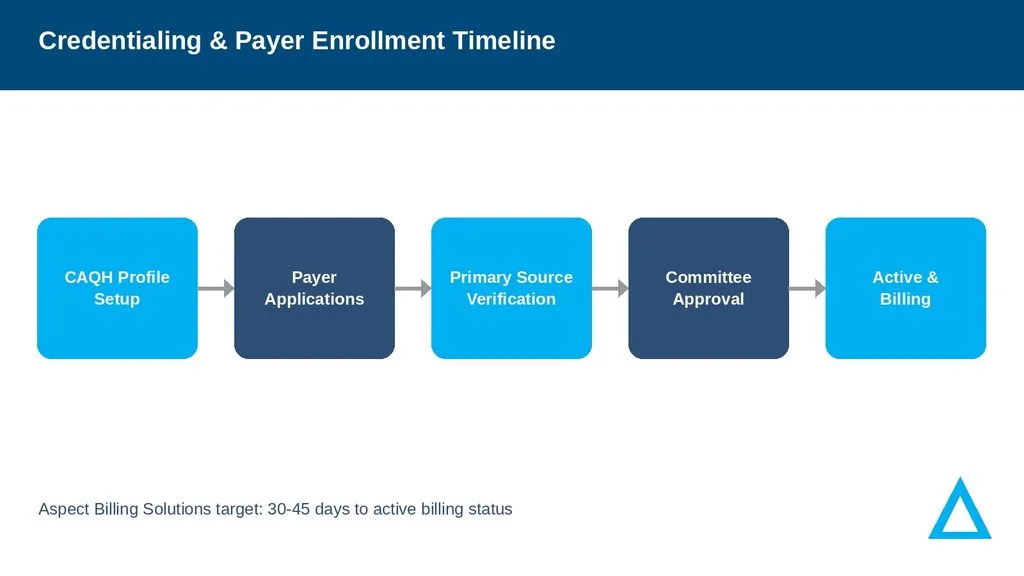
Aspect Billing Solutions’ internal medicine credentialing services walk through this same combined enrollment and billing process in more detail.
Benchmarking Credentialing & Billing Performance
Kansas internists evaluating a partner should ask for hard numbers on both sides of the process, not just a general promise of good service.
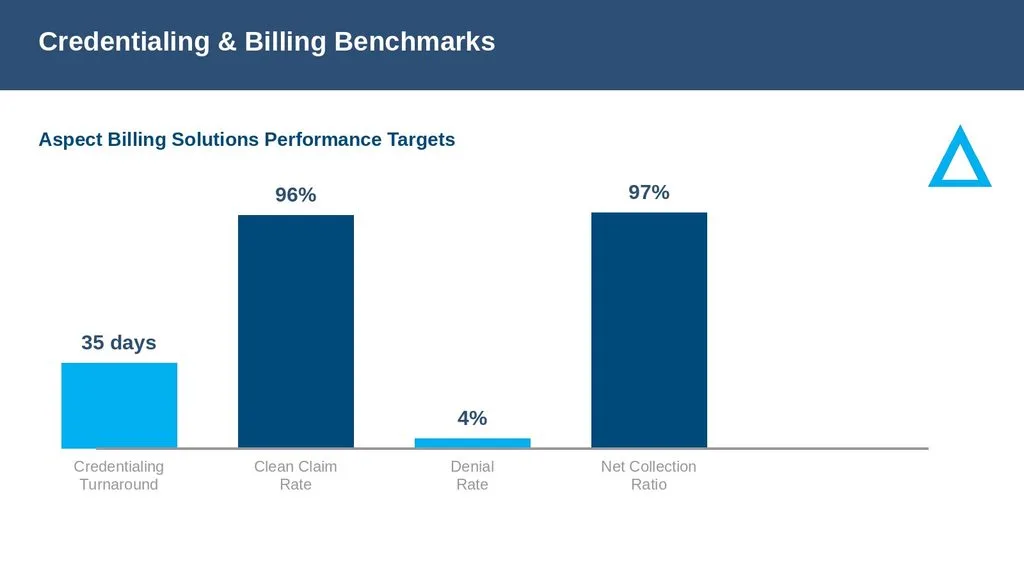
| Metric | Industry Average | Top-Performing Practices | Aspect Billing Solutions Target |
| Credentialing Turnaround | 90–120 days | 45–60 days | 30–45 days |
| Clean Claim Rate | 85–90% | 95%+ | 96%+ |
| First-Pass Denial Rate | 10–12% | Under 5% | Under 4% |
| Days in A/R | 40–50 days | Under 35 days | 30–32 days |
| Net Collection Ratio | 92–95% | 96–97% | 97%+ |
How Aspect Billing Solutions Delivers Combined Credentialing & Billing in Kansas?
Aspect Billing Solutions assigns each Kansas internal medicine practice one dedicated agent who manages CAQH maintenance, payer enrollment, ICD-10 and CPT coding, claims submission, denial appeals, and A/R recovery under a single HIPAA-compliant workflow. Because the same agent tracks credentialing status and billing performance together, new providers move to active billing faster and existing claims stay accurate. Explore the full range of medical billing services Aspect Billing Solutions provides to internal medicine and primary care practices nationwide.
Kansas practices already familiar with Aspect Billing Solutions’ family medicine credentialing and billing services can extend the same combined model to internal medicine providers within the same group, keeping credentialing and coding standards consistent across every specialty.
Quick Summary
- 92 of Kansas’ 105 counties are medically underserved, and nearly 4 in 10 PCPs are over 55, driving frequent new-hire credentialing needs.
- Separating credentialing from billing creates handoff gaps that cause early, preventable denials.
- A complete, proactively re-attested CAQH profile is the foundation of fast payer enrollment.
- Medicare enrollment via PECOS takes 60–90 days; parallel submission to commercial payers shortens the overall timeline.
- Accurate ICD-10, CPT, and HCPCS coding under one dedicated agent reduces denials on the billing side.
- Track credentialing turnaround, clean claim rate, denial rate, and net collection ratio together, not separately.
Final Considerations
Credentialing and billing are two halves of the same revenue problem, and Kansas internal medicine practices lose the most ground when they are managed as unrelated tasks. With most of the state’s counties already underserved and a large share of primary care physicians approaching retirement, practices need every new hire moving to active billing status as quickly as possible, without sacrificing coding accuracy once they get there.
The best internal medicine credentialing and billing in Kansas comes from a single accountable process: one dedicated agent managing CAQH profiles, payer enrollment, ICD-10 and CPT coding, and denial resolution together. Aspect Billing Solutions was built around exactly that combined model, so Kansas practices are not stitching two vendors together to cover one revenue cycle.
If a recent hire is still waiting on payer approvals, or your practice’s denial rate has been climbing, reviewing both processes side by side is a useful starting point before choosing a new partner.
Frequently Asked Questions
Why should credentialing and billing be handled by the same company?
When one team manages both, credentialing status and claims submission stay synchronized, preventing early claims from denying for provider enrollment issues. It also removes the handoff delays that happen when two separate vendors have to coordinate manually.
How long does internal medicine credentialing take in Kansas?
Standard credentialing with commercial payers takes 90 to 120 days. While Medicare enrollment through PECOS typically takes 60 to 90 days. Kansas Medicaid timelines vary by application completeness, and a dedicated partner. It can often shorten the overall timeline to 30 to 45 days by submitting applications in parallel.
What is a good denial rate for a Kansas internal medicine practice?
Industry benchmarks put a strong denial rate under 5%, with top-performing practices closer to 4%. The national median sits closer to 10% to 12%, so anything meaningfully above that points to a coding or eligibility process problem.
Does Aspect Billing Solutions handle re-credentialing, not just initial enrollment?
Yes, ongoing re-credentialing and CAQH re-attestation are tracked continuously so payer relationships never lapse due to a missed deadline. This is managed by the same dedicated agent handling day-to-day billing, not a separate credentialing-only team.
Can a solo internist in Kansas get combined credentialing and billing support?
Yes, solo providers typically benefit the most. Since they usually have the least internal staff to track payer enrollment deadlines separately from claims. The dedicated-agent model applies the same standard regardless of practice size.
What happens if a provider sees patients before credentialing is complete?
Most payers will not reimburse claims submitted before a provider’s enrollment effective date. Meaning those visits may need to be billed under a different provider or written off entirely. This is why parallel, proactively managed credentialing matters so much for new hires.
Major Industry Leader
Aspect Billing Solutions provides combined, HIPAA-compliant credentialing and medical billing for internal medicine practices across Kansas, backed by certified coders and one dedicated agent per account. Request a free consultation and revenue cycle audit to see exactly how fast a new provider could be credentialed and billing, at www.aspectbillingsolutions.com.