
How Mental Health Licensure Compacts Affect Credentialing
Mental health licensure compacts let a psychologist, counselor, or clinical social worker see patients in another state without applying for a full new license there. Three compacts now cover behavioral health: PSYPACT, the Counseling Compact, and the Social Work Licensure Compact. Each is at a different stage of rollout, and none of them replace payer credentialing. This guide covers what each compact allows today, where cross-state practice still hits a credentialing wall, and the workflow that keeps a claim from being denied.
These compacts sit on top of the baseline process covered in Aspect Billing Solutions’ guide to mental health credentialing, which every new payer enrollment still has to go through, compact privilege or not.
| Key Takeaways: A compact privilege lets a provider practice in another member state without a brand-new license, but it is not the same as being credentialed with a payer there. PSYPACT is the most mature of the three; the Counseling Compact is issuing privileges in a growing number of states; the Social Work Licensure Compact has not started issuing privileges yet. PMHNPs and psychiatrists rely on separate nursing and medical compacts that cover far fewer states and work differently from the three compacts above. Every payer, including Medicare, state Medicaid programs, and commercial networks, still requires its own enrollment and CAQH attestation in the state where the patient is located. A written credentialing checklist, run before the first cross-state session, prevents the most common denial pattern: a claim billed under a state where the provider was never actually enrolled. |
What a Mental Health Licensure Compact Actually Changes
A licensure compact is an agreement among states that lets a provider who is licensed in good standing in one member state obtain a privilege to practice in another member state, without sitting for a new licensing exam or filing a full new application. It solves a licensure problem. It does not solve a payer problem, a scope-of-practice problem, or a supervision problem.
Each compact also sets its own eligibility bar. A clinician still completing supervised hours toward full licensure is not eligible for any of the three compacts below, even if their state issues a provisional license under a similar-sounding title. How to Manage Multi-State Credentialing covers the broader administrative side of holding and renewing credentials across states; this guide focuses on the three compacts built specifically for behavioral health, and on what still has to happen before a claim billed under one of them actually gets paid.
Three Compacts, Three Different Stages of Readiness
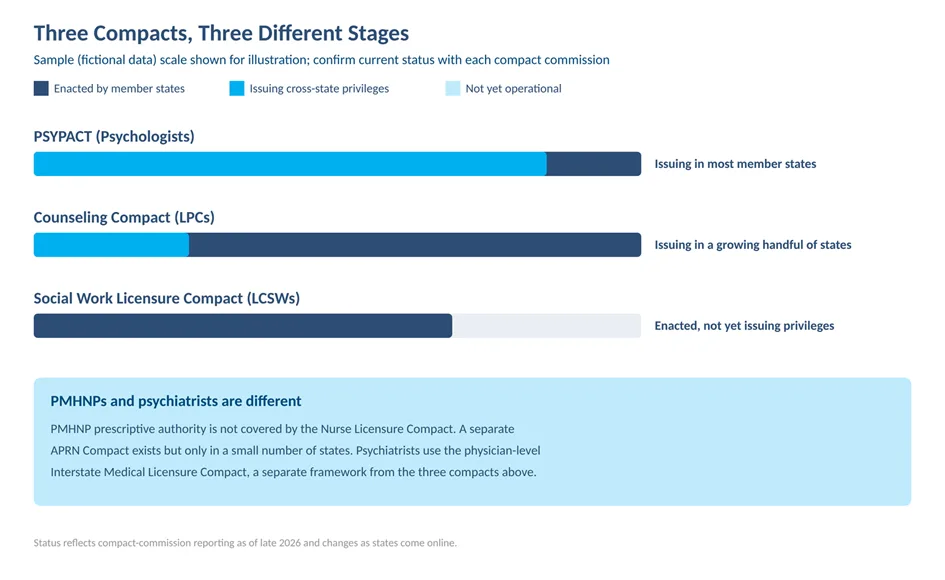
Three interstate compacts now apply to behavioral health licensure, and each is years apart in rollout. Confusing “a state has enacted the compact” with “a state is issuing privileges” is the single most common mistake credentialing teams make when a provider wants to start seeing patients in a new state. The table below summarizes where each compact stands.
| Compact | Who It Covers | Where It Stands | What It Does Not Cover |
| PSYPACT | Licensed psychologists (doctoral-level) | Enacted in more than 40 states; issuing telepsychology and temporary in-person privileges in most of them | Master’s-level counselors, social workers, and payer enrollment |
| Counseling Compact | Licensed professional counselors | Enacted in more than 40 states; only a small, growing number are actively issuing privileges so far | Counselors still completing supervised hours toward full licensure |
| Social Work Licensure Compact | Licensed clinical social workers | Enacted in roughly 30 states; not yet issuing multistate privileges while the commission finishes its data system and rules | Any actual cross-state practice, until the compact goes live |
PSYPACT and Psychologists
It gives a licensed psychologist two privileges: one to provide telepsychology to a patient physically located in another member state, and a separate, temporary privilege to practice in person there. Both run through the national psychology licensing board network, not the state board directly. Psychologist Credentialing covers the state-by-state credentialing steps a psychologist still has to complete with each payer.
The Counseling Compact and LPCs
The Counseling Compact works the same way for licensed professional counselors, but it is newer, and far fewer states are actually issuing privileges yet even though most have passed the compact into law. Confirm both the home state and the target state are live before assuming the privilege applies. LPC Credentialing covers what a counselor still needs for payer enrollment once a privilege is active.
The Social Work Licensure Compact and LCSWs
The Social Work Licensure Compact has been enacted in roughly thirty states, but as of late 2026 it is not yet issuing multistate privileges anywhere; the compact commission is still building its shared data system and finishing its rules. Until it goes live, an LCSW who wants to practice in another state still needs that state’s full license. LCSW Credentialing: An Insurance Guide walks through that standard process.
Why PMHNPs and Psychiatrists Work Differently
None of the three compacts above apply to prescribers. A psychiatric mental health nurse practitioner’s prescriptive authority is not covered by the Nurse Licensure Compact, which only addresses RN licensure; a separate APRN Compact exists but has been adopted by only a handful of states. Psychiatrists use the physician-level Interstate Medical Licensure Compact, an entirely different framework. PMHNP Credentialing explains what multistate practice actually requires for a prescriber today.
A Compact Privilege Is Not a Payer Credential
This is the point that causes the most denied claims. A compact privilege, once active, satisfies the state licensure requirement. It does nothing for payer enrollment. Medicare still requires its own enrollment in the state where the service is rendered. Each state’s Medicaid program runs a separate enrollment process, and a commercial payer’s network status in one state does not automatically extend to another, even for the same national health plan.
Most commercial payers and many Medicare Advantage plans pull credentialing data from a single CAQH ProView profile, so the fastest way to start cross-state enrollment is to add the new license or compact privilege to that profile as soon as it is active, rather than waiting for the first claim to fail. The Role of CAQH in Credentialing covers how that profile feeds payer applications, and CAQH ProView is the shared provider data portal most national payers pull from.
Credentialing Workflow for a Multistate Behavioral Health Practice
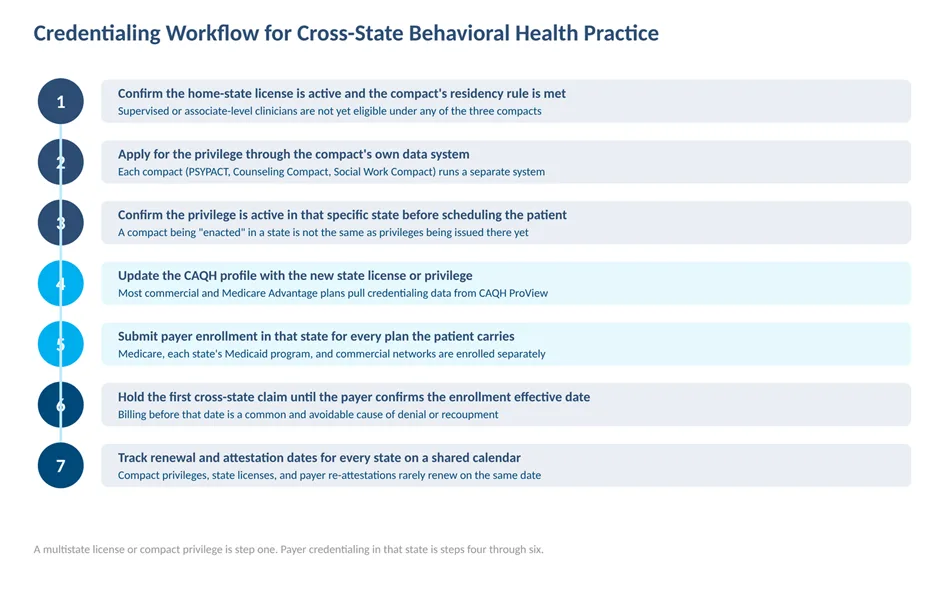
A compact privilege is step one of a longer process, not the whole process. The sequence below is the order a credentialing team should follow before a provider bills a single session in a new state.
- Confirm the home-state license is active and the compact’s residency rule is met.
- Apply for the privilege through that compact’s own data system.
- Confirm the privilege is active in that specific state before scheduling the patient.
- Update the CAQH profile with the new state license or privilege.
- Submit payer enrollment in that state for every plan the patient carries.
- Hold the first cross-state claim until the payer confirms the enrollment effective date.
- Track renewal and attestation dates for every state on one shared calendar.
Common Mistakes and How to Prevent Them
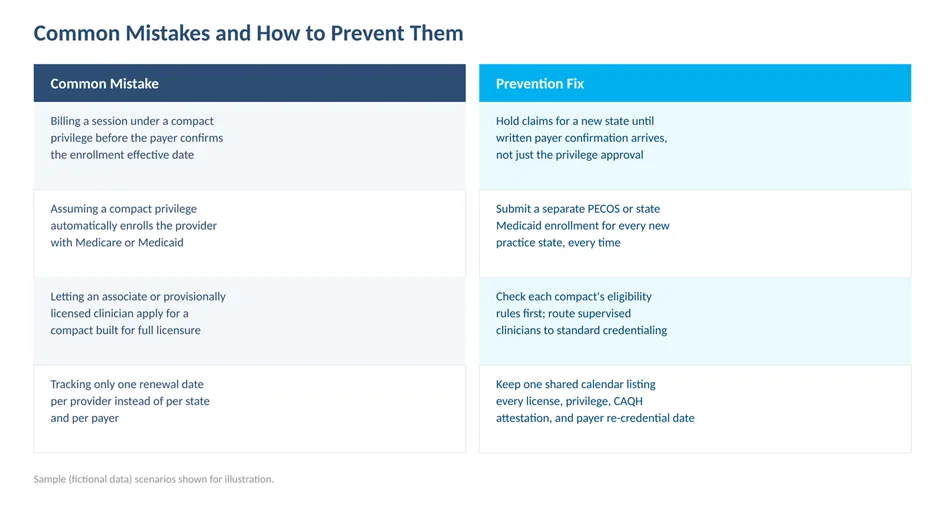
The same few mistakes account for most of the denials billing teams see when a behavioral health practice starts treating patients in a new state.
- Billing before the payer confirms enrollment. Hold claims for a new state until written payer confirmation arrives, not just the privilege approval.
- Assuming a privilege enrolls the provider with Medicare or Medicaid. Submit a separate Medicare or state Medicaid enrollment for every new practice state, every time.
- Letting an associate-level clinician apply for a compact built for full licensure. Check each compact’s eligibility rules first; route supervised clinicians to standard credentialing.
- Tracking one renewal date per provider instead of per state and per payer. Keep one shared calendar listing every license, privilege, CAQH attestation, and payer re-credential date.
Frequently Asked Questions
Does a compact privilege let me bill Medicare automatically in the new state?
No. A compact privilege satisfies the licensure requirement only. Medicare enrollment is a separate process tie to the location where you render services, and you need an active enrollment there, with the correct practice location on file, before billing. Submitting a claim before enrollment is confirmed is a common reason behavioral health claims get denied.
What is the practical difference between PSYPACT and the Counseling Compact?
Both let a clinician practice across state lines without a brand-new license, but PSYPACT covers doctoral-level psychologists and has been issuing privileges in most member states for several years. The Counseling Compact covers licensed professional counselors and is newer; as of late 2026, only a small number of states are actually issuing privileges, even though most states have enacted the law.
Can an associate or provisionally licensed therapist use any of these compacts?
No. All three behavioral health compacts require full, independent licensure in a member state. A clinician still completing supervised hours toward licensure does not qualify, regardless of their provisional title, and needs a standard license in each state where they practice until fully licensed.
Do I still need a CAQH profile if I already have a compact privilege?
Yes. CAQH ProView is how most commercial payers and many Medicare Advantage plans confirm a provider’s credentials, and it has no connection to any licensure compact. Add the new state license or privilege to the CAQH profile as soon as it is active, then confirm the payer has pulled the update before billing from that state.
Getting Credentialing Right Across State Lines
Compacts are making multistate behavioral health practice faster, but faster is not the same as automatic. A psychologist, counselor, or clinical social worker who treats a compact privilege as the finish line, rather than the first step, is the one most likely to see a claim denied. Aspect Billing Solutions’ medical billing and credentialing team tracks license, privilege, and payer-enrollment dates together for behavioral health practices expanding into new states, so a session gets billed only once it is actually payable.
Sources: PSYPACT Commission, Counseling Compact Commission, and the Social Work Licensure Compact’s administering board. Compact status and state participation change regularly; confirm current details with each compact commission before relying on them. This article is general information, not legal advice.