
LPC Credentialing: A Counselor’s Path to Insurance Panels
LPC credentialing is how a licensed professional counselor gets approved to bill insurers and Medicare. You need an active state license, an NPI, a complete CAQH profile and a separate application for each payer. Since 2024, Medicare also enrolls mental health counselors directly. This guide explains the Medicare rules, the group practice steps and the delays to avoid. If you would rather hand off the paperwork, see our credentialing service.
| Key takeaways Medicare enrolls mental health counselors, and the license title does not decide eligibility.Medicare needs 2 years or 3,000 hours of post-master’s supervised experience.Each state of service needs its own Medicare enrollment form.Medicare payment for counselor services began January 1, 2024, with no earlier effective date. |
Who counts as a counselor for Medicare
LPC, LMHC and LPCC are state license titles. Medicare looks at the underlying requirements instead. The CMS counselor FAQ says the title does not decide eligibility, and the rule at 42 CFR 410.54 sets the standard.
| Requirement | What Medicare requires | Evidence to have ready |
| Degree | Master’s or doctoral degree that qualifies for counselor licensure | Diploma or transcript |
| Experience | At least 2 years or 3,000 hours of post-master’s supervised clinical experience | Supervision statement |
| License | State license or certification where you provide services | License and expiration date |
| Taxonomy | Code 101YM0800X when you apply for an NPI as a counselor | NPPES record |
Addiction and alcohol and drug counselors may enroll as counselors when they meet every requirement. Commercial plans and Medicaid set their own rules, so read each provider manual.
LPC credentialing step by step
The workflow has six stages. Start early, because each payer works on its own timeline.
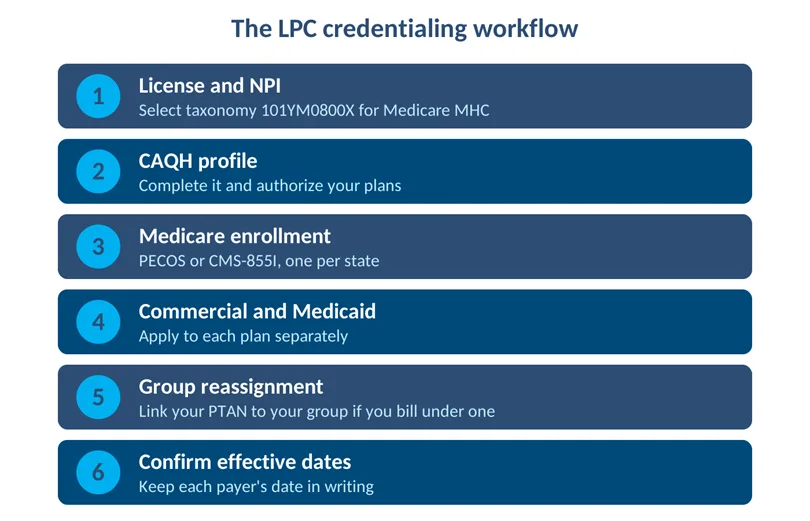
Text summary: confirm license and NPI, complete CAQH, enroll in Medicare, apply to commercial plans and Medicaid, set up group reassignment if needed, then confirm each effective date in writing.
- Set up identifiers. Use the same name and address in NPPES, CAQH and on your license.
- Complete CAQH. Our post on how CAQH fits into credentialing explains what it does and does not replace.
- Enroll with Medicare. Follow the details in the next section.
- Apply elsewhere. File each Medicaid and commercial application separately and log every reference number.
- Confirm dates. Keep each payer’s written effective date before you schedule insured clients.
Medicare enrollment details for counselors
CMS recommends PECOS, the online enrollment system, though you may also file the paper CMS-855I. On paper, choose Undefined Non-Physician Practitioner Specialty and write MHC beside it. You need a separate form for every state where you work, which our guide to multi-state credentialing helps you plan.
If your state license process does not already require supervised experience, send a signed statement on letterhead. CMS does not accept email for this proof. Medicare pays no earlier than January 1, 2024, and it pays counselors 75 percent of the fee schedule amount, according to the CMS mental health booklet.
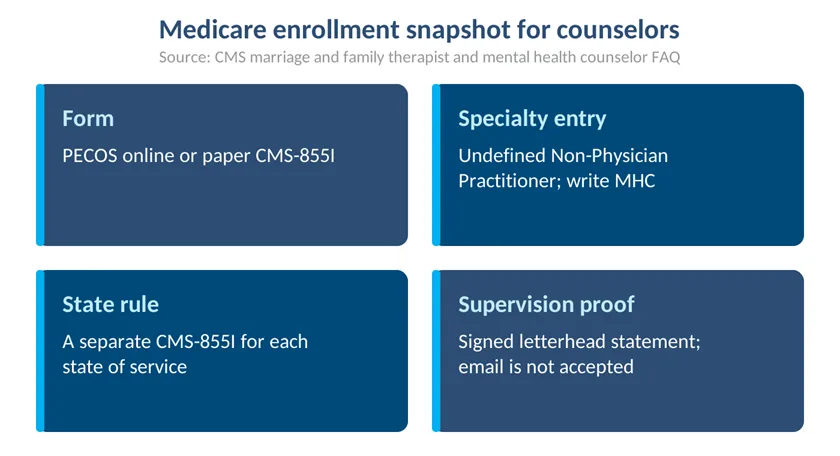
Text summary: use PECOS or the CMS-855I, enter the undefined practitioner specialty with MHC, file one form per state, and send supervision proof on signed letterhead.
Opting out and group practices
Counselors who see Medicare patients but do not enroll must file an opt-out affidavit with their Medicare contractor. The opt-out lasts 2 years and renews automatically unless you give written notice at least 30 days before it ends. It may affect participation in some Medicare Advantage or Medicaid programs.
If you bill through a group, both you and the group must be enrolled or enrolling. The group’s existing PTAN stays the same, and the contractor issues you an individual PTAN linked to the group.
Common LPC credentialing delays
Most delays come from small form and documentation errors.
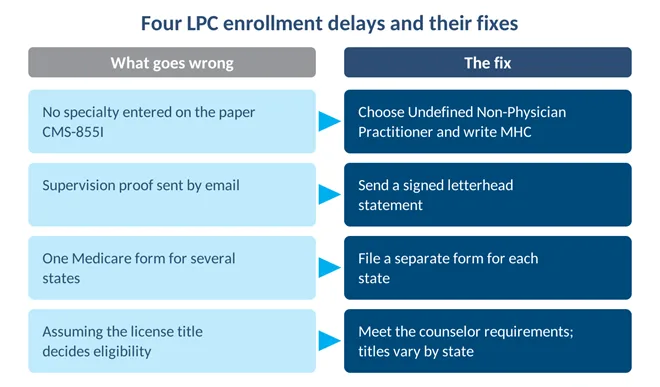
Text summary: enter the right specialty, send signed supervision proof, file one form per state, and do not rely on the license title alone.
Our list of other credentialing errors that delay payments covers more.
Frequently asked questions
How long does LPC credentialing take?
Each payer sets its own timeline, and commercial approvals often take months. Medicare contractors process applications on their own schedule, and CMS recommends PECOS for enrollment. Start before you plan to see insured clients, follow up regularly and wait for a written effective date before billing.
Is an LMHC credentialed differently from an LPC?
Medicare does not treat them differently. CMS says the license title does not decide eligibility, and what matters is meeting the counselor requirements. Titles vary by state, and commercial plans may use their own provider categories, so check each plan’s manual.
Can I bill Medicare for services before January 1, 2024?
No. CMS says Medicare payment for counselor services began January 1, 2024, and it grants no earlier effective date. Claims with earlier dates of service are not payable, so confirm your enrollment effective date in writing before you submit any new claims.
Do I need a separate Medicare form for each state?
Yes. CMS requires a separate CMS-855I for every state where you provide services. Plan the forms early when you practice across state lines, and keep your license, supervision proof, NPI and addresses consistent across each application so the Medicare contractor can match your records without sending requests back to you.
Can I bill under my group’s number?
Yes, after reassignment. Both you and the group must be enrolled or enrolling. Your group’s existing PTAN does not change, and the Medicare contractor issues you an individual PTAN linked to the group, so confirm both records before you bill.
Final Considerations
LPC credentialing moves faster when your license, supervision proof, NPI and CAQH profile match before the first application. Once you are approved, accurate claims come next, and our mental health billing guide covers codes and documentation.
If you want help, send a message through our contact page. Our team replies within 24 hours.
Sources: CMS marriage and family therapist and mental health counselor FAQ; 42 CFR 410.54; CMS Medicare Mental Health booklet (MLN1986542, March 2026). This article is general information, not legal or billing advice. Confirm current rules with each payer.