
LCSW Credentialing With Insurance: A Step-by-Step Guide
LCSW credentialing is how insurers confirm a licensed clinical social worker’s degree, license and supervised experience before adding them to a network. Finish your clinical licensure first, set up your NPI and CAQH profile, then apply to each payer and to Medicare separately. This guide covers the requirements, the steps, the Medicare rules for clinical social workers and the mistakes that delay a start date.
If you would rather have someone else file and follow up on the applications, Aspect Billing Solutions offers credentialing services for behavioral health practices and solo clinicians.
| Key takeaways Payers generally credential clinicians who hold an independent clinical license, so licensure comes first.Medicare has its own enrollment path and its own definition of a clinical social worker.Each payer decides on its own timeline and issues its own start date.Do not schedule insured clients until a start date is confirmed in writing. |
What LCSW Credentialing Covers
Credentialing is the payer’s review of your qualifications. Contracting sets the rates and terms. Enrollment, or roster setup, is when the plan loads you into its system with a start date. These are three separate events, so ask each plan which one a status update refers to. Titles also vary by state, so your license may read LCSW, LICSW or LISW, but payers look for the same thing: an independent clinical license in good standing.
Requirements Before You Apply
Most delays start with an incomplete file. Gather these items before you open a single application, and save each as a clear PDF.
| Requirement | What the payer checks | Tip |
| Social work degree | Master’s or doctoral degree from an accredited program | Keep a diploma or transcript copy ready |
| Independent clinical license | Active license in the state where you see clients | Confirm the license is not a supervised or associate-level license |
| Supervised clinical experience | Post-degree supervised hours, where the payer or Medicare asks | Keep supervisor letters on file |
| NPI | Individual NPI number | Apply once; it stays with you |
| Malpractice coverage | Active policy | Upload the current certificate |
| CAQH profile | Complete, attested profile | Authorize each payer to view it |
Typical LCSW credentialing requirements. Each payer publishes its own list.
Step-by-Step: How LCSWs Get on Insurance Panels
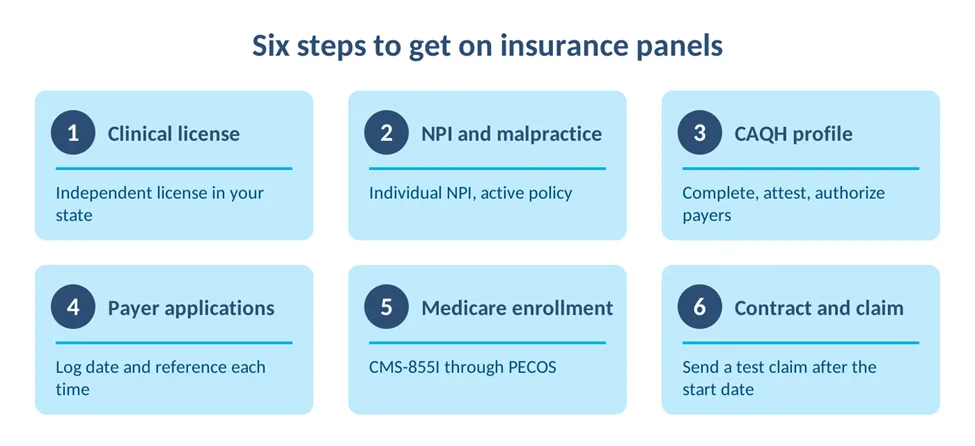
The graphic summarizes six stages: clinical license, NPI and malpractice, CAQH profile, payer applications, Medicare enrollment, then contract and test claim.
- Hold your independent clinical license. Most payers will not review an application until it is issued.
- Set up your NPI and malpractice policy. Both appear on every application.
- Complete and attest your CAQH profile. The role of CAQH in credentialing is to hold your records in one shared profile that many commercial payers read, so keep it current.
- Apply to each payer. Record the date, reference number and contact name for every submission.
- Enroll in Medicare separately. See the next section.
- Review the contract and confirm the start date. Check rates, covered locations and the exact effective date, then send a test claim.
Medicare Enrollment for Clinical Social Workers
Medicare defines a clinical social worker in federal regulation, 42 CFR 410.73. The person must hold a master’s or doctoral degree in social work, have at least two years of supervised clinical social work after the degree, and be licensed or certified as a clinical social worker in the state where services are performed. Where a state has no such license, the rule sets an alternative based on the state’s highest practice-level credential plus supervised practice.
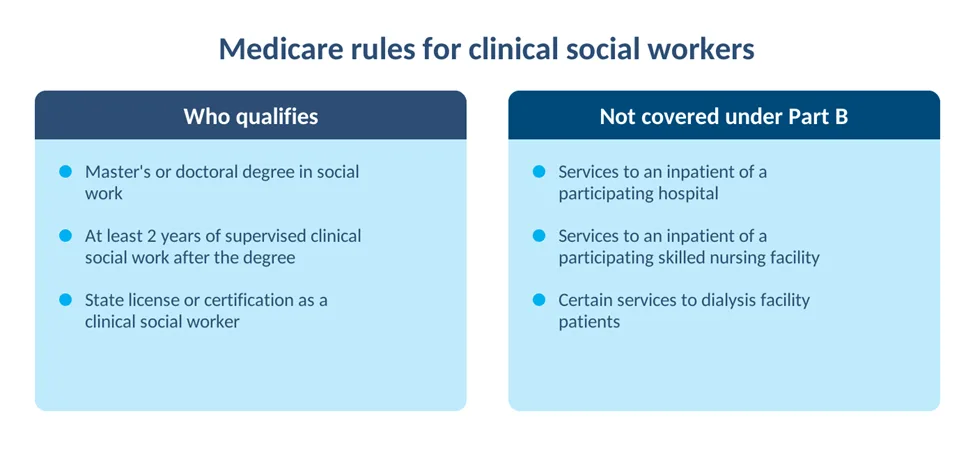
You enroll with the CMS-855I, either on paper or online through PECOS, the Medicare enrollment system. The CMS enrollment applications page lists the forms. The First Coast clinical social worker enrollment page lists the supporting items, including a signed and dated certification statement, proof of your degree, a copy of your license and, unless you reassign benefits to a group, an electronic funds transfer agreement.
Coverage is limited to services for the diagnosis and treatment of mental illness that state law allows you to perform. Part B does not cover these services when they are furnished to inpatients of a participating hospital or skilled nursing facility, or certain services to dialysis facility patients. For how Medicare and Medicaid enrollment differ, see this comparison of Medicare vs. Medicaid credentialing.
How Long Does LCSW Credentialing Take?
There is no fixed timeline. Each payer sets its own review pace, and a complete application moves faster than one that needs corrections. Plan in months, set a separate target date for every plan, and follow up on a schedule instead of waiting for a letter. Treat a start date as real only when the plan states it in writing.
Sample tracker (fictional data)
Use a simple tracker and change the payer names and dates to match your own applications. All details below are fictional.
| Payer | Applied | Status | Start date | Next step |
| Northwind Health PPO | Mar 3 | Approved | Jun 1 | Add second office |
| Harbor Mutual HMO | Mar 3 | Pending | Not issued | Call in 2 weeks |
| Medicare | Mar 10 | More information requested | Not issued | Send license copy |
Sample (fictional data): one row per payer keeps every start date and next step visible.
If you also see clients by telehealth, you generally need a license in the state where the client is located, and payers may credential you per state. This guide to managing multi-state credentialing shows how to track each state.
Common LCSW Credentialing Mistakes
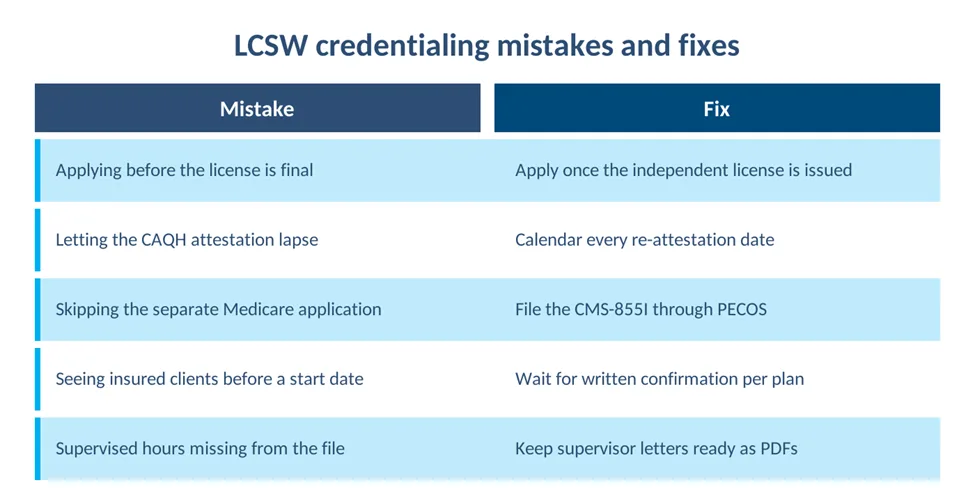
- Applying before the license is final: apply once the independent license is issued.
- Letting the CAQH attestation lapse: calendar every re-attestation date.
- Skipping the separate Medicare application: file the CMS-855I.
- Seeing insured clients before a start date: wait for written confirmation.
- Missing supervised hours documentation: keep supervisor letters ready.
Frequently Asked Questions
Can an LCSW bill Medicare?
Yes, once enrolled. Medicare covers clinical social worker services for the diagnosis and treatment of mental illness that state law allows. You must meet the federal definition, enroll with the CMS-855I and follow the coverage limits, including the exclusions for certain inpatient settings.
How long does it take to get credentialed with insurance?
It depends on the payer, how complete your application is and how fast you respond to requests. Plan on months, track each plan separately, and follow up on a schedule. Wait for a written start date before you book insured clients.
Do I need a separate application for every insurance company?
Yes. Each payer reviews your file and issues its own decision and start date. A complete CAQH profile saves time because many commercial payers read it, but it does not replace each payer’s own approval.
Can I see insured clients while my application is pending?
You can see clients, but do not assume the plan will pay in-network rates. Many plans pay only from the confirmed start date. Ask each payer in writing about earlier dates and tell clients about possible out-of-network costs first.
What if I am not fully licensed yet?
Most payers want an independent clinical license before they credential you. If you are still completing supervised hours, check each payer’s rules for supervised practice, and keep your supervisor documentation organized for when you apply.
Final Considerations
LCSW credentialing rewards preparation: a clinical license in hand, a complete CAQH profile, a log for every application and no insured visits until a start date is confirmed. Once you are in network, clean claims depend on correct coding and documentation, which our mental health billing guide covers for behavioral health practices.
Aspect Billing Solutions is a HIPAA-compliant medical billing and coding company that assigns a dedicated agent to each provider. If you want help with applications or follow-up, contact our team to discuss your practice.
Sources: Medicare regulation 42 CFR 410.73, CMS enrollment resources and First Coast Service Options. Payer rules vary, so follow each payer’s provider manual and contract. This article is general information, not legal advice.