
Psychotherapy Add-On Codes With E/M: 90833, 90836 and 90838
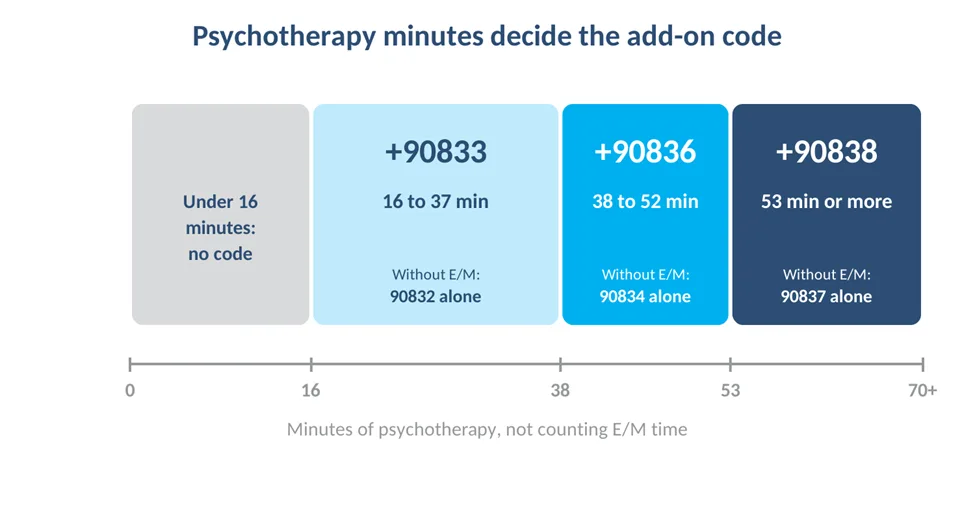
Psychotherapy add-on codes 90833, 90836 and 90838 report therapy delivered during the same visit as an evaluation and management (E/M) service. You bill the E/M code first, then add the code that matches the minutes of psychotherapy. This guide covers the time ranges, who can bill them, how to pick the E/M level, what to document and the errors that trigger denials.
These codes are one piece of psychiatric billing, and our mental health billing services guide shows where they fit in the full claim cycle.
| Key takeaways An add-on is never billed alone; it always rides on an E/M code for the same visit.Psychotherapy minutes set the code: 16-37 for 90833, 38-52 for 90836, 53 or more for 90838.Pick the E/M level by medical decision making, because E/M time cannot overlap therapy time.Only clinicians who can bill E/M, such as psychiatrists and psychiatric NPs, use these codes. |
What the psychotherapy add-on codes mean
The AMA CPT code set describes each add-on as psychotherapy with the patient, performed with an E/M service, listed separately in addition to the E/M code. Each one mirrors a standalone psychotherapy code.
| Add-on code | Descriptor time | Minutes required | Standalone twin |
| +90833 | 30 minutes | 16 to 37 | 90832 |
| +90836 | 45 minutes | 38 to 52 | 90834 |
| +90838 | 60 minutes | 53 or more | 90837 |
The ranges above come from the Noridian mental health billing page, which also warns not to bill psychotherapy for sessions under 16 minutes. Choose the code closest to the actual therapy time.
Who can bill 90833, 90836 and 90838
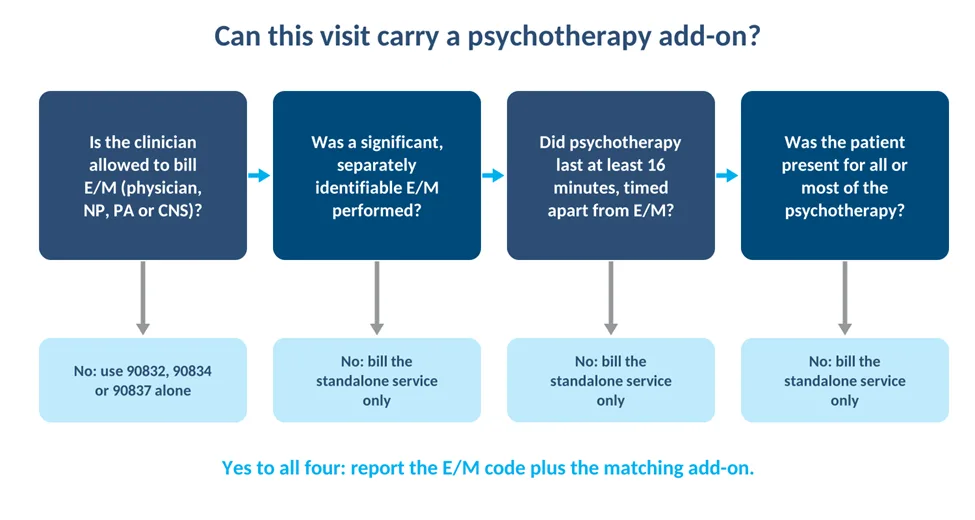
Because each add-on must ride on an E/M code, only clinicians who can bill E/M use them. That means psychiatrists and other physicians, psychiatric nurse practitioners, physician assistants and clinical nurse specialists, within their state scope.
Psychologists, clinical social workers, marriage and family therapists and mental health counselors do not bill E/M, so they report standalone psychotherapy codes such as 90832, 90834 and 90837. The diagram shows the four checks a visit must pass.
How to choose the E/M level with an add-on
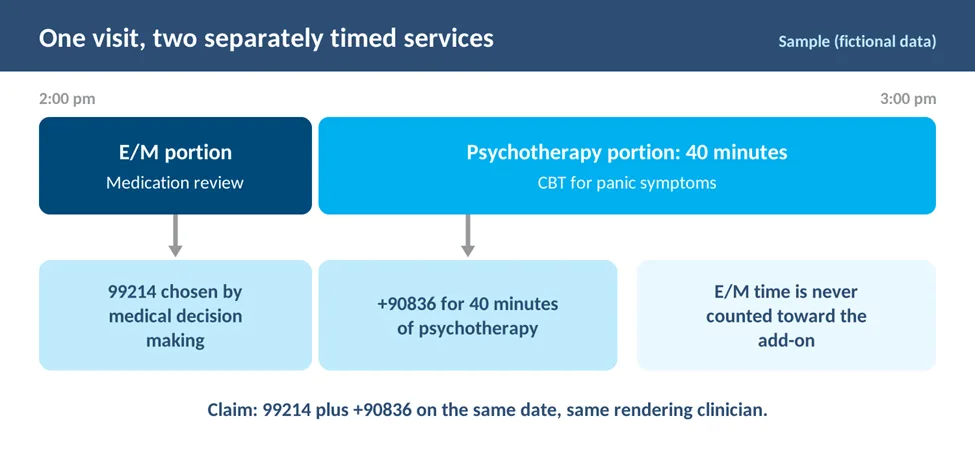
Both services must be significant and separately identifiable, and they must not overlap. Since time spent on E/M activities cannot count toward psychotherapy, choose the E/M level by medical decision making (MDM), not total visit time. Our guide to 2026 E/M coding by MDM and time explains the MDM levels.
A separate diagnosis is not required for the E/M and the psychotherapy on the same date. What matters is that the note shows two distinct services with their own content.
Sample (fictional data): A psychiatric nurse practitioner sees Alex Kim for a medication follow-up with moderate MDM, then provides 40 minutes of cognitive behavioral therapy for panic symptoms. The claim shows 99214 for the E/M and +90836 for the therapy. Change the clinician, patient, MDM level and minutes to match your own visit.
Documentation that supports the add-on
Reviewers look for the two services as separate parts of the note. Record:
- The E/M elements: history, exam where relevant and the decision making behind the plan
- Psychotherapy time on its own, not one total that includes the E/M portion
- The therapy type, themes and interventions used
- Progress or regression and the updated treatment plan
- Risk factors, such as suicidal or homicidal thoughts, when present
- A legible signature with credentials
Noridian lists missing time, a single combined time and unseparated E/M content among common review errors. A Wisconsin Physicians Service billing article adds that prolonged service codes cannot be reported with these add-ons, and crisis codes 90839 and 90840 are not reported with the 90832 to 90838 range.
Telehealth and payer differences
Medicare covers behavioral telehealth on a permanent basis, including visits with the patient at home, as the CMS Medicare mental health booklet describes. Place of service codes and modifiers still differ by payer, and our comparison of telehealth modifiers 95 and GT covers those rules.
Commercial plans and Medicaid programs set their own add-on policies in their contracts and provider manuals, so check each payer’s manual before you bill. Our therapist’s guide to CMS behavioral health directives covers the wider Medicare picture.
Common add-on code mistakes
| Mistake | Fix and prevention |
| Add-on billed without an E/M code | Report the standalone code (90832, 90834 or 90837) instead |
| One total time for the whole visit | Record psychotherapy minutes separately from E/M work |
| E/M level picked by total visit time | Select the E/M level by medical decision making |
| Add-on billed by a psychologist or LCSW | Use standalone psychotherapy codes for clinicians who cannot bill E/M |
| Therapy under 16 minutes billed | Bill the E/M alone and record actual minutes |
| Prolonged services added on top | Leave prolonged service codes off these claims |
G2211 is a different E/M add-on with its own rules, and our G2211 add-on code guide explains when it applies.
Frequently asked questions
Can I bill 90833 without an E/M code?
No. 90833, 90836 and 90838 are add-on codes, so they are only reported with a primary E/M code for the same visit. If no E/M service was performed, report the standalone psychotherapy code that matches the time, such as 90832 for 16 to 37 minutes of therapy.
How many minutes of psychotherapy are needed for 90836?
90836 requires 38 to 52 minutes of psychotherapy, timed separately from the E/M portion of the visit. Fewer minutes point to 90833, and 53 minutes or more point to 90838. Record the therapy minutes on their own rather than one total time for the whole visit.
Can I use time to choose the E/M level with an add-on?
Medicare contractor guidance says to select the E/M level by medical decision making when psychotherapy is also reported, because time spent on E/M activities cannot count toward psychotherapy. Document the MDM elements clearly so the E/M level stands on its own.
Do the E/M and psychotherapy need different diagnoses?
No. A separate diagnosis is not required for the E/M and the psychotherapy on the same date of service. The note still has to show two significant and separately identifiable services, each with its own content and, for psychotherapy, its own time.
Can psychiatric nurse practitioners bill psychotherapy add-on codes?
Yes, when their state scope of practice allows both E/M and psychotherapy and they are enrolled with the payer. Physician assistants and clinical nurse specialists follow the same logic. Clinicians who cannot bill E/M, such as psychologists and clinical social workers, use standalone psychotherapy codes instead.
Final Considerations
Psychotherapy add-on codes pay well when the note keeps the two services apart: E/M chosen by decision making, therapy timed on its own and both clearly documented. Get those three right and most add-on denials disappear.
If you want psychiatric claims reviewed before submission, our medical billing and coding services assign a dedicated agent to your practice, or you can send our team a message to start.
Sources: AMA CPT code set; Noridian Medicare, Mental Health billing guidance; Wisconsin Physicians Service, Billing and Coding: Psychiatry and Psychology Services (A57480); CMS, Medicare Mental Health (MLN1986542). This article is general information, not legal advice. Confirm current rules with each payer.